Three independent lot files
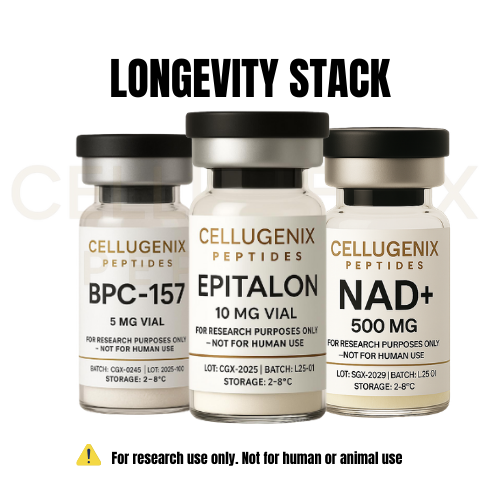
BPC-157, Epitalon, and NAD+ each ship with separate paperwork.

$219.98
Tissue repair capacity fades with age much like telomere length does, so this bundle sets a repair-focused peptide alongside two compounds tied to cellular aging mechanisms, giving researchers a way to look at regeneration and senescence side by side.
Specifications for each compound in the BPC-157 + Epitalon + NAD+ Research Bundle are listed individually below.
| Specification | BPC-157 | Epitalon | NAD+ |
|---|---|---|---|
| Compound | BPC-157 | Epitalon | NAD+ |
| Quantity | 5mg | 10mg | 500mg |
| Product format | Research-grade pentadecapeptide | Research-grade synthetic tetrapeptide | Research-grade coenzyme compound |
| Intended use | Laboratory research only | Laboratory research only | Laboratory research only |
| Documentation | COA available through our COA library | COA available through our COA library | COA available through our COA library |
| Related category | Tissue & Matrix Research | Telomere & Senescence Research | Cellular Energy & Longevity Research |
This bundle is sold only for scientific study by qualified professionals. Not for use in diagnostic or therapeutic procedures. Not for human or veterinary use.
Look over the compliance section and each compound's storage guidance before submitting an order.
This bundle pairs BPC-157 with two compounds studied in cellular-senescence research. BPC-157 is studied through nitric-oxide and growth-factor pathway assays, including angiogenesis and cell-migration assays, which places it in a different category from Epitalon, whose studied mechanism centres on telomerase-activity assays.
NAD+ ties the two together from a metabolic standpoint. As a coenzyme in redox reactions and sirtuin-pathway assays, it is studied alongside both cell-migration and telomerase-related research without duplicating either peptide's mechanism. The three compounds give a lab three separate entry points into cell-migration, senescence, and redox/energy assays.
Each compound targets a different piece of the research set: cell migration, telomerase activity, and redox/energy metabolism.
Each of the three vials carries its own batch documentation, meaning a lot can be checked on its own merits instead of against a single record covering the whole bundle.
The documentation standard here matches every other listing across the Cellugenix catalog.
BPC-157, Epitalon, and NAD+ each ship with separate paperwork.
Identity and purity for every batch are checked by a third party.
None of the three compounds are marketed for anything beyond research use.
All three vials travel together under a single tracking number.
Each vial is packed individually to prevent contact in transit.
A repair-focused peptide, a pineal-derived tetrapeptide, and a coenzyme don't share one storage profile, so treat each vial according to its own guidance.
This bundle spans three categories across the Cellugenix catalog.
Reference pages for testing standards and ordering policy.
BPC-157 at 5mg, Epitalon at 10mg, and NAD+ at 500mg, each shipped as its own documented vial.
This version swaps MOTS-C for BPC-157, shifting the third variable from mitochondrial-signalling assays to cell-migration assays alongside the same Epitalon and NAD+ pairing.
No. BPC-157 is studied in nitric-oxide and growth-factor cell-migration assays, while Epitalon's studied mechanism centres on telomerase-activity assays, so the two address separate research questions.
Yes, BPC-157, Epitalon, and NAD+ each have an independent batch record in the COA library.
No, each compound's stability profile differs, so check the individual storage page for BPC-157, Epitalon, and NAD+ separately.
If you're weighing quantities, delivery timing, or anything else before you check out, our team is on hand to walk through it with you.

Our products are crafted for research and for investigative purposes and are not suitable for direct human consumption or consumers, nor are they intended for clinical or therapeutic use. The statements and products listed on this website are not intended to diagnose, treat, cure, or prevent any disease.
Compliance protocol: 18+ · Research only · No human use
This catalog is restricted to qualified researchers aged 18 or over. Thank you for your honesty — please close this window.
