Independent lot files
All six vials are documented separately, regardless of which combo they belong to.

$0.00
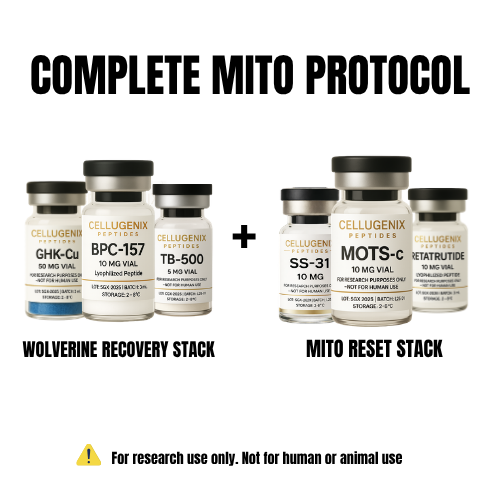
Six peptides, organized into two purpose-built stacks, cover repair signaling on one side and mitochondrial-metabolic function on the other, giving a lab two research phases under one order.
The framework is split into two stacks. Specifications for each are listed in the tables below.
| Specification | GHK-Cu | BPC-157 | TB-500 |
|---|---|---|---|
| Compound | GHK-Cu | BPC-157 | TB-500 |
| Quantity | 50mg | 10mg | 5mg |
| Product format | Research-grade copper tripeptide complex | Research-grade pentadecapeptide | Research-grade synthetic peptide fragment |
| Intended use | Laboratory research only | Laboratory research only | Laboratory research only |
| Documentation | COA available through our COA library | COA available through our COA library | COA available through our COA library |
| Related category | Tissue, Skin & Matrix Research | Tissue Repair & Regeneration Research | Tissue Repair & Regeneration Research |
| Specification | SS-31 | MOTS-C | GLP-3 (R) |
|---|---|---|---|
| Compound | SS-31 | MOTS-C | GLP-3 (R) |
| Quantity | 10mg | 10mg | 10mg |
| Product format | Research-grade tetrapeptide | Research-grade mitochondrial-derived peptide | Research-grade triple-receptor agonist peptide |
| Intended use | Laboratory research only | Laboratory research only | Laboratory research only |
| Documentation | COA available through our COA library | COA available through our COA library | COA available through our COA library |
| Related category | Mitochondrial & Metabolic Peptide Research | Mitochondrial & Metabolic Peptide Research | Metabolic Peptide Research |
This bundle is sold only for scientific study by qualified professionals. Not for use in diagnostic or therapeutic procedures. Not for human or veterinary use.
Look over the compliance notes and both stacks' storage pages before you check out.
Think of this as two research phases packaged together. The first sub-stack groups three peptides studied at the matrix and cell-migration level: GHK-Cu for fibroblast collagen-gene expression and glycosaminoglycans, BPC-157 for nitric-oxide and growth-factor pathway assays (including angiogenesis assays), and TB-500 for actin-mediated cell migration.
Phase two shifts the lens inward to the mitochondria. SS-31 attaches to cardiolipin on the inner membrane and helps keep cristae structure intact under oxidative stress, MOTS-C is transcribed from mitochondrial DNA itself and triggers AMPK signaling from inside the cell's energy system, and GLP-3 (R) works outside the mitochondria entirely, engaging GLP-1, GIP, and glucagon receptors to influence appetite and energy expenditure.
Seeing it as two phases rather than six loose compounds gives a research team a way to sequence or compare studies: matrix/cell-migration assays first, mitochondrial-metabolic assays second, or both in parallel depending on the protocol.
Each compound has a specific job within its assigned phase, and none of the six duplicate another's mechanism.
All six vials, whichever phase they belong to, come with independent batch paperwork. A researcher can pull the exact lot record for any single compound instead of relying on one document covering the whole framework.
The same documentation approach applied to single peptides carries through to this six-compound framework.
All six vials are documented separately, regardless of which combo they belong to.
Identity and purity checks are run by a lab outside our own operation.
Nothing in this framework is sold for anything other than laboratory use.
Both stacks travel together under one tracking number.
The Wolverine and MITO Reset vials are packed in separate, cushioned sections.
Six peptides means six sets of handling notes. Don't default to one storage routine for the whole framework.
This framework touches three categories in the Cellugenix catalog.
Reference material on testing and compliance for this framework.
Six vials split into two phases: the Wolverine Stack (GHK-Cu 50mg, BPC-157 10mg, TB-500 5mg) and the MITO Reset Stack (SS-31 10mg, MOTS-C 10mg, GLP-3 (R) 10mg).
Either works. Some labs sequence them as two phases; others run both in parallel to compare matrix/cell-migration assays against mitochondrial-metabolic assays.
Yes, all six vials ship with individual batch documentation, regardless of which stack they belong to.
No, each compound has distinct handling requirements, so review the individual page for every peptide before preparation.
Both contain the same six compounds. This listing frames them as a two-phase framework rather than a single combined protocol, which may suit labs that plan to sequence the phases rather than run them as one unit.
Working out which phases to run and whether to run them in sequence or side by side? Reach out and we'll help you plan it.


Our products are crafted for research and for investigative purposes and are not suitable for direct human consumption or consumers, nor are they intended for clinical or therapeutic use. The statements and products listed on this website are not intended to diagnose, treat, cure, or prevent any disease.
Compliance protocol: 18+ · Research only · No human use
This catalog is restricted to qualified researchers aged 18 or over. Thank you for your honesty — please close this window.