Five separate batch files
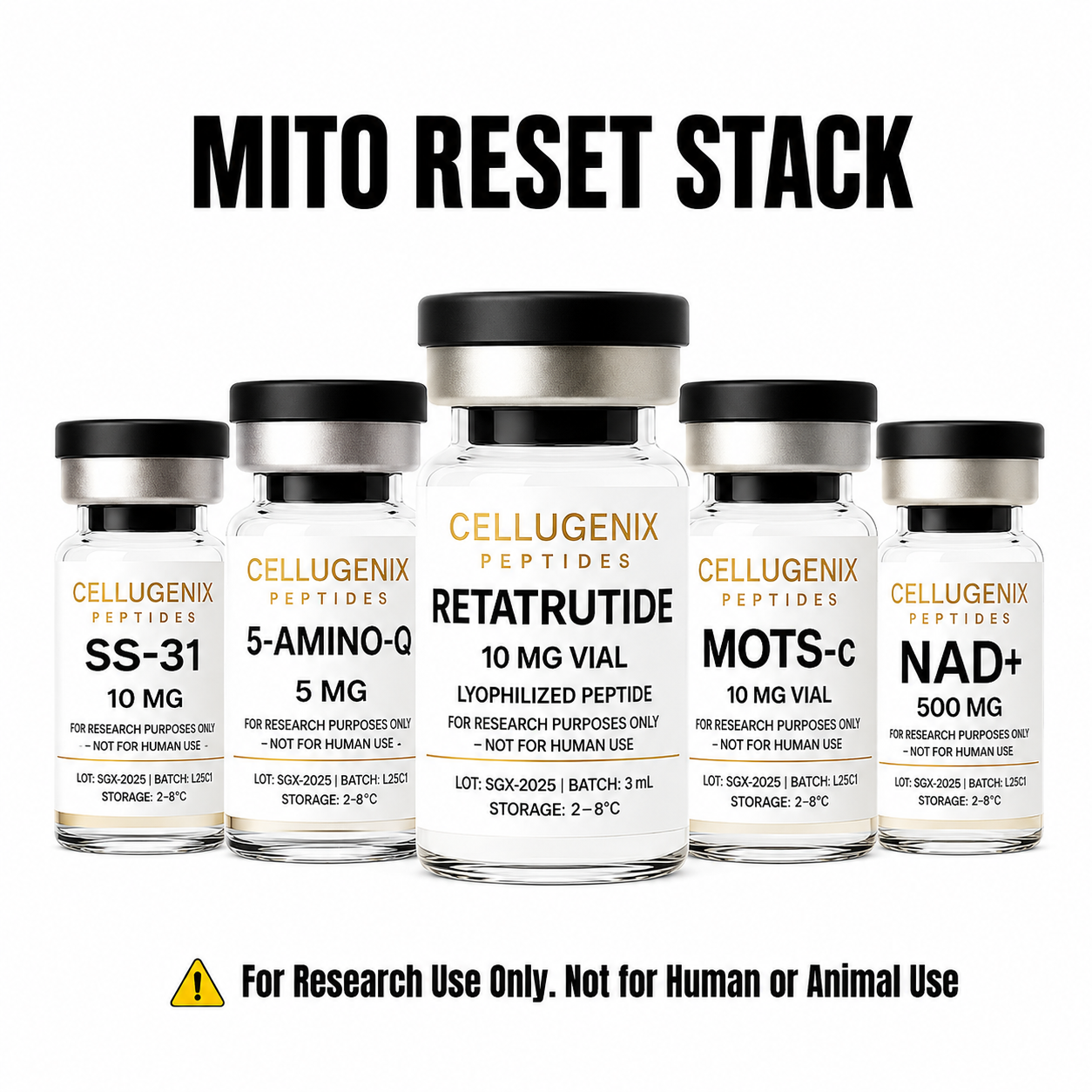
SS-31, 5-Amino-1MQ, GLP-3 (R), MOTS-C, and NAD+ each ship with independent paperwork.

$419.96
Five compounds cover NAD+ metabolism from three angles at once: direct supplementation, enzyme inhibition that preserves it, and mitochondrial-level signaling that responds to it, alongside a receptor-based metabolic agonist.
Each of the five compounds is documented individually in the table below.
| Specification | SS-31 | 5-Amino-1MQ | GLP-3 (R) | MOTS-C | NAD+ |
|---|---|---|---|---|---|
| Compound | SS-31 | 5-Amino-1MQ | GLP-3 (R) | MOTS-C | NAD+ |
| Quantity | 10mg | 5mg | 10mg | 10mg | 500mg |
| Product format | Research-grade tetrapeptide | Research-grade small-molecule NNMT inhibitor | Research-grade triple-receptor agonist peptide | Research-grade mitochondrial-derived peptide | Research-grade coenzyme compound |
| Intended use | Laboratory research only | Laboratory research only | Laboratory research only | Laboratory research only | Laboratory research only |
| Documentation | COA available through our COA library | COA available through our COA library | COA available through our COA library | COA available through our COA library | COA available through our COA library |
| Related category | Mitochondrial & Metabolic Peptide Research | Metabolic Peptide Research | Metabolic Peptide Research | Mitochondrial & Metabolic Peptide Research | Cellular Energy & Longevity Research |
This bundle is sold only for scientific study by qualified professionals. Not for use in diagnostic or therapeutic procedures. Not for human or veterinary use.
Review the compliance section and each compound's storage page before finalizing an order.
NAD+ sits at the center of this stack, but the five compounds approach it in different ways. NAD+ itself is supplied directly as a coenzyme, while 5-Amino-1MQ works upstream by blocking NNMT, the enzyme that would otherwise divert nicotinamide away from NAD+ regeneration and toward degradation. SS-31 doesn't touch NAD+ levels at all; instead it binds cardiolipin in the inner mitochondrial membrane and helps preserve cristae structure under oxidative stress.
MOTS-C is a mitochondrially encoded peptide that activates AMPK signalling when cellular energy status changes, studied in cellular-signalling assays. GLP-3 (R) operates outside the mitochondria, engaging the GLP-1, GIP, and glucagon receptors, and is studied in receptor-binding and cAMP-signalling assays.
Together, the five compounds let a lab study NAD+ availability, mitochondrial membrane integrity, and downstream metabolic signaling as separate but connected variables in one research setup.
Five compounds, five separate points of entry into NAD+ and mitochondrial biology.
Each of the five vials in this stack has its own lot-specific record, letting a researcher confirm the exact batch received rather than relying on one shared document for the full set.
This five-compound stack is documented to the same standard as every single-peptide listing in our catalog.
SS-31, 5-Amino-1MQ, GLP-3 (R), MOTS-C, and NAD+ each ship with independent paperwork.
Identity and purity are verified by a third party for every batch.
None of the five compounds are marketed beyond research use.
All five vials travel together under one tracking number.
Each item is packed separately to prevent contact damage in transit.
A peptide, a coenzyme, and a small-molecule inhibitor don't share one storage rulebook, so treat each vial on its own terms.
This stack spans three categories across the Cellugenix catalog.
Reference pages for testing standards and ordering policy.
Five: SS-31 10mg, 5-Amino-1MQ 5mg, GLP-3 (R) 10mg, MOTS-C 10mg, and NAD+ 500mg.
It's a small-molecule NNMT inhibitor rather than a peptide, but it's included here because its mechanism connects directly to NAD+ availability, the same pathway that NAD+ and MOTS-C in this stack also touch.
Each of the five vials has an independent batch record, viewable through the COA library.
No. Each compound has a different stability profile, so the individual handling page should be checked for every item before use.
All five connect to NAD+ or mitochondrial function, but through distinct mechanisms, ranging from direct supplementation to enzyme inhibition, membrane stabilization, and receptor-level signaling.
Have a question about your order status, a specific lot number, or the condition of an item on arrival? Contact our support team and we'll get it sorted.

Our products are crafted for research and for investigative purposes and are not suitable for direct human consumption or consumers, nor are they intended for clinical or therapeutic use. The statements and products listed on this website are not intended to diagnose, treat, cure, or prevent any disease.
Compliance protocol: 18+ · Research only · No human use
This catalog is restricted to qualified researchers aged 18 or over. Thank you for your honesty — please close this window.
