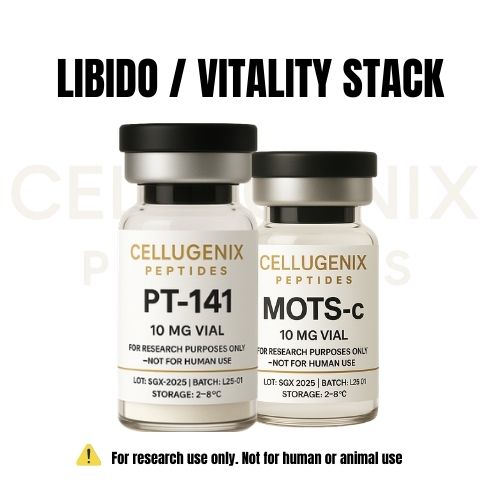
Two independent lot files
PT-141 and MOTS-C each ship with their own paperwork.

$104.98
One peptide acts on melanocortin receptors deep in the hypothalamus, the other is transcribed straight from mitochondrial DNA, so this pairing puts a central-nervous-system arousal pathway next to a cellular energy pathway in the same order.
Details for each compound are separated in the table below.
| Specification | PT-141 | MOTS-C |
|---|---|---|
| Compound | PT-141 | MOTS-C |
| Quantity | 10mg | 10mg |
| Product format | Research-grade cyclic heptapeptide | Research-grade mitochondrial-derived peptide |
| Intended use | Laboratory research only | Laboratory research only |
| Documentation | COA available through our COA library | COA available through our COA library |
| Related category | Neuropeptide & CNS Research | Mitochondrial & Metabolic Peptide Research |
| Support | Contact Cellugenix before ordering if documentation is needed | Contact Cellugenix before ordering if documentation is needed |
This bundle is sold only for scientific study by qualified professionals. Not for use in diagnostic or therapeutic procedures. Not for human or veterinary use.
Check the compliance section and each compound's storage page ahead of checkout.
PT-141, also known as bremelanotide, is a synthetic derivative of alpha-MSH that binds melanocortin receptors, primarily MC4R and MC3R, in the hypothalamus. That binding triggers a cAMP-PKA signaling cascade in the medial preoptic area that drives dopamine release, a mechanism entirely separate from peripheral vascular pathways.
MOTS-C has nothing to do with receptor binding at all. It's a 16-amino-acid peptide encoded within mitochondrial DNA that translocates to the nucleus under metabolic stress and activates AMPK, connecting cellular energy status to broader physiological signaling.
Pairing a central-nervous-system receptor agonist with a mitochondria-encoded metabolic peptide gives a lab two independent variables to study side by side, one rooted in brain signaling, the other in cellular bioenergetics.
The two compounds don't overlap mechanistically, which is exactly what makes them useful to compare in the same study.
Both vials in this stack carry their own lot-specific records, so a researcher can confirm the exact batch on hand instead of relying on a single certificate for the pair.
This two-compound stack follows the same documentation standard as every listing in our catalog.
PT-141 and MOTS-C each ship with their own paperwork.
Identity and purity for each batch are confirmed outside our facility.
Neither compound is marketed beyond research use.
Both vials ship together under one tracking number.
Each item is secured individually within the shipment.
A central-acting peptide and a mitochondrial peptide don't share identical stability needs, so check each one on its own terms.
This stack spans two categories within the Cellugenix catalog.
Reference pages for testing standards and ordering policy.
PT-141 at 10mg and MOTS-C at 10mg, each shipped as an individually documented vial.
Their mechanisms don't overlap on purpose. PT-141 works through central melanocortin receptor signaling, while MOTS-C operates at the mitochondrial level, giving researchers two distinct physiological variables in one order.
Yes, PT-141 and MOTS-C each carry a separate batch record accessible through the COA library.
No. Their stability profiles differ, so consult the individual handling page for each compound before use.
No. Research shows PT-141 works centrally through hypothalamic MC4R activation and downstream dopamine release, a mechanism distinct from the peripheral vascular pathway that PDE5 inhibitors target.
Have a question about tracking your shipment, verifying a lot number, or an issue with how an item arrived? Reach out to our support team and we'll help resolve it.


Our products are crafted for research and for investigative purposes and are not suitable for direct human consumption or consumers, nor are they intended for clinical or therapeutic use. The statements and products listed on this website are not intended to diagnose, treat, cure, or prevent any disease.
Compliance protocol: 18+ · Research only · No human use
This catalog is restricted to qualified researchers aged 18 or over. Thank you for your honesty — please close this window.