HCG 5000 IU: Human Chorionic Gonadotropin Research Overview
Quick Answer
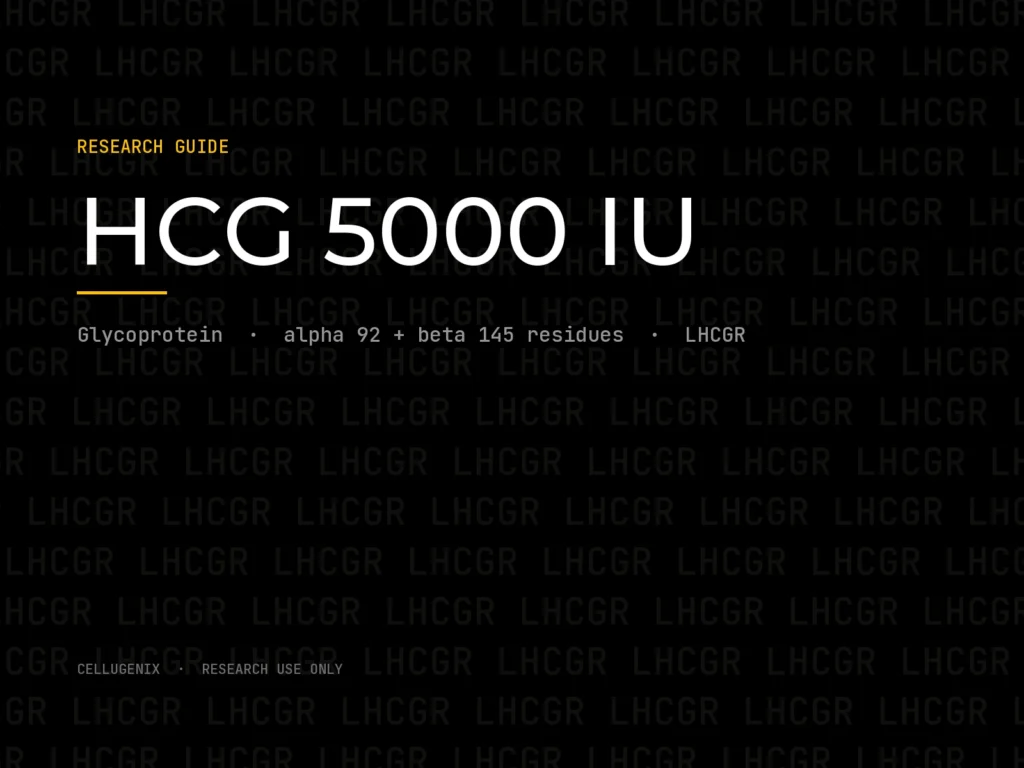
HCG (human chorionic gonadotropin) is a glycoprotein hormone made of two non-covalently joined subunits: an alpha subunit of 92 amino acids, shared with LH, FSH and TSH, and a hormone-specific beta subunit of 145 amino acids. It is heavily glycosylated (about 36–37 kDa in total) and acts as an agonist at the LH/CG receptor. Its amount is given in International Units (IU) of biological activity, so a 5000 IU vial is defined by activity, not by milligrams.
Key Takeaways
- Two subunits: a common alpha chain (92 residues) and a specific beta chain (145 residues).
- A glycoprotein: roughly a third of its mass is carbohydrate.
- Binds the LH/CG receptor (LHCGR), a G-protein-coupled receptor that signals through cAMP.
- Quantity is stated in IU, a unit of biological activity defined against an international reference standard.
- Supplied as a lyophilized solid in a sealed vial.
Identifiers
| Field | Value |
|---|---|
| Full name | Human chorionic gonadotropin |
| Other names | hCG, chorionic gonadotrophin |
| Class | Glycoprotein hormone (heterodimer) |
| Alpha subunit | 92 amino acids (common to LH, FSH and TSH) |
| Beta subunit | 145 amino acids (hormone-specific) |
| Approximate mass | 36–37 kDa, including glycans |
| Receptor | LH/CG receptor (LHCGR) |
| Unit | International Units (IU) of biological activity |
| Form | Lyophilized solid, sealed vial (5000 IU) |
What 5000 IU Means
Glycoprotein hormones vary in their sugar content from preparation to preparation, so mass alone does not describe how active they are. Instead, their quantity is expressed in International Units, measured against an international reference standard for chorionic gonadotropin. A 5000 IU vial therefore contains material with 5000 units of activity on that scale. This is why HCG is listed in IU rather than in milligrams like synthetic peptides.
Structure and Receptor
The alpha subunit is identical in HCG, luteinising hormone (LH), follicle-stimulating hormone (FSH) and thyroid-stimulating hormone (TSH); the beta subunit gives each hormone its receptor specificity. HCG’s beta chain is closely related to LH’s but has an extended C-terminal region carrying additional O-linked glycans. HCG and LH both bind the LH/CG receptor, which couples mainly to Gs and raises intracellular cAMP.
Research Areas
- LH/CG receptor signalling and cAMP assays
- Steroidogenesis in Leydig and granulosa cell cultures
- Glycoprotein-hormone structure and glycosylation studies
Related reading: Kisspeptin-10, a peptide studied upstream in the same hormonal axis.
Storage of the Sealed Vial
HCG ships as a lyophilized (freeze-dried) solid in a sealed vial labelled with its lot number. Store sealed vials as stated on the label, protected from light and moisture; see our storage and handling guide.
Documentation
Third-party reports for Cellugenix compounds are published in the COA library, searchable by compound or lot number. If a report for the current HCG lot is not listed yet, the COA is available on request. New to certificates? Read how to read a COA.
Frequently Asked Questions
What is HCG?
HCG (human chorionic gonadotropin) is a two-subunit glycoprotein hormone that acts as an agonist at the LH/CG receptor. It is studied in receptor-signalling and steroidogenesis research.
What does 5000 IU mean on an HCG vial?
IU stands for International Units, a measure of biological activity defined against an international reference standard. A 5000 IU vial contains 5000 units of activity, not a fixed number of milligrams.
Why is HCG measured in IU instead of milligrams?
Its sugar content varies between preparations, so mass alone does not reflect activity. Activity units make preparations comparable.
What receptor does HCG bind?
The LH/CG receptor (LHCGR), the same G-protein-coupled receptor bound by luteinising hormone.
Is HCG a peptide?
It is a glycoprotein: a protein made of two amino-acid chains (92 and 145 residues) carrying sugar chains, rather than a short synthetic peptide.
Sold for in-vitro laboratory research only. Not for human or animal use and not for diagnostic or therapeutic procedures. Nothing here describes or suggests use in people.
For Research Use Only. Not for use in diagnostic or therapeutic procedures.