Kisspeptin-10 (Metastin 45-54): Sequence, Receptor Pharmacology and Research Overview
Kisspeptin-10 is what remains when you trim every longer kisspeptin back to its active core. Cut one more residue off the end and the receptor stops responding, which is why it turns up as the reference agonist in almost every KISS1R paper published since 2001. Cellugenix supplies kisspeptin-10 5 mg as a laboratory reagent.
In short: What is Kisspeptin-10?
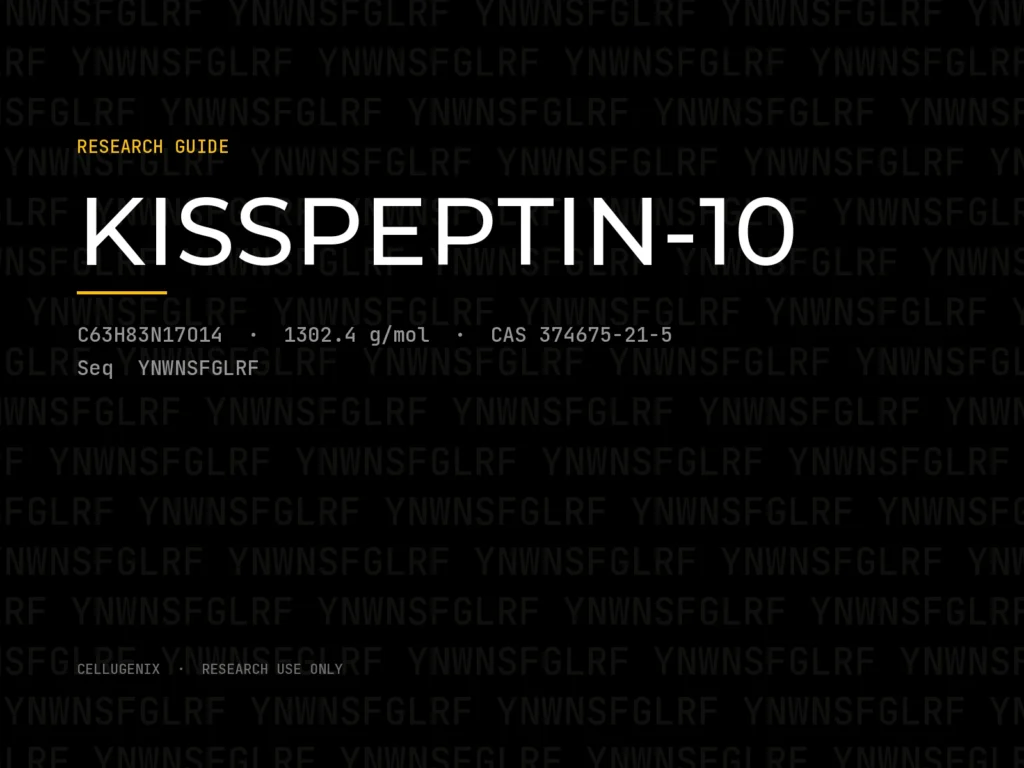
Kisspeptin-10 is the C-terminal ten-residue fragment of kisspeptin: Tyr-Asn-Trp-Asn-Ser-Phe-Gly-Leu-Arg-Phe-NH2 (YNWNSFGLRF-NH2). It is the shortest form that fully activates the kisspeptin receptor KISS1R (GPR54). Formula C63H83N17O14, MW 1302.4 g/mol, CAS 374675-21-5. Labs use it as a reference agonist in KISS1R binding and signalling assays.
Key takeaways
- Ten residues with a C-terminal amide, the shortest fully active kisspeptin fragment.
- Shares the RF-amide motif (Arg-Phe-NH2) with KP-54, KP-14 and KP-13.
- The human and rodent forms differ at residue 10: Phe in human, Tyr in mouse and rat.
- Lot LK-KISS-10-012926 verifies at 99.39% purity by HPLC on the testing lab’s own archive.
Kisspeptin-10 at a Glance
Quick answer: The identifiers below cover human kisspeptin-10. The chemistry comes from PubChem CID 25240297 and the sequence position from UniProt entry Q15726. Form, counter-ion and purity come from the lot-specific batch certificate.
| Field | Value |
| Name | Kisspeptin-10 |
| Other names | Metastin 45-54, KP-10, kisspeptin-10 (45-54) |
| Sequence (3-letter) | Tyr-Asn-Trp-Asn-Ser-Phe-Gly-Leu-Arg-Phe-NH2 |
| Sequence (1-letter) | YNWNSFGLRF-NH2 |
| Formula | C63H83N17O14 |
| Molecular weight (average) | 1302.4 g/mol |
| Monoisotopic mass | 1301.6305 Da |
| CAS | 374675-21-5 |
| PubChem CID | 25240297 |
| Receptor | KISS1R (GPR54), a Gq/11-coupled class A GPCR |
| Form | Lyophilised solid in a sealed vial |
| Counter-ion | TFA or acetate, depending on the synthesis; check the certificate |
| Batch report | LK-KISS-10-012926 |
| Purity (this lot) | 99.39% by HPLC |
Two of those numbers do the work in a lab: the average mass of 1302.4 g/mol drives molar calculations, and 1301.6305 Da is what a mass spectrometer reports for the monoisotopic species.
What Is Kisspeptin-10?
Quick answer: Kisspeptin-10 is one of several peptides cut from the product of the KISS1 gene. The others are kisspeptin-54, kisspeptin-14 and kisspeptin-13. All of them end in the same Arg-Phe-NH2 motif, which is the part that binds KISS1R. Kisspeptin-10 is the last ten residues of kisspeptin-54.
The KISS1 gene codes a precursor protein, listed in UniProt entry Q15726 at 138 residues. Enzymatic processing trims that precursor into the amidated peptides above, each sharing the same C-terminal end and differing only in how much extra sequence stays attached at the front. That shared ending puts kisspeptins in the RF-amide peptide family, a structural grouping named for the Arg-Phe-NH2 pair every member carries. The name describes chemistry, nothing more.
Three groups reported the receptor pairing independently in 2001:
- Ohtaki and colleagues, in Nature, isolated the 54-residue amidated peptide and named it metastin. The “metastin 45-54” label counts residues 45 to 54 of that peptide.
- Kotani and colleagues, in the Journal of Biological Chemistry, named the family kisspeptins and characterised the 54-, 14- and 13-residue forms at GPR54.
- Muir and colleagues, also in that journal, cloned the human receptor from a cDNA library and called it AXOR12.
Three names for one receptor is the legacy of that year. GPR54, AXOR12 and hOT7T175 all describe what is now called KISS1R, and older papers use whichever name their authors coined.
Kisspeptin-10 vs Kisspeptin-54 (and KP-13, KP-14)
Quick answer: All four peptides end in the same ten residues and bind KISS1R at low nanomolar concentrations in receptor assays. Kotani and colleagues reported that the 54-, 14- and 13-residue peptides “bound with low nanomolar affinities to rat and human GPR54 expressed in Chinese hamster ovary K1 cells”. KP-10 is the minimal fully active sequence, which is why it serves as the standard reference agonist.
| Variant | Residues | KISS1 positions | MW (g/mol) | Lab notes |
| , – | , – | , – | , – | , – |
| Kisspeptin-54 (metastin) | 54 | 68-121 | ~5,857 | The full isolated peptide; highest synthesis cost per mole |
| Kisspeptin-14 | 14 | 108-121 | 1741.9 | C82H112N22O21, CAS 374675-19-1; comparative binding work |
| Kisspeptin-13 | 13 | 109-121 | 1626.8 | C78H107N21O18; comparative binding work |
| Kisspeptin-10 | 10 | 112-121 | 1302.4 | Minimal fully active fragment; the usual reference agonist |
Length drives cost. Each residue added to a solid-phase synthesis is another coupling step with its own yield loss, so a 54-mer costs more per milligram than a 10-mer, and far more per mole. A 5 mg vial of KP-10 holds roughly 3.8 µmol; the same 5 mg of KP-54 holds about 0.85 µmol.
The vulnerable spot in all of them is inside the decapeptide itself. Tomita and colleagues reported that “matrix metalloproteinase mediated deactivation of kisspeptins through hydrolysis of the Gly-Leu peptide bond has been reported”, then built analogues with non-hydrolysable replacements for that dipeptide. Their (E)-alkene and hydroxyethylene isostere analogues “maintained the original activity with higher stability in murine serum and resistance to MMP-9-mediated cleavage”. The Gly-Leu bond falls at positions 7 and 8 of KP-10, so the shortest form carries the same cleavage site as the longer ones.
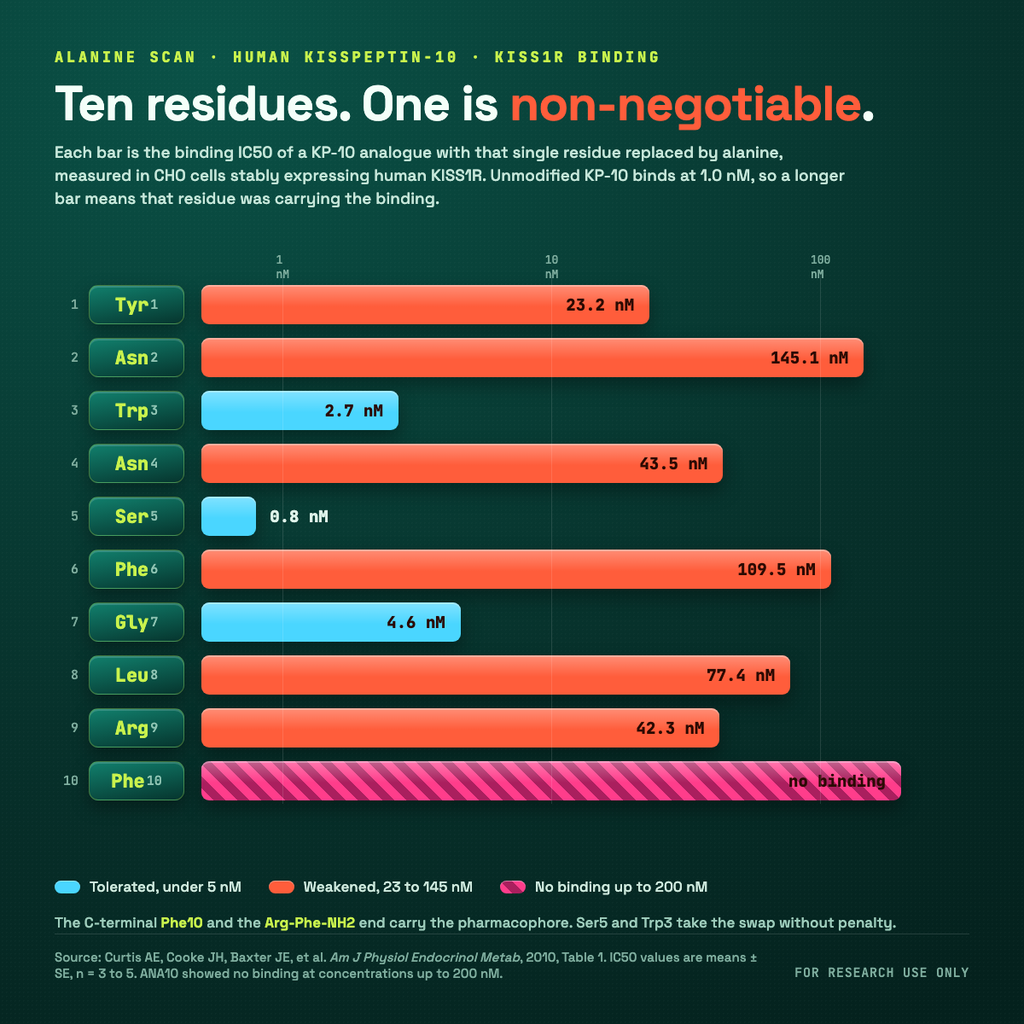
Radial pharmacophore wheel showing alanine-scan binding IC50 for each of the ten kisspeptin-10 residues, with Phe6, Leu8 and Arg9 marked as the largest losses in affinity.
Human vs Rodent Kisspeptin-10: One Residue Apart
Quick answer: Human kisspeptin-10 ends in Phe-NH2 (YNWNSFGLRF-NH2). The mouse and rat form ends in Tyr-NH2 (YNWNSFGLRY-NH2). The Cayman datasheet for the rodent peptide lists it as C63H83N17O15 at FW 1318.4, with CAS 478507-53-8, covering residues 110 to 119 of the rodent precursor.
One hydroxyl group separates the two. Swapping phenylalanine for tyrosine adds a single oxygen, which puts the rodent peptide 16 Da above the human one: 1318.4 against 1302.4. On a mass spectrum that gap is unmistakable, so an identity result tells you which species form is in the vial even when the label does not.
The two forms are separate catalogue items with separate CAS numbers, and suppliers stock both. Kotani’s binding work covered rat and human GPR54 side by side in one CHO-K1 host, so cross-species receptor activity is established, though the peptides remain distinct reagents. Cellugenix supplies the human sequence; the sequence line on the kisspeptin-10 5 mg certificate is the field to confirm it against.
How Kisspeptin-10 Acts at KISS1R: Receptor Pharmacology
Quick answer: KISS1R is a class A GPCR coupling mainly to Gq/11. In cell assays, kisspeptin-10 binding activates phospholipase C, which drives inositol phosphate production and intracellular calcium release, followed by ERK1/2 phosphorylation. The receptor also recruits β-arrestin and internalises.
Kotani’s group catalogued that readout set in the original characterisation, reporting that the kisspeptins “stimulated PIP(2) hydrolysis, Ca(2+) mobilization, arachidonic acid release, ERK1/2 and p38 MAP kinase phosphorylation, and stress fiber formation” in GPR54-expressing CHO-K1 cells. Every item on that list is now a usable assay endpoint.
What the receptor does next is a separate branch. Working in HEK293 cells, Pampillo and colleagues found that KP-10-stimulated KISS1R undergoes GRK2-dependent desensitisation and associates with β-arrestin-1 and β-arrestin-2. They measured internalisation by labelling surface receptors at 4 °C, treating with 100 nM KP-10 at 37 °C, then tracking the loss of surface immunofluorescence by flow cytometry. Desensitisation there was phosphorylation-independent, unusual enough to make KISS1R a recurring model in arrestin research.
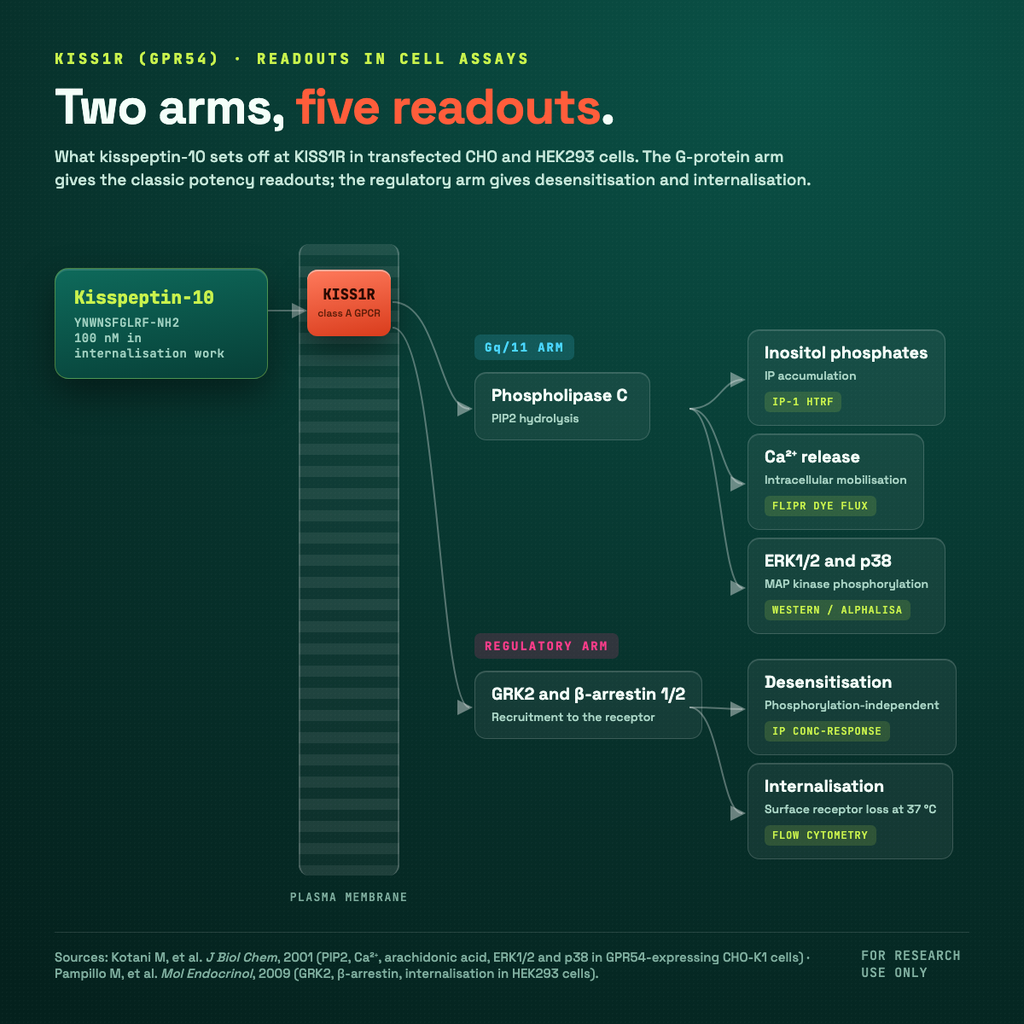
Branch diagram of KISS1R signalling in cell assays, showing the Gq/11 to phospholipase C arm producing inositol phosphates, calcium release and ERK1/2 phosphorylation, alongside the GRK2 and beta-arrestin arm leading to desensitisation and internalisation.
Which residues carry the binding is mapped residue by residue. Curtis and colleagues ran a full alanine scan of human KP-10 in CHO cells stably expressing human KISS1R, with the unmodified peptide binding at an IC50 of 1.0 ± 0.3 nM. Replacing the C-terminal Phe10 with alanine abolished binding altogether, with no activity up to 200 nM. Asn2, Phe6, Leu8 and Arg9 each cost two orders of magnitude or close to it, at 145.1, 109.5, 77.4 and 42.3 nM. Ser5 and Trp3 took the swap in stride, at 0.8 and 2.7 nM.
So the pharmacophore is the C-terminal end plus Asn2, and the C-terminal amide is required alongside it, which is why every catalogue sequence carries the -NH2 notation. Analogue chemistry leaves that set alone and modifies everything around it.
What Is Kisspeptin-10 Used For in Research? Assays and Methods
Quick answer: In the lab, kisspeptin-10 is the reference agonist for KISS1R. It appears in radioligand binding, calcium mobilisation, inositol phosphate accumulation, ERK phosphorylation and β-arrestin recruitment assays, usually in KISS1R-transfected CHO or HEK293 cells, as the positive control in antagonist screening, and as a reference standard in HPLC and LC-MS.
The formats it turns up in:
- Radioligand binding, competing against ¹²⁵I-labelled KP-10 in KISS1R-expressing membranes.
- Calcium flux, read on a plate imager such as FLIPR after dye loading.
- Inositol phosphate accumulation, measured as IP-1 by HTRF, the endpoint Pampillo’s group used.
- ERK1/2 phosphorylation, by western blot or a plate-based immunoassay.
- β-arrestin recruitment, by BRET or NanoBiT complementation between tagged receptor and arrestin.
- Receptor internalisation, by surface labelling with flow cytometry, or by live-cell imaging.
- Antagonist and analogue screening, where KP-10 sets the maximum response for comparison.
- Protease stability work, including the MMP-9 cleavage studies behind the isostere analogues above.
- Analytical reference standard, for retention time and mass confirmation in method development.
Two habits keep numbers comparable across a project. Run KP-10 from one lot as the positive control on every plate, and record the host cell line with the data, since potency values from CHO and HEK293 hosts can differ enough to skew a comparison.
Is Kisspeptin-10 FDA-Approved? Regulatory Status (October 2026)
Quick answer: No. A Drugs@FDA search for kisspeptin and metastin as active ingredients, run on 12 October 2026, returns no approved product. Kisspeptin peptides have been studied as investigational agents under research protocols. Research suppliers sell kisspeptin-10 for laboratory use only, not for human or veterinary use.
Two things follow. A compound with no approved application cannot lawfully be marketed for human use, and copy describing effects can turn a reagent listing into a drug listing whatever the research-use wording elsewhere on the page says. The US legality of research peptides turns on exactly that distinction between a reagent listing and a drug listing.
The World Anti-Doping Agency’s Prohibited List also names kisspeptin and its agonist analogues, added in the 2024 edition and still listed in 2026 under section S2. That listing governs competitive sport and carries no implication for laboratory purchasing. WADA publishes each revision in October for a 1 January start, so confirm the status against the current List itself.
Storage of the Sealed Vial
Kisspeptin-10 ships as a lyophilised (freeze-dried) solid in a sealed vial. Store sealed vials as stated on the label, protected from light and moisture, with sealed-vial storage conditions giving the temperature range. Each vial carries its lot number, which ties it to its certificate. The solid is soluble in water or DMSO for assay preparation.
How to Verify Research-Grade Kisspeptin-10
Quick answer: Check that the certificate names kisspeptin-10 with the human sequence YNWNSFGLRF-NH2, shows HPLC purity with a chromatogram attached, reports the measured amount against the label, and carries a report number you can look up on the testing laboratory’s own site.
The Cellugenix 5 mg lot is report LK-KISS-10-012926, issued by Testides. Pasting that number into the lookup at testides.com returns the record behind the certificate: kisspeptin-10, white lyophilised powder, 99.39% purity by HPLC with the chromatogram attached, tested 5 February 2026 and issued 6 February 2026. The certificate is on the kisspeptin-10 5 mg COA page, and our guide to reading a COA walks through each field.
Two limits apply to any certificate, this one included:
- No mass-spectrometry result. The report lists HPLC as the test performed and records molecular weight as not reported. Identity by mass is a separate request, so ask for it if your assay needs it.
- Counter-ion and net peptide content. Synthetic peptides come as a salt, usually trifluoroacetate or acetate. That counter-ion is part of the weighed powder, so net peptide in a vial runs below the gross weight, often by 10 to 20 percent for a TFA salt. HPLC area percent describes how pure the peptide fraction is; a content or net-peptide figure tells you how much peptide the vial holds.
A lab lookup confirms that Testides issued a report under that number and shows the values recorded against it. It does not identify which vial the sample came from, so the lot match on your own label remains the step that ties the paperwork to the material in hand.
Frequently Asked Questions
What is kisspeptin-10?
Kisspeptin-10 is the C-terminal ten-residue fragment of kisspeptin, sequence Tyr-Asn-Trp-Asn-Ser-Phe-Gly-Leu-Arg-Phe-NH2 (YNWNSFGLRF-NH2). It is the shortest fragment that fully activates the kisspeptin receptor KISS1R, also called GPR54, which makes it the standard reference agonist in KISS1R binding and signalling assays. Catalogues also list it as metastin 45-54 or KP-10.
What is the molecular weight and CAS number of kisspeptin-10?
Human kisspeptin-10 has a molecular formula of C63H83N17O14, an average molecular weight of 1302.4 g/mol and a monoisotopic mass of 1301.6305 Da. Its CAS number is 374675-21-5 and its PubChem CID is 25240297. The mouse and rat form is a separate entry: C63H83N17O15, FW 1318.4, CAS 478507-53-8.
What is the difference between kisspeptin-10 and kisspeptin-54?
Length, mass and cost. KP-54 is the full 54-residue peptide at roughly 5,857 g/mol; KP-10 is its last ten residues at 1302.4 g/mol. Both end in the same Arg-Phe-NH2 motif and bind KISS1R at low nanomolar concentrations in receptor assays. KP-10 is cheaper to synthesise, and 5 mg of it holds about 4.5 times more material in molar terms.
Is mouse kisspeptin-10 the same as human kisspeptin-10?
No. The human peptide ends in phenylalanine (YNWNSFGLRF-NH2) and the mouse and rat peptide ends in tyrosine (YNWNSFGLRY-NH2). That single hydroxyl puts the rodent form 16 Da heavier, at FW 1318.4 against 1302.4, with its own CAS number of 478507-53-8. They are separate catalogue items, so match the certificate’s sequence to the species your assay needs.
What is kisspeptin-10 used for in research?
It is the reference agonist for KISS1R. Labs run it in radioligand binding against ¹²⁵I-labelled KP-10, calcium flux and inositol phosphate assays, ERK1/2 phosphorylation readouts, β-arrestin recruitment by BRET or NanoBiT, and internalisation imaging, generally in CHO or HEK293 cells expressing KISS1R. It also serves as the positive control in antagonist screening and as an analytical reference standard.
Is kisspeptin-10 FDA-approved?
No. A Drugs@FDA search for kisspeptin and metastin as active ingredients, run on 12 October 2026, returns no approved product. Research suppliers sell kisspeptin-10 for laboratory use only, labelled Research Use Only, and it is not for human or veterinary use. Kisspeptin and its agonist analogues also appear on the WADA Prohibited List, which applies to competitive sport.
The Bottom Line
Kisspeptin-10 is the minimal KISS1R agonist and the standard reference peptide for receptor assays, mapped down to the residues that carry the binding. Confirm the species form, the salt form, and the batch certificate before ordering. New to reagent peptides? Start with our overview of what research peptides are.
For laboratory research use only. Not for human or animal use. Products are supplied to qualified purchasers under our Terms of Service.
References
- Ohtaki T, Shintani Y, Honda S, et al. Nature, 2001; 411(6837): 613-617. PMID 11385580.
- Kotani M, Detheux M, Vandenbogaerde A, et al. Journal of Biological Chemistry, 2001; 276(37): 34631-34636. PMID 11457843.
- Muir AI, Chamberlain L, Elshourbagy NA, et al. Journal of Biological Chemistry, 2001; 276(31): 28969-28975. PMID 11387329.
- Tomita K, Oishi S, Ohno H, Peiper SC, Fujii N. Journal of Medicinal Chemistry, 2008. PMID 19007202.
- Pampillo M, Camuso N, Taylor JE, et al. Molecular Endocrinology, 2009; 23(12): 2060-2074. PMID 19846537.
- Curtis AE, Cooke JH, Baxter JE, et al. American Journal of Physiology: Endocrinology and Metabolism, 2010. doi:10.1152/ajpendo.00426.2009.
- PubChem. Kisspeptin-10, CID 25240297.
- UniProt. KISS1 (human), entry Q15726.
- Cayman Chemical. Kisspeptin-10 (mouse, rat), item 14036.
- FDA. Drugs@FDA database, searched 12 October 2026.
- WADA. Prohibited List, section S2.
- Testides. Report LK-KISS-10-012926.
For laboratory research use only. Not for human or animal use.