GLP-3 (R): Triple-Agonist Research Peptide Overview
Quick Answer
GLP-3 (R) is a synthetic peptide that acts as an agonist at three receptors at once: the GIP receptor, the GLP-1 receptor and the glucagon receptor. In the research literature this triple-agonist molecule is known as retatrutide (LY3437943), an investigational compound that is not approved for any use. Cellugenix supplies it as GLP-3 (R), a lyophilized research peptide with a third-party batch COA, for in-vitro receptor and signalling research.
Key Takeaways
- A single peptide with agonist activity at three receptors: GIPR, GLP-1R and GCGR.
- Built on a peptide backbone with a fatty-acid side chain that binds serum albumin, a feature studied in pharmacokinetic research.
- Listed by Cellugenix as GLP-3 (R) in 5 mg, 10 mg and 20 mg vials.
- The current 5 mg lot tested at Purity by HPLC by Canada Peptide Testing.
- Investigational: sold strictly for in-vitro laboratory research.
Identifiers
| Field | Value |
|---|---|
| Catalogue name | GLP-3 (R) |
| Literature name | Retatrutide (LY3437943) |
| Class | Triple agonist peptide (GIP, GLP-1 and glucagon receptors) |
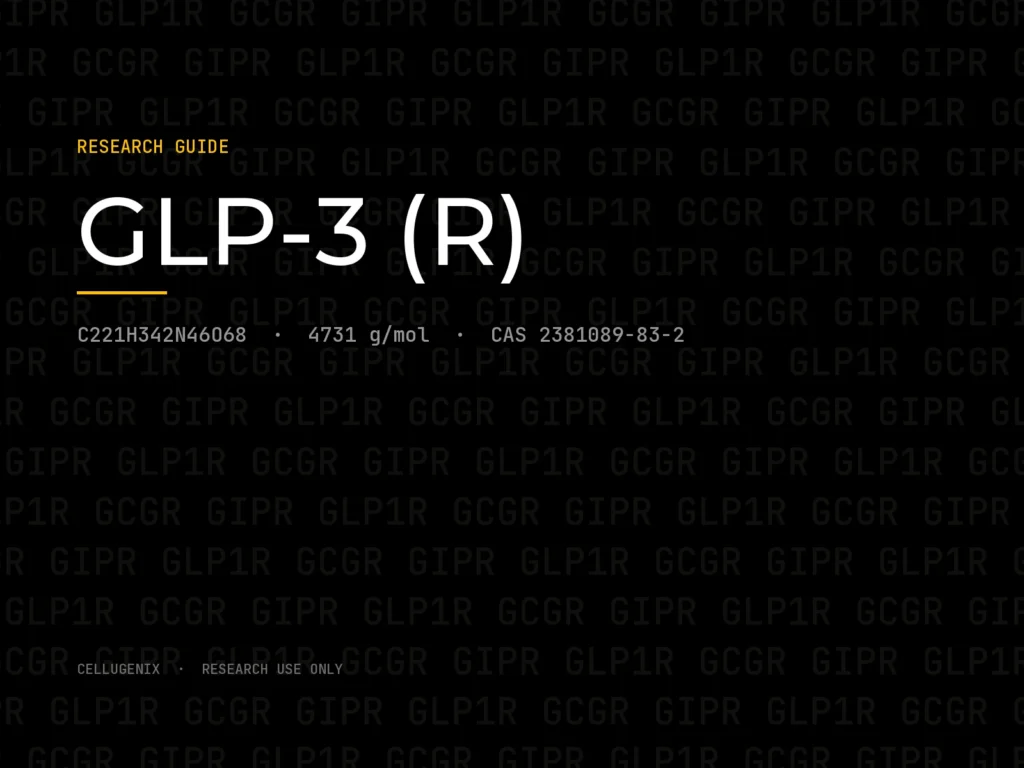
| Molecular formula | C221H342N46O68 |
| Molecular weight | About 4731 g/mol |
| CAS number | 2381089-83-2 |
| Form | Lyophilized solid, sealed vial (5, 10 or 20 mg) |
Three Receptors, One Peptide
GIP, GLP-1 and glucagon are three related peptide hormones, each with its own G-protein-coupled receptor. Earlier research compounds targeted one of these receptors, or two (dual GIP and GLP-1 receptor agonists). GLP-3 (R) was designed to activate all three, which makes it a reference tool for comparing single, dual and triple receptor activity in the same assay system.
Research Areas
- Receptor-binding and selectivity assays at GIPR, GLP-1R and GCGR
- cAMP accumulation in receptor-expressing cell lines
- Comparative incretin and glucagon receptor pharmacology
- Albumin binding and peptide stability studies
It is also supplied in research sets: the MOTS-c + GLP-3 (R) stack and the GLP-3 (R) + MOTS-c + AOD9604 bundle.
Storage of the Sealed Vial
GLP-3 (R) ships as a lyophilized (freeze-dried) solid in a sealed vial labelled with its lot number. Store sealed vials as stated on the label, protected from light and moisture; see our storage and handling guide.
Analytical Verification and Documentation
The current 5 mg lot was tested by Canada Peptide Testing, an independent laboratory: Purity by HPLC and 5.97 mg measured content (batch L25-01, report CPT-RETATR-A337C9, tested September 27, 2026). Because the certificate comes from the lab’s own reference library, it names the molecule by its literature name. Earlier lots and the other sizes are documented too:
- GLP-3 (R) 5 mg certificate (Canada Peptide Testing, 99.96%)
- GLP-3 (R) 10 mg certificate (99.97%)
- GLP-3 (R) 20 mg certificate (99.99%)
New to certificates? Read how to read a COA.
Frequently Asked Questions
What is GLP-3 (R)?
GLP-3 (R) is a synthetic triple-agonist peptide that activates the GIP, GLP-1 and glucagon receptors. It is used in receptor-binding and signalling research.
Is GLP-3 (R) the same as retatrutide?
GLP-3 (R) is the catalogue name Cellugenix uses for the triple-agonist peptide known in the research literature as retatrutide (LY3437943). Retatrutide is an investigational compound and is not approved for any use; GLP-3 (R) is sold for in-vitro research only.
What receptors does GLP-3 (R) act on?
Three G-protein-coupled receptors: the GIP receptor (GIPR), the GLP-1 receptor (GLP-1R) and the glucagon receptor (GCGR).
What is the difference between a dual and a triple agonist?
A dual agonist activates two of these receptors (for example GIP and GLP-1); a triple agonist such as GLP-3 (R) also activates the glucagon receptor.
How pure is Cellugenix GLP-3 (R)?
The current 5 mg lot tested at Purity by HPLC with 5.97 mg measured content (Canada Peptide Testing, report CPT-RETATR-A337C9). Every certificate is in the COA library.
Sold for in-vitro laboratory research only. Not for human or animal use and not for diagnostic or therapeutic procedures. Nothing here describes or suggests use in people.
For Research Use Only. Not for use in diagnostic or therapeutic procedures.