How to Read a COA and Evaluate Research Peptide Quality (2026 Buyer’s Guide)
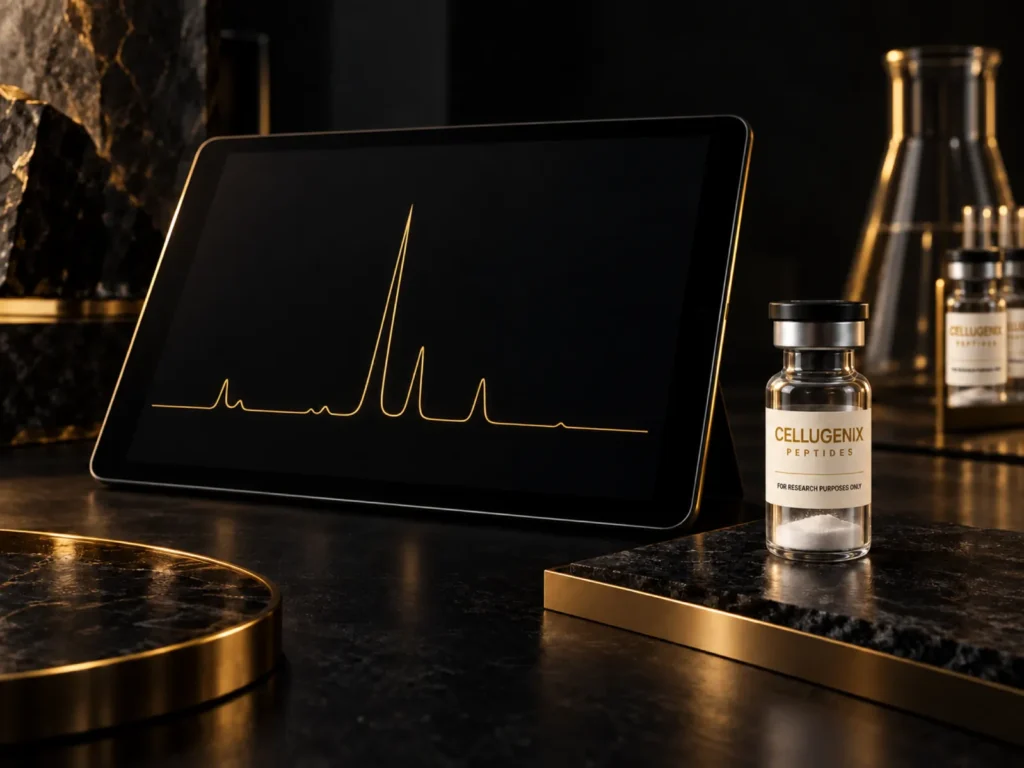
A Certificate of Analysis, or COA, is the lab report that comes with a research peptide. It tells you what is actually in the vial, not just what the label claims. If you buy research peptides in the United States, learning to read a COA properly is the single most useful skill you can pick up. The COA is often the only real proof of research peptide quality you have.
This guide walks through what a COA is, what it should include, and how to read one section by section. It also covers RUO labeling, why the FDA cares about it, and the red flags that tell you a document is not worth trusting.
What Is a Certificate of Analysis (COA) for Research Peptides?
COA meaning in laboratory peptide research
A Certificate of Analysis is a short lab document that reports the testing results for one specific batch of a peptide. It usually lists the compound’s identity, its purity, and a handful of other quality checks. Think of it as a report card for that exact production run.
This is more important than it sounds. A COA is tied to one specific lot, rather than the product in general. A supplier cannot hand you a COA from a different batch and call it proof of what is in your vial. If the batch number on the document does not match the batch number on your vial, the COA tells you nothing about what you actually received.
Why COAs matter for US labs and qualified professionals
A COA does three jobs at once.
- It supports reproducibility, since two researchers working from the same batch data are more likely to get comparable results.
- It gives you a paper trail for internal quality records.
- And it backs up any published work that references the compound, since reviewers and readers may ask what was actually used.
In the United States, this is even more important right now. Research peptides sold as RUO material are under closer FDA scrutiny than they were a few years ago. Buyers who cannot show batch-level documentation have little to fall back on if a supplier’s claims turn out to be wrong.
COA vs marketing brochure: key differences
A real COA is batch-specific, dated, and built around actual lab methods. It names the test type, shows the raw output such as a chromatogram or a mass spectrum, and states a pass or fail result.
A marketing PDF looks similar at a glance but skips all of that. It has no batch number, no method description, and no underlying data, just a purity figure and some confident language. If a document reads more like an advertisement than a lab report, treat it like one.
Research Peptides and RUO Labeling in the USA
What are research peptides and RUO (Research Use Only) products?
Research peptides are synthetic peptides made for laboratory work: in vitro studies and assay development. They are not made or sold for human use.
The RUO label signals that a product is meant for basic research, assay development, or drug discovery work, not for diagnosing, treating, or preventing anything in a person. That label carries real legal weight, and it only holds up if the way a product is sold matches what the label says.
RUO peptides vs therapeutic peptides: regulatory overview for US buyers
RUO peptides carry no therapeutic claims and no clinical approval. They are sold strictly within a research context, and a supplier that steps outside that context, even in casual marketing, puts its RUO status at risk.
Therapeutic peptides sit in a completely different category. They go through FDA drug or device review, follow manufacturing rules under Good Manufacturing Practice, and carry approved labeling for a specific use. A COA does not change which category a product falls into. It documents quality, but does not grant approval.
Why US labs must take “Not for human use” seriously
The FDA has said plainly that a ‘research use only’ disclaimer does not protect a seller whose actual marketing points to human use. Official FDA guidance on RUO and IUO labeling says the agency looks at the full picture. That means labeling, advertising, and how a product is actually sold, instead of just the words printed on the vial.
For a lab, this is not only a legal question. Institutions have their own policies about RUO handling, and mixing up ‘documented quality’ with ‘cleared for human use’ is a mistake with real consequences. A clean COA tells you what is in the vial. It says nothing about whether that vial belongs anywhere near a person.
What a High-Quality Peptide COA Should Include
Essential COA fields: product name, sequence, and concentration
A usable COA starts with the basics:
- the product name, a catalog number, and the peptide’s sequence or molecular formula.
- It should also state the form, whether that is a lyophilized (freeze-dried) powder or a liquid solution, and the concentration, if the product is sold pre-dissolved.
- The sequence is more crucial than buyers often realize. It is the detail that lets you cross-check the compound against its expected molecular weight later on, when you get to the identity testing section of the report.
Batch and lot numbers: linking the COA to your vial
A batch or lot number is a unique code assigned to one production run. Every vial from that run should carry the same number, and the COA for that run should carry it too.
This single detail is what separates a real COA from a template. If the number on the paperwork does not match the number printed on your vial’s label, you are not actually holding documentation for what you have. Treat that mismatch as a reason to pause, not a technicality to overlook.
Testing laboratory details: lab name, accreditation, and contact info
A trustworthy COA names the lab that ran the tests, along with an address or working contact method. Look for a stated accreditation, and specifically for ISO/IEC 17025, the international standard built for testing and calibration labs. It is a stronger signal than a general quality certification, because it is assessed against a lab’s actual technical ability to produce accurate results, not just its internal paperwork process. You can check what that accreditation covers directly through A2LA, one of the accrediting bodies that assesses labs against this standard.
Testing done by an outside lab, one with no financial stake in the result, carries more weight than testing done in-house by the same company that made the peptide.
Analytical methods listed: HPLC, UPLC, LC-MS, MS, and more
The COA should name its methods instead of just reporting a number.
- High-Performance Liquid Chromatography (HPLC) or its faster cousin UPLC measure purity.
- Mass spectrometry (MS), sometimes paired with HPLC as LC-MS, confirms identity.
- Some COAs add extra checks such as Karl Fischer titration for water content, endotoxin testing, or residual solvent analysis.
A document that just says “tested” without naming a method is not giving you anything you can verify.
Test results section: purity, identity, and additional quality data
Each listed method should come with an actual result, not a vague pass label. Purity is usually written as a number, such as ‘Purity (HPLC): 99.1%,’ and a strong COA pairs that number with the chromatogram it came from. Identity results typically show a molecular weight, often alongside a spectrum image.
A number by itself asks you to trust it, while one with its supporting graph lets you check it.
Step-by-Step: How to Read a Research Peptide COA
Step 1: Match batch and lot numbers to your vial
Start here, every time. Pull up the vial label, the COA, and the packing slip, and confirm all three show the same lot number. This single check catches the most common problem with COAs: a generic document that was never tied to the batch you actually received.
If a supplier cannot produce a COA with a batch number that matches your vial, it means you have no verified data for what you are holding.
Step 2: Confirm who performed the testing (in-house vs third-party)
Check whether the listed lab is part of the seller’s own company or a separate outside lab. In-house testing is not automatically dishonest, but it carries an obvious conflict of interest: the company grading its own work has a reason to grade generously.
Third-party testing removes that incentive. If a COA does not make the testing relationship clear, ask the supplier directly which one it is before you rely on the document.
Step 3: Interpret HPLC purity results and chromatograms
The purity figure tells you what share of the sample is the target peptide, based on the size of its peak compared to every other peak on the chart. A quick glance at the chromatogram itself, not just the printed number, tells you whether that figure holds up. One clean dominant peak is a good sign. Several large peaks of similar size means the sample is a mixture.
For a deeper look at how this number is calculated and what threshold fits which kind of work, see the HPLC section below.
Step 4: Verify peptide identity using mass spectrometry data
Purity tells you how clean the sample is; it says nothing about whether it is the right molecule. Mass spectrometry answers that question by comparing the peptide’s theoretical mass, calculated from its sequence, against the mass the instrument actually measured. A COA missing this comparison has only told you half the story.
The full explanation of acceptable mass variance and what identity data alone can and cannot confirm is covered later in this guide.
Step 5: Review extra quality parameters (water, solvents, endotoxin, sterility)
Beyond purity and identity, a handful of secondary results are also important, depending on your work. Water content affects how accurately you can calculate how much actual peptide is in a given weight of powder. Residual solvent levels matter for both safety and for keeping an assay from being thrown off by leftover chemicals. Endotoxin and sterility results become essential the moment a study involves cell culture, where contamination can quietly ruin an experiment.
Not every application needs every one of these tests. Screening work can often skip endotoxin data; cell-based work generally cannot.
Step 6: Check dates, document version, and COA authenticity
Look at the testing date before anything else on this list. A COA from three years ago tells you nothing reliable about a batch synthesized last month, even if it is technically for “the same product.” Also check for a version number or code. Suppliers sometimes update testing methods or formats over time.
Where a supplier offers a lookup tool or QR code tied to the batch, use it. That kind of verification path is a strong sign the COA was built to be verified instead of just shown on the website.
Understanding HPLC Purity on a Peptide COA
What is HPLC purity testing for research peptides?
Reverse-phase HPLC works by pushing a liquid sample through a column packed with material that interacts differently with each compound in the mix. Different molecules move through at different speeds, which physically separates the target peptide from whatever else is in the sample, so each one can be measured on its own.
How purity percentage is calculated from the chromatogram
The instrument’s software measures the area under each peak on the chromatogram, since peak area corresponds to how much of each substance is present. Purity is simply the main peak’s area divided by the total area of every peak, expressed as a percentage. A sample showing one large peak at 99% of total area and several tiny ones making up the rest is reported as Purity by HPLC.
Recommended purity thresholds for US labs (95%, 98%, 99% and above)
The right threshold depends on the work. Purity of 95% or higher is generally treated as acceptable for early screening and exploratory studies, where rough activity signals are the goal. For quantitative, concentration-response, or publication-grade research, 98 to 99% or higher is the standard most labs hold to, since even small impurity levels can shift measured results at that level of precision.
How to read HPLC graphs and identify impurity peaks
- Find the tallest, widest peak first. That is almost always the target compound.
- Every smaller peak around it represents an impurity, whether that is a synthesis byproduct, a related but incomplete sequence, or a degradation product.
- Note where each peak sits along the timeline; this is called its retention time.
- Then check the baseline between peaks. A flat, quiet baseline is a good sign. A noisy, wandering one makes the whole reading less trustworthy.
Common HPLC-related red flags on peptide COAs
Watch for a purity percentage with no chromatogram attached, since a number with nothing behind it cannot be checked. A visibly noisy baseline is another warning sign, and so is a large secondary peak that the document never explains. If a COA states Purity by HPLC but the graph shows a messy trace with several sizable peaks, trust the picture over the printed number.
How Mass Spectrometry Confirms Peptide Identity
Why MS identity data is critical for research peptide quality
A purity test can tell you a sample is clean without ever confirming what that clean sample actually is. Mass spectrometry closes that gap. It measures the compound’s mass directly, which rules out the possibility that a supplier shipped the wrong peptide, or a related one, under the correct label.
Theoretical vs observed molecular weight: what the numbers mean
Every peptide has a theoretical mass, calculated mathematically from its amino acid sequence. Mass spectrometry produces an observed mass, the number the instrument actually measures from the physical sample. If a peptide’s sequence predicts a mass of 1,419 daltons and the instrument reads 1,419.3, that agreement confirms the compound matches its label.
Acceptable variance between observed and theoretical mass
Some gap between theoretical and observed mass is normal and expected; instruments do not read a perfectly exact number every time. A typical acceptable range runs a few daltons, or a few parts per million depending on the instrument used. A strong COA states what tolerance it applied, rather than leaving you to guess.
Identity testing limitations and how to spot incomplete COAs
Mass spectrometry confirms mass, and mass alone cannot always rule out every possible related sequence, which is why identity testing works best alongside purity testing rather than in place of it. A COA that lists only a theoretical mass, with no observed value from an actual measurement, has not really confirmed identity at all. That is one of the clearer signs of an incomplete document.
Additional Quality Tests to Look For on a COA
Water content and residual solvent analysis
Peptide powder is rarely pure peptide by weight; it also holds water and salts left over from synthesis. Water content testing (often run by Karl Fischer titration) tells you how much of the vial’s weight is actually water, which matters for anyone converting milligrams into moles for precise work. Residual solvent testing checks for leftover chemicals such as acetonitrile or trifluoroacetic acid (TFA), which can interfere with sensitive assays if present at meaningful levels.
Endotoxin and sterility testing for sensitive applications
Endotoxins are heat-stable compounds shed by certain bacteria, and they can interfere with cell-based assays even in tiny amounts. This testing is most important for cell culture work, where contamination can quietly distort results without any obvious sign. Sterility testing serves a similar purpose for research that requires a contamination-free sample.
Heavy metals and other contaminants (when relevant)
Some applications call for an extra layer of screening, including a check for heavy metal residues from the synthesis process. This is not standard on every COA, but it is worth requesting for particularly sensitive or high-stakes research.
When US labs should insist on extra testing data
Push for the fuller test panel, including endotoxin and sterility data, whenever a study moves into live cell culture. For basic screening or exploratory in vitro work, a strong purity and identity result is often enough on its own.
How to Evaluate Research Peptide Quality Using a COA
Peptide purity vs peptide identity: why you need both
Purity and identity answer two different questions, and neither one substitutes for the other. A sample could be Purity by HPLC and still be the wrong compound entirely, or correctly identified but loaded with impurities. Only a COA that reports both gives you a full picture of what you are working with.
Setting lab-specific quality thresholds for RUO peptides
Every lab benefits from writing down its own baseline before batches start arriving, rather than deciding case by case. A reasonable starting point covers three rules.
- Set a minimum purity threshold matched to the type of work being done.
- Require mass spectrometry data on every batch, without exception.
- Require endotoxin testing only where it is relevant.
Building a simple quality checklist for every new batch
Pull the earlier step-by-step section into a repeatable routine. Confirm the batch number. Confirm the testing lab. Check the HPLC result and its chromatogram. Check the MS result. Review any extra tests your work requires, and confirm the testing date. Running the same checks on every incoming batch turns COA review from a one-time judgment call into a habit.
When to reject a batch based on COA findings
Some findings are disqualifying on their own.
- Purity that falls below your lab’s threshold is one.
- Missing mass spectrometry data is another.
- So is any real discrepancy between what the COA claims and what the chromatogram or spectrum actually shows.
Federal investigators have found real cases where a supplier’s paperwork claimed one compound while independent testing turned up something else entirely, sometimes a substance with real physiological effects. That gap between claim and reality is exactly what a careful COA review is meant to catch before it becomes your problem.
Common COA Red Flags US Buyers Should Watch For
Missing batch numbers or non-specific COAs
A COA with no batch number cannot be tied to any specific vial, which means it cannot really tell you anything about what you received. Treat a generic, reused-looking document as equivalent to having no COA at all.
No HPLC chromatogram, only a purity number
A purity percentage without its underlying chromatogram is a claim you cannot verify. Ask for the actual chart, not just the summary figure.
COAs without mass spectrometry identity data
A COA that reports purity but skips identity confirmation has left out half the picture. Purity alone never confirms that a sample is the compound it claims to be.
Vague or untraceable testing laboratory information
Watch for phrases like “independent lab” with no name, address, or way to contact anyone there. A testing claim that cannot be checked is functionally the same as an unverified claim.
Old COAs with outdated testing dates
Peptides degrade, and testing methods change over time. A COA dated years before your purchase, attached to a “current” batch, should raise questions rather than reassure you.
Inconsistencies between product page and COA
Compare the sequence and purity figures on the product listing against what the COA actually states. If the two disagree, even slightly, that mismatch deserves an answer before you rely on either one.
COA Best Practices for US Labs and Qualified Professionals
How to document COAs in your lab (LIMS, shared drive, QA system)
Keep every COA in one central place, whether that is a Laboratory Information Management System (LIMS) or a well-organized shared drive. A consistent naming convention, such as compound plus batch number plus date, makes a document easy to find months later when you actually need it.
Linking COAs to inventory, experiments, and publication data
Tag each COA against its matching inventory entry so anyone in the lab can trace a vial back to its documentation in seconds. Reference the specific COA and batch number directly in experiment notes, and again in the methods section of any resulting publication.
Creating a standard operating procedure (SOP) for COA review
Write down the review steps as a formal SOP, including who checks incoming COAs, what counts as a pass or a rejection, and how a flagged batch gets escalated. A documented process holds up under audit far better than an informal habit that lives in one person’s head.
Training new lab staff to interpret peptide COAs correctly
New staff should learn this skill early, not pick it up after a mistake. A short onboarding checklist covering the sections in this guide, paired with a few real COA examples to practice on, gets a new hire reading these documents confidently within a single session.
US Regulatory and Compliance Context for RUO Peptides
FDA and regulatory attention on RUO peptide marketing
FDA scrutiny of RUO peptide marketing has increased sharply in 2026. The agency has issued waves of warning letters against sellers whose product pages described effects in people. This happened despite an RUO label printed elsewhere on the same page. The label alone has never been the deciding factor. The surrounding marketing language is.
Why robust COA documentation supports defensible lab practices
Thorough COA records give a lab something solid to point to during an internal review, an IRB inquiry, or an institutional audit. In an environment where enforcement attention on this category keeps growing, a documented, batch-linked paper trail is not paperwork for its own sake. It is the difference between a lab that can show its work and one that cannot.
Risk mitigation for US institutions sourcing research peptides
Three habits reduce institutional risk. Choose suppliers who provide accessible, batch-specific COAs as standard practice. Keep every COA on file well past the life of the batch it documents. Build in a short internal review step before a new compound enters lab use. None of these habits are complicated, but skipping them is exactly how documentation gaps happen.
Choosing a Trusted Research Peptide Supplier in the USA
Quality signals: COA transparency, third-party labs, and ISO/QMS
Look for a supplier that makes its COAs easy to find, ideally through a searchable library rather than a document you have to request. Favor suppliers who use outside labs for testing over those relying only on in-house results, and check for a stated ISO/IEC 17025 accreditation on the testing side.
How to compare COAs from different US peptide vendors
Line up COAs from different sources side by side. Compare how much detail each one includes, how consistent that detail is across different batches from the same supplier, and how wide the testing scope actually is. A supplier whose COAs vary wildly in format or completeness from batch to batch is telling you something about how seriously it treats documentation.
Questions to ask suppliers about COA and testing methods
A few direct questions cut through most marketing language fast:
- Is testing done in-house or through an outside lab?
- Can you share the actual chromatogram for this specific batch, not a sample one?
- What is the testing lab’s name, and is it accredited?
A supplier that answers clearly and quickly is telling you something useful. One that deflects is telling you something too.
How a COA library and batch-specific records help US labs
A searchable COA library, where you can pull up documentation by lot number at any time, saves real time during audits and when writing up methods sections later. It also signals that a supplier expects its documentation to be checked, which is a meaningfully different posture than a supplier that only produces a COA when asked.
Example Workflow: Verifying a New Research Peptide Batch
8-step checklist US labs can follow for every new lot
- Download the COA as soon as the order arrives.
- Match the batch number on the COA to the number on the vial.
- Confirm which lab performed the testing, and whether it was in-house or third-party.
- Check the HPLC purity result against the actual chromatogram.
- Verify the mass spectrometry identity data against the peptide’s theoretical mass.
- Review any additional tests your specific work requires, such as endotoxin data.
- Confirm the testing date is recent and matches the batch you received.
- Archive the COA in your lab’s system, tagged to the matching inventory entry.
Applying the workflow to any peptide class
This eight-step process does not change based on what category of peptide you are working with. A receptor-ligand peptide, a metabolic-pathway compound, and an enzyme-substrate peptide all get the same review. Match the batch, confirm the lab, check purity and identity, review any extras, confirm the date, and file it. Consistency across compound types is what makes the process actually stick as a habit.
How this COA workflow reduces variability in preclinical research
A consistent review process cuts down on the kind of surprises that come from an unverified batch, whether that means an unexpectedly weak result or an experiment that cannot be reproduced later. Fewer surprises translates directly into more reliable comparisons between studies and less wasted time chasing down inconsistent results after the fact.
Frequently Asked Questions About Reading Peptide COAs
What purity percentage should US labs look for in research peptides?
For early screening work, 95% or higher is generally acceptable. For quantitative or publication-grade research, most labs look for 98 to 99% or higher, since impurities below that level can begin to affect precise measurements.
Do all COAs need both HPLC and MS data?
Yes, and this is worth treating as a firm requirement rather than a preference. HPLC confirms purity, MS confirms identity, and a COA missing either one has only told you half of what you need to know.
How often should COAs be updated for recurring batches?
Every new batch or lot should come with its own COA, since testing results from one production run do not apply to the next. How often a supplier retests beyond that depends on their internal policy, and it is worth asking about directly.
Can a US lab rely on supplier-run tests, or should it insist on third-party results?
Supplier-run, in-house testing can be acceptable for lower-stakes work, but third-party data carries more weight because it removes the conflict of interest. When in doubt, ask the supplier which type of testing backs their COA.
What should a lab do if the COA and vial label don’t match?
Quarantine the batch immediately, and do not use it in any experiment. Contact the supplier for an explanation before deciding whether to proceed, request a replacement, or seek a refund.
Conclusion: Using COAs to Protect Your Research and Your Lab
Key takeaways for reading a COA and evaluating peptide quality
Three things separate a COA worth trusting from one that is not.
- It is linked to a specific batch.
- It includes both HPLC and mass spectrometry data.
- And it is recent enough to actually describe what you are holding.
Miss any one of those three, and the document stops being reliable evidence.
How strong COA practices support reproducible science in US labs
Careful COA review does more than protect one experiment. It builds a body of work that other researchers can trust, supports institutional compliance, and gives you real confidence in results instead of a hope that the label was accurate.
Next steps: building your own COA checklist and supplier criteria
Turn this guide into your lab’s actual practice: write down your minimum thresholds, use the eight-step workflow on every new batch, and hold every supplier to the same documentation standard.
Printable Checklist: COA and Research Peptide Quality Guide
One-page COA review checklist for US labs
Everything in the eight-step workflow above fits on a single printable page: batch match, testing lab, HPLC result and chromatogram, MS result, extra tests as needed, testing date, and archive. Keep a printed copy at the bench for a quick reference.
How to use the checklist with your peptide inventory
Pin a printed copy of the checklist wherever new shipments get logged, and run through it the moment a batch arrives, before it goes into storage. Treating COA review as the first step, rather than an afterthought, is what makes the habit sustainable.
For Research Use Only. Not for use in diagnostic or therapeutic procedures.