ARA-290 (Cibinetide): Sequence, Receptor Binding and Laboratory Use
Erythropoietin engages two different receptor arrangements. ARA-290 engages one. The 11-residue peptide is modelled on a single face of erythropoietin’s helix B, the face that meets the EPOR-CD131 heteroreceptor, and it leaves the EPOR homodimer alone in receptor assays. That selectivity turns one half of a two-part receptor story into a reagent a laboratory can use by itself.
This guide walks through the ARA-290 peptide’s identifiers, the reason its chain opens with pyroglutamate, how it compares with erythropoietin at the receptor, where it turns up in assay work, its regulatory standing, sealed-vial storage and what each lot certificate should report.
For Research Use Only. Not for use in diagnostic or therapeutic procedures.
In short: what is ARA-290?
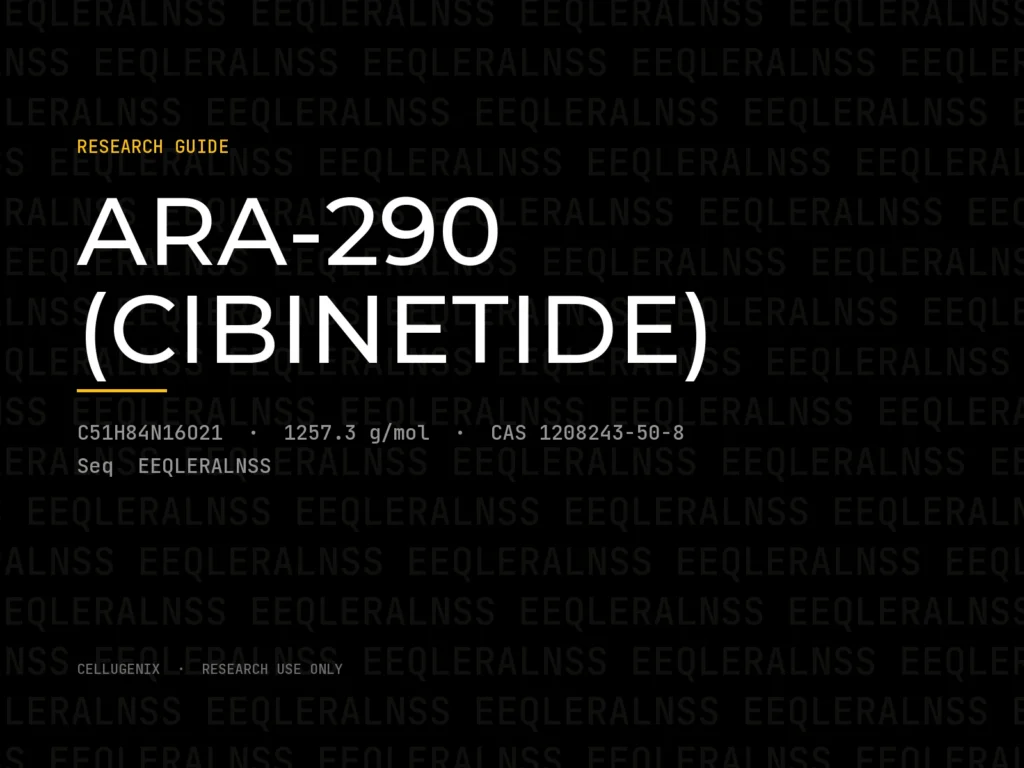
ARA-290 (Cibinetide) is an 11-residue peptide, pGlu-Glu-Gln-Leu-Glu-Arg-Ala-Leu-Asn-Ser-Ser (C51H84N16O21, 1257.3 g/mol, CAS 1208243-50-8), derived from the helix B surface of erythropoietin. In receptor assays it binds the EPOR-CD131 heteroreceptor without activating the EPOR homodimer, which lets researchers study that receptor arrangement on its own.
✓ 11 residues, opening with pyroglutamate
✓ Binds the EPOR-CD131 heteroreceptor, leaving the EPOR homodimer unactivated
✓ Sold for bench research only; the FDA has approved no product containing it
Contents
1. ARA-290 at a glance
2. What ARA-290 is
3. ARA-290 vs EPO at the receptor
4. Assays
5. FDA status
6. Vial storage
7. Verifying a lot
8. FAQs
ARA-290 at a Glance
Quick answer: ARA-290 is an 11-residue synthetic peptide registered as CAS 1208243-50-8, with PubChem filing it under CID 91810664. The formula C51H84N16O21 works out to 1257.3 g/mol on average, against a monoisotopic mass of 1256.60. Cibinetide is the compound’s international non-proprietary name.
| Field | Value |
| Sequence | pGlu-Glu-Gln-Leu-Glu-Arg-Ala-Leu-Asn-Ser-Ser |
| Other names | Cibinetide, helix B surface peptide (HBSP), pHBSP |
| Length | 11 amino acids (N-terminal pyroglutamate) |
| Formula / MW | C51H84N16O21 / 1257.3 g/mol |
| Monoisotopic mass | 1256.60 |
| CAS | 1208243-50-8 |
| Forms | Free base; acetate salt (Cibinetide acetate) |
| Parent protein | Erythropoietin (helix B surface) |
| Receptor target | EPOR-CD131 heteroreceptor |
| Status | Not an FDA-approved drug; research reagent |
| Cellugenix supply | ARA-290 10 mg, lyophilized; batch COA not yet published |
PubChem’s compound record files Cibinetide alongside the synonyms ARA 290, pHBSP and pyroglutamate helix B surface peptide, so a supplier listing under any of those names describes the same molecule. Lot details for the vial on sale appear on the ARA-290 10 mg specification page.
What Is ARA-290 (Cibinetide)?
Quick answer: ARA-290, also called Cibinetide, is a synthetic 11-residue peptide that reproduces a small surface region of erythropoietin’s helix B. It was designed to engage the EPOR-CD131 heteroreceptor while leaving the EPOR homodimer unactivated, separating two receptor arrangements that erythropoietin engages together.
Erythropoietin itself is a glycoprotein. UniProt entry P01588 records a 193-residue precursor whose 27-residue signal sequence is cleaved to leave a mature chain of 166 residues, carrying three N-linked sugar chains, one O-linked sugar chain and two disulfide bonds. ARA-290 reproduces one face of that protein in 11 residues and no sugars at all.
The design works from the folded protein. Helix B turns one side toward the solvent, and the residues on that side are scattered through the erythropoietin chain, drawn together only once the protein folds. Line ARA-290 up against the mature erythropoietin sequence and no continuous stretch matches, which follows from copying a surface in three dimensions. John Cheetham and colleagues at Amgen solved the solution structure that made such surfaces readable, reporting in Nature Structural Biology that “the overall topology of the protein is revealed as a novel combination of features.”
Why Does It Start With Pyroglutamate?
The N-terminal residue is cyclized, which closes off the free amine that an ordinary peptide carries at that end. Laboratories track the same chemistry as an unplanned modification elsewhere: Lauren Bersin, Sajal Patel and Elizabeth Topp noted in Molecular Pharmaceutics that “N-terminal glutamate can cyclize to form pyroglutamate in pharmaceutically relevant peptides and proteins.” In ARA-290 the ring is deliberate, so an LC-MS check should find it already closed.
Is ARA-290 a Peptide, and Is It Hydrophobic?
ARA-290 is a peptide, built from 11 standard residues by chemical synthesis. It reads as hydrophilic: eight of its 11 residues are polar or charged, including two glutamates, one arginine, two serines, a glutamine and an asparagine. Two glutamate side chains and the free C-terminus against a single arginine leave a net charge near minus 2 at neutral pH.
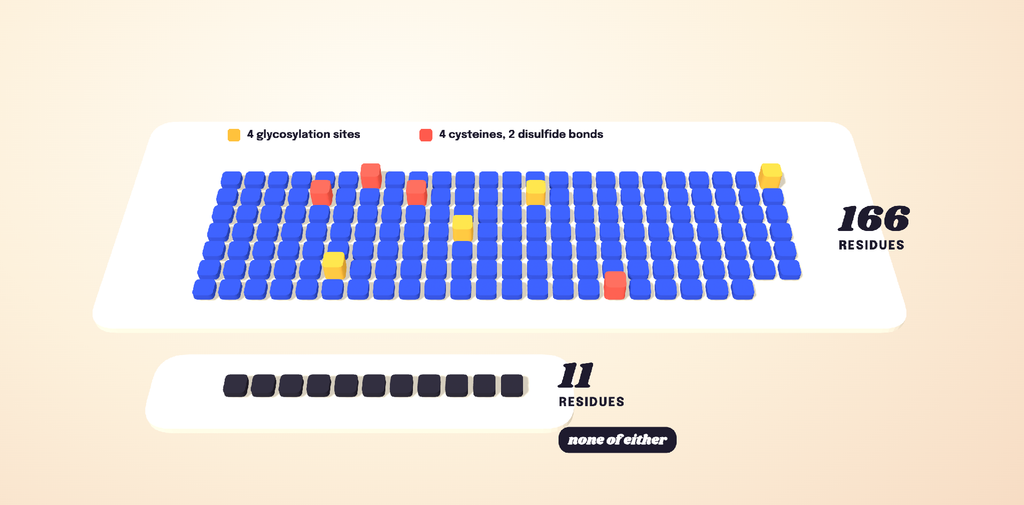
Comparison of erythropoietin’s 166 residues, four glycosylation sites and two disulfide bonds beside ARA-290’s 11 residues
How Does ARA-290 Differ From EPO at the Receptor Level?
Quick answer: Erythropoietin signals through an EPOR homodimer and an EPOR-CD131 heteroreceptor, and the full protein engages both. ARA-290 reproduces only the helix B surface that interacts with the heteroreceptor, so in receptor assays it binds the EPOR-CD131 complex while the homodimer stays unactivated.
| Erythropoietin (full protein) | ARA-290 | |
| Size | 166 residues, glycosylated | 11 residues |
| EPOR homodimer | Activates | Doesn’t activate (in receptor assays) |
| EPOR-CD131 heteroreceptor | Engages | Engages |
| Lab use | Reference ligand for both | Tool for the heteroreceptor pathway alone |
Oded Livnah and colleagues at the Scripps Research Institute crystallized the unliganded EPOR extracellular domain at 2.4 angstrom resolution and reported in Science that “the actual dimer configuration is critical for the biological response and signal efficiency.” Geometry decides what a bound receptor pair does next, which is the opening ARA-290 was built to exploit.
CD131, the second partner, is the β-common subunit shared with the GM-CSF, IL-3 and IL-5 receptor systems. Paul Carr’s group at the Australian National University solved its complete extracellular domain and described it in Cell as “forming a stable interlocking dimer in the absence of ligand.” Pairing that subunit with EPOR produces a receptor assembly whose composition differs from the EPOR homodimer, and a ligand selective for one of the two lets each be assayed separately.
Which Assays Is ARA-290 Used In?
Quick answer: ARA-290 appears in receptor-binding assays for the EPOR-CD131 heteroreceptor, downstream signalling work on JAK2 and STAT phosphorylation and NF-κB activity, cytokine-release assays in cultured cells, and cell-viability and apoptosis assays that compare heteroreceptor with homodimer signalling.
| Assay | What it measures | Readout |
| Receptor binding | EPOR-CD131 vs EPOR homodimer binding | Competitive binding, co-IP |
| JAK2 / STAT | Pathway activation | Phospho-JAK2 / STAT (western blot) |
| NF-κB activity | Transcription-factor signalling | Reporter assay, western blot |
| Cytokine release | Secretion by cultured cells | ELISA, multiplex |
| Viability / apoptosis | Cell survival under assay stress | MTT, caspase-3, annexin V |
Receptor-binding work comes first, because everything downstream depends on which complex the peptide occupies. Competitive binding puts labelled erythropoietin and unlabelled ARA-290 in the same well and reads the displacement, while co-immunoprecipitation pulls down one receptor subunit and asks which partners come with it.
JAK2 acts immediately below both receptor arrangements, so phospho-specific antibodies against JAK2 and the STAT proteins show whether a ligand triggered signalling at all. Running the same blots on cells carrying EPOR alone and on cells carrying EPOR with CD131 separates the two pathways by cell line.
NF-κB reporter assays read transcription-factor activity through a luciferase signal, and cytokine-release panels measure what cultured cells secrete afterwards by ELISA or a multiplex bead array. Viability and apoptosis endpoints close the set. MTT tracks metabolically active cells, while caspase-3 activity and annexin V staining count cells entering apoptosis.
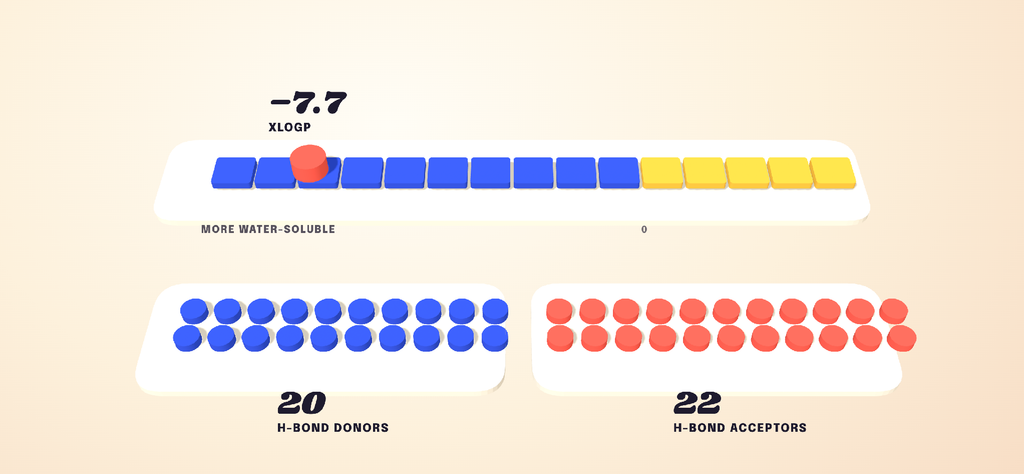
ARA-290’s XLogP of −7.7, 20 hydrogen-bond donors and 22 hydrogen-bond acceptors
Is ARA-290 FDA-Approved?
Quick answer: No. The FDA has approved no product containing Cibinetide, and ARA-290 holds no drug approval of its own. Cellugenix ships it for in-vitro bench work under reagent labeling that reads “For Research Use Only. Not for use in diagnostic or therapeutic procedures.”
Research-reagent supply follows its own labeling rules, separate from the approval pathway that governs medicines. A compound can hold a published international non-proprietary name, as Cibinetide does, while carrying no marketing authorization anywhere. The research peptides and US law in 2026 guide sets out how US rules treat this category, and what Research Use Only means explains the labeling itself.
Storage of the Sealed Vial
ARA-290 arrives freeze-dried in a sealed vial marked with its lot number. Leave the seal in place, shield the contents from light and damp, hold the vial at its labeled temperature, and treat the label as the shelf-life reference. Per-family temperature ranges are collected in the storage and handling guide.
How to Verify Research-Grade ARA-290
Quick answer: Start with the batch-specific COA. A Cellugenix report states the HPLC purity with its method, the measured content and the report number under a named laboratory. Identity, including the closed pyroglutamate ring, is confirmed by an LC-MS mass of 1257.3, which a lab can run in-house.
Work through these fields:
1. Matching lot numbers. Certificate and vial label should name the same lot.
2. HPLC purity and method. The method belongs beside the figure.
3. Optional in-house LC-MS check. Expect 1257.3 as the average mass for the free base. On an electrospray trace the 1+ ion lands near m/z 1257.6, with the 2+ ion near m/z 629.3.
4. Pyroglutamate confirmed. A chain whose N-terminus failed to cyclize reads roughly 17 to 18 Da heavier.
5. Salt form stated. Acetate counter-ions add mass, so the named form governs which figure a calculation takes.
6. Laboratory and report number. Both should be printed, ideally with a verification route back to the laboratory’s own record.
No ARA-290 certificate appears in the COA library yet. Until one is posted there, support releases the current lot’s report on request, so ask for it before the vial enters an experiment. For a walkthrough of each field, see how to read a COA, and for what the two techniques detect, see HPLC vs mass spectrometry.
Frequently Asked Questions
What is ARA-290?
ARA-290 is a synthetic 11-residue peptide, pGlu-Glu-Gln-Leu-Glu-Arg-Ala-Leu-Asn-Ser-Ser, modelled on the helix B surface of erythropoietin. In receptor assays it binds the EPOR-CD131 heteroreceptor and leaves the EPOR homodimer unactivated. Laboratories use it in receptor-binding, JAK2 and STAT signalling, and cell-culture assays, under research-use-only labeling.
Is ARA-290 the same as Cibinetide?
Yes. Cibinetide is the international non-proprietary name for the same molecule, and ARA-290 is its development code. PubChem files both under CID 91810664, alongside the aliases pHBSP and pyroglutamate helix B surface peptide. A certificate or paper naming any one of these describes the identical 11-residue sequence.
What is the molecular weight of ARA-290?
The free base (C51H84N16O21) averages 1257.3 g/mol, with 1256.60 as its monoisotopic mass. Acetate salt forms weigh more, so whichever form a label names decides the value that belongs in a concentration calculation.
What is the CAS number of ARA-290?
The CAS registry number for ARA-290 is 1208243-50-8, which covers Cibinetide as the free base. PubChem holds the same compound as CID 91810664. Checking that number against the sequence on a label and a certificate confirms all three point to one molecule.
How does ARA-290 differ from erythropoietin?
Erythropoietin is a glycosylated protein of 166 residues that engages both the EPOR homodimer and the EPOR-CD131 heteroreceptor. ARA-290 reproduces only the helix B surface involved in the second arrangement, across 11 residues with no sugars, so in receptor assays it engages the heteroreceptor alone.
Is ARA-290 FDA-approved?
No. ARA-290 has no FDA approval, and Cibinetide appears in no approved product. Cellugenix sells it strictly for in-vitro bench research, and every vial carries research-use-only labeling. Holding an international non-proprietary name says nothing about approval status in any country.
The Bottom Line
ARA-290 is an 11-residue helix B surface peptide that binds the EPOR-CD131 heteroreceptor while leaving the EPOR homodimer unactivated, which makes it a selective tool for that receptor pathway in vitro. Check the HPLC purity on the batch certificate, and confirm identity with an LC-MS mass near 1257.3.
For Research Use Only. Not for use in diagnostic or therapeutic procedures.
Sources
- PubChem. Cibinetide, CID 91810664 (National Library of Medicine).
- UniProt. Erythropoietin, entry P01588 (UniProt Consortium).
- Cheetham JC, Smith DM, Aoki KH, et al. Nature Structural Biology, 1998; 5(10): 861-866. PMID 9783743.
- Livnah O, Stura EA, Middleton SA, et al. Science, 1999; 283(5404): 987-990. PMID 9974392.
- Carr PD, Gustin SE, Church AP, et al. Cell, 2001; 104(2): 291-300. PMID 11207369.
- Bersin LM, Patel SM, Topp EM. Molecular Pharmaceutics, 2021; 18(8): 3116-3124. PMID 34232660.
For Research Use Only. Not for use in diagnostic or therapeutic procedures.