AOD9604: Sequence, Structure and Laboratory Identity
One residue separates AOD9604 from the plain C-terminal fragment of human growth hormone, and that swap moves the mass by exactly 16 Da. The peptide runs 16 residues, opens with a tyrosine, and closes a disulfide bridge between its two cysteines. Below are the sequence, the structure, and the checks that confirm both on a certificate.
For Research Use Only. Not for use in diagnostic or therapeutic procedures.
In short: what is AOD9604?
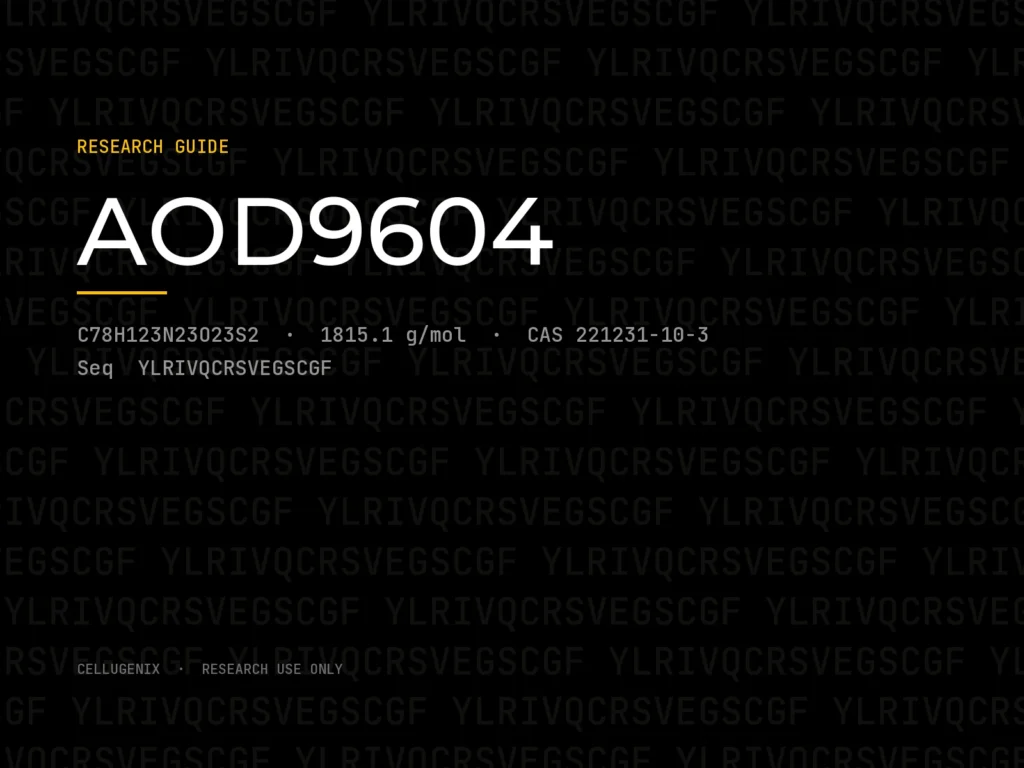
AOD9604 is a synthetic 16-residue peptide, Tyr-Leu-Arg-Ile-Val-Gln-Cys-Arg-Ser-Val-Glu-Gly-Ser-Cys-Gly-Phe (C78H123N23O23S2, 1815.1 g/mol, CAS 221231-10-3). It combines an N-terminal tyrosine with residues 177 to 191 of human growth hormone, and its two cysteines form an internal disulfide bridge. It’s supplied as a research reagent.
✓ 16 residues with one disulfide bridge
✓ Based on the C-terminal region of hGH, plus Tyr
✓ A research reagent the FDA has approved for no use
Contents
1. AOD9604 at a glance
2. What AOD9604 is
3. AOD9604 vs hGH 176-191
4. The disulfide bridge
5. What it’s studied in
6. FDA status
7. Vial storage
8. Verifying a lot
9. FAQs
AOD9604 at a Glance
Quick answer: AOD9604 is a hexadecapeptide registered as CAS 221231-10-3 and filed in PubChem as CID 71300630. Formula C78H123N23O23S2 puts the bridged molecule at 1815.1 g/mol average, 1813.86 monoisotopic, with cysteines at positions 7 and 14.
| Field | Value |
| Sequence | YLRIVQCRSVEGSCGF |
| Other names | Tyr-hGH (177-191); often listed as “hGH fragment 176-191 (Tyr-modified)” |
| Length | 16 amino acids |
| Structure | Cyclic: Cys7-Cys14 disulfide, equal to Cys182-Cys189 in hGH numbering |
| Formula / MW | C78H123N23O23S2 / 1815.1 g/mol |
| CAS | 221231-10-3 |
| Forms | Free base; acetate salt |
| Status | Not an FDA-approved drug; research reagent |
| Cellugenix supply | AOD9604 10 mg, lyophilized; Purity by HPLC by HPLC-UV |
PubChem’s record carries a trap for anyone searching by name. Its synonyms include “Tyr-somatostatin (177-191)”, yet the parent protein is somatotropin, the formal name for growth hormone in UniProt entry P01241. Somatostatin is a separate protein with its own gene. Match the structure, never the synonym. Lot figures appear on the AOD9604 10 mg specification page.
What Is AOD9604?
Quick answer: AOD9604 is a synthetic hexadecapeptide that adds a tyrosine to residues 177 to 191 of human growth hormone. Its two cysteines form a disulfide bridge, giving a small internal loop. Chemists built it for structure-activity studies of growth-hormone C-terminal fragments.
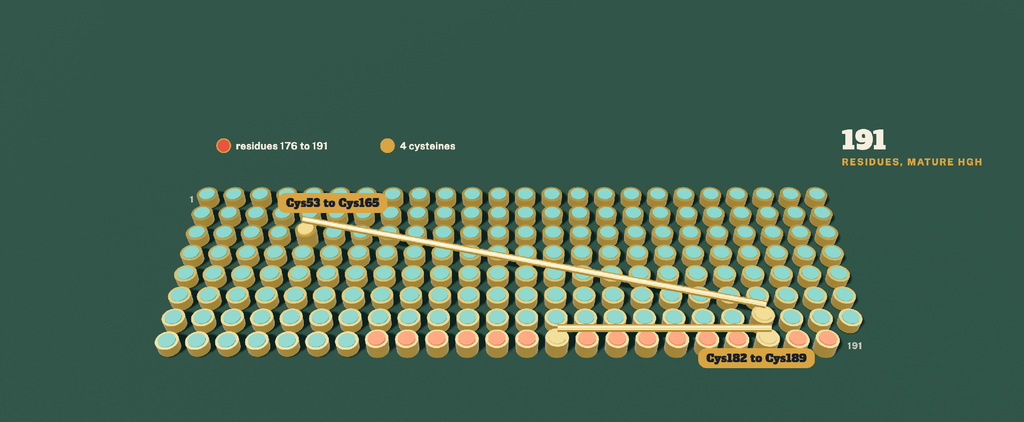
Growth hormone runs to 191 residues in its mature form. Positions 177 to 191, the last 15, read LRIVQCRSVEGSCGF. Put a tyrosine in front of that run and you have AOD9604.
Abraham de Vos, Mark Ultsch and Anthony Kossiakoff crystallized the hormone with its receptor, describing it in Science as “a four-helix bundle with an unusual topology.” Tim Clackson and James Wells later mapped which side chains carry receptor affinity, in the Journal of Molecular Biology. A short C-terminal fragment tests one defined region of that structure.
Is AOD9604 a Peptide or Growth Hormone?
It’s a peptide of 16 residues. The hormone is a 191-residue protein with two disulfide bridges and its own fold. AOD9604 reproduces 15 residues from its C-terminal end and adds one in front, under a tenth of the parent sequence.
Is AOD9604 a GLP-1?
No. The GLP-1 sequence comes from proglucagon and shares no stretch with YLRIVQCRSVEGSCGF. The two have separate parent proteins and separate registry entries.
AOD9604 vs the hGH 176-191 Fragment: What’s the Difference?
Quick answer: “hGH fragment 176-191” is the 16-residue C-terminal sequence of growth hormone, opening with phenylalanine at position 176. AOD9604 replaces that phenylalanine with tyrosine. Both run 16 residues and carry the disulfide bridge, so the first residue and the mass tell them apart.
| AOD9604 | hGH fragment 176-191 | |
| Sequence basis | Tyr + hGH 177-191 | hGH 176-191 |
| First residue | Tyr | Phe |
| Length | 16 residues | 16 residues |
| Disulfide bridge | Yes | Yes |
| Molecular weight | 1815.1 g/mol | 1799.1 g/mol |
| Mass to expect in an LC-MS check | LC-MS near 1815 | LC-MS near 1799 |
Tyrosine is phenylalanine carrying one extra hydroxyl group, so the gap between the two molecules comes to 16.0 Da, the mass of a single oxygen atom. Their formulas differ by that one atom: C78H123N23O23S2 against C78H123N23O22S2.
A 16 Da gap is small in percentage terms and wide open to a mass spectrometer, so one run settles which of the two a vial holds. HPLC alone leaves it open, since both elute as one clean peak.
The Disulfide Bridge and What It Means for Identity
Quick answer: AOD9604’s cysteines at positions 7 and 14 form one disulfide bridge, matching Cys182 and Cys189 in growth-hormone numbering. Closing that bridge removes two hydrogen atoms, so the bridged molecule weighs 1815.1 g/mol while the open chain weighs 1817.1. LC-MS reads the difference directly.
Two cysteines leave one possible bridge, keeping the analysis simple. Peng Wu and colleagues at China’s National Institute of Metrology, in Rapid Communications in Mass Spectrometry, put the general case plainly: “it is of importance to assign disulfide connectivity for a peptide.” Peptides with three or more bridges need partial reduction to sort the pairings out. AOD9604 needs only a mass reading.
A bridged batch gives an average mass of 1815.1, and material that never closed the bridge gives 1817.1. Dimers, two chains bonded to each other, land near double the single-chain mass.
A free-thiol assay offers an optional cross-check. Ellman’s reagent reacts with unpaired cysteine thiols and reports them by colour, an approach that carries into modern analytical workflows, as a free-thiol method in the Journal of Chromatography B describes. A correctly bridged lot returns close to zero free thiol.

What Is AOD9604 Studied In?
Quick answer: AOD9604 appears in structure-activity studies of growth-hormone C-terminal fragments. Laboratories compare its receptor binding against full-length hGH, and set the tyrosine-modified peptide beside the unmodified 176-191 fragment to see what one substitution changes in an assay.
Receptor-binding comparisons form the core of that work, with the Genentech crystal structures as the reference.
The second comparison stays inside the fragment pair. Running AOD9604 and hGH 176-191 side by side isolates what the phenylalanine-to-tyrosine substitution contributes, since every other residue matches.
Is AOD9604 FDA-Approved?
Quick answer: No. The FDA has cleared no product containing AOD9604, and the compound itself holds no drug approval. Cellugenix sells it to laboratories as an in-vitro research reagent under labeling that reads “For Research Use Only. Not for use in diagnostic or therapeutic procedures.”
Reagent supply follows one set of rules and drug approval another. A registry number, a PubChem entry and a published structure all document identity, and none amounts to authorization to market a medicine. For where US law puts this category, read research peptides and US law in 2026, and for what the label phrase actually covers, what Research Use Only means.
Storage of the Sealed Vial
Cellugenix ships AOD9604 freeze-dried and sealed, with the lot printed on the vial. Leave that seal intact until the material goes into an experiment, store it dark and dry, and follow the temperature and expiry the label gives. Our storage and handling guide lists the ranges each product family uses.
How to Verify Research-Grade AOD9604
Quick answer: Canada Peptide Testing, an independent laboratory, ran this lot on September 28, 2026, and recorded Purity by HPLC by HPLC-UV in report CPT-AOD960-C71465. The certificate covers purity and content; an LC-MS mass near 1815.1, run in-house, pins the bridged molecule.
Six checks cover it:
1. Lot on the paperwork equals lot on the vial. The current certificate covers lot CGX-2025, batch L25-01.
2. A purity figure with its method. 99.62% by HPLC-UV here.
3. An optional in-house LC-MS mass near 1815.1. A single reading settles the tyrosine and the closed bridge together.
4. Masses that signal trouble. Around 1799 points to the plain 176-191 fragment, and around 1817 to a chain whose bridge never closed.
5. A named salt form. Acetate counter-ions raise the formula weight, and whichever form the label names is the one a concentration calculation needs.
6. An issuing laboratory you can trace. Canada Peptide Testing published CPT-AOD960-C71465 on October 2, 2026, and that number reopens the original record on the lab’s site.
You’ll find the full report on the AOD9604 10 mg certificate page in our COA library. New to these documents? Start with how to read a COA, then compare the methods in HPLC vs mass spectrometry.
Frequently Asked Questions
What is AOD9604?
AOD9604 is a synthetic 16-residue peptide, YLRIVQCRSVEGSCGF, built from residues 177 to 191 of human growth hormone with a tyrosine added at the front. Its cysteines form one disulfide bridge. It carries CAS 221231-10-3 and reaches laboratories as a lyophilized research reagent.
What is the sequence of AOD9604?
The sequence reads Tyr-Leu-Arg-Ile-Val-Gln-Cys-Arg-Ser-Val-Glu-Gly-Ser-Cys-Gly-Phe, or YLRIVQCRSVEGSCGF. Residues 2 through 16 match positions 177 to 191 of mature growth hormone, and the cysteines at 7 and 14 close its single bridge.
What is the molecular weight of AOD9604?
The bridged free base (C78H123N23O23S2) averages 1815.1 g/mol, with 1813.86 as its monoisotopic mass. A chain that never closed its bridge comes to 1817.1. Acetate salts run heavier still, and the printed form settles which number applies.
Is AOD9604 the same as hGH fragment 176-191?
No. The 176-191 fragment opens with phenylalanine, and AOD9604 opens with tyrosine. Every other residue matches, and both carry the disulfide bridge. That one substitution adds a single oxygen atom, putting AOD9604 at 1815.1 g/mol against 1799.1 for the plain fragment.
Is AOD9604 FDA-approved?
No. No approved product contains AOD9604, and the compound carries no drug authorization of its own. Cellugenix sells it purely as laboratory material under research-use-only labeling. A published structure and a registry number document identity, nothing more.
The Bottom Line
AOD9604 is a 16-residue, disulfide-bridged peptide built on hGH 177 to 191 with a tyrosine at the N-terminus. One oxygen atom separates it from the plain 176-191 fragment, and two hydrogen atoms separate the bridged form from the open chain. Check HPLC purity on the certificate, and confirm identity with an LC-MS run.
For Research Use Only. Not for use in diagnostic or therapeutic procedures.
Sources
- PubChem. AOD9604, CID 71300630 (National Library of Medicine).
- UniProt. Somatotropin, entry P01241 (UniProt Consortium).
- de Vos AM, Ultsch M, Kossiakoff AA. Science, 1992; 255(5042): 306-312. PMID 1549776.
- Clackson T, Ultsch MH, Wells JA, de Vos AM. Journal of Molecular Biology, 1998; 277(5): 1111-1128. PMID 9571026.
- Wu P, Cheng Y, Wang W, Li M. Rapid Communications in Mass Spectrometry, 2025; 39(11): e10026. PMID 40084697.
- Pu Y, Chen Y, Nguyen T, et al. Journal of Chromatography B, 2019; 1114-1115: 93-99. PMID 30939413.
For Research Use Only. Not for use in diagnostic or therapeutic procedures.