DSIP (Emideltide): Sequence, Identity, Regulatory Status and Laboratory Use
For laboratory research use only. Not for human or animal use.
DSIP is a nine-residue peptide named after a 1970s experiment. Half a century later, nobody has pinned down a receptor for it. So when a DSIP peptide vial reaches the bench, its name tells you very little, and its identity data tells you nearly everything.
This laboratory guide covers the identifiers, free base vs acetate, the story behind the name, lab uses, 2026 FDA status, storage, the SDS and the COA checks.
In short: What is DSIP?
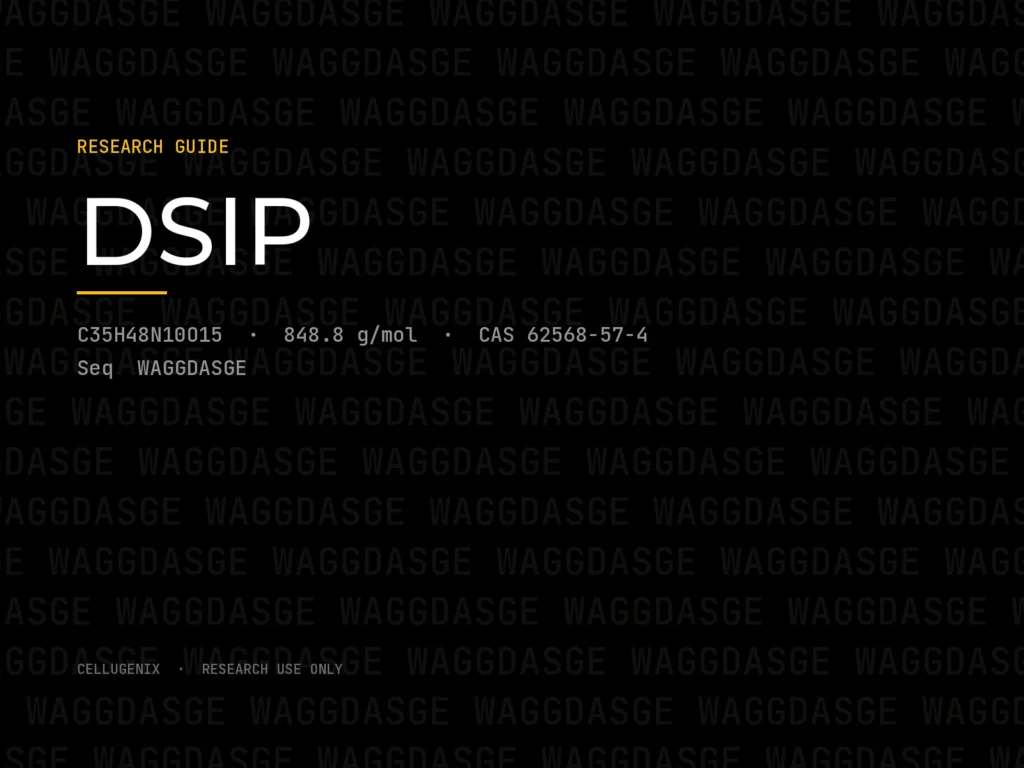
DSIP (delta sleep-inducing peptide; INN emideltide) is a synthetic nonapeptide, Trp-Ala-Gly-Gly-Asp-Ala-Ser-Gly-Glu (WAGGDASGE), with formula C35H48N10O15, molecular weight 848.8 g/mol and CAS 62568-57-4. A Basel group published its sequence in 1977. No receptor has been confirmed for it, so labs use it mainly as a well-characterised peptide reference.
✓ Nine residues, free N-terminal Trp and C-terminal Glu
✓ INN: emideltide (free base and acetate)
✓ A research reagent, not an FDA-approved drug
DSIP at a Glance
Quick answer: DSIP is the linear nonapeptide WAGGDASGE, registered by the FDA under the INN emideltide with UNII YN28Z5YZ73 and cross-listed as PubChem CID 68816. The free base, C35H48N10O15, weighs 848.8 g/mol. The table below gathers every identifier a lab needs before it orders or logs a lot.
| Field | Value |
| Sequence | Trp-Ala-Gly-Gly-Asp-Ala-Ser-Gly-Glu (WAGGDASGE) |
| Other names | Emideltide (INN) · delta sleep-inducing peptide (historical name) |
| Length | 9 residues, linear, free termini |
| Formula | C35H48N10O15 (free base) |
| Molecular weight | 848.8 g/mol average · 848.33 Da monoisotopic |
| CAS | 62568-57-4 (free base) · none listed for the acetate |
| PubChem / FDA GSRS | CID 68816 · EMIDELTIDE, UNII YN28Z5YZ73 |
| Forms | Free base; acetate |
| Status | Not an FDA-approved drug; research reagent |
| Cellugenix | DSIP 5 mg, lyophilized; report LK-DSIP-5-052226 (Testides), purity by HPLC, see the batch result |
The FDA’s GSRS record for emideltide links UNII YN28Z5YZ73 to CAS 62568-57-4 and PubChem CID 68816. All three identifiers describe one substance, the free base. Lot details for the vial appear on the DSIP 5 mg specification.
What Is DSIP (Emideltide)?
Quick answer: DSIP is a linear nine-residue peptide, WAGGDASGE, isolated by Guido Schoenenberger and Marcel Monnier’s group in Basel, who published its sequence in PNAS in 1977. The name comes from that study. A dedicated receptor was never identified, so the name records the peptide’s discovery and makes no proven statement about its mechanism.
Is DSIP a Peptide?
Yes. DSIP is nine amino acids joined by peptide bonds, with no disulfide bridges and no ring. It pairs one bulky hydrophobic residue, the N-terminal tryptophan, with two acidic ones, Asp5 and Glu9, which makes the chain amphiphilic. That tryptophan also absorbs at 280 nm, giving HPLC analysts a handy second detection wavelength.
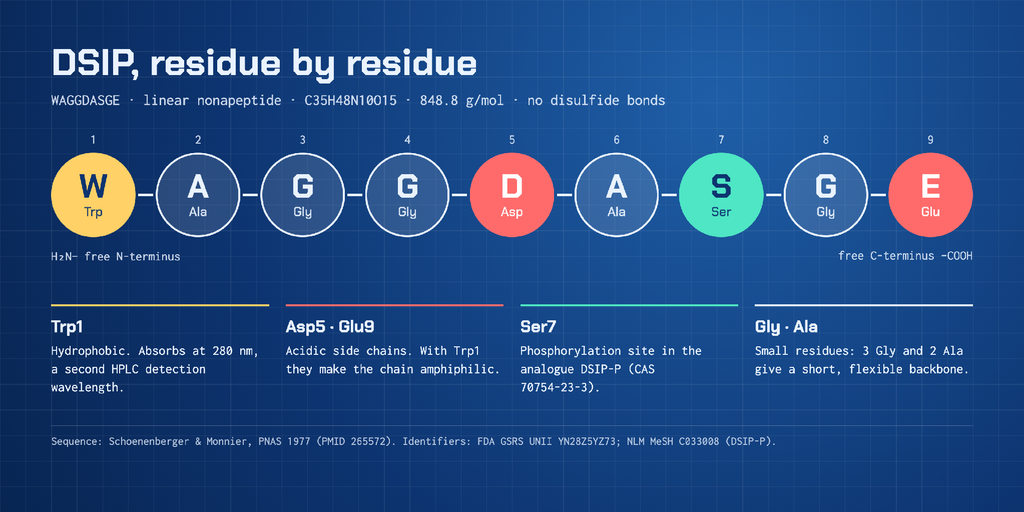
Residue map of DSIP, WAGGDASGE: Trp1 hydrophobic, Asp5 and Glu9 acidic, Ser7 the phosphorylation site in DSIP-P, plus three Gly and two Ala
Where the Name Comes From
The 1977 Basel paper (Schoenenberger and Monnier, PNAS, PMID 265572) named the peptide after the effect its authors were measuring, and the label stuck. Kovalzon and Strekalova’s 2006 review in the Journal of Neurochemistry titled DSIP “a still unresolved riddle”. They noted that its gene, precursor protein and receptor were never isolated. For lab records, the INN emideltide is the cleaner name.
DSIP vs “DSIP-Immunoreactive” Proteins
Antibodies raised against DSIP also bind unrelated proteins. In 1993, a team reported a 77-residue porcine protein with a leucine-zipper motif that a DSIP antiserum recognised (European Journal of Biochemistry, PMID 8375381). The matching gene, TSC22D3 (also called GILZ), carried the gene symbol DSIPI, “delta sleep inducing peptide, immunoreactor”, in the HGNC registry.
TSC22D3 belongs to the TSC22 protein family, and its only link to the nonapeptide is that antibody cross-reaction. Catalogue searches for “DSIP” can still return these proteins and their antibodies, so confirm the CAS, sequence and MW on the COA before ordering.
Emideltide Free Base vs Acetate: What’s in the Vial?
Quick answer: Emideltide comes as the free base or as an acetate salt, and the two forms have different formula weights. The same “5 mg” fill can therefore hold different amounts of actual peptide. The FDA’s 2026 briefing called both forms poorly characterised, which is why the COA’s identity and content results decide what a vial holds.
| Free base | Acetate | |
| What it is | Peptide only | Peptide plus acetate counter-ions |
| Formula | C35H48N10O15 | C35H48N10O15 · x(C2H4O2) |
| MW for calculations | 848.8 g/mol | 848.8 + 60 per acetate (908.8 with one) |
| CAS / UNII | 62568-57-4 / YN28Z5YZ73 | None listed in the FDA briefing |
| What to check on the COA | HPLC purity, mass, content | The same, plus counter-ion or net peptide content |
The confusion shows up in the FDA’s own files. According to the FDA briefing document on emideltide, one withdrawn nomination paired free-base identifiers with acetic-acid content testing on its certificate. Another certificate gave a molecular formula that, in the FDA’s words, “does not correspond to any emideltide structure.”
Two numbers on a COA sound alike and measure different things:
- Purity is the share of the HPLC peak area that belongs to DSIP. A high figure means few related impurities.
- Content is how many milligrams of peptide the vial holds. Counter-ions and residual water lower it. With one acetate per chain, 5 mg of salt carries about 4.67 mg of DSIP (848.8 ÷ 908.8).
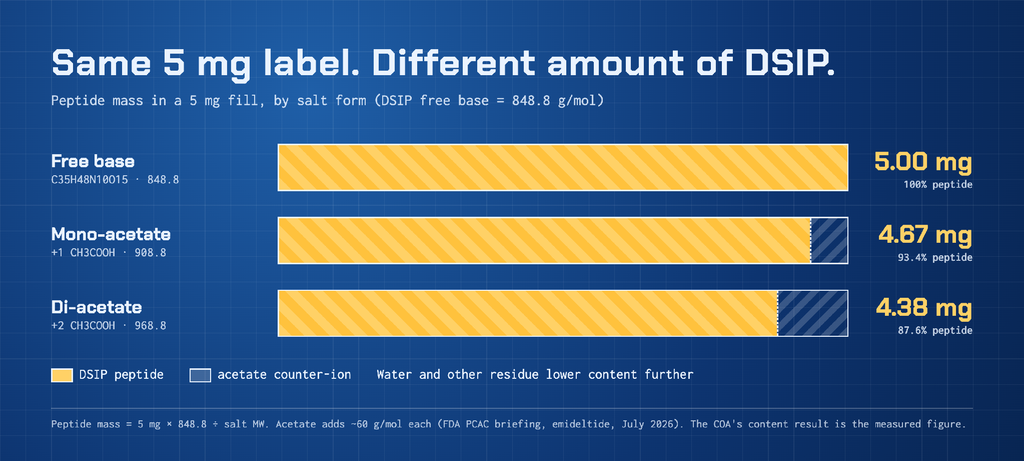
DSIP peptide mass in a 5 mg fill: 5.00 mg as free base, 4.67 mg as mono-acetate and 4.38 mg as di-acetate
The Cellugenix DSIP COA reports HPLC purity and checks content against the label. It doesn’t state the salt form yet. Because the salt form is still missing, HPLC purity vs mass-spec identity is the distinction to read first.
How Is DSIP Used in the Lab?
Quick answer: With no confirmed receptor, DSIP serves mainly as a well-characterised peptide for chemistry and analytical work. Labs use it in stability and degradation studies, as an HPLC and MS reference standard, in conformation studies, as an immunoassay antigen, in analogue chemistry and in receptor-binding preparations.
| Use | What labs measure |
| Stability and degradation | Peptidase cleavage in serum or plasma in vitro; half-life at 37 °C |
| Analytical reference | HPLC retention time, MS mass, impurity profile |
| Structure studies | Solution conformation by NMR; membrane-induced changes by CD |
| Immunoassay standards | Reference antigen; antibody-specificity checks |
| Analogue chemistry | DSIP-P, phosphorylated at Ser7 (CAS 70754-23-3), plus cyclic analogues |
| Receptor-binding work | No displacement of reference ligands in membrane binding assays; NMDA-receptor involvement reported in neuron preparations; no dedicated receptor |
Speed is the big handling issue. In Graf, Saegesser and Schoenenberger’s 1987 study in Peptides (PMID 3628078), DSIP broke down quickly in serum and plasma, releasing free tryptophan, while the phosphorylated analogue degraded more slowly. The FDA briefing summarises in-vitro serum half-lives at 37 °C of 10 minutes or less. Cold samples, protease inhibitors and a fast route to the HPLC keep that clock from skewing the results.
Is DSIP FDA-Approved? (2026 Regulatory Status)
Quick answer: No. Its status in one line: not an FDA-approved drug; not recommended for the 503A bulks list at the July 2026 PCAC meeting; sold for laboratory research only. FDA staff had advised against listing either form, and the committee’s vote on 24 July 2026 is advisory.
| Question | Status |
| FDA-approved? | No; neither form is a component of an approved drug |
| 503A bulks list (PCAC, 24 July 2026) | Not recommended; reported tally 6 yes, 7 no, 1 abstention (FDA minutes not yet posted) |
| FDA’s concerns | Free base and acetate poorly characterised · no USP/NF monograph · no approved drug · possible impurities and aggregation |
| What happens next | Any final listing decision goes through FDA rulemaking |
| Research sale | Research Use Only |
Emideltide was the one substance of seven that the committee turned down, after a two-day review listed on the FDA’s PCAC meeting page. The vote concerns pharmacy compounding. Laboratory reagents follow separate rules, which is what Research Use Only means.
DSIP Safety Data Sheet and GMP vs Research Grade
Quick answer: A DSIP safety data sheet covers lab handling of the lyophilized solid: hazards, protective equipment, spills, disposal and storage. Research-grade DSIP is made for laboratory use outside drug GMP, and the batch COA is its quality evidence. Treat the SDS as the handling document and the COA as the identity document.
What’s on a DSIP SDS?
A standard 16-section SDS for a peptide powder lists:
- Identification: product name, emideltide, CAS 62568-57-4
- Hazards: GHS classification, often “not classified” for small peptides
- Handling and storage: dust control, sealed containers, temperature
- Exposure controls: gloves, eye protection, lab coat
- Spills and disposal: sweep-up method and waste route
- Properties: appearance, formula, molecular weight
The DSIP product page doesn’t link an SDS at the moment. Request one from admin@cellugenixpeptides.io before the vial enters your chemical inventory.
Is Research DSIP GMP-Grade?
No. Drug GMP (21 CFR Parts 210 and 211) governs the manufacture of finished drugs. Research-grade DSIP is synthesised for laboratory use and documented batch by batch through its COA. A supplier claiming GMP should be able to show certification for that site and that product.
Storage of the Sealed Vial
Cellugenix ships DSIP as a lyophilized solid in a sealed vial. Store it sealed as stated on the label, protected from light and moisture. When the vial arrives, log the lot and report number (LK-DSIP-5-052226 for the current batch) beside its storage location, so every result traces back to one certificate. Temperature ranges are in the storage and handling guide.
How to Verify Research-Grade DSIP
Quick answer: A solid DSIP COA names DSIP or emideltide with the sequence WAGGDASGE, shows HPLC purity with a chromatogram, reports content against the label, gives a mass-spec identity near 848.8 and carries a report number that verifies on the lab’s own site. Each line closes a different gap.
- Name and sequence: DSIP or emideltide, WAGGDASGE
- Purity: HPLC result with the chromatogram attached
- Content: measured milligrams against the label claim
- Identity: a mass result near 848.8 (monoisotopic 848.33 Da)
- Salt form: free base or acetate, stated outright
- Traceability: a report number you can verify with the issuing lab
The current Cellugenix batch, LK-DSIP-5-052226, was tested by Testides on 26 May 2026 and covers steps 1, 2, 3 and 6. It has no MS result and no salt form. The full record is on the DSIP 5 mg COA page, and our walkthrough on how to read a COA covers each field.
Frequently Asked Questions
What is DSIP?
DSIP is a synthetic nonapeptide with the sequence WAGGDASGE, formula C35H48N10O15 and CAS 62568-57-4. Its INN is emideltide. A Basel group published the sequence in 1977. No dedicated receptor has been identified, so laboratories use it mainly as a characterised peptide for analytical, stability and structure work.
What is the amino acid sequence of DSIP?
DSIP reads Trp-Ala-Gly-Gly-Asp-Ala-Ser-Gly-Glu, or WAGGDASGE in one-letter code. The chain is linear, with a free amine on the N-terminal tryptophan and a free acid on the C-terminal glutamate. Serine 7 is the site used to make the phosphorylated analogue, DSIP-P.
What is emideltide?
Emideltide is the International Nonproprietary Name for DSIP. The FDA registers the free base as EMIDELTIDE, UNII YN28Z5YZ73, linked to CAS 62568-57-4 and PubChem CID 68816. Its 2026 briefing evaluated two related substances, emideltide free base and emideltide acetate, and treated them as distinct materials.
Is DSIP FDA-approved?
No. DSIP is not an FDA-approved drug and was not recommended for the 503A bulks list at the July 2026 PCAC meeting. FDA staff cited poor characterisation of both forms and the absence of a USP monograph. Suppliers sell it for laboratory research only, labelled Research Use Only.
What is the molecular weight of DSIP?
The free base weighs 848.8 g/mol, with a monoisotopic mass of 848.33 Da. Each acetate counter-ion adds about 60 g/mol, so a mono-acetate comes to roughly 908.8 g/mol. Calculations should use the form named on the COA, and mass-spec identity checks use the free-base value.
Is research DSIP GMP-grade?
No. Research-grade DSIP is made for laboratory use and isn’t produced under drug GMP, which covers finished-drug manufacturing. Its quality evidence is the batch certificate of analysis: HPLC purity, content against the label and, ideally, a mass-spec identity result. A GMP claim should come with site and product certification.
The Bottom Line
DSIP is a well-characterised nonapeptide carrying a historical, outcome-style name and no confirmed receptor. For a lab, the useful facts are the sequence, the salt form and the measured content, all of which belong on the certificate. Start with the DSIP 5 mg specification and COA before the vial joins your inventory.
For laboratory research use only. Not for human or animal use.
Sources
- PubChem. Emideltide, CID 68816 (National Library of Medicine).
- FDA Global Substance Registration System. Emideltide, UNII YN28Z5YZ73.
- FDA. Briefing Document, Emideltide-Related Bulk Drug Substances, Pharmacy Compounding Advisory Committee, July 23-24, 2026.
- Schoenenberger GA, Monnier M. Proc Natl Acad Sci USA, 1977; 74(3): 1282-1286. PMID 265572.
- Kovalzon VM, Strekalova TV. Journal of Neurochemistry, 2006; 97(2): 303-309. PMID 16539679.
- Graf MV, Saegesser B, Schoenenberger GA. Peptides, 1987; 8(4): 599-603. PMID 3628078.
- European Journal of Biochemistry, 1993. PMID 8375381.
- Biochemistry, 1994. PMID 8312250.
- HGNC. TSC22D3, HGNC:3051.
- NLM MeSH. DSIP-P, record C033008.
For laboratory research use only. Not for human or animal use.