Three separate batch files
GHK-Cu, BPC-157, and TB-500 each ship with independent paperwork.

$183.97
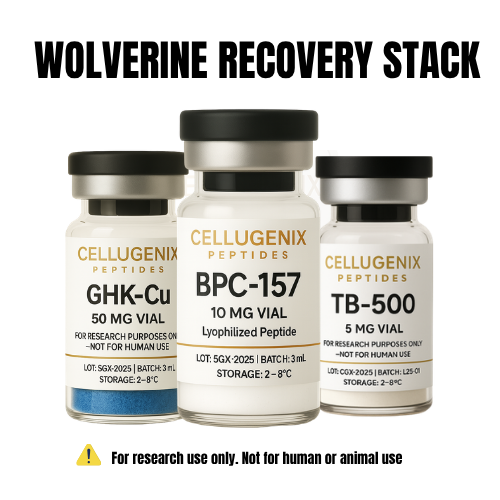
“Wolverine stack” is the name researchers gave BPC-157 and TB-500 after noticing how the two peptides cover complementary ground in tendon and ligament injury models, one acting locally, the other moving systemically. This bundle adds GHK-Cu as a third layer, aimed at the wound-closure and scar-quality side of the same injury site.
Specifications for each compound in the Wolverine Stack Research Bundle are listed individually below.
| Specification | GHK-Cu | BPC-157 | TB-500 |
|---|---|---|---|
| Compound | GHK-Cu | BPC-157 | TB-500 |
| Quantity | 50mg | 10mg | 5mg |
| Product format | Research-grade copper tripeptide complex | Research-grade pentadecapeptide | Research-grade synthetic peptide fragment |
| Intended use | Laboratory research only | Laboratory research only | Laboratory research only |
| Documentation | COA available through our COA library | COA available through our COA library | COA available through our COA library |
| Related category | Tissue & Matrix Research | Tissue & Matrix Research | Tissue & Matrix Research |
This bundle is sold only for scientific study by qualified professionals. Not for use in diagnostic or therapeutic procedures. Not for human or veterinary use.
Review the compliance section and each compound's storage guidance before submitting an order.
The name traces back to online research communities describing BPC-157 as the peptide studied for local angiogenesis and growth-factor signalling assays, while TB-500 is studied for actin sequestration in cell-migration assays. Both are studied side by side in cell-migration and collagen-organization assays.
GHK-Cu isn't part of the original nickname, but it covers a different assay area: as a copper-binding tripeptide, it is studied for fibroblast collagen-gene expression and matrix metalloproteinase regulation in cell assays, complementary to the cell-migration work the other two are studied in.
Each compound in this bundle is studied in a different assay area within the pairing.
Each of the three vials in this bundle carries independent batch documentation, so a lot can be verified on its own rather than through a single record covering the full set.
This bundle carries the same documentation approach applied across every listing in our catalog.
GHK-Cu, BPC-157, and TB-500 each ship with independent paperwork.
Identity and purity for every batch are verified by a third party.
None of the three compounds are marketed beyond laboratory use.
All three vials travel together under one tracking number.
Each vial is individually secured within the shipment.
A copper peptide and two structurally distinct repair peptides don't share one storage profile, so treat each vial according to its own guidance.
This bundle spans two categories across the Cellugenix catalog.
Reference pages for testing standards and ordering policy.
GHK-Cu at 50mg, BPC-157 at 10mg, and TB-500 at 5mg, each shipped as an individually documented vial.
It's an informal nickname used in research communities for the BPC-157 and TB-500 combination, not a formal scientific designation.
BPC-157 and TB-500 are studied in angiogenesis and cell-migration assays; GHK-Cu is studied for fibroblast collagen-gene expression, a different assay area.
No, they're studied as complementary rather than identical mechanisms. BPC-157 is described as acting locally through growth factor signaling, while TB-500 works systemically through actin regulation.
Yes, GHK-Cu, BPC-157, and TB-500 each have an independent batch record accessible through the COA library.
Have questions about quantities, delivery windows, or anything else before finalizing this order? Get in touch and our team will help you sort it out.
