BPC-157: Sequence, Identity and Laboratory Research
Few research peptides get requested as often as the BPC-157 peptide, and few get described as loosely online. For a lab, the useful facts are short: fifteen residues in a fixed order, a known mass, a salt form that changes that mass, and a certificate that should tie the vial to all three.
Below, you’ll find the peptide’s identifiers, the difference between its two salt forms, the pathways and assays labs use it in, where it stands with the FDA, how sealed vials are kept and what each batch certificate shows.
For Research Use Only. Not for use in diagnostic or therapeutic procedures.
In short: what is BPC-157?
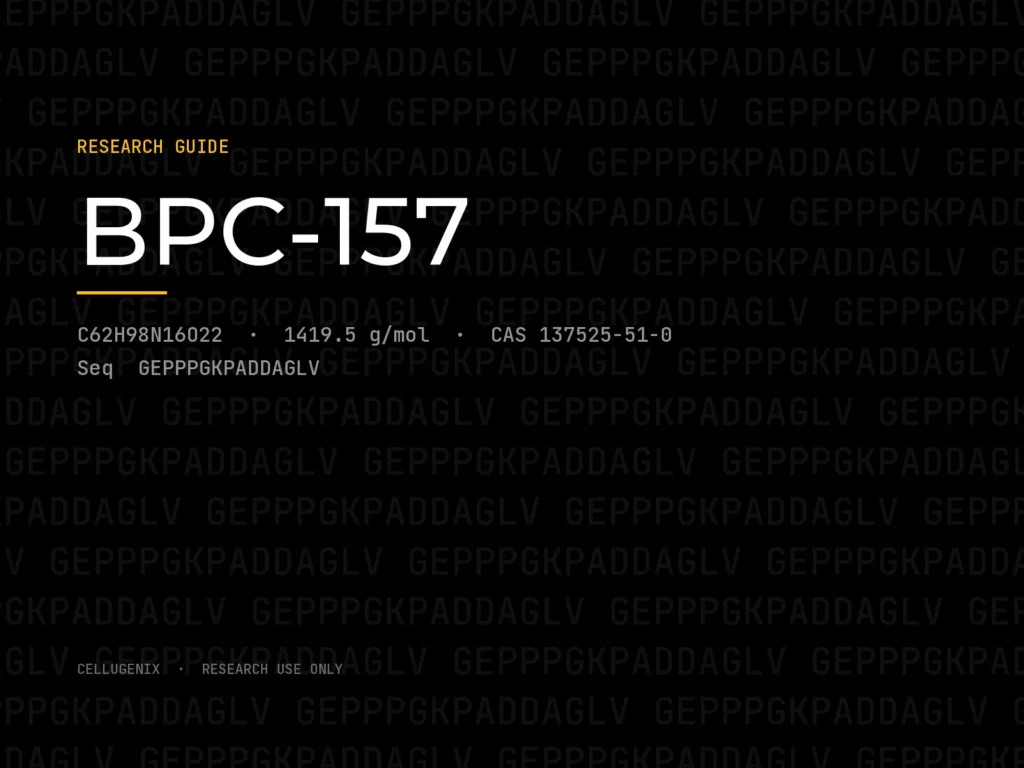
BPC-157 (PL 14736) is a synthetic peptide of 15 residues, Gly-Glu-Pro-Pro-Pro-Gly-Lys-Pro-Ala-Asp-Asp-Ala-Gly-Leu-Val, registered as CAS 137525-51-0 with the free-base formula C62H98N16O22 (1419.5 g/mol). In vitro, researchers examine it in VEGFR2, nitric-oxide and FAK-paxillin signaling assays and in cell-migration assays. Suppliers offer it as a free base or an acetate salt.
✓ 15 residues, 1419.5 g/mol as the free base
✓ Examined in VEGFR2, NO and FAK signaling assays
✓ A laboratory reagent with no FDA drug approval
Contents
- Identity at a glance
- What BPC-157 is
- Free base or acetate
- Pathways and assays
- FDA status
- Vial storage
- Certificate checks
- Related research peptides
- FAQs
BPC-157 at a Glance
Quick answer: BPC-157 is the pentadecapeptide GEPPPGKPADDAGLV, registered under CAS 137525-51-0 and listed in PubChem as CID 9941957. Its free-base formula is C62H98N16O22 with a molecular weight of 1419.5 g/mol, and acetate versions weigh more. Manufacturers build it on a solid-phase synthesizer. The table below gathers its technical information in one place.
| Field | Value |
| Sequence | Gly-Glu-Pro-Pro-Pro-Gly-Lys-Pro-Ala-Asp-Asp-Ala-Gly-Leu-Val (GEPPPGKPADDAGLV) |
| Other names | PL 14736, BPC 15, pentadecapeptide BPC-157 |
| Length | 15 amino acids |
| Molecular formula | C62H98N16O22 (free base) |
| Molecular weight | 1419.5 g/mol (free base); acetate is higher, see the COA |
| CAS number | 137525-51-0 |
| Forms | Free base; acetate salt |
| Synthesis | Solid-phase peptide synthesis |
| Studied pathways | VEGFR2, eNOS / nitric oxide, FAK-paxillin, ERK1/2 |
| Status | Unapproved as a drug; sold as a lab reagent |
| Cellugenix supply | 5 mg and 10 mg, lyophilized; current batch COAs 99.95% and Purity by HPLC by HPLC |
CAS numbers name one specific substance, and salt forms often carry registry entries of their own. PubChem’s compound record lists “Bpc 15” and “PL-14736” among the synonyms, along with separate entries for the free base and a trifluoroacetate. Batch figures for each size appear on the BPC-157 10 mg specification and COA, plus the BPC-157 5 mg listing.
What Is BPC-157?
Quick answer: A pentadecapeptide, BPC-157 consists of 15 amino acids in the order GEPPPGKPADDAGLV and also goes by the catalogue code PL 14736. Chemists assemble it one residue at a time on a resin support, and suppliers deliver it as a lyophilized solid, either as the free base or paired with acetate counter-ions.
Its sequence was drawn from a larger protein that Predrag Sikiric’s group described in the early 1990s. Every vial sold today is made from scratch by chemical synthesis, residue by residue on a resin bead.
That method has a famous pedigree. Robert Bruce Merrifield received the 1984 Nobel Prize in Chemistry “for his development of methodology for chemical synthesis on a solid matrix,” the technique behind most synthetic research peptides made today.
What Is BPC-157 Made Of?
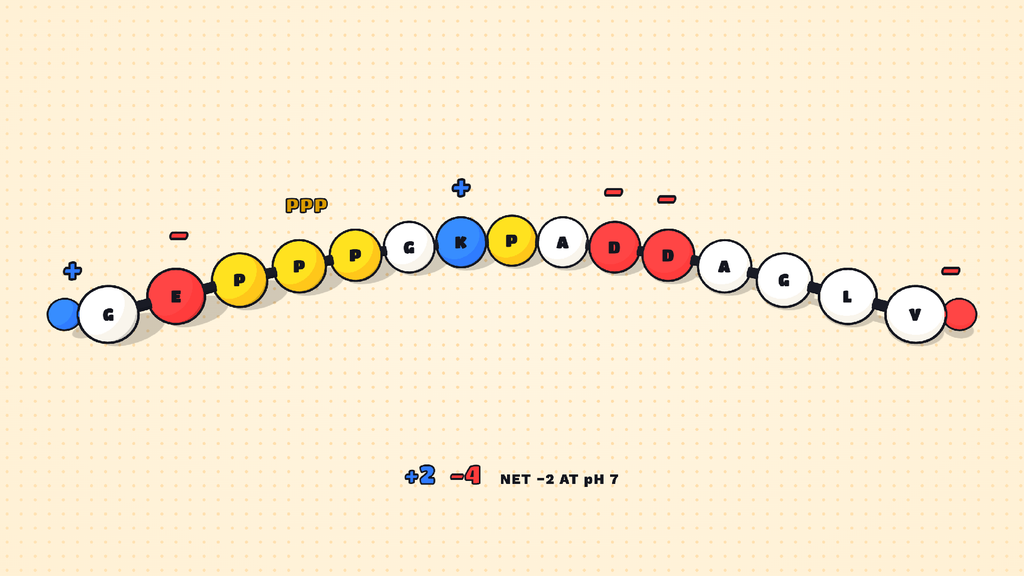
Fifteen standard L-amino acids, read from the N-terminus: glycine, glutamate, three prolines, glycine, lysine, proline, alanine, two aspartates, alanine, glycine, leucine and valine. Four of the fifteen are proline, three of them packed together at positions 3 to 5, which gives the front half of the chain a stiff, kinked shape. Lysine at position 7 is the only basic side chain, which keeps the number of salt-pairing sites in the next section small.
Is BPC-157 a GLP-1?
No, the 15-residue BPC-157 chain shares no sequence family with GLP-1, a peptide hormone of 30 to 31 residues. Labs don’t study it as a ligand for the GLP-1 receptor, and its published in-vitro work centers on VEGFR2, eNOS and focal-adhesion signaling.
BPC-157 Free Base vs Acetate: What’s the Difference?
Quick answer: BPC-157 free base and BPC-157 acetate carry the identical peptide. The acetate form holds acetate counter-ions picked up during purification, so its formula weight is higher and each milligram of powder holds a little less peptide. A label or COA should say which form the vial contains.
| Free base | Acetate salt | |
| Peptide | GEPPPGKPADDAGLV | Same |
| Counter-ion | None | Acetate |
| Formula weight | 1419.5 g/mol | Higher (depends on acetate content) |
| What the documents should show | Form named on the label; purity by HPLC; measured content | Form named on the label; purity by HPLC; measured content |
Each acetate adds about 60.05 g/mol, and BPC-157 carries two basic groups that can pair with one: the N-terminal amine and the lysine side chain. A fully paired diacetate would therefore weigh about 1539.6 g/mol, roughly 8% more than the free base, while real batches often land in between.
Some compounds also arrive as trifluoroacetate salts, a leftover of HPLC purification that PubChem records for BPC-157 too. Whichever salt is present, the form printed on the label decides which molecular weight a calculation should use.
Charge map of the 15-residue BPC-157 chain showing its basic and acidic sites
Which Signaling Pathways and Assays Is BPC-157 Studied In?
Quick answer: In-vitro BPC-157 studies mostly measure VEGFR2 phosphorylation, eNOS activation and nitric-oxide output, FAK-paxillin phosphorylation and ERK1/2 signaling. They run in endothelial cells such as HUVEC and in fibroblast cultures, with readouts from western blots, Griess assays, tube-formation assays and scratch or transwell migration assays.
| Pathway or target | What’s measured | Typical assay | Typical cell system |
| VEGFR2 | Receptor phosphorylation, internalization | Western blot, immunofluorescence | Endothelial cells (HUVEC) |
| eNOS / nitric oxide | eNOS phosphorylation, NO production | Western blot, Griess assay | Endothelial cells |
| FAK-paxillin | FAK and paxillin phosphorylation | Western blot | Fibroblast cultures |
| ERK1/2 | MAPK pathway activation | Western blot | Endothelial and fibroblast cells |
| Cell migration | Gap closure, cell spreading | Scratch assay, transwell migration | Fibroblast and endothelial cultures |
| Tube formation | Endothelial network formation in vitro | Matrigel tube-formation assay | HUVEC |
Each assay answers a narrow question in the dish. The Griess assay reads nitrite, a stable breakdown product, because nitric oxide itself lasts only moments; Nathan Bryan and Matthew Grisham’s 2007 methods review explains why labs track these metabolites.
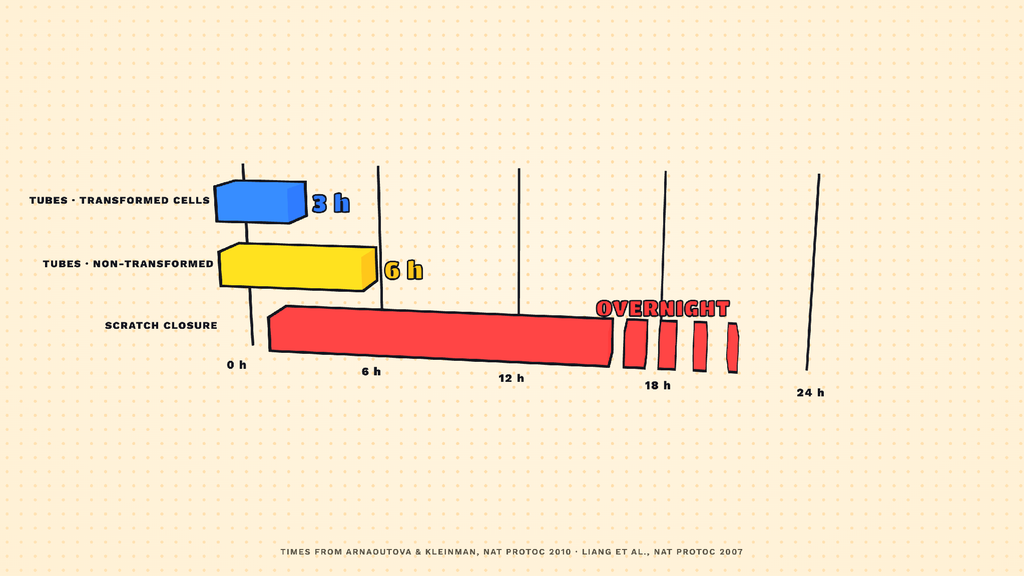
The scratch assay is the simplest of the migration tests. A pipette tip scrapes a straight gap across a cell monolayer, and the gap is photographed at intervals as cells move back in, a technique a University of Michigan team described in Nature Protocols as “an easy, low-cost and well-developed method to measure cell migration in vitro.”
Transwell migration adds direction to the picture. Cells rest on a porous membrane above a chamber holding the test condition, and the count of cells that cross to the underside after a set time gives the readout.
Western blots carry most of the signaling work in the table. Phospho-specific antibodies detect the activated form of VEGFR2, eNOS, FAK, paxillin, or ERK1/2, and labs normalize each band against the total protein to compare conditions fairly.
Tube formation reads a different behavior. Endothelial cells plated on gelled basement-membrane extract link into networks, which Irina Arnaoutova and Hynda Kleinman’s protocol calls “rapid, quantitative and reliable.”
Time bars showing how long tube-formation and scratch assays take to read out
No Single Defined Receptor
No receptor specific to BPC-157 has been identified so far. In-vitro studies therefore track what happens downstream, such as phosphorylation of VEGFR2, eNOS, FAK, paxillin, or ERK1/2, and treat those signals as the measurable footprint of the peptide in a given cell type. A binding study with labeled BPC-157 would be the direct route to a named partner, and published work hasn’t settled on one yet.
Is BPC-157 FDA-Approved?
Quick answer: The FDA has never cleared BPC-157 as a medicine. Cellugenix and other suppliers sell it to laboratories as a reagent for cell-culture and analytical work, with clear research-use-only labeling.
The research peptides and US law in 2026 explainer covers the US regulatory picture, while what Research Use Only means unpacks the meaning of the label.
Storage of the Sealed Vial
Quick answer: Cellugenix ships BPC-157 freeze-dried inside a sealed vial that carries its lot number. Keep the seal intact, shield the vial from light and damp, and follow the label for temperature. Shelf life for a sealed vial comes from the supplier and appears on that label.
For shelf-life questions, the conditions and any expiry information printed on the vial label are the reference. Temperature ranges for each product family are collected on one page, the storage and handling guide.
How to Verify Research-Grade BPC-157
Quick answer: Open the certificate for the size you hold. The 5 mg lot was tested by Canada Peptide Testing on September 27, 2026, at Purity by HPLC by HPLC-UV, and the 10 mg lot by Testides on May 26, 2026, at 99.32%. Each report number opens the original record at the issuing lab.
| Certificate field | BPC-157 5 mg | BPC-157 10 mg |
| Laboratory | Canada Peptide Testing | Testides |
| Report number | CPT-BPC157-DB0C43 | LK-BPC-10-052226 |
| Batch and lot | L25-01 · CGX-2025 | See certificate |
| Purity | 99.95% (HPLC-UV) | 99.32% (HPLC-UV) |
| Measured content | 5.00 mg | See certificate |
| Tested | September 27, 2026 | May 26, 2026 |
Both reports cover purity and content by HPLC-UV. A lab that wants mass confirmation can run LC-MS in-house, where the singly protonated ion should appear near m/z 1419.7 (from a monoisotopic mass of 1418.70) and the doubly charged ion near m/z 710.4.
Complete records are posted on the BPC-157 10 mg certificate and BPC-157 5 mg certificate pages. Field-by-field help is in how to read a COA, and for a comparison of the two analytical methods, consult HPLC vs mass spectrometry.
BPC-157 Alongside Other Research Peptides
Quick answer: BPC-157 is often supplied next to TB-500, KPV and GHK-Cu, yet the four sequences are unrelated. Each one is examined for a different in-vitro target: actin binding for TB-500, melanocortin-derived signaling for KPV and copper binding for GHK-Cu.
- KPV is the Lys-Pro-Val tripeptide from the end of alpha-MSH, covered in the KPV overview.
- GHK-Cu is a copper-carrying tripeptide, profiled in the GHK-Cu overview.
- TB-500 copies a short actin-binding region of thymosin beta-4, as the TB-500 overview explains.
- None of the three resembles BPC-157’s proline-rich chain. A BPC-157 + TB-500 mixture combines two of them in one vial.
Frequently Asked Questions
What is BPC-157?
BPC-157 is a synthetic pentadecapeptide, GEPPPGKPADDAGLV, also catalogued as PL 14736 and CAS 137525-51-0. Labs use it in cell-culture assays of VEGFR2, eNOS and FAK-paxillin signaling, and in scratch and tube-formation assays. It reaches buyers as a lyophilized free base or acetate salt with research-only labeling printed on each vial.
What is the sequence of BPC-157?
BPC-157 reads Gly-Glu-Pro-Pro-Pro-Gly-Lys-Pro-Ala-Asp-Asp-Ala-Gly-Leu-Val, or GEPPPGKPADDAGLV in one-letter code. That’s 15 residues with a free N-terminal amine and a free C-terminal carboxyl. The chain holds four prolines, one lysine and three acidic residues, a glutamate and two aspartates.
What is the molecular weight of BPC-157?
The free base, C62H98N16O22, weighs 1419.5 g/mol and has a monoisotopic mass of 1418.70. Acetate salts weigh more, up to about 1539.6 g/mol if both basic groups carry an acetate. The form printed on the label tells you which value applies.
What is the CAS number of BPC-157?
BPC-157’s CAS registry number is 137525-51-0. PubChem files the same compound under CID 9941957 and lists synonyms including PL-14736, Bpc 15 and BPC-157 free base. Matching the CAS number and sequence across a label, certificate and paper confirms they describe one molecule.
What is the difference between BPC-157 free base and acetate?
The peptide is identical in both. The acetate form carries acetate counter-ions from purification, so its formula weight is higher and slightly less of each milligram is peptide. Calculations must use the weight of whichever form is in the vial, so the label should name it.
Is BPC-157 FDA-approved?
No, BPC-157 has no approval from the FDA in any form. Cellugenix ships it only as a reagent for cell-culture and analytical work, and its research-use-only label applies to every lot.
The Bottom Line
Fifteen residues long, BPC-157 (GEPPPGKPADDAGLV) weighs 1419.5 g/mol as the free base and more as an acetate. In vitro, labs follow it through VEGFR2, nitric-oxide and FAK signaling and through migration and tube-formation assays. Each batch certificate reports purity by HPLC, and LC-MS can confirm the mass.
BPC-157 10 mg specification and COA
For Research Use Only. Not for use in diagnostic or therapeutic procedures.
Sources
- PubChem. BPC-157, CID 9941957 (National Library of Medicine).
- The Nobel Prize in Chemistry 1984, R. Bruce Merrifield (Nobel Foundation).
- Bryan NS, Grisham MB. Free Radical Biology and Medicine, 2007; 43(5): 645–657. PMID 17664129.
- Liang CC, Park AY, Guan JL. Nature Protocols, 2007; 2(2): 329–333. PMID 17406593.
- Arnaoutova I, Kleinman HK. Nature Protocols, 2010; 5(4): 628–635. PMID 20224563.
For Research Use Only. Not for use in diagnostic or therapeutic procedures.