GHK-Cu Copper Peptide: What It Is and What Research Shows (2026)
GHK-Cu is one of the smallest metal-binding peptides studied in biology. It was first described in 1973 after a plasma fraction changed protein output in cultured liver tissue, and later work traced that activity to a three-residue peptide with a strong grip on copper(II). Today it is used in laboratories as a copper-binding tool compound, from fibroblast cultures to protein crystallography.
Here you’ll find what GHK-Cu is, how it holds on to copper, the in-vitro assays it appears in, how it compares with other copper peptides, and how to check a research batch.
GHK-Cu from Cellugenix is sold only for in-vitro laboratory research and isn’t for human or veterinary use. What follows summarizes published laboratory studies.
Quick answer: What is GHK-Cu copper peptide?
GHK-Cu is a small complex of three amino acids (glycine, histidine and lysine) bound to a copper(II) ion. GHK was first isolated from human plasma and described in 1973. Researchers study it in copper-transport, matrix-signaling and gene-expression assays in cultured cells.
✓ A natural tripeptide bound to copper, which is why it’s blue
✓ Studied mainly in cell-culture, copper-binding and gene-expression assays
✓ Supplied as a lyophilized laboratory reagent for in-vitro research only
Contents
- GHK-Cu at a glance
- What is GHK-Cu?
- Mechanism of action
- What the research shows
- GHK-Cu vs AHK-Cu
- GHK-Cu in GLOW and KLOW
- How to verify a batch
- FAQs
GHK-Cu at a Glance
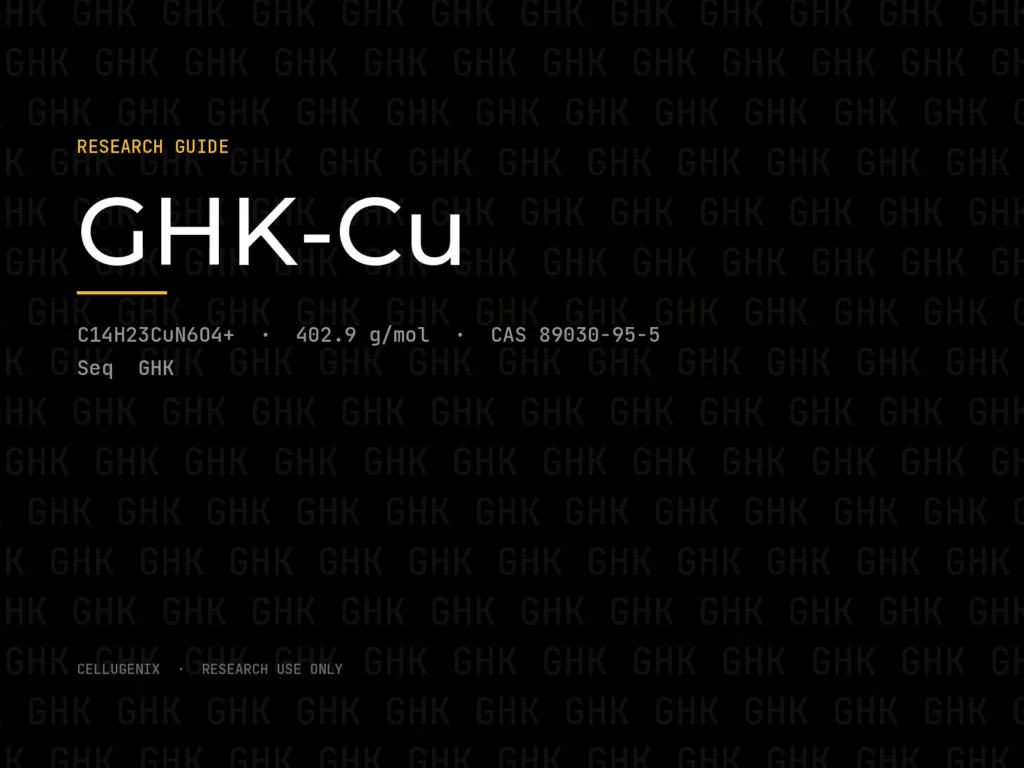
Quick answer: GHK-Cu is glycyl-L-histidyl-L-lysine bound to a single copper(II) ion. The free peptide weighs about 340.4 g/mol and the copper complex about 402.9 g/mol. It appears as a blue to violet-blue powder.
| GHK-Cu | |
| Full name | Glycyl-L-histidyl-L-lysine copper(II) complex |
| Also called | Copper peptide, copper tripeptide, Copper Tripeptide-1 (INCI) |
| Type | Tripeptide bound to one copper(II) ion |
| Origin | First isolated from human plasma samples (Loren Pickart, 1973) |
| Formula and molecular weight | GHK: C14H24N6O4, ~340.4 g/mol · GHK-Cu: C14H23CuN6O4+, ~402.9 g/mol |
| Appearance | Blue to violet-blue powder, colored by copper(II) |
| Main research areas | Copper transport, extracellular matrix signaling in cell culture, gene expression |
| Cellugenix | GHK-Cu 50 mg · batch COA 99.82% (HPLC) |
Something to note on the molecular weight: commercial material is often an acetate or other salt, so the figure printed on a certificate can be higher than 402.9. The salt form listed on the COA tells you which number applies. Batch details are on the GHK-Cu 50 mg specification and COA page.
What Is GHK-Cu Copper Peptide?
Quick answer: GHK-Cu is the copper complex of GHK, a three-residue peptide Loren Pickart pulled out of human plasma in 1973. He found it while studying why one plasma fraction changed how cultured liver tissue behaved. Later work traced the effect to GHK and its strong affinity for copper(II).
The discovery reads like a lab mystery, and it started with a simple comparison. Pickart compared plasma samples and added them to liver tissue in culture, and one fraction changed which proteins the tissue made. He chased that activity down to GHK, and later studies showed how tightly it grabs copper.
Research interest has continued, and a 2018 review by Pickart and Anna Margolina in the International Journal of Molecular Sciences summarized gene data “revealing multiple biochemical pathways regulated by GHK.”
Is GHK-Cu a Peptide?
Yes, GHK is a tripeptide: glycine, histidine and lysine linked end to end. GHK-Cu is that same peptide holding a copper(II) ion, which makes it a peptide-metal complex. Chemists sometimes call it a metallopeptide, and the copper changes its color, charge and behavior in solution.
What’s the Difference Between GHK and GHK-Cu?
GHK is the free tripeptide, a white to off-white solid with no metal attached. GHK-Cu is the same peptide with copper(II) bound, which turns it blue. Most published studies use the copper complex, because the copper-binding step is central to how GHK is thought to work. The two names describe one peptide in two states, and labels should state which one a vial holds.
How Does GHK-Cu Work? Mechanism of Action
Quick answer: The GHK-Cu mechanism is thought to run two ways. As a carrier, it binds copper tightly and can deliver it to cells, where copper is a cofactor for enzymes such as lysyl oxidase, which cross-links collagen and elastin. As a signal, GHK has been linked to changes in the expression of many genes in cell studies.
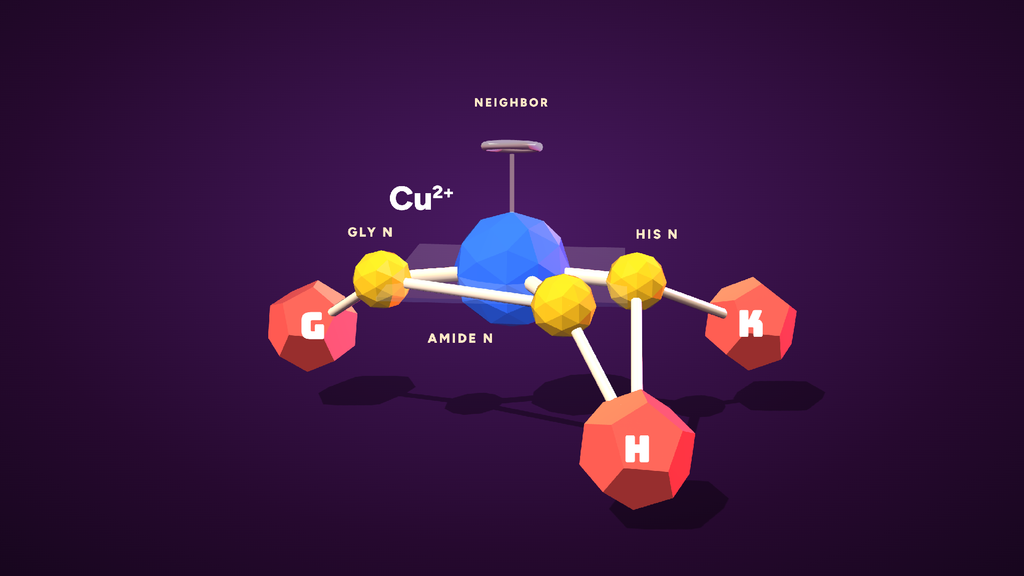
GHK tripeptide holding a copper(II) ion through three nitrogen atoms
How GHK Binds Copper
Three nitrogen atoms do the binding: the amino nitrogen of glycine, the nitrogen of the glycine-histidine peptide bond (which gives up a proton to bind) and a nitrogen in histidine’s imidazole ring. Together they form a flat platform around the copper, and neighboring molecules can fill the remaining positions. That grip is strong enough for GHK to compete with albumin, the main copper-carrying protein in plasma, for copper(II).
Copper, Lysyl Oxidase and Collagen
Lysyl oxidase is a copper-dependent enzyme. It links collagen and elastin fibers into a stable mesh, and without copper it can’t work. Because GHK carries copper into cells, researchers link it to this step, and cell studies have recorded more collagen and glycosaminoglycan output from fibroblasts treated with GHK-Cu. Those results come from cultured cells, and they trace a pathway from copper delivery to enzyme activity in a dish.
GHK and Gene Expression
The broadest finding comes from data analysis. The Broad Institute’s Connectivity Map stores how thousands of compounds change gene activity in human cell lines, and GHK is one of them. Pickart and Margolina’s 2018 review reports that GHK was associated with a change of 50% or more in 31.2% of the human genes measured.
The review groups the affected genes into pathways, including the proteasome system that clears damaged proteins and several DNA repair routes. Those numbers describe expression patterns in cultured cells. They suggest which pathways GHK touches, and each one still needs its own experiment to confirm what happens downstream. In practice, the Connectivity Map gives researchers a list of leads to test.
Why Is GHK-Cu Blue?
Copper(II) complexes absorb light at the red-orange end of the spectrum, so the light left over looks blue. GHK-Cu powder and solutions range from sky blue to violet-blue. A research batch that looks white or colorless suggests the copper isn’t bound, which makes color a quick first identity check before reading the COA.
What Does GHK-Cu Research Show?
Quick answer: Most GHK-Cu laboratory work is cell-based: matrix synthesis in fibroblast cultures, copper binding and transport, antioxidant enzyme assays and gene-expression analysis. It is also used outside biology as a copper-binding tag in protein crystallography.
- Fibroblast cultures: collagen and glycosaminoglycan synthesis
- Copper binding and transport: affinity measurements against albumin and other copper carriers
- Gene expression: Connectivity Map and transcriptomic profiling in human cell lines
- Antioxidant enzyme assays: copper-dependent enzyme activity in cell-free and cell systems
- Structural biology: GHK as a copper-binding tag for X-ray crystallography
GHK has also found a job far from biology labs, described in a protein crystallography research paper. In 2020, a team at the Max Planck Institute for Biophysical Chemistry fused GHK to proteins as a copper-binding tag for X-ray crystallography. Writing in Acta Crystallographica Section D, they called it “a convenient way of both crystallizing and phasing macromolecular structures.” The same copper grip that interests biologists helps structural biologists solve protein shapes.
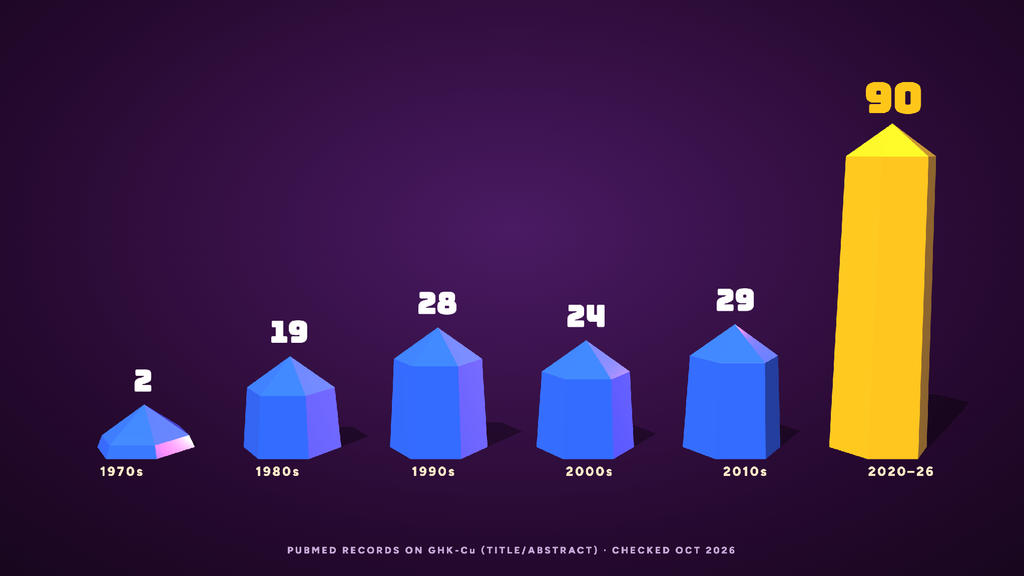
PubMed records on GHK-Cu by decade, 1970s to 2020s
GHK-Cu vs AHK-Cu and Other Copper Peptides
Quick answer: GHK-Cu is the best-studied copper peptide, and it has close relatives. AHK-Cu swaps glycine for alanine and has a much smaller published literature.
| GHK-Cu | AHK-Cu | |
| Sequence | Gly-His-Lys + Cu | Ala-His-Lys + Cu |
| Origin | Natural (first isolated from plasma) | Synthetic analog |
| Main research focus | Copper transport, matrix signaling in cell culture, gene expression | Smaller set of cell studies |
| Evidence base | Largest | Small |
The swap is a single amino acid at the start of the chain, and both peptides keep the histidine that anchors the copper.
For researchers, the comparison has a practical side. GHK-Cu has decades of published data to compare results against, while AHK-Cu work rests on a much smaller set of papers. Picking the better-documented compound makes it easier to place a new result in context. Both complexes are blue for the same reason, so color can’t tell them apart, and the compound name and sequence on the COA do that job.
GHK-Cu in GLOW and KLOW Research Blends
Quick answer: GHK-Cu is the main component of two multi-peptide research blends. GLOW combines GHK-Cu with BPC-157 and TB-500, and KLOW adds KPV to the same three. Both are supplied for laboratory research, each as one sealed vial with one lot number.
| Blend | Components |
| GLOW | GHK-Cu, BPC-157, TB-500 |
| KLOW | GHK-Cu, BPC-157, TB-500, KPV |
Each component has its own research history. KPV (Lys-Pro-Val) is the last three residues of alpha-MSH, used in NF-kB signaling assays, and BPC-157 and TB-500 are compared in our BPC-157 vs TB-500 guide. Blend certificates report HPLC purity and content for the vial as a whole, and each product page lists the components. Full specifications are on the GLOW 70 mg blend specification, KLOW 80 mg blend specification and KPV pages.
How to Verify Research-Grade GHK-Cu
Quick answer: Start with the batch-specific COA and confirm the HPLC purity figure and the method used. Check that the product and batch match the vial, and that the report names who ran it and when. Then look at the powder itself: genuine GHK-Cu is blue, and a colorless sample suggests the copper isn’t bound.
Use this five-point checklist to verify the quality and authenticity of your research-grade GHK-Cu:
- Product and batch: the COA names GHK-Cu and matches the vial you received
- HPLC purity: a percentage tied to a named method (the current Cellugenix GHK-Cu 50 mg report shows 99.82%)
- Lab and date: who ran the test, and when
- Appearance: blue to violet-blue lyophilized powder
- Storage: sealed, protected from light and moisture, as the label states
Cellugenix posts third-party reports in a public COA library you can search by compound, and the current report is on the GHK-Cu batch COA page. For help reading each line, see how to read a peptide COA, and for the difference between HPLC purity testing and LC-MS identity testing, see HPLC vs mass spectrometry.
Handling details are in our guide to peptide storage and handling. Saving the report alongside the experiment record means anyone repeating the work later can see exactly which lot was used.
Frequently Asked Questions
Is GHK-Cu an endogenous peptide?
Yes, GHK is endogenous: Loren Pickart first isolated it from human plasma samples in 1973, where it occurs bound to copper(II). The research-grade compound sold for laboratory study is synthesized to match that natural sequence, glycyl-L-histidyl-L-lysine, with copper bound to it.
What does GHK stand for?
GHK uses the one-letter codes for its three amino acids: G for glycine, H for histidine and K for lysine. The full chemical name is glycyl-L-histidyl-L-lysine. Adding “-Cu” shows that a copper(II) ion is bound to the peptide.
Is GHK-Cu in KLOW?
Yes, KLOW is a four-component research blend of GHK-Cu, BPC-157, TB-500 and KPV. GLOW holds the first three without KPV. Each blend’s product page lists its components, and the batch COA is published or available on request for the current lot.
Why is research-grade GHK-Cu blue?
The color comes from the copper(II) ion. Copper(II) complexes absorb red-orange light, so the powder looks blue to violet-blue. Free GHK without copper is white, so a pale or colorless research batch suggests the copper isn’t bound. Color is a quick check that comes before reading the COA.
How should lyophilized GHK-Cu be stored?
Store the vial sealed and protected from light and moisture, as its label states. Moisture is the main threat to lyophilized powder, so the vial stays closed until the moment it’s needed. Our peptide storage and handling page has the rest of the handling notes.
The Bottom Line
GHK-Cu is a natural tripeptide that grips copper(II) tightly, with a large body of cell-based research on copper transport, matrix signaling and gene expression, and a separate role as a crystallography tag. At Cellugenix, every vial ships as an in-vitro laboratory reagent with a published third-party certificate.
Browse Cellugenix’s structure and matrix research peptides
Sources
- Pickart L, Margolina A. International Journal of Molecular Sciences, 2018; 19(7): 1987. PMID 29986520.
- Mehr A et al. Acta Crystallographica Section D, 2020; 76: 1222–1232. PMID 33263328.
- Broad Institute. Connectivity Map.
For Research Use Only. Not for use in diagnostic or therapeutic procedures.