TB-500: Thymosin Beta-4 Fragment, Identity and Laboratory Research
“TB-500” is one of the most searched research peptide names, but suppliers don’t all use it for the same molecule. A seven-residue fragment and a 43-residue protein can both turn up under that label, and their masses differ more than fivefold. For a lab, the first job is pinning down which molecule is in the vial.
This guide covers the TB-500 peptide’s sequence, its masses, how the parent protein holds actin in vitro, the assays that use it, its FDA status, storage, and certificate checks.
For Research Use Only. Not for use in diagnostic or therapeutic procedures.
In short: what is TB-500?
TB-500 is a synthetic peptide based on thymosin beta-4 (Tβ4), a 43-residue protein found in most cell types. It copies the short region of Tβ4 that binds actin. Suppliers usually describe it as the acetylated fragment Ac-LKKTETQ, residues 17-23. In vitro, it appears in G-actin binding, actin polymerization and cell-migration assays.
✓ A seven-residue piece of thymosin beta-4, far smaller than the full protein
✓ Check the mass: the name covers more than one preparation
✓ A lab reagent the FDA has never approved as a medicine
Contents
1. TB-500 at a glance
2. What TB-500 is
3. TB-500 vs thymosin beta-4
4. Assays
5. FDA status
6. Vial storage
7. Verifying a lot
8. Other research peptides
9. FAQs
TB-500 at a Glance
Quick answer: TB-500 is usually sold as Ac-LKKTETQ, a seven-residue peptide copied from residues 17-23 of thymosin beta-4. Its free-base formula works out to C38H68N10O14, with an average mass near 889 Da, while full-length Tβ4 weighs about 4,963 Da. The table below collects the identifiers a lab needs before ordering or logging a lot.
| Field | Value |
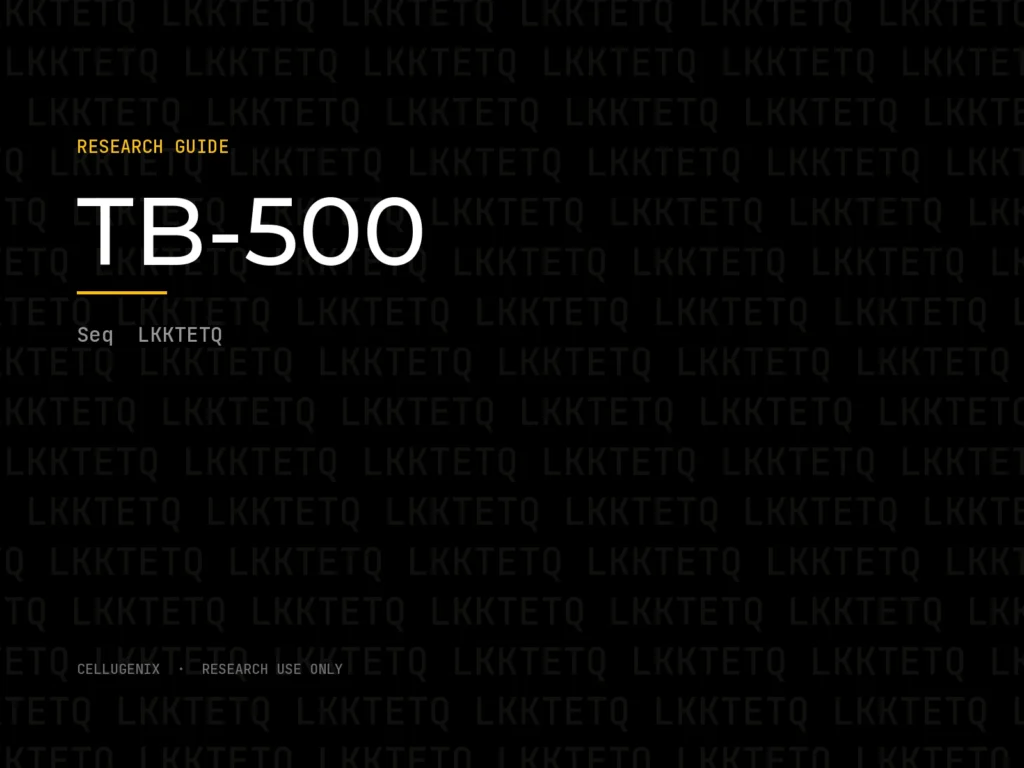
| Sequence (as supplied) | Ac-Leu-Lys-Lys-Thr-Glu-Thr-Gln (Ac-LKKTETQ) |
| Parent protein | Thymosin beta-4 (43 residues) |
| Position in parent | Residues 17-23 (the actin-binding motif) |
| Other names | Thymosin beta-4 fragment, Tβ4 (17-23) |
| Expected mass | Ac-LKKTETQ fragment ~889 Da (C38H68N10O14) · full-length Tβ4 ~4,963 Da |
| Forms | Free base; acetate salt |
| Studied in | G-actin binding, actin polymerization, cell-migration and endothelial assays |
| Status | Not an FDA-approved drug; research reagent |
| Cellugenix supply | TB-500 5 mg, lyophilized; current lot 4.98 mg measured content (99.6% of label); Purity by HPLC by HPLC-UV |
Both mass figures come from adding up residue masses. The fragment’s value includes an acetyl cap of about 42 Da on the N-terminal leucine. The protein’s value follows the 43-residue chain in UniProt entry P62328, which records that the starting methionine is cleaved off and the serine left at position 1 carries an acetyl group. Current batch data is on the TB-500 5 mg specification and COA page.
What Is TB-500?
Quick answer: TB-500 is a short synthetic peptide based on the actin-binding motif of thymosin beta-4. The motif, LKKTETQ at residues 17-23, belongs to the stretch of Tβ4 that contacts monomeric (G-) actin. Most suppliers describe TB-500 as this seven-residue sequence with an acetyl group capping its N-terminus.
Thymosin beta-4 was first characterized in the early 1980s from thymosin fraction 5, a mixture of small peptides, and has since been found in most cell types examined. Ten years later, Daniel Safer, Marshall Elzinga and Vivianne Nachmias reported in the Journal of Biological Chemistry that an actin-sequestering peptide called Fx was the very same molecule. They described authentic Tβ4 as “forming a 1:1 complex with actin monomers and inhibiting polymerization.”
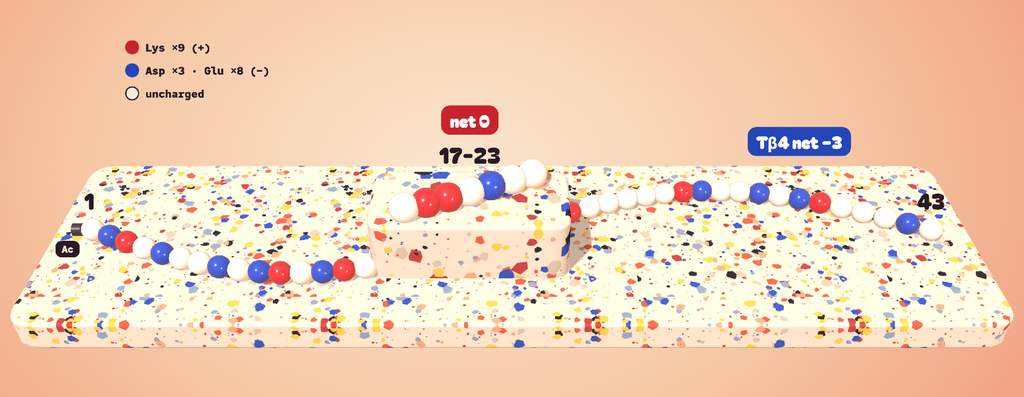
Fragment’s 1+ and 2+ ions beside full Tβ4’s 3+ to 7+ ions
What Does TB-500 Bind?
In vitro, the target is G-actin, the single-subunit form of actin. Full-length Tβ4 works as a G-actin-sequestering protein, holding monomers so they can’t add onto growing filaments, and the LKKTETQ stretch forms part of its contact surface. How closely the fragment alone matches it is covered under assays.
Is TB-500 the Same as Thymosin Alpha-1?
No. Thymosin alpha-1 is a separate 28-residue peptide with an unrelated sequence. Both names come from the same early peptide mixture, which is the only link, so a certificate or paper about one tells you nothing about the other.
Is TB-500 the Same as Thymosin Beta-4?
Quick answer: No. Thymosin beta-4 is the full 43-residue protein, and TB-500 usually means a synthetic seven-residue fragment of it, Ac-LKKTETQ. Because the name has no standard definition, some products sold as “TB-500” hold longer Tβ4 fragments or the whole protein. A mass measurement is the one reliable way to tell these apart.
| TB-500 (Ac-LKKTETQ) | Full-length thymosin beta-4 | |
| Length | 7 residues | 43 residues |
| Expected mass | ~889 Da | ~4,963 Da |
| Relationship | Fragment (residues 17-23) | Parent protein |
| N-terminus | Acetylated | Acetylated Ser1 |
| Mass to expect in an LC-MS check | Near ~889 Da | Near ~4,963 Da |
No registry entry links the TB-500 name to a single structure. Over the years the label has been applied to the acetylated heptapeptide, to longer synthetic pieces of Tβ4 and to full-length material, and listings rarely say which. An HPLC trace can’t settle it alone, because one clean peak proves there’s one main compound and leaves its identity open.
Mass settles it quickly. Full-length Tβ4 outweighs the fragment by more than 4,000 Da, a gap no counter-ion could account for. Every acetate counter-ion brings roughly 60 Da, and the fragment has only two lysines to pair with, so even a fully salted batch stays near 1,009 Da.
Mass spectrometry flags smaller errors as well. A batch missing its acetyl cap reads about 42 Da light, and a single deleted residue removes between 101 and 129 Da, depending on which amino acid dropped out during synthesis.
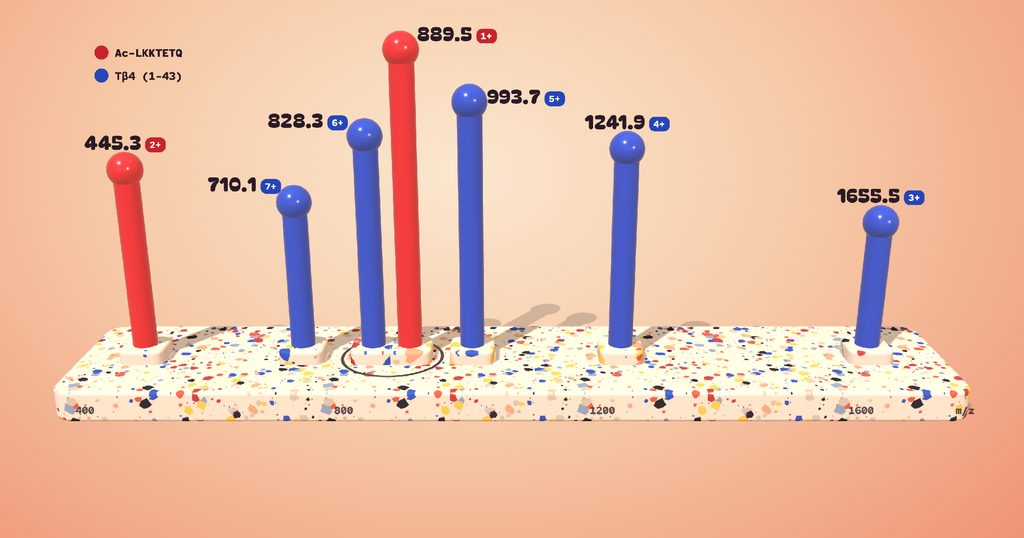
43-bead charge chain
Which Assays Is TB-500 Used In?
Quick answer: TB-500 and thymosin beta-4 appear mainly in actin biochemistry and cell-motility work. The standard set covers G-actin binding, actin polymerization measured by pyrene-actin or DNase I inhibition assays, cytoskeleton imaging, and cell-migration and endothelial tube-formation assays run in culture.
| Assay | What it measures | Typical readout |
| G-actin binding | Peptide binding to monomeric actin | Fluorescence, co-sedimentation |
| Actin polymerization (pyrene-actin) | Rate and extent of F-actin formation | Pyrene fluorescence over time |
| DNase I inhibition assay | Free G-actin available | DNase I activity |
| Cytoskeleton imaging | F-actin organization in cultured cells | Phalloidin staining, microscopy |
| Cell migration | Cell movement in culture | Scratch (gap-closure) assay, transwell |
| Endothelial tube formation | Network formation in vitro | Matrigel tube-formation assay (HUVEC) |
Pyrene-actin assays follow polymerization as it happens. Actin tagged with pyrene fluoresces far more brightly once the subunit is built into a filament, so the signal climbs as F-actin forms. John Cooper, Sharon Walker and Thomas Pollard validated the method in 1983 and concluded that “pyrene actin fluorescence is a valid assay for actin polymerization.” A sequestering protein slows and lowers that curve, because fewer free monomers are left to extend filaments.
The DNase I inhibition assay counts free monomer by a different route. G-actin binds deoxyribonuclease I and blocks its activity, so the loss of enzyme activity reports how much monomer a sample holds. Ingrid Blikstad and colleagues described the test in Cell in 1978, showing that in mixtures of the two forms only monomeric actin registers as an inhibitor.
In co-sedimentation, a high-speed spin pellets filaments, and peptide left in the supernatant beside unpolymerized actin is measured on a gel. Fluorescent phalloidin binds F-actin and outlines filament organization in fixed cells, while gap-closure and transwell counts score movement, and HUVEC plated on Matrigel are scored for the networks they build.
Fragment vs Full Protein in Assays
Much of the actin literature uses full-length Tβ4. A 2004 crystal structure from Robert Robinson’s group at Uppsala University showed that Tβ4 holds actin “by capping both ends of the actin monomer,” a contact that spans far more than seven residues. Findings for the protein don’t carry over to Ac-LKKTETQ automatically, so each study should name the exact molecule and mass it tested.
Is TB-500 FDA-Approved?
Quick answer: No. The FDA hasn’t approved TB-500 as a drug for any use. It’s sold as a laboratory reagent for in-vitro work and labeled “For Research Use Only. Not for use in diagnostic or therapeutic procedures.”
The research peptides and US law in 2026 guide covers the US regulatory picture, and what Research Use Only means covers the wording printed on each label.
Storage of the Sealed Vial
TB-500 ships from Cellugenix freeze-dried, sealed in a vial printed with its lot number. Store it closed, dry, and dark, and hold it at the temperature stated on its label. For assay preparation, the peptide is soluble in water or DMSO. Temperature ranges for every product family appear in our storage and handling guide.
How to Verify Research-Grade TB-500
Quick answer: Open the batch-specific certificate first. For the current TB-500 5 mg lot, Canada Peptide Testing reports Purity by HPLC by HPLC-UV and 4.98 mg measured content against a 5.00 mg label, under report CPT-TB500-72578C, tested September 28, 2026. The report number links straight to the lab’s original record online.
Work through these fields in order:
1. Lot number matches the vial. The current lot is batch L25-01, lot CGX-2025.
2. HPLC purity and method. This lot reads 99.26% by HPLC-UV.
3. Measured content vs label. 4.98 mg found, 99.6% of the 5.00 mg stated.
4. Testing lab, report number and verification link. Canada Peptide Testing, CPT-TB500-72578C, reported October 2, 2026, with a verify link to the lab’s record.
5. Salt form stated. The form tells you which molecular weight belongs in any calculation.
6. Optional in-house LC-MS check. Expect a mass near 889 Da for Ac-LKKTETQ and a far higher one for longer Tβ4 material.
The full report is on the TB-500 5 mg certificate page. For a field-by-field walkthrough, try how to read a COA, and for what each technique detects, check HPLC vs mass spectrometry.
TB-500 Alongside Other Research Peptides
Quick answer: TB-500 is often supplied alongside BPC-157, yet the two sequences are unrelated and studied for different in-vitro targets: TB-500 for actin binding, BPC-157 for VEGFR2, FAK and nitric-oxide pathways. Neither one can stand in for the other in an assay.
BPC-157 is a 15-residue, proline-heavy chain with a free N-terminus, profiled in BPC-157 sequence and identity, and it shares no stretch of sequence with Ac-LKKTETQ. The BPC-157 + TB-500 mixture combines both compounds in one vial, so any assay using it has two molecules to account for.
Frequently Asked Questions
What is TB-500?
TB-500 is a lab-made peptide that copies thymosin beta-4’s actin-contact motif. Most suppliers define it as Ac-LKKTETQ, a seven-residue chain with an acetylated N-terminus and an average mass near 889 Da. Labs use it in G-actin binding, pyrene-actin polymerization, and cell-migration assays, and it’s sold only as a research reagent.
Is TB-500 the same as thymosin beta-4?
No. Thymosin beta-4 is a 43-residue protein of about 4,963 Da, while TB-500 normally refers to its residues 17-23, about 889 Da once acetylated. Some products labeled TB-500 contain longer pieces or the full protein, so a mass reading is the dependable way to confirm which molecule a vial holds.
Is TB-500 the same as Thymosin Alpha-1?
No. Thymosin alpha-1 is a 28-residue acetylated peptide with its own sequence, Ac-SDAAVDTSSEITTKDLKEKKEVVEEAEN, and no overlap with LKKTETQ. Both names trace back to thymosin fraction 5, the peptide mixture where each was first found, which explains the shared word. Data and certificates for one never apply to the other.
What is the molecular weight of TB-500?
For Ac-LKKTETQ, the free base (C38H68N10O14) has an average molecular weight of about 889 Da. Full-length thymosin beta-4 comes to roughly 4,963 Da. Acetate salts of the fragment weigh a little more, up to about 1,009 Da with both lysines paired, so the stated form and a measured mass decide which value applies.
What is the sequence of TB-500?
TB-500 reads Ac-Leu-Lys-Lys-Thr-Glu-Thr-Gln, or Ac-LKKTETQ in one-letter code. Those seven residues match positions 17 to 23 of mature thymosin beta-4, counted from the acetylated serine that opens the protein once its starting methionine is removed. The motif falls inside the central actin-binding stretch of the protein.
Is TB-500 FDA-approved?
No. The FDA has never approved TB-500 as a medicine, and Cellugenix supplies it solely as a lab reagent labeled for research use.
The Bottom Line
TB-500 usually means Ac-LKKTETQ, the actin-binding fragment of thymosin beta-4, studied in actin polymerization and cell-motility assays. The name stretches across more than one preparation, so pair the batch COA’s HPLC purity and content with a mass check that confirms which molecule is in the vial.
TB-500 5 mg specification and COA
For Research Use Only. Not for use in diagnostic or therapeutic procedures.
Sources
- UniProt. Thymosin beta-4, entry P62328 (UniProt Consortium).
- Safer D, Elzinga M, Nachmias VT. Journal of Biological Chemistry, 1991; 266(7): 4029-4032. PMID 1999398.
- Cooper JA, Walker SB, Pollard TD. Journal of Muscle Research and Cell Motility, 1983; 4(2): 253-262. PMID 6863518.
- Blikstad I, Markey F, Carlsson L, Persson T, Lindberg U. Cell, 1978; 15(3): 935-943. PMID 728995.
- Irobi E, Aguda AH, Larsson M, et al. EMBO Journal, 2004; 23(18): 3599-3608. PMID 15329672.
For Research Use Only. Not for use in diagnostic or therapeutic procedures.