5-Amino-1MQ Research Overview: Structure, Salt Forms and NNMT Enzyme Assays
Most vendors list 5-Amino-1MQ beside BPC-157 and TB-500, so plenty of buyers assume it’s a peptide. It’s actually a small quinolinium molecule with one ring system and a single positive charge. Labs use it as a nicotinamide N-methyltransferase (NNMT) inhibitor in enzyme and cell assays.
That positive charge explains the most common mix-up around this compound: two molecular weights that both look correct. This guide walks through the structure, the salt forms, the enzyme, the assays, the regulatory position and what a certificate should show. It’s written for the bench, so every result below is labelled by study type: enzyme assay, cell-free membrane model or cultured cells. Cellugenix supplies 5-Amino-1MQ as a laboratory reagent in 5 mg and 50 mg vials.
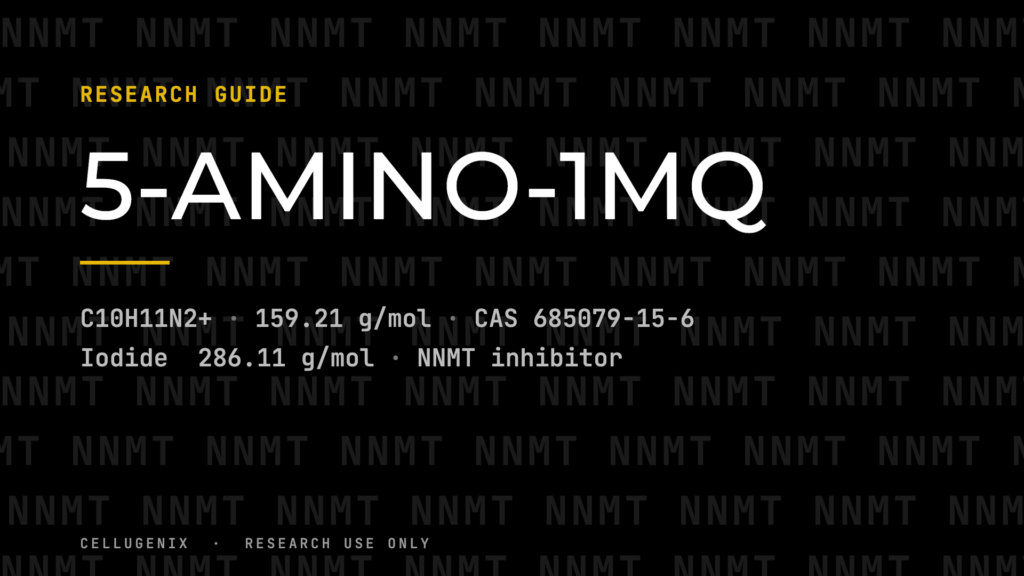
| Quick answer: what is 5-Amino-1MQ?5-Amino-1MQ (5-amino-1-methylquinolinium) is a synthetic small molecule with no amino-acid chain. Its cation is C10H11N2+ (159.21 g/mol), and it’s usually supplied as the iodide salt (C10H11IN2, 286.11 g/mol). In enzyme assays it inhibits nicotinamide N-methyltransferase (NNMT), which makes it a reference inhibitor for NNMT research.✓ One quinoline ring system✓ Two molecular weights: 159.21 (cation) and 286.11 (iodide)✓ A research reagent with no FDA approval |
5-Amino-1MQ at a Glance
5-Amino-1MQ is a quinolinium cation that labs buy as a salt and use against one enzyme, NNMT. The identifiers below come from PubChem CID 950107 and the Sigma-Aldrich SML2832 listing. The Cellugenix lines come from each batch certificate.
| Field | Value |
| , – | , – |
| Chemical name | 5-amino-1-methylquinolin-1-ium (PubChem: 1-methylquinolin-1-ium-5-amine) |
| Class | Quinolinium small molecule |
| Cation | C10H11N2+ · 159.21 g/mol · monoisotopic mass 159.0922 Da |
| Iodide salt | C10H11IN2 · 286.11 g/mol |
| CAS | 685079-15-6 (cation) · 42464-96-0 (iodide) |
| PubChem CID | 950107 (cation) |
| Appearance | Powder; Sigma-Aldrich lists its iodide as faint red to dark brown |
| Target | NNMT |
| Status | No FDA approval; sold for laboratory research |
| Cellugenix | 5 mg (Testides, 99.27%) · 50 mg (Canada Peptide Testing, 99.74%); purity by HPLC |
Full lot details are on the 5-Amino-1MQ 5 mg specification and the 5-Amino-1MQ 50 mg specification pages.
Is 5-Amino-1MQ a Peptide?
No. A peptide is a chain of amino acids joined by amide bonds. 5-Amino-1MQ is one fused-ring quinolinium cation, with a methyl group on the ring nitrogen and an amino group at position 5. Peptide suppliers carry it because the same labs order it, and its chemistry places it with small organic molecules.
The comparison below shows how far apart the two classes are.
| Feature | Typical research peptide | 5-Amino-1MQ |
| Building blocks | Amino acids | One quinoline ring system |
| Key bonds | Amide (peptide) bonds | Aromatic ring with an N-methyl group |
| Size | About 500 to 5,000 Da | 159 Da (cation) |
| Made by | Solid-phase peptide synthesis | Small-molecule organic synthesis |
| Quality check | HPLC plus MS | HPLC plus MS, plus the counter-ion |
The size difference shows up clearly on a mass spectrometer. A peptide usually appears as several multiply charged ions, so its spectrum needs deconvoluting. 5-Amino-1MQ is already a cation, so it gives one main signal at m/z 159.09 with no extra proton required. That single peak makes identity easy to confirm, and it leads straight into the salt question.
Cation, Iodide or Chloride? Why 5-Amino-1MQ Has Two Molecular Weights
5-Amino-1MQ carries a permanent positive charge, so it always travels with a counter-ion. Databases such as PubChem list the cation at 159.21 g/mol. Suppliers sell a salt, usually the iodide at 286.11 g/mol and sometimes the chloride. A vial labelled “5 mg” therefore holds a different amount of the active cation depending on which salt is inside.
| Form | Formula | MW (g/mol) | CAS | Share that is cation |
| Cation | C10H11N2+ | 159.21 | 685079-15-6 | 100% |
| Iodide | C10H11IN2 | 286.11 | 42464-96-0 | about 56% |
| Chloride | C10H11ClN2 | 194.66 (calculated) | None confirmed in PubChem | about 82% |
Iodine alone weighs 126.9 g/mol, which accounts for the whole difference between the two numbers.
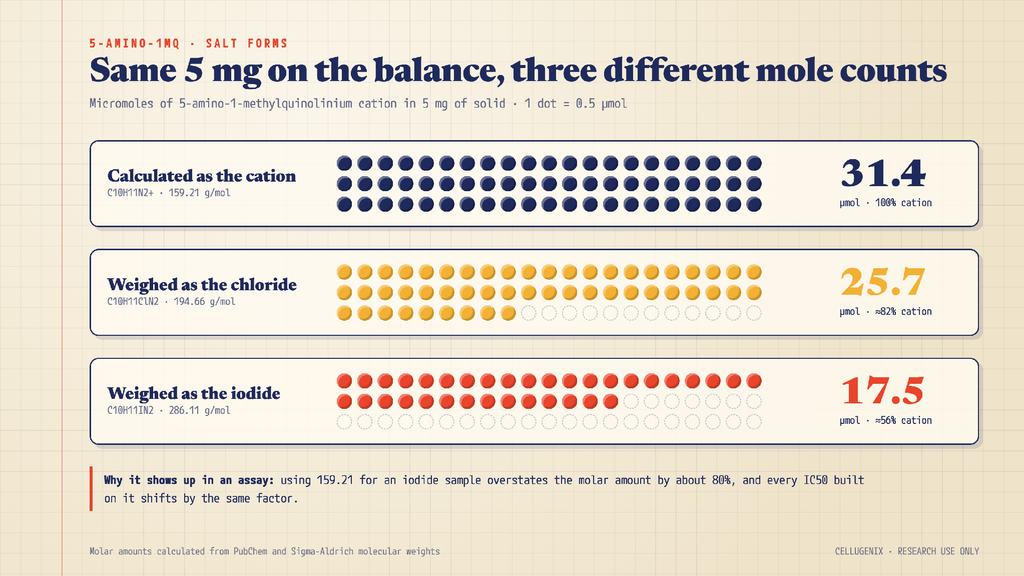
5-Amino-1MQ salt forms: micromoles of cation in 5 mg weighed as the cation, chloride or iodide, shown as dot grids
Why It Shows Up in an Assay: The Molar Maths
Assays run on moles, and the salt changes the count. Here’s the arithmetic for 5 mg of solid:
- Weighed as the iodide: 5 mg ÷ 286.11 g/mol ≈ 17.5 µmol of cation
- Weighed as the chloride: 5 mg ÷ 194.66 g/mol ≈ 25.7 µmol
- Calculated as if it were the cation: 5 mg ÷ 159.21 g/mol ≈ 31.4 µmol
So a lab that uses the database weight for an iodide sample overstates its molar amount by about 80%. Any IC50 or concentration-response curve built on that number shifts by the same factor.
What the COA Should State
A useful certificate names the salt form and the counter-ion. Its mass-spec result should land near m/z 159.09 in positive mode, since the iodide separates from the cation and doesn’t appear in that spectrum. Our guide to HPLC vs mass spectrometry explains what each method can and can’t confirm.
What Is NNMT? The Enzyme 5-Amino-1MQ Targets
NNMT is a cytosolic methyltransferase. It moves a methyl group from S-adenosylmethionine (SAM) onto nicotinamide, producing 1-methylnicotinamide (1-MNA) and S-adenosylhomocysteine (SAH). That one reaction links two well-studied systems: NAD+ salvage, which recycles nicotinamide, and the methylation cycle that runs on SAM.
| Substrates | Enzyme | Products |
| , – | , – | , – |
| Nicotinamide + SAM | NNMT | 1-MNA + SAH |
Because 1-MNA is the direct product, labs often treat a fall in 1-MNA as the clearest readout that NNMT activity has dropped. SAM and SAH give a second readout. Their ratio is a common index of methylation capacity in cultured cells, and LC-MS can measure all three metabolites, plus NAD+, from the same extract.
How 5-Amino-1MQ Inhibits NNMT
5-Amino-1MQ looks a lot like the methylated product, which fits how it works. Sigma-Aldrich describes it as a “substrate site-targeting, selective” NNMT inhibitor. In their 2018 Biochemical Pharmacology paper, Neelakantan, Watowich and colleagues at the University of Texas Medical Branch suggested these quinoliniums gain selectivity by “specifically interacting with the NA-binding pocket of NNMT.” That’s the nicotinamide pocket, away from the SAM site that many methyltransferase inhibitors target.
The same team reported an NNMT IC50 of about 1 µM for 5-Amino-1MQ in enzyme assays. Its selectivity data were just as tidy:
- Related methyltransferases (enzyme assays): about 10% COMT inhibition at 600 µM, and no meaningful inhibition of DNMT1 or PRMT3 at the concentrations tested.
- NAD+ salvage enzymes (enzyme assays): no NAMPT inhibition up to 100 µM, and no SIRT1 inhibition up to 300 µM.
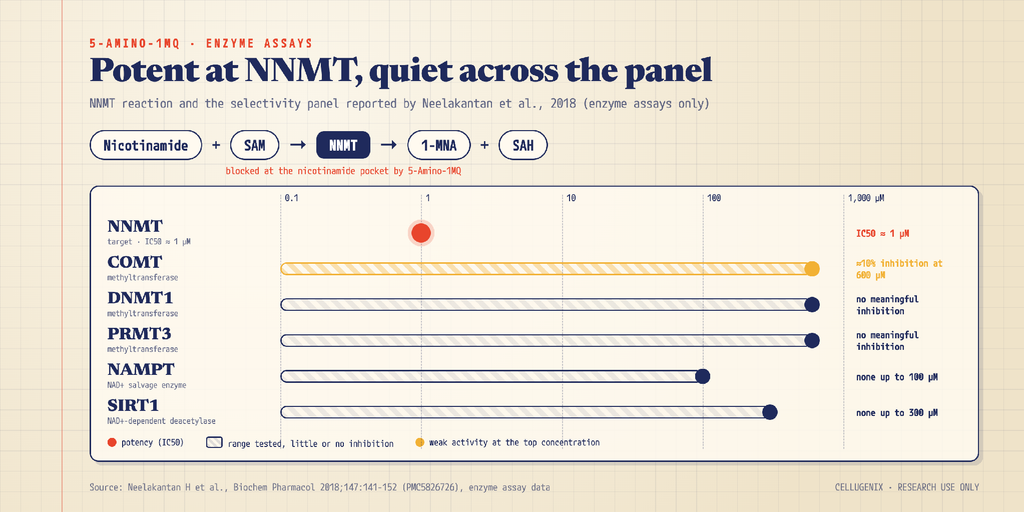
NNMT reaction and 5-Amino-1MQ selectivity panel: IC50 near 1 µM at NNMT against highest concentrations tested at COMT, DNMT1, PRMT3, NAMPT and SIRT1
How Is 5-Amino-1MQ Used in the Lab?
In practice, 5-Amino-1MQ is a tool compound. Labs reach for it when they need to switch NNMT off in an enzyme or cell assay and see what follows. These are the common study types:
| Assay | What it measures | Study type |
| NNMT inhibition | IC50 against recombinant NNMT | Enzyme assay |
| Selectivity panel | Activity at related methyltransferases and NAD+ salvage enzymes | Enzyme assay |
| Metabolite measurement | 1-MNA, SAM/SAH and NAD+ by LC-MS | Cultured cells |
| Permeability | PAMPA and Caco-2 monolayers | In vitro |
| Viability counter-screen | MTT | Cultured cells |
| Analytical reference | Retention time, MS and counter-ion | Analytical |
A frequent question is how well the molecule crosses membranes. The in-vitro permeability data answer it. In PAMPA, a cell-free membrane model, 5-Amino-1MQ showed high passive permeability, while its parent 1-MQ and the product 1-MNA showed none. In Caco-2 monolayers, a cultured cell barrier model, it showed high transport with no detectable efflux, according to the Neelakantan study.
For a charged molecule, that result stands out, and it’s the main reason the amino-substituted quinoliniums became the reference compounds for cell work. In the cell assays, an MTT counter-screen helps labs confirm that a drop in 1-MNA reflects enzyme inhibition while cell numbers hold steady.
Analytical labs use the compound differently. A characterised lot serves as a reference standard for HPLC retention time and for the m/z 159.09 signal, which lets a lab confirm identity on new batches or on samples pulled from other suppliers. Here the counter-ion check comes first, since every molar figure downstream depends on it.
Is 5-Amino-1MQ FDA-Approved? (2026 Status)
No. 5-Amino-1MQ isn’t an FDA-approved drug, and no approved product contains it. Research suppliers sell it for laboratory use only, so a capsule or supplement listing is a red flag for any lab sourcing a characterised reagent. Those products rarely carry a report number, a salt form or a chromatogram, which are the three details a reagent buyer needs most.
FDA addressed the compound directly this year. Its January 20, 2026 warning letter to GenoGenix LLC named “5-amino-1-methylquinolinium iodide (5-Amino-1MQ)” and said it does “not appear on the 503B bulks list.”
| Question | Status (October 2026) |
| FDA-approved? | No |
| 503B bulks list (outsourcing facilities) | Not listed, per FDA’s January 2026 warning letter |
| 503A and dietary-ingredient status | Not covered by this guide |
The 503B list governs what outsourcing facilities may compound. It says nothing about laboratory reagents, which is why research suppliers describe 5-Amino-1MQ by purity, identity and lot, with no clinical claims attached.
New to reagent compounds? Our overview of what research peptides are covers how research-use supply works.
Storage of the Sealed Vial
Store the sealed vial as stated on the label, protected from light and moisture. Sigma-Aldrich lists −20 °C for its iodide powder, so check the label and certificate for the lot in hand.
On arrival, log the lot number and the report number next to the vial’s location. That one entry ties every later result to a specific certificate. Our storage and handling guide covers receiving and logging in more detail.
5-Amino-1MQ COA: What to Check
A strong certificate shows five things: the compound and its salt form, HPLC purity with a chromatogram, content measured against the label, an MS result near m/z 159, and a report number that verifies with the lab. Here’s how the two current Cellugenix reports read against that list.
50 mg, report CPT-5AMINO-B31E42. Canada Peptide Testing tested the sample on September 27 and reported on October 2, 2026. HPLC-UV purity came in at 99.74%, and measured content was 51.22 mg against a 50 mg label, a fill accuracy of 102.4%. The record verifies on the lab’s site, and the full certificate is in our 5-Amino-1MQ 50 mg COA page.
5 mg, report LK-5AM-5-052226. Testides tested this lot on May 26, 2026 and reported HPLC-UV purity of 99.27%. The Testides record and our 5-Amino-1MQ 5 mg COA page carry the details.
Both reports cover HPLC purity and content. Neither states the salt form or includes a mass-spec result, so a lab that needs identity confirmation or an exact molar basis can request both. For the 50 mg lot, it also helps to ask whether the 51.22 mg content figure is calculated as the salt or the cation, since those differ by about 80%. Our guide on how to read a COA walks through each field.
Frequently Asked Questions
Is 5-Amino-1MQ a peptide?
No. It’s a quinolinium small molecule with one ring system and no amino acids. Peptide suppliers stock it because the same research labs buy it, and its chemistry places it with small organic molecules such as quinoline dyes and probes.
What is the molecular weight of 5-Amino-1MQ?
The cation, C10H11N2+, weighs 159.21 g/mol. The iodide salt, C10H11IN2, weighs 286.11 g/mol. A certificate should say which form its figures use, because 5 mg of the iodide holds about 17.5 µmol of cation and 5 mg of pure cation would hold about 31.4 µmol.
What is the CAS number for 5-Amino-1MQ?
PubChem lists 685079-15-6 for the cation. The iodide salt carries CAS 42464-96-0. PubChem doesn’t list a CAS number for a chloride salt.
Why is 5-Amino-1MQ coloured?
Aromatic amines like the quinolinium ring absorb visible light, so the solid has colour. Sigma-Aldrich lists its iodide powder as faint red to dark brown. Shade can vary by salt and lot, so the certificate’s appearance line is the reference for each batch.
What enzyme does 5-Amino-1MQ inhibit?
It inhibits nicotinamide N-methyltransferase (NNMT), with an IC50 of about 1 µM in enzyme assays. It appears to bind the nicotinamide pocket, which helps explain its selectivity over SAM-site enzymes such as DNMT1 and PRMT3.
Is 5-Amino-1MQ FDA-approved?
No. It has no FDA approval, and FDA’s January 2026 warning letter confirmed it isn’t on the 503B bulks list. It’s sold for laboratory research only.
The Bottom Line
5-Amino-1MQ is a small molecule with two common weights and one enzyme target. The details that shape an experiment are the salt form, the mass-spec result and a report number that verifies. Batch details for each size are on the 5-Amino-1MQ 5 mg and 5-Amino-1MQ 50 mg pages.
For Research Use Only. Not for use in diagnostic or therapeutic procedures. Products are supplied to qualified purchasers under our Terms of Service.
References
- Neelakantan H, Vance V, Wetzel MD, et al. Biochemical Pharmacology, 2018; 147: 141-152. doi:10.1016/j.bcp.2017.11.007. In-vitro and enzyme-assay sections cited.
- PubChem. 5-Amino-1-methylquinolinium, CID 950107.
- Sigma-Aldrich. 5-Amino-1-methylquinolinium iodide, product SML2832.
- FDA. Warning letter to GenoGenix LLC, MARCS-CMS 718739, January 20, 2026.
- Canada Peptide Testing. Report CPT-5AMINO-B31E42.
- Testides. Report LK-5AM-5-052226.
For Research Use Only. Not for use in diagnostic or therapeutic procedures.