CJC-1295 vs. Ipamorelin: Structure, Receptors and COA Checks
CJC-1295 and Ipamorelin are often listed side by side, but they are different molecules studied at different receptors. CJC-1295 is a synthetic analogue of growth hormone-releasing hormone (GHRH) and is studied at the GHRH receptor. Ipamorelin is a synthetic pentapeptide studied as a ligand of the growth hormone secretagogue receptor (GHS-R1a), also called the ghrelin receptor.
This article compares the two as laboratory materials: what each molecule is, which receptor and in-vitro assay types it appears in, how the two differ, and how to verify identity and purity before a vial goes into an experiment. Everything here concerns research-use material for in-vitro work only.
Quick Answer: What Is the Difference Between CJC-1295 and Ipamorelin?
They differ in size, sequence origin and target. CJC-1295 is a 29-residue peptide built on the first 29 amino acids of human GHRH, sold with or without a DAC maleimide linker. It is studied at the GHRH receptor, a class B G protein-coupled receptor (GPCR). Ipamorelin is a 5-residue peptide containing non-natural amino acids and is studied at GHS-R1a, a class A GPCR. Because the receptors belong to different GPCR families and couple to different signaling pathways, the two compounds are characterised in different assay formats.
CJC-1295 vs Ipamorelin at a Glance
| Feature | CJC-1295 | Ipamorelin |
| Compound class | GHRH analogue (modified GHRH 1-29 amide) | Growth hormone secretagogue (GHS) peptide |
| Length | 29 residues (no-DAC); 30 with the DAC lysine | 5 residues |
| Studied receptor | GHRH receptor (class B GPCR) | GHS-R1a, the ghrelin receptor (class A GPCR) |
| Typical signaling readout | cAMP accumulation | Intracellular calcium, IP1, beta-arrestin recruitment |
| Formats | With DAC and without DAC (separate materials) | Single format |
| Quality checks | Batch COA, purity by HPLC, identity by MS | Batch COA, purity by HPLC, identity by MS |
| Status | Research use only | Research use only |
What Is CJC-1295?
Sequence and design
CJC-1295 is a modified version of GHRH(1-29)-NH2, the shortest fragment of human GHRH that retains full receptor binding. Four positions are substituted relative to the native fragment: D-Ala at position 2, Gln at 8, Ala at 15 and Leu at 27. These changes are chemical stability choices. D-Ala2 resists cleavage by dipeptidyl peptidase-4 (DPP-4), Gln8 avoids the deamidation-prone Asn, and Leu27 replaces an oxidation-prone Met. The no-DAC form is also known as modified GRF(1-29) or tetrasubstituted GRF(1-29).
Sequence (no-DAC): Tyr-D-Ala-Asp-Ala-Ile-Phe-Thr-Gln-Ser-Tyr-Arg-Lys-Val-Leu-Ala-Gln-Leu-Ser-Ala-Arg-Lys-Leu-Leu-Gln-Asp-Ile-Leu-Ser-Arg-NH2.
What the DAC modification means
DAC stands for Drug Affinity Complex. In the DAC form, a lysine is added at position 30 and carries a maleimidopropionic acid (MPA) group on its side chain. The maleimide is a thiol-reactive linker designed to form a covalent bond with a free cysteine, such as Cys34 of serum albumin. The receptor-binding sequence is the same in both forms. What changes is the molecular mass, the chemistry, and how the material behaves in assay media.
That last point matters at the bench. A free maleimide can react with thiol-containing components of a buffer or medium, including albumin, glutathione or DTT. When comparing DAC and no-DAC material in the same cell-based assay, labs typically record the buffer composition so that any conjugation in the well is accounted for.
Researchers sourcing the shorter form often start with a documented CJC-1295 without DAC research material and its batch COA.
What Is Ipamorelin?
Sequence and class
Ipamorelin is a synthetic pentapeptide in the growth hormone secretagogue family: Aib-His-D-2-Nal-D-Phe-Lys-NH2, where Aib is 2-aminoisobutyric acid and D-2-Nal is D-3-(2-naphthyl)alanine. The non-natural residues and the C-terminal amide are part of its design. It is not a fragment of ghrelin; it is a small synthetic ligand studied at the same receptor that ghrelin binds.
Why its receptor profile matters in research
Ipamorelin was introduced in the literature as a selective member of the GHS class. For in-vitro work, what matters is that it is a small, well-defined GHS-R1a ligand with no GHRH receptor activity, so in a comparison with CJC-1295 each compound isolates a different receptor input.
CJC-1295 vs Ipamorelin: Receptors and Assay Types
CJC-1295 and GHRH receptor signaling
The GHRH receptor is a class B GPCR that couples mainly to Gs, so receptor activation raises intracellular cAMP. CJC-1295 is typically characterised in:
- Competition binding assays against a labelled GHRH analogue in membranes from GHRH receptor-expressing cells.
- cAMP accumulation assays (HTRF, AlphaScreen or luciferase reporter formats) in cell lines engineered to express the receptor.
- Enzyme stability assays, such as incubation with DPP-4, where the D-Ala2 substitution is the variable of interest.
Ipamorelin and GHS-R1a signaling
GHS-R1a is a class A GPCR that couples mainly to Gq/11, so activation drives inositol phosphate turnover and calcium release from intracellular stores. The receptor is also known for high constitutive activity. Ipamorelin is typically characterised in:
- Radioligand competition binding against labelled ghrelin in GHS-R1a-expressing cell membranes.
- Calcium mobilisation assays (fluorescent dye or aequorin readouts) in HEK293 or CHO cells expressing GHS-R1a.
- IP1 accumulation and beta-arrestin recruitment assays, used to compare G protein and arrestin signaling.
- Receptor internalisation and desensitisation studies in cultured cells.
Why researchers compare the two pathways
One compound acts at a Gs-coupled class B receptor, the other at a Gq-coupled class A receptor. Used side by side, they give two independent receptor inputs with different second messengers, which makes them useful for receptor pharmacology, cross-talk studies in co-expressing cell systems, and assay development.
Figure 1: CJC-1295 and Ipamorelin act at two different receptors (research pathway diagram).
CJC-1295 With DAC vs. Without DAC
Two separate materials
With DAC and without DAC are not interchangeable. They have different molecular masses, different lengths (30 vs 29 residues) and different reactivity, because only the DAC form carries a thiol-reactive maleimide. Order the form your protocol specifies, and check that the COA names that exact form. In a CJC-1295 no-DAC vs Ipamorelin comparison, the receptor difference is the variable; adding the DAC form introduces a second, chemical variable.
Figure 2: CJC-1295 DAC and no-DAC as separate research materials.
What to verify on a COA
Because the two forms differ, the paperwork has to match the exact material. Confirm these on the Certificate of Analysis:
- Exact compound name, including whether it is the DAC or no-DAC form.
- Product format, such as lyophilized powder.
- Theoretical and observed molecular mass.
- Batch or lot number.
- Purity by HPLC, with the chromatogram.
- Mass spectrometry identity data.
We explain each field in our How to Read a COA guide and our HPLC vs. mass spectrometry explainer, so the form you order matches the form you verify.
Can CJC-1295 and Ipamorelin Be Compared in the Same Study?
Yes, in a well-controlled in-vitro design. Because they act at different receptors with different second messengers, a comparison needs defined assay readouts for each receptor, matched controls, and batch documentation for every vial.
Avoiding confounded designs
- Confirm compound identity for every vial.
- Use batch-specific COAs and record lot numbers in the lab notebook.
- Record buffer composition, especially thiol content when DAC material is used.
- Change one variable at a time.
- Use a reference ligand for each receptor (native GHRH(1-29) or ghrelin) as a positive control.
Figure 3: two receptor inputs, measured with separate assay readouts.
How to Verify CJC-1295 and Ipamorelin Quality
A complete COA confirms you have the right compound, at a documented purity, with records you can trace. Work through four checks.
Start with a batch-specific COA
- The product and peptide name match the vial label.
- The COA includes an identifiable batch or lot number.
- The lot number matches the product you received.
- Testing dates are visible.
- Laboratory information is available.
Batch COAs for our materials are published in the COA Library.
Confirm purity with HPLC
Purity by HPLC, see the batch COA. HPLC separates the main peptide peak from other detectable peaks, so it shows how much of the sample is the target compound. A strong COA includes the chromatogram and method data. A purity figure on its own does not confirm what the compound is.
Confirm identity with mass spectrometry
Mass spectrometry compares the observed molecular mass with the theoretical mass for the sequence. For CJC-1295 this is also how the DAC and no-DAC forms are told apart, since the DAC lysine and MPA group add measurable mass. HPLC and MS together give stronger documentation than either alone: one shows how much, the other shows what.
Check storage information
Store the sealed lyophilized vial as stated on the label, protected from light and moisture, and keep the batch documentation with it. The storage and documentation guide covers record-keeping in more detail.
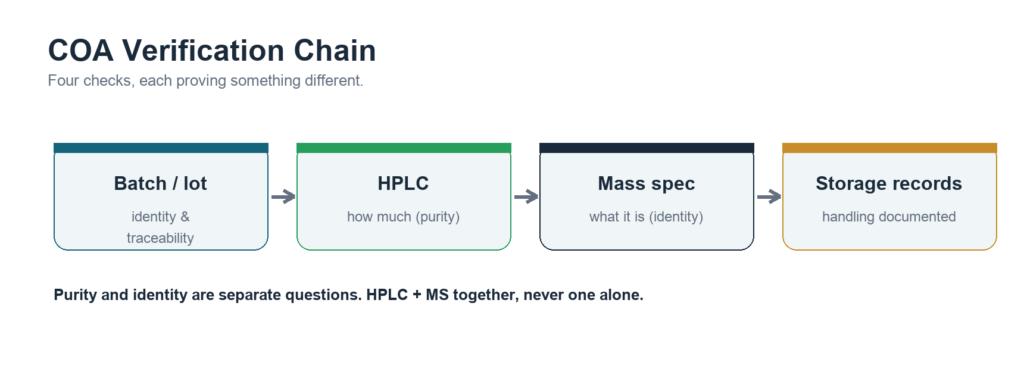
Figure 4: the COA verification chain and what each test shows.
Common Misconceptions
“CJC-1295 and Ipamorelin are the same thing”
They are different molecules (29 or 30 residues vs 5) that bind different receptors in different GPCR families.
“DAC and no-DAC are the same compound”
They share a receptor-binding sequence but differ in length, mass and chemistry. Handle them as separate catalogue items with separate COAs.
“A high purity figure proves the product is authentic”
Purity and identity are separate questions. HPLC shows how much target compound is present; mass spectrometry confirms what that compound is. Use both.
“RUO means the product can be used for any purpose”
Research use only means in-vitro laboratory research only. The labeling exists to keep that boundary clear.
CJC-1295 vs. Ipamorelin: Which Fits Your Study?
The right choice depends on the receptor you are studying:
- Choose CJC-1295 for GHRH receptor work: binding, cAMP signaling, or DPP-4 stability studies, and for comparisons between the DAC and no-DAC chemistry.
- Choose Ipamorelin for GHS-R1a work: binding, calcium or IP1 signaling, arrestin recruitment and receptor internalisation.
- Use both when the design calls for two independent GPCR inputs in the same system.
- In every case, keep the batch COA, HPLC chromatogram and MS identity data with the vial.
Frequently Asked Questions
What is the main difference between CJC-1295 and Ipamorelin?
CJC-1295 is a 29-residue GHRH analogue studied at the Gs-coupled GHRH receptor. Ipamorelin is a 5-residue GHS peptide studied at the Gq-coupled GHS-R1a. They are distinct compounds used in different assay formats.
Is CJC-1295 without DAC different from CJC-1295 with DAC?
Yes. The DAC form adds a lysine carrying a thiol-reactive maleimide linker, which changes its mass and its reactivity in assay media. The two are separate materials with separate COAs.
Why do labs need both HPLC and mass spectrometry?
HPLC measures detectable purity, or how much target compound is present, while mass spectrometry confirms molecular identity, or what the compound is. Together they give a stronger analytical record than either alone.
What should a COA include for a research peptide?
At minimum: product identity, batch number, test method, purity by HPLC, mass spectrometry identity data, test date and traceable laboratory information. Our batch COAs are in the COA Library.
Final Takeaway
CJC-1295 and Ipamorelin are different molecules for different questions: a GHRH(1-29) analogue at a class B receptor, and a synthetic pentapeptide at the class A ghrelin receptor GHS-R1a. For either one, confirm the exact form, check purity by HPLC and identity by MS on the batch COA, and store the sealed vial as the label states.
For Research Use Only. Not for use in diagnostic or therapeutic procedures.