Buying MOTS-c Peptide for Research: What the COA Should Show
When the FDA reviewed MOTS-c this year, the certificate of analysis it received listed one form of the peptide in the title and a different form by its CAS number. If that can reach a regulator, it can reach you on a product page. MOTS-c is a 16-residue peptide first found in mitochondrial DNA, and if you want to buy MOTS-c peptide for research, the batch COA is the only thing that tells you what’s actually in the vial. Here’s how to read one in about two minutes.
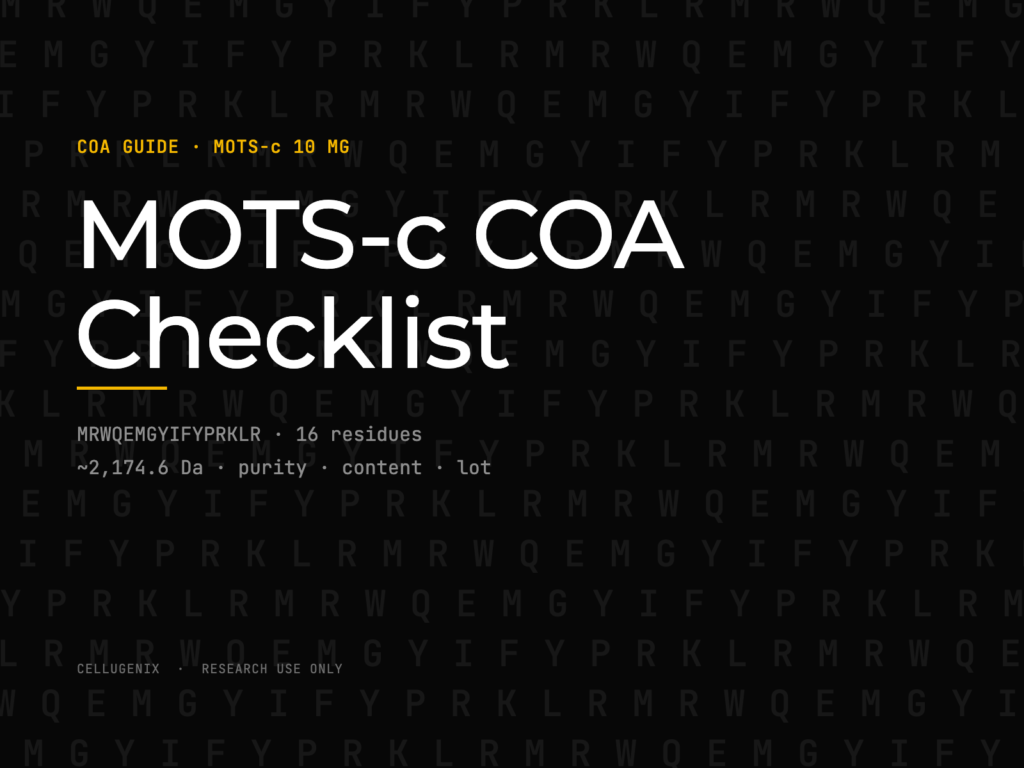
Quick answer: Before you buy MOTS-c, check the batch COA. It should show a mass matching the 16-residue peptide (about 2,174.6 Da as free base), HPLC purity with the method, the net content measured in the vial, a lot number that matches your vial, a test date, and an independent lab you can verify with.
6 things to check
- The mass matches MOTS-c.
- The salt form is stated.
- HPLC purity is given with the method.
- Net content is checked against the 10 mg label.
- The lot on the vial matches the lot on the COA.
- The lab, test date, and a way to verify the report are shown.
This guide covers identification and documentation only. MOTS-c is sold For Research Use Only.
What You’re Buying: MOTS-c at a Glance
Quick answer: MOTS-c is a 16-residue peptide, MRWQEMGYIFYPRKLR, encoded by a short stretch of the mitochondrial 12S rRNA gene (MT-RNR1). Research suppliers sell it as a lyophilized powder, usually as a free base or an acetate salt.
“Mitochondrial-derived peptide” just means its code is in the small genome inside mitochondria, not in the cell’s nucleus. The values below match the PubChem record for MOTS-c and FDA’s July 2026 briefing.
| Identifier | Value |
|---|---|
| Sequence | MRWQEMGYIFYPRKLR (Met-Arg-Trp-Gln-Glu-Met-Gly-Tyr-Ile-Phe-Tyr-Pro-Arg-Lys-Leu-Arg) |
| Residues | 16 |
| Formula (free base) | C101H152N28O22S2 |
| Molecular weight (free base) | ~2,174.6 g/mol |
| CAS | 1627580-64-6 |
| PubChem CID | 146675088 |
| Form | Lyophilized powder |
Notice the two M’s: methionines at positions 1 and 6, which come up again under impurities. For the backstory, start with the MOTS-c sequence and research overview.
Free Base vs Acetate: Which Molecular Weight Should the COA Show?
Quick answer: The peptide’s mass on an LC-MS result is the same either way: about 2,174.6 Da as the neutral molecule. An acetate or TFA counter-ion adds weight to the powder, not to the peptide ion the instrument detects. That’s why some pages list ~2,234.7 (a one-acetate salt formula) and others ~2,174.6.
FDA counts the two forms as separate ingredients. Its July 2026 briefing document lists the free base at 2,174.6 g/mol and writes the acetate as “C101H152N28O22S2·xCH3COOH” with the weight marked “NA”. That “x” is the catch: the number of acetates varies by batch, so the salt has no single fixed weight.
| Free base | Acetate salt | |
|---|---|---|
| Molecular weight | ~2,174.6 g/mol | ~2,234.7 with one acetate, more with each extra |
| What the mass spec reads | ~2,174.6 | ~2,174.6 |
| What the label weight includes | Peptide plus residual water | Peptide plus acetate plus residual water |
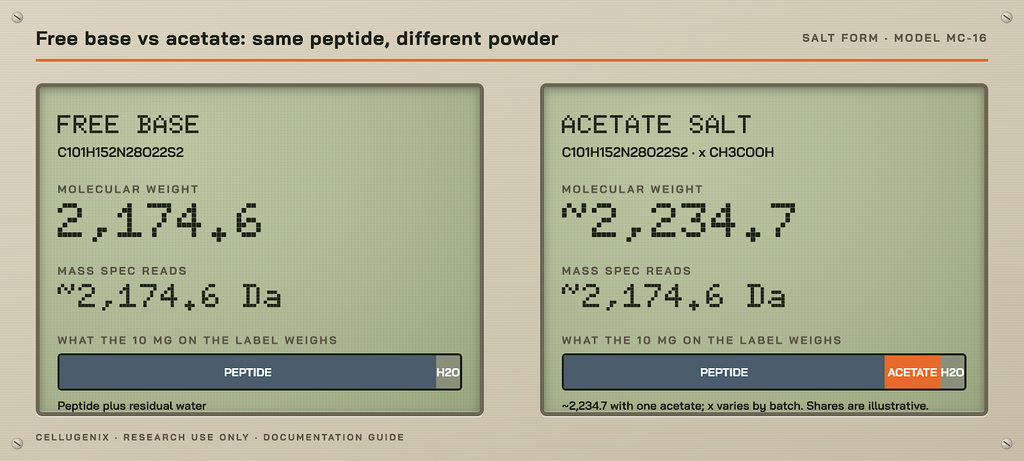
MOTS-c free base vs acetate salt: formula, molecular weight, and what the 10 mg vial weight includes
What the Mass Spec Actually Reads
A peptide this size rarely shows as one neat peak. Electrospray adds protons, so MOTS-c appears as charged ions: [M+2H]²⁺ near m/z 1,088.3 and [M+3H]³⁺ near m/z 725.9. A good COA prints observed beside theoretical mass, and says whether it’s average (2,174.6) or monoisotopic (about 2,173.1).
Why the Salt Form Changes the mg in the Vial
The scale weighs everything in the powder: peptide, counter-ions, and leftover water. So “10 mg” of an acetate salt isn’t 10 mg of peptide unless the supplier fills by net content. That’s why the content line deserves as much attention as purity.
What a MOTS-c COA Should Show: The Checklist
Quick answer: One lot, one report, one named lab, with both identity (mass) and purity (HPLC) reported. Purity alone doesn’t prove the main peak is MOTS-c.
| COA field | What to look for | Red flag |
|---|---|---|
| Identity (LC-MS) | Observed ≈ theoretical (~2,174.6 Da) | Missing, or a mass far off |
| Purity (HPLC-UV) | A % with method, wavelength, and chromatogram | A round 100%, or no method |
| Net peptide content | mg measured against the 10 mg label | Not reported |
| Salt form | Free base, acetate, or TFA stated | Not stated |
| Lot/batch number | Same as the vial label | Missing |
| Test date | Matches the batch on sale | Months older than the batch |
| Lab and report number | A named independent lab you can verify with | In-house only |
| Endotoxin (optional) | An LAL or rFC result in EU/mg | None, if you run cell-culture assays |
The same fields apply to other compounds, as the TB-500 COA checklist shows with a much smaller target mass.
Identity: Observed vs Theoretical Mass
HPLC tells you how clean a sample is, not what the main peak is. LC-MS weighs the molecule so you can compare it with 2,174.6 Da. Because HPLC vs mass spectrometry answer different questions, a complete certificate carries both. Within a Dalton or so is a match. Off by hundreds points to a different or truncated peptide.
Purity: Reading the HPLC Line
Purity is the area under the main peak divided by the area under all the peaks the UV detector picked up, written as area %. It’s commonly reported at 98% or more, so judge the batch result and the method together. A number with no wavelength, column, or trace behind it is one you have to take on trust.
Net Content: Is a 10 mg Vial Really 10 mg?
Purity is not content. A sample can be 99% pure and still contain less peptide than the label says, or more. Net content is the measured mg in the vial against the label, and it should be stated for each lot.
Lot, Date, and Lab Verification
Copy the lot code from the vial label, then look for it on the certificate. Then check that the date is close to the batch you’re buying. To confirm the report is real:
- Use the QR code or a verify link on the lab’s own site.
- If there’s no portal, email the lab with the report number.
Without a public lookup, independent lab testing is just a claim, and a lab accredited to ISO/IEC 17025 has had its technical competence assessed by an outside body. Fields like water content and residual TFA are quick once you know how to read a COA line by line.
Methionine Oxidation: The MOTS-c Impurity to Look For
Quick answer: MOTS-c has two methionines, at positions 1 and 6, and methionine oxidizes easily. A common impurity is therefore MOTS-c +16 Da (one oxidation) or +32 Da (two). On HPLC, it usually shows as a nearby side peak, and on mass spec as a +16 Da ion.
Each oxidation turns methionine into methionine sulfoxide. A 2015 study in the Journal of Proteomics found that oxidizing one methionine usually shortens retention in reversed-phase HPLC, so the oxidized form tends to elute just ahead of the main peak. A 2010 methionine-oxidation study in mAbs cautioned that, unless conditions are carefully controlled, samples can oxidize by more than one route.
What it changes: it lowers purity, and it’s a sign the peptide met air, light, or moisture. A good COA shows a main peak well above any oxidation peak, plus a mass result for the main peak itself.
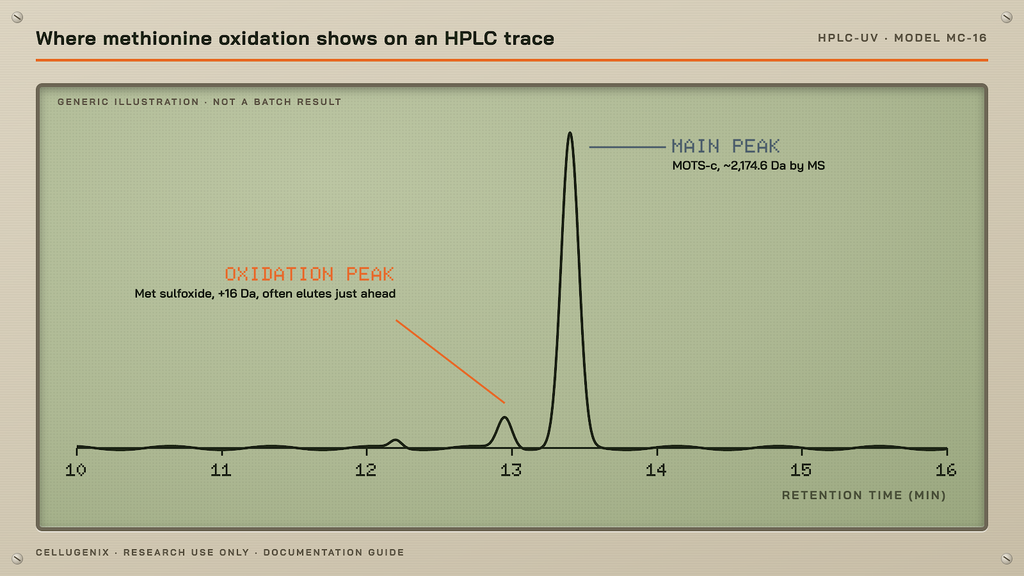
Generic HPLC trace with the main MOTS-c peak and a smaller methionine-oxidation side peak eluting just before it
Sealed, cold, dry, and dark limits oxidation, and each product family has its own temperatures in the storage and handling guide.
7 Red Flags on a MOTS-c COA
FDA’s own review shows how easily paperwork slips. Its briefing notes the certificate sent with the MOTS-c nomination “refers to one BDS by name in the title and a different BDS by the CAS number.” Watch for these:
- No lab is named, or the testing is in-house only.
- No lot number, or one that doesn’t match the vial.
- A test date months older than the batch being sold.
- No mass result, or a mass that doesn’t fit MOTS-c.
- Purity given as a round 100%, or without a method.
- “10 mg” with no content figure and no salt form.
- The same report image reused across sizes, products or years.
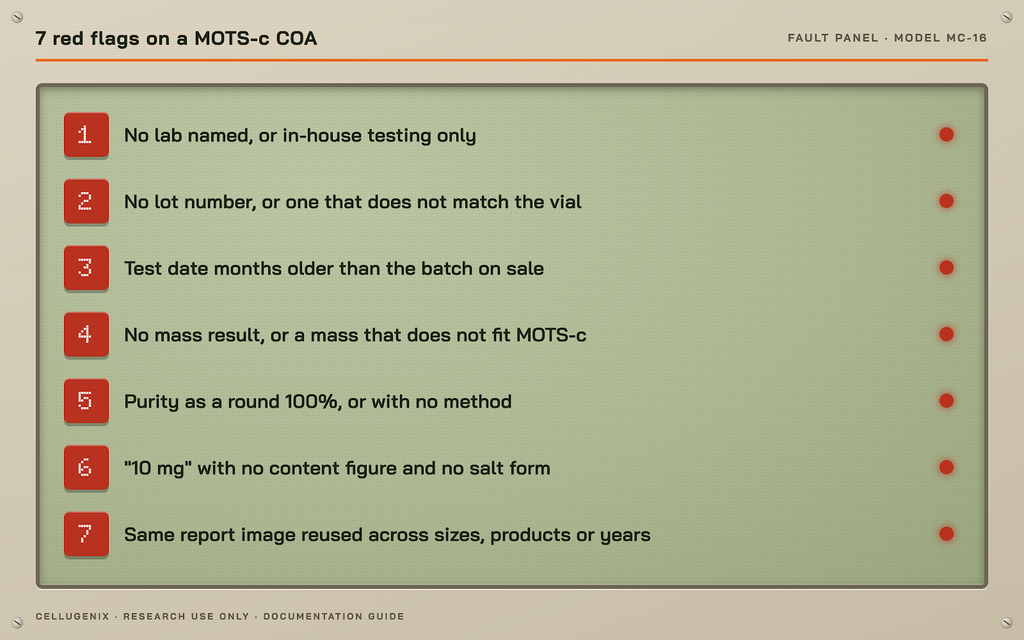
Checklist of seven red flags on a MOTS-c certificate of analysis
Flag 6 comes up often on peptide forums. In one r/Peptides thread, the COA and a second test both put a vial well above its label weight, and only the content line showed it.
Example: Our MOTS-c 10 mg COA
Quick answer: This is what the current Cellugenix MOTS-c 10 mg certificate reports, and what it doesn’t cover.
| Field | Result |
|---|---|
| Report number | LK-MOTS-10-021126 |
| Laboratory | Testides (independent) |
| Lot number | L25-01 |
| Method | HPLC-UV purity and content |
| Purity | See the batch result (99.41% on this report) |
| Measured content | 10.26 mg against 10 mg (102.6% fill accuracy) |
| Tested | Feb 23, 2026 |
| Mass spec/endotoxin | Not included on this report |
| Verification | QR code, plus a Verify button on testides.com |
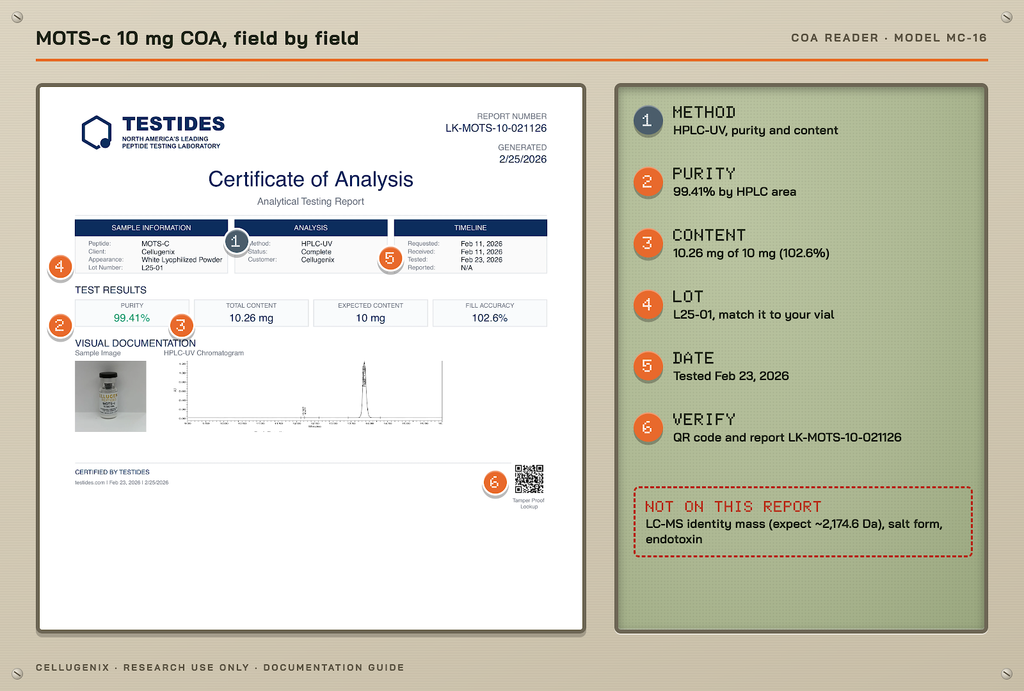
MOTS-c 10 mg certificate of analysis, report LK-MOTS-10-021126, HPLC purity and content
The chromatogram shows one dominant peak near 13.86 minutes and one small peak near 12.22 minutes. The report has no mass-spec identity result or endotoxin assay, so if your work depends on confirmed identity, confirm it yourself by LC-MS when the vial arrives and look for about 2,174.6 Da.
Open the full MOTS-c 10 mg certificate to check it against the lab’s record, and find every other report in the COA library. Once the lot matches, you can buy MOTS-c 10 mg for research with the paperwork in hand.
Can You Buy MOTS-c Legally?
Quick answer: In the US, MOTS-c isn’t an FDA-approved drug. It’s sold as a research chemical labelled For Research Use Only, for laboratory use. That’s the position as of November 15, 2026.
FDA’s Pharmacy Compounding Advisory Committee reviewed MOTS-c free base and MOTS-c acetate as separate bulk substances at its July 23 and 24, 2026 meeting. It approved nothing.
Why Isn’t MOTS-c an Approved Drug?
Nobody has an approved application for it. FDA’s evaluation records no USP or NF monograph for either form, and neither is part of an approved drug.
Can You Buy Research Peptides Online?
Yes, as research material. The supplier publishes a batch COA, the buyer confirms the order is for laboratory research, and the paperwork stays tied to the vial. Local rules are the buyer’s responsibility, so check research peptides and US law in 2026 against your own state and institution. Learn what Research Use Only means before you order.
MOTS-c is also named on the WADA Prohibited List under section S4.4, as an AMPK activator.
Why Does MOTS-c Cost More Than Shorter Peptides?
Quick answer: At 16 residues, with two methionines and a tryptophan, MOTS-c takes more synthesis steps and more careful purification than short peptides, and every lot needs testing. The price per vial mostly reflects the net content, the purity, and how much testing the lot gets.
Every extra residue is another coupling step where a chain can stop short, and those truncated chains have to be purified out. So compare price per verified mg, not per label. A vial measured at 10.26 mg and one with no content figure aren’t the same purchase. Very cheap listings often skip mass spec or reuse old reports, which moves the checking onto your own LC-MS time.
Storage When Your MOTS-c Arrives
Quick answer: MOTS-c ships lyophilized. Keep sealed vials at −20 °C for long-term storage, dry and away from light. Its methionines make it prone to oxidation, so limit air exposure. Note the lot number and arrival date.
FDA’s briefing reports lyophilized MOTS-c is stable “when stored at -20°C desiccated and protected from light in a tightly closed container.” Freeze-drying is what gives lyophilized peptides that shelf stability.
How MOTS-c Is Used in the Lab
Quick answer: In cell-based work, MOTS-c is studied in AMPK signalling and folate–methionine cycle assays. It’s also used to study signalling between mitochondria and the nucleus, since it moves into the nucleus of cultured cells under stress conditions.
Lee and colleagues first described the peptide in Cell Metabolism in 2015, tracing folate-cycle and AMPK readouts in cell models. In 2018, Kim and colleagues reported its move into the nucleus of stressed cultured cells.
Labs mapping each pathway assay by assay can follow the MOTS-c research overview, and labs weighing it against a small-molecule ERR agonist often start with SLU-PP-332 vs MOTS-c.
FAQs
Where can I buy MOTS-c for research?
From a supplier that publishes a COA for the exact lot, tested by a named lab you can verify with. Every MOTS-c for sale at Cellugenix links to its batch certificate, with the lab’s report number beside the purity result.
What is the molecular weight of MOTS-c?
About 2,174.6 g/mol as free base. The acetate-salt formula is heavier, but LC-MS reads the peptide mass.
What is the sequence of MOTS-c?
MRWQEMGYIFYPRKLR, 16 residues.
Is MOTS-c FDA-approved?
No. As of November 15, 2026, there’s no approved MOTS-c drug in the US.
How do I verify a MOTS-c COA?
Match the lot number, then look up the report number with the lab or scan the QR code.
What purity should a MOTS-c COA show?
Commonly 98% or more by HPLC. Judge the batch result and the method.
Is a 10 mg vial 10 mg of peptide?
Only if the supplier fills by net content, check the content figure and the salt form on the COA.
Bottom Line
Read the certificate before the price. Check the mass, salt form, purity, content, lot, date, and lab, then match the lot to your vial when the box arrives. A report you can’t verify with the lab counts as missing. Compare the lot on the MOTS-c 10 mg specification and batch COA with the lab’s record.
For laboratory research use only. Not for human or animal use. Full terms of sale and use are set by the Cellugenix legal notice.
Sources (all confirmed November 15, 2026)
For laboratory research use only. Not for human or animal use.