Buying SLU-PP-332 for Research: What the COA Should Show
Search for SLU-PP-332 and the first result calls it a peptide. The fourth calls it a small molecule. A paid listing higher up files it under a receptor family it has nothing to do with. Each of those labels implies a different certificate, and only one of them can document what is in the vial.
Quick answer: Before you buy SLU-PP-332, read the batch COA. It is a small molecule, C18H14N2O2, about 290 Da, and not a peptide. The certificate should carry HPLC purity with its method, a mass that lands near 290 Da, the measured content, a lot number matching your vial, a test date, and an independent lab you can check.
Six things to check
- The mass is about 290 Da.
- HPLC purity is given with the method.
- Content matches the label.
- The lot on the vial matches the lot on the COA.
- The test date and lab are shown.
- There is a way to verify the report.
This guide covers identification and documentation only. SLU-PP-332 is sold For Research Use Only.
What You’re Buying: SLU-PP-332 Is a Small Molecule, Not a Peptide
Quick answer: SLU-PP-332 is a synthetic small molecule weighing about 290 Da, an acyl hydrazone developed at Saint Louis University as an agonist of the estrogen-related receptors. There are no amino acids in it and no peptide bonds, whatever the listing calls it.
| Identifier | Value |
| Chemical name | (E)-4-hydroxy-N’-(naphthalen-2-ylmethylene)benzohydrazide |
| CAS | 303760-60-3 |
| PubChem CID | 5338394 |
| Formula | C18H14N2O2 |
| Molecular weight | 290.3 g/mol |
| Monoisotopic mass / [M+H]⁺ | 290.106 / 291.113 |
| Chemical class | Acyl hydrazone; small-molecule ERR agonist |
| Form | Solid powder |
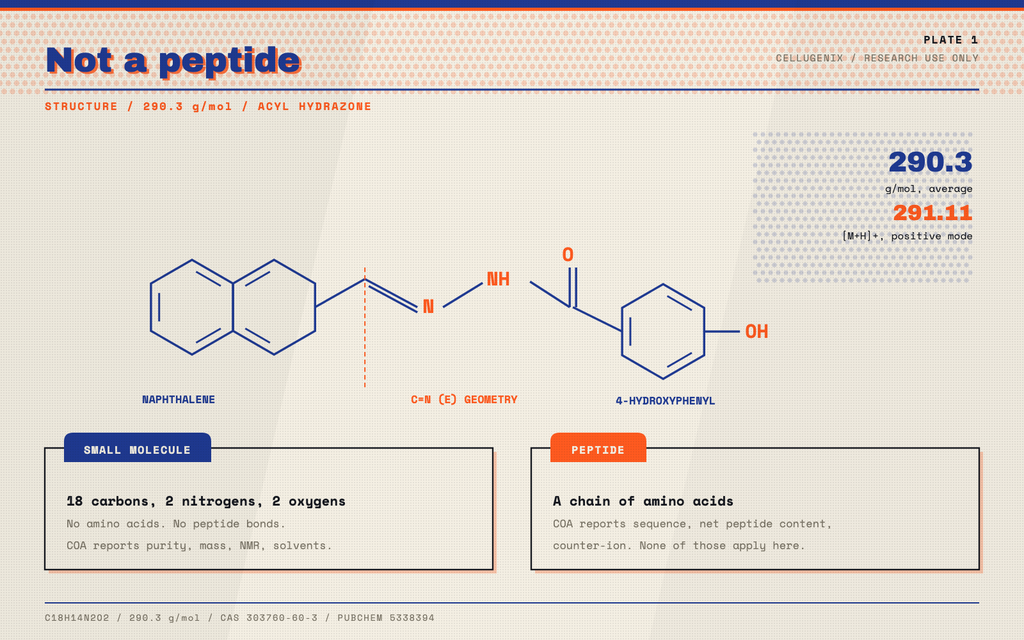
Structure of SLU-PP-332 drawn as a small molecule: naphthalene ring, C=N bond in the E geometry, hydrazone linker and 4-hydroxyphenyl ring, with formula C18H14N2O2 and 290.3 g/mol
Every figure there comes from PubChem CID 5338394, where CAS 303760-60-3 resolves to the same record. The structure on file carries the (E) geometry at the C=N bond, which matters further down this page.
Why the “Peptide” Label Matters When You Buy
Certificates are built around the compound class they document. A peptide COA reports a sequence, net peptide content, and a counter-ion, because those are what go wrong when you chain amino acids together. None of them exist here. A small-molecule COA reports purity by HPLC, a mass, sometimes an NMR spectrum, and the solvents and water left from manufacturing.
So the label is a signal about the testing. A supplier who files this compound as a peptide stands a fair chance of testing it like one, and peptide checks on an acyl hydrazone will pass a vial nobody examined for what actually goes wrong with it. Reading the SLU-PP-332 research overview first takes ten minutes and tells you which tests the chemistry calls for.
What a SLU-PP-332 COA Should Show: The Checklist
Quick answer: One lot, one report, one named lab, carrying purity by HPLC and identity by mass, with NMR as the stronger structural check where a supplier runs it. Purity on its own tells you the sample is clean. It cannot tell you the clean thing is SLU-PP-332.
| COA field | What it tells you | What to look for | Red flag |
| Purity (HPLC-UV) | Share of the main peak | A % with the method and wavelength, trace attached | “Pending”, a round 100%, or no method |
| Identity (LC-MS) | Mass of the main peak | [M+H]⁺ near 291, or [M−H]⁻ near 289 | Missing, or a mass that does not fit |
| Identity (¹H NMR, optional) | Whether the structure matches | “Conforms to structure”, with the spectrum | Optional, so judge the rest |
| Content | mg in the vial | Close to the label | Not reported |
| Lot number | Which vials were tested | Matches the vial label | Missing, or the same code on unrelated products |
| Test date | When the sample was run | Recent, matching the batch on sale | Older than the batch |
| Lab and report number | Who tested it | A named independent lab, with a verification link or QR code | In-house testing only |
| Residual solvents/water | Leftovers from manufacturing | Reported, where the supplier tests them | Optional, so judge the rest |
Purity: HPLC With a Method
Reagent catalogues sell this compound at ≥98% by HPLC, the grade Cayman Chemical lists against CAS 303760-60-3. That is a specification, the floor a batch has to clear. The batch result is the measurement, and it should arrive with its column, wavelength, and method. Water content, residual solvents, and the other lines you will meet on the page work the same way, and how to read a COA goes field by field.
Identity: Mass and Structure
LC-MS answers the mass question: positive mode should put the protonated molecule near 291.11, negative mode near 289.10. ¹H NMR answers the harder one, whether the atoms sit where the name says. NMR is the stronger of the two here, since mass alone cannot separate compounds that happen to weigh the same. That division of labour between HPLC vs mass spectrometry is why a thorough certificate carries results from both.
Content: Is a 5 mg Vial 5 mg?
This part is simpler than it is for peptides. No counter-ion, no net peptide content, no water of hydration to subtract, so the measured amount should sit close to the labelled one. A slight overfill is routine. A missing content result is the thing to notice.
Lot, Date and Lab Verification
Three codes should agree: the lot on your vial, the lot on the certificate, and the report number you can look up. Scan the QR code, open the lab’s verify link, or email the lab the report number and ask. A lab that publishes its reports turns independent lab testing into something you can check for yourself. ISO/IEC 17025 accreditation raises the bar again, because that standard is assessed on how a laboratory actually runs its methods and handles its data.
The same six-field logic applies across compounds, and the TB-500 COA checklist works through it for a peptide, where the fields differ.
Is Endotoxin Testing Relevant?
Endotoxin is a release test built for biologics and peptides, where fermentation and handling put it there in the first place. On a synthetic small molecule, purity, identity, and residual solvents carry far more information. Treat an endotoxin result as a useful optional extra for cell-culture work.
SLU-PP-332 Impurities to Look For
Quick answer: Acyl hydrazone chemistry produces two predictable families of related compounds. One is the geometric twin of the molecule, the (Z) isomer. The other is the pair of fragments it splits into on contact with water: 2-naphthaldehyde and 4-hydroxybenzohydrazide.
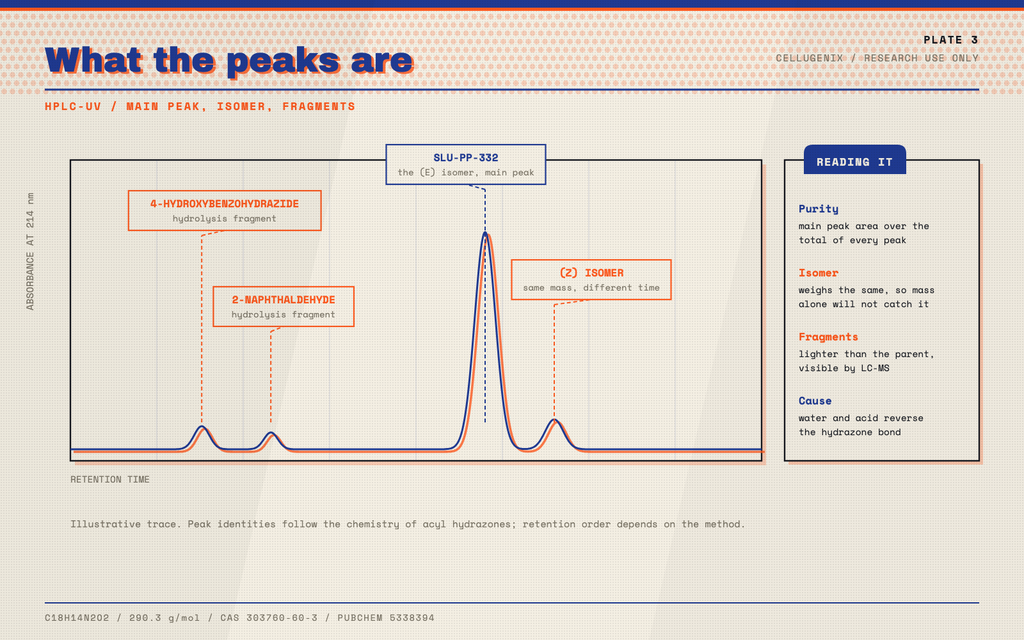
Illustrative HPLC trace labelling the SLU-PP-332 main peak, the Z isomer and the two hydrolysis fragments, 2-naphthaldehyde and 4-hydroxybenzohydrazide
The C=N bond at the centre of this molecule can sit in two arrangements. PubChem files SLU-PP-332 as the (E) form, and work in the International Journal of Molecular Sciences in 2023 (PMID 37834186) reports that acylhydrazones isomerize at that bond more readily than simple hydrazones, the (Z) form is usually too unstable to persist unless something holds it in place. On a chromatogram, an isomer appears as a separate peak at a different retention time.
The second route runs backwards through the synthesis. An acyl hydrazone is made by condensing a hydrazide with an aldehyde, and that reaction reverses in water, fastest under mildly acidic conditions. Reversed here, it gives 2-naphthaldehyde and 4-hydroxybenzohydrazide, both lighter than the parent and both visible by LC-MS.
A good certificate shows one dominant peak, with any neighbours small and, better still, named. Moisture and acid drive the reverse reaction, so a sealed dry container is doing chemical work, and our storage and handling guide gives the conditions by product family.
“Lyophilized” SLU-PP-332: What the Label Means
Quick answer: Lyophilized means freeze-dried from solution. It is the standard way peptides are finished, and a small molecule like SLU-PP-332 usually arrives as a plain solid powder. The word says nothing about quality either way.
Freeze-drying earns its place with peptides, which are fragile in solution and dissolve cleanly from the cake. A 290 Da acyl hydrazone has neither problem, so the description usually carries across from a supplier’s peptide catalogue. What lyophilized means is worth knowing precisely, if only so the word stops reading as a grade.
Three lines on the certificate carry what that word does not: appearance, purity and mass. Our own report gives the first of those as “white lyophilized powder”.
7 Red Flags on a SLU-PP-332 COA
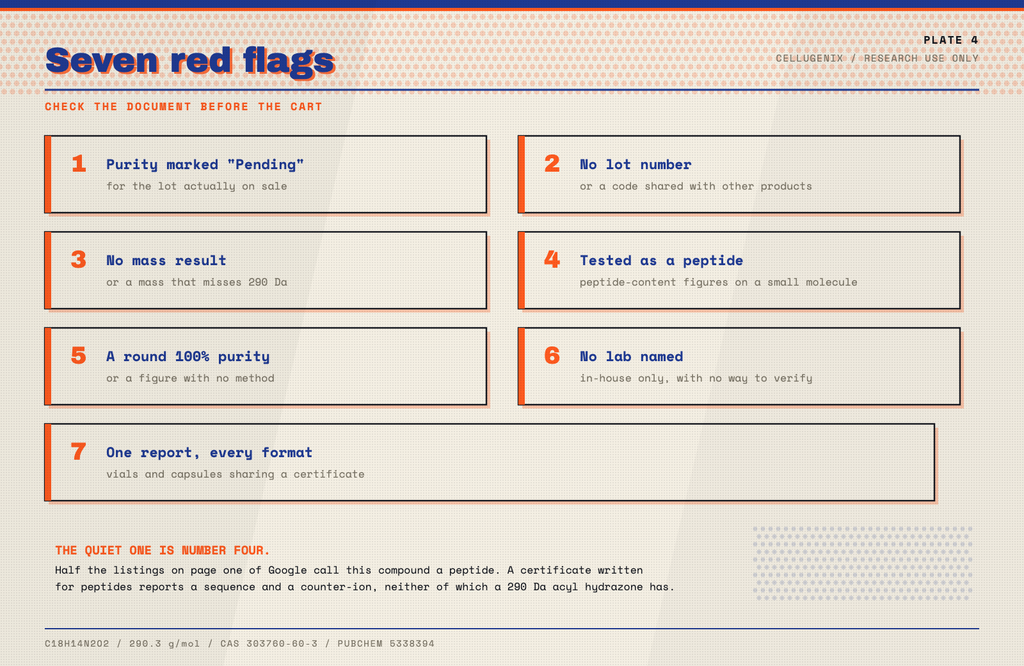
Checklist of seven red flags on a SLU-PP-332 certificate of analysis
- The HPLC result is marked “Pending” for the lot being sold.
- No lot number, or a lot code shared with unrelated products.
- No mass result, or a mass that does not fit around 290 Da.
- The compound is tested and described as a peptide, with peptide-content figures on a small molecule.
- Purity given as a round 100%, or without a method.
- No lab named, or in-house testing only, with no way to verify.
- A test date older than the batch, or one report reused across sizes and forms.
Number seven deserves an extra beat. Capsules and vials are separate manufacturing runs, filled on different equipment at different strengths. A certificate for a 5 mg vial describes that vial and nothing else, whatever name sits at the top of both pages.
Example: Our SLU-PP-332 5 mg COA
Quick answer: This is what the current Cellugenix SLU-PP-332 5 mg certificate reports, and what it does not.
| Field | Result |
| Report number | CPT-SLUPP3-59BAF8 |
| Laboratory | Canada Peptide Testing (independent) |
| Method | HPLC-UV purity and content |
| Purity | See the batch result, 99.75% on this report |
| Measured content | 5.30 mg against a 5.00 mg label, a fill accuracy of 106% |
| Tested/reported | Sep 29, 2026 / Oct 2, 2026 |
| Mass spec / NMR | Not on this report |
| Verification | QR code and Verify link on the lab’s site |
Each certificate also carries the batch and lot it belongs to, which is the code to read off your vial and match before anything goes into an assay. One honest note about the template: the sample identification block heads its first field “Peptide”, because the laboratory tests mostly peptides. The compound is a small molecule, and the result lines below that field are the ones that carry information.
The empty line is the one to read. HPLC purity and measured content are here; a mass result and an NMR spectrum are not, which means the document shows how clean the material is without proving which molecule it is. Labs that need identity settled run LC-MS or ¹H NMR on receipt, looking for 291.11 in positive mode.
Every line of it, chromatogram included, is on the SLU-PP-332 5 mg certificate, and the COA library holds the rest by compound and lot. The spec sheet sits beside the report if you want to buy SLU-PP-332 5 mg online. SLU-PP-332 Capsules are a separate product on a separate lot, so they need a report of their own.
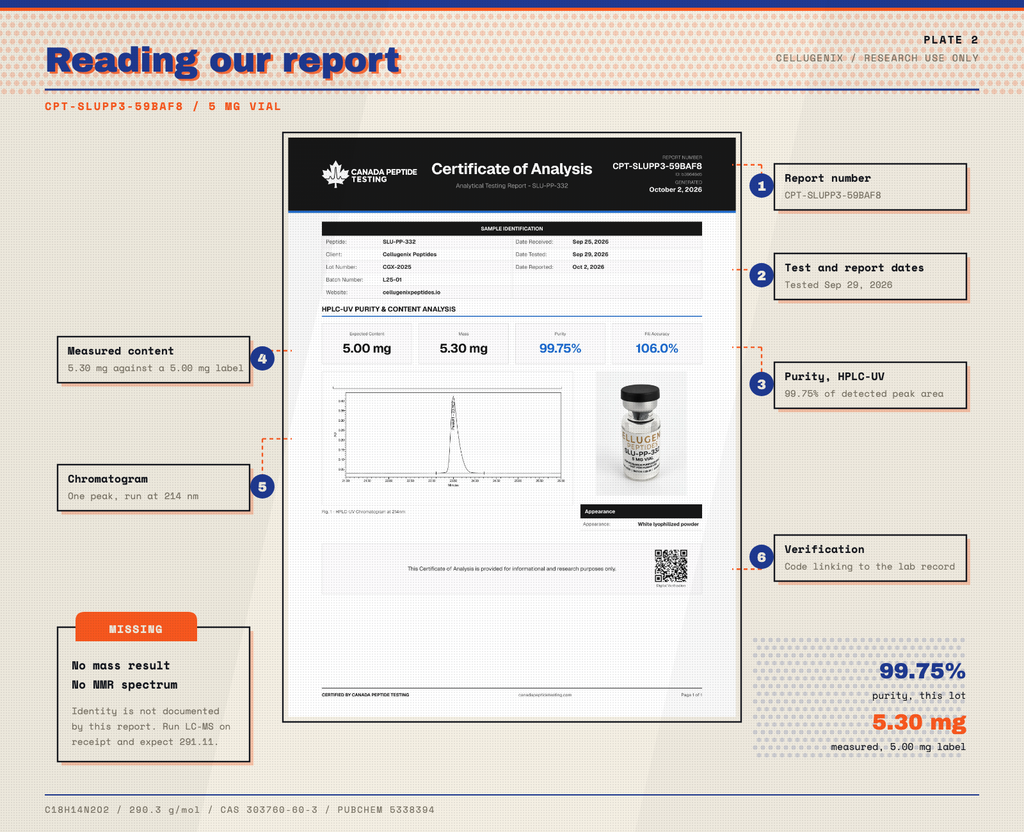
Certificate of analysis for SLU-PP-332 5 mg, report CPT-SLUPP3-59BAF8, showing HPLC purity and measured content
Can You Buy SLU-PP-332 Legally?
Quick answer: SLU-PP-332 holds no US drug approval and no approved human use. US suppliers sell it as a research chemical under For Research Use Only terms, for laboratory work, which is the position on November 9, 2026.
A ClinicalTrials.gov search on that date returned zero registered studies of SLU-PP-332, and zero for estrogen-related receptor agonists as a class. Everything published on it sits in cells and animal models.
Why Some Sellers Ask You to Verify as a Researcher
Research-use-only terms are a statement about permitted use, and a supplier selling on those terms has a reason to confirm the buyer is working within them. In practice, that means an account check at the point of sale, sometimes an institutional email, sometimes a research-use confirmation at checkout. The words printed on the vial carry a precise meaning, so what Research Use Only means is worth reading before an account gets opened, alongside research compounds and US law in 2026 for the wider picture.
One line for completeness: the WADA 2026 Prohibited List does not name SLU-PP-332 and carries no class entry for ERR agonists. Its S0 section covers any pharmacological substance with no current approval from a governmental regulatory health authority for human therapeutic use.
What Affects the Price of SLU-PP-332?
Quick answer: Three things move the price: the quantity, the purity grade, and how much testing each lot receives, which can mean HPLC alone or HPLC plus mass spec and NMR.
Work in price per verified mg. Verified carries that phrase: it points at a measured content figure on a certificate, a different thing from the number printed on a label.
Then check the certificate belongs to the thing you are buying. Same compound, same supplier, different form, different lot, different report. A capsule priced per capsule and a vial priced per mg become comparable only once you know what each lot measured.
Storage When Your SLU-PP-332 Arrives
Quick answer: Keep sealed containers cold, dry, and dark. Moisture drives the reverse reaction that breaks this compound into its two fragments, so a dry container is doing real chemical work. Note the lot number and arrival date when the package lands.
Cayman lists −20 °C for the solid and calls it sparingly soluble in DMSO at 1 to 10 mg/ml. Catalogue solubility figures for this molecule vary a great deal between suppliers, a reminder that a spec sheet describes a compound while a certificate describes the batch in your hand. For assay preparation, it is soluble in DMSO.
What Is SLU-PP-332 Used For in the Lab?
Quick answer: In vitro, SLU-PP-332 activates the estrogen-related receptors ERRα, ERRβ, and ERRγ, and laboratories use it in reporter-gene assays and target-gene expression work in cultured cells. It is most potent at ERRα.
The ordering is measurable. In HEK293 reporter-gene assays, Cayman Chemical lists EC50 values of 98 nM at ERRα, 230 nM at ERRβ, and 430 nM at ERRγ, about a fourfold step from first to last. Billon and colleagues first described the compound as a pan-ERR agonist with its highest potency at ERRα, in ACS Chemical Biology in 2023 (PMID 36988910), and followed it in the Journal of Pharmacology and Experimental Therapeutics (PMID 37739806).
Those numbers are what a mislabelled vial puts at risk, since an assay run at 100 nM leaves no margin for a sample that is half isomer. What the three receptors do, and why a pan-agonist is useful at the bench, sits in our SLU-PP-332 receptor pharmacology notes.
FAQs
Where can I buy SLU-PP-332 online for research?
Buy where the certificate is published for the exact lot and the exact form, and where the laboratory that ran it is named and reachable. The lot, the test date, and the report number are worth reading while the order is still a decision. Our current results sit with the SLU-PP-332 for sale listing.
Is SLU-PP-332 a peptide?
No. It is a small molecule of about 290 Da, an acyl hydrazone built from a hydrazide and an aldehyde. Peptides are chains of amino acids joined by peptide bonds, and this compound contains neither. Listings that call it a peptide are using the word loosely.
What is the molecular weight of SLU-PP-332?
About 290.3 g/mol, from the molecular formula C18H14N2O2. Its monoisotopic mass is 290.106 Da, which on an LC-MS run appears as a protonated molecule near 291.113 in positive mode, or near 289.098 in negative mode.
What is the CAS number of SLU-PP-332?
303760-60-3. That registry number resolves to PubChem CID 5338394, the same record that carries the formula, the mass, and the (E) structure, so it is a quick way to check that a product page and a certificate describe one compound.
What purity should a SLU-PP-332 COA show?
Reagent catalogues list it at 98% or higher by HPLC. Read the figure the batch actually returned and the method printed beside it, because a specification describes what a batch must clear, while the certificate describes what this one did.
How do I verify a SLU-PP-332 COA?
Start at the vial: its lot code should appear on the certificate word for word. Then take the report number to the laboratory, through its lookup page or the code printed on the document. Where a lab offers neither, an email quoting the report number should get an answer.
Do capsules and vials share a COA?
No. They are different manufacturing lots in different formats, and each one needs its own report. A certificate for a 5 mg vial says nothing about a capsule, even when both carry the same compound name.
Judge It as a Small Molecule
SLU-PP-332 is a 290 Da small molecule, so judge it on small-molecule evidence: purity with a method, a mass near 290, measured content, a lot that matches your vial, a test date, and a lab you can reach. A certificate written for peptides cannot do that job, and neither can a product page. See the SLU-PP-332 5 mg batch COA.
For laboratory research use only. Not for human or animal use. Full terms are set out in our legal notice.
Sources
- PubChem CID 5338394, CAS 303760-60-3 (last checked November 9, 2026): https://pubchem.ncbi.nlm.nih.gov/compound/5338394
- Cayman Chemical item 41719, purity grade, solubility, and ERR EC50 values (last checked November 9, 2026): https://www.caymanchem.com/product/41719/slu-pp-332
- Billon et al., ACS Chemical Biology, 2023, PMID 36988910 (last checked November 9, 2026): https://pubmed.ncbi.nlm.nih.gov/36988910/
- Billon et al., Journal of Pharmacology and Experimental Therapeutics, 2024, PMID 37739806 (last checked November 9, 2026): https://pubmed.ncbi.nlm.nih.gov/37739806/
- Acylhydrazone E/Z isomerization, International Journal of Molecular Sciences, 2023, PMID 37834186 (last checked November 9, 2026): https://pubmed.ncbi.nlm.nih.gov/37834186/
- ClinicalTrials.gov, zero registered studies of SLU-PP-332 (last checked November 9, 2026): https://clinicaltrials.gov/
- WADA 2026 Prohibited List (last checked November 9, 2026): https://www.wada-ama.org/en/prohibited-list
For laboratory research use only. Not for human or animal use.