Buying KPV Peptide for Research: What the COA Should Show
You can read a KPV listing in about ten seconds. Ten milligrams, 99%+ pure, ships tomorrow. The batch certificate behind it may take a few minutes, and anyone about to buy KPV peptide for a project should start there: it is the part that tells a lab what is actually in the vial.
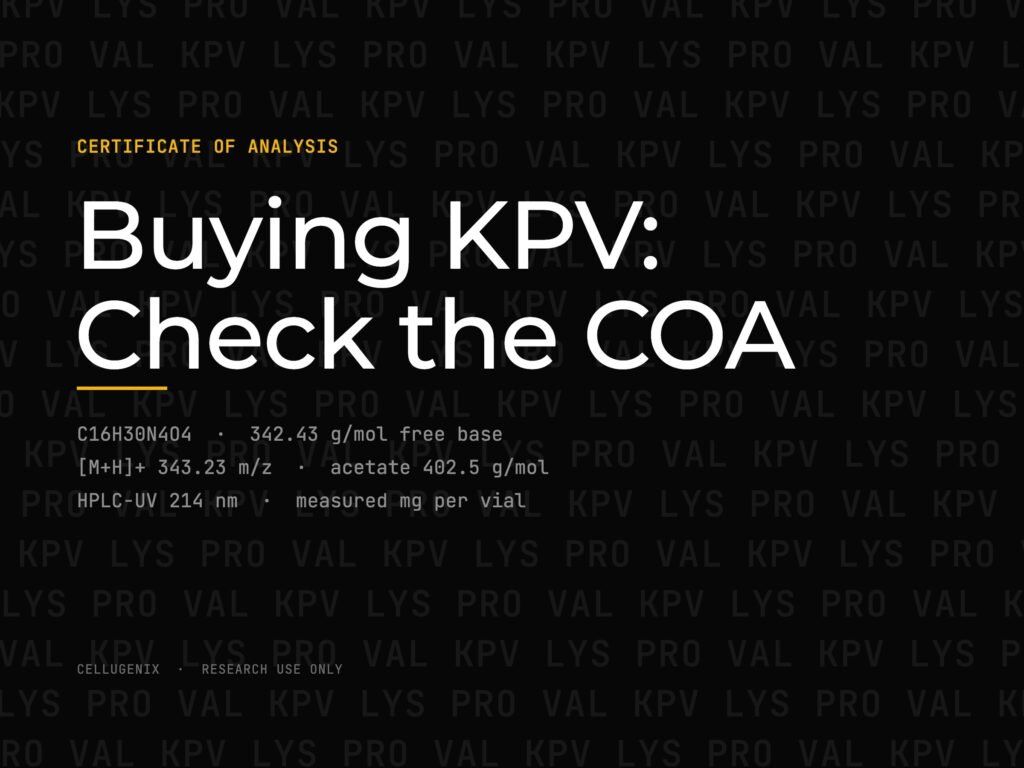
KPV is the tripeptide Lys-Pro-Val, the last three residues of alpha-MSH, weighing about 342 g/mol. That small size makes it one of the easier research peptides to verify: one clear mass, one main HPLC peak, one measured content figure.
When FDA reviewers evaluated KPV documentation in May 2026, they reported that most certificates they could find for the free base carried a purity result and nothing on impurity limits. That gap is the reason the paperwork earns a few minutes before the order goes in.
Quick answer: Before you buy KPV, check the batch COA. KPV is the tripeptide Lys-Pro-Val (C16H30N4O4, about 342 Da). The COA should show HPLC purity with the method, a mass that matches about 343 m/z for [M+H]⁺, the measured mg in the vial, the salt form, a lot number that matches your vial, a test date, and an independent lab you can verify.
Seven things to check before ordering
- A mass of about 343 for [M+H]⁺
- HPLC purity with the method stated
- Measured mg per vial, next to the label claim
- Salt form named on the report
- The lot on the vial matching the lot on the COA
- A test date and a named laboratory
- A verify link or report number that opens the lab’s own record
This guide covers identification and documentation only. KPV is sold For Research Use Only.
What You’re Buying: KPV (Lys-Pro-Val) at a Glance
Quick answer: KPV is a synthetic tripeptide of lysine, proline, and valine, matching residues 11 to 13 of alpha-MSH. At roughly 342 Da, it sits near the bottom of the research-peptide size range, leaving a certificate little room to be vague.
| Identifier | Value | Why it matters on a certificate |
| Sequence | H-Lys-Pro-Val-OH (KPV) | The report should print the sequence in full |
| Origin | Alpha-MSH residues 11 to 13 (some catalogues write “ACTH 11-13”) | Two names, one compound |
| CAS (free base) | 67727-97-3 | Most references reuse it for the acetate |
| Formula (free base) | C16H30N4O4 | A different formula means a different substance |
| Molecular weight (free base) | 342.43 g/mol | Every content calculation runs from it |
| Monoisotopic mass | 342.23 Da, so [M+H]⁺ lands near 343.23 | The number a mass spectrum should reproduce |
| Acetate salt (1:1) | C16H30N4O4·CH3COOH, 402.5 g/mol | Same peptide, 60 g/mol heavier per molecule |
| PubChem CID | 125672 | The public record to check against |
| Appearance | White to off-white lyophilized powder | A colour note is a real data point |
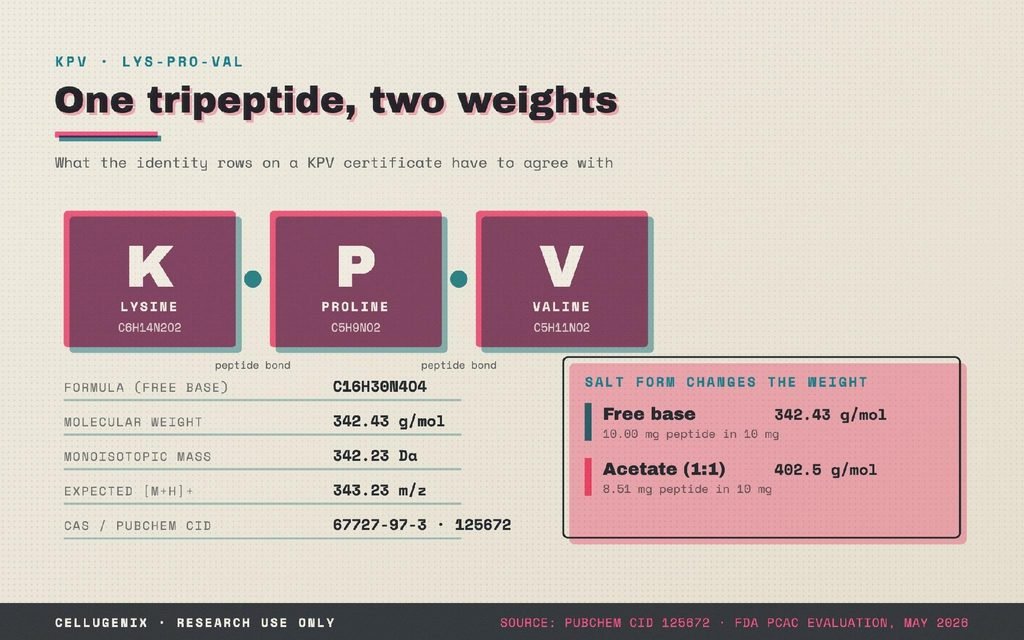
Lys-Pro-Val structure card showing formula C16H30N4O4, molecular weight 342.43 g/mol, and the free base versus acetate comparison
Those values come from PubChem CID 125672 and the FDA’s evaluation table, which lists both forms side by side. Every row traces to one thing: the KPV sequence and alpha-MSH origin fix the formula, and the formula fixes the mass a spectrum has to return.
Free Base, Acetate or TFA Salt: Why the Label Matters
Peptides come off solid-phase synthesis as TFA salts, and some are converted to acetate. The counter-ion rides along as extra weight, so 10 mg of KPV acetate contains less peptide than 10 mg of free base.
FDA’s 2026 evaluation puts a number on it: the acetate weighs 402.5 g/mol against 342.43 for the free base, roughly 15% of the vial mass given to the counter-ion in a 1:1 salt. Both forms share one CAS number in most public references, so the CAS line cannot tell you which arrived.
Most listings quote the free-base KPV molecular weight and stop there. Where the report omits the salt form, the supplier is the only place to get it.
What a KPV COA Should Show: The Checklist
Quick answer: One lot, one report, one named laboratory, reporting purity by HPLC, identity by mass, and content in milligrams. A purity percentage describes the chromatogram’s shape. Naming the main peak as Lys-Pro-Val is a separate test, and so is weighing the vial.
| COA field | What it tells you | What to look for | Red flag |
| Purity (HPLC-UV) | Share of the main peak | A percentage with the method, such as 214 nm, plus the chromatogram | “Pending”, a round 100%, or no chromatogram |
| Identity (LC-MS) | Mass of the main peak | [M+H]⁺ near 343.2 for the free base | A mass reconciling with neither 342.43 nor 402.5 |
| Identity (FTIR or amino acid analysis) | Functional groups, or the residue ratio | An FTIR match, or Lys:Pro:Val close to 1:1:1 | “Fillers/excipients detected” |
| Content | Milligrams of KPV in the vial | A measured figure next to the labelled one | Content not reported at all |
| Salt / counter-ion | Free base, acetate or TFA | Named on the report | Absent from every field |
| Related substances | Impurity limits and results | Total and single-impurity limits, each with a result | Limits with no results, or results with no limits |
| Lot number | Which vials were tested | A code that matches the vial label | Missing, or the same code on unrelated products |
| Dates | When the sample was run | Test and report dates consistent with the batch on sale | A report older than the batch |
| Laboratory and verification | Who ran it | A named lab, a report number, and a verification link | In-house testing only |
| Endotoxin (optional) | Bacterial endotoxin | Units stated as EU/mg | A figure with no units |
That impurity row comes straight from the regulator. The FDA’s May 2026 evaluation of KPV-related bulk drug substances examined two certificates. The acetate certificate reported identification, amino acid composition, assay, related substances, water content, and acetate content, with a total impurity limit of 2.0% against a result of 0.9%, and a single-impurity limit of 1.0% against a result of 0.24%. For the free base, FDA wrote that most certificates it found “only contain purity testing results”, with “no information on the impurity limits/testing results”.
Purity: HPLC With a Method
Supplier listings routinely advertise 99%+ purity, and the wider record says that is unremarkable: across 6,285 publicly posted third-party test reports, median purity was 99.80%, interquartile range 99.50% to 99.90% (Mendias and Awan, preprint, 2026). High purity is the norm, so the number alone separates little. The current KPV lot reports 99.35%. A percentage means something only alongside the method that produced it, which is why the difference between HPLC vs mass spectrometry decides whether the big peak was identified or merely counted.
Identity: Mass Spec vs FTIR
Mass spectrometry gives the molecular mass, and for free-base KPV the protonated ion should appear near 343.2 m/z. FTIR confirms chemical groups, supporting an identity claim while leaving the residue order open. Amino acid analysis gives a ratio close to 1:1:1.
An instrument listed under “equipment” is not a spectrum run on your sample. Look for the result, the expected value, and the measured value.
Lot, Date and Lab Verification
Match the lot on the vial to the lot on the certificate, then open the lab’s own record through the QR code or report number. A certificate hosted only on a vendor’s site, with no route back to the signing lab, leaves the claim unchecked. Suppliers who publish independent lab testing records make that round trip a ten-second job.
Endotoxin Units: EU/mg vs EU/vial
Endotoxin results appear on some reports and stay optional for most cell-culture work. In the 243 reports carrying endotoxin data, purity and endotoxin showed no correlation (R² below 0.01). Where a result appears, convert before comparing suppliers: EU/vial divided by measured mg gives EU/mg. Working out how to read a COA field by field is mostly this kind of unit housekeeping.
Purity, Content and Label: Three Different Numbers
These three numbers get used as if they were one, and they are not.
- Purity: The main peak’s share of everything the detector saw.
- Content: The milligrams of compound actually weighed into the vial.
- Label: The intended fill printed on the sticker.
A vial can be 99% pure and hold 7 mg or 13 mg. Bachem’s quality-control guide makes the same point about net peptide content: purity and content “are not equivalent, because the former includes peptidic contaminants”.
The gap shows up at scale. Across 6,285 publicly posted third-party reports from 203 suppliers, 32.8% of samples met the purity criterion and still fell outside 90% to 110% of label claim, against 3.0% that passed on amount and failed purity.
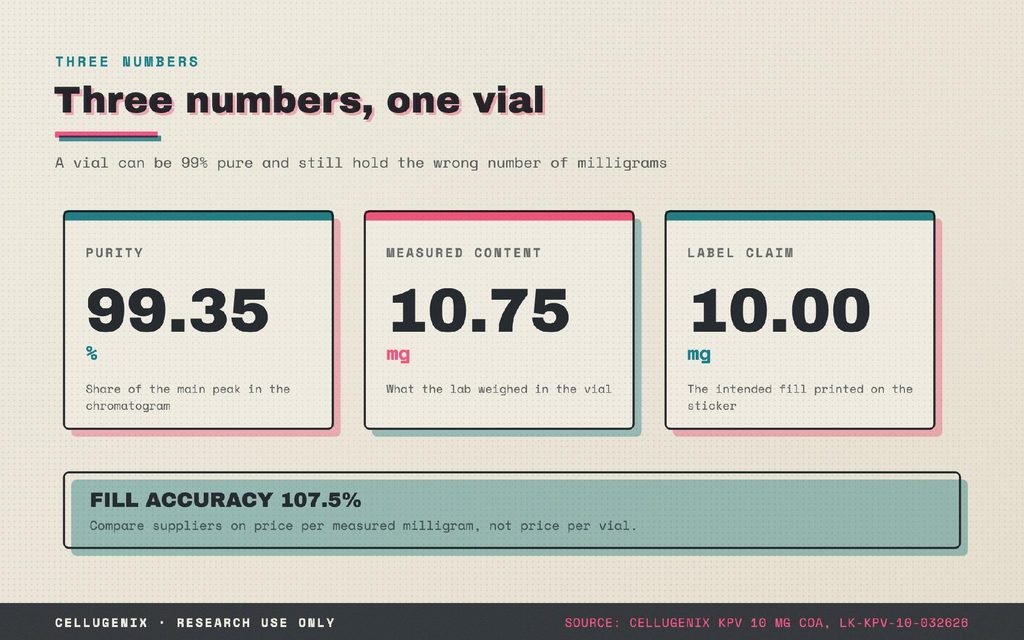
Three gauges comparing 99.35% HPLC purity, 10.75 mg measured content, and a 10 mg label claim on the KPV certificate
The current Cellugenix KPV certificate shows how the pair reads together: 99.35% purity by HPLC-UV, and 10.75 mg measured against a 10 mg label, a fill accuracy of 107.5%. A small overfill is ordinary manufacturing tolerance. An underfill quietly changes every concentration calculated from the label.
Compare price per measured milligram, which works only when the certificate reports content.
7 Red Flags on a KPV COA
- Purity or the lot shown as “Pending” for the batch currently on sale.
- A missing mass result, or an expected value that fits neither 342.43 nor 402.5 g/mol.
- No measured content, only the label milligrams repeated back.
- No salt form anywhere, on the report or the product page.
- No lot number, or one lot code appearing across unrelated products.
- No laboratory named, no report number, and no way to verify the document.
- A test date older than the batch, or one report reused across several vial sizes.
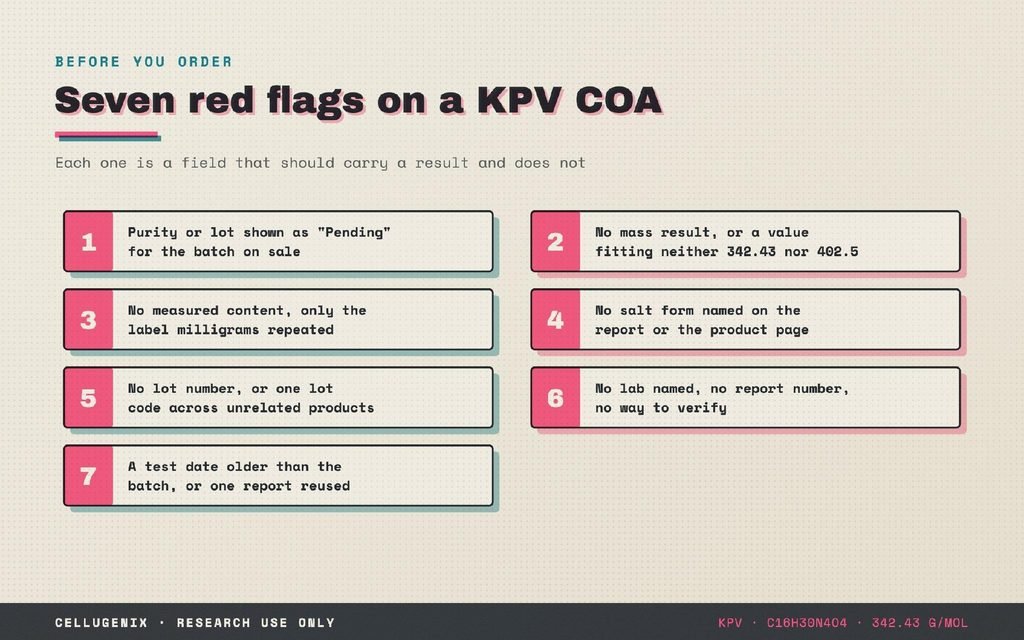
Checklist graphic of seven red flags to look for on a KPV certificate of analysis
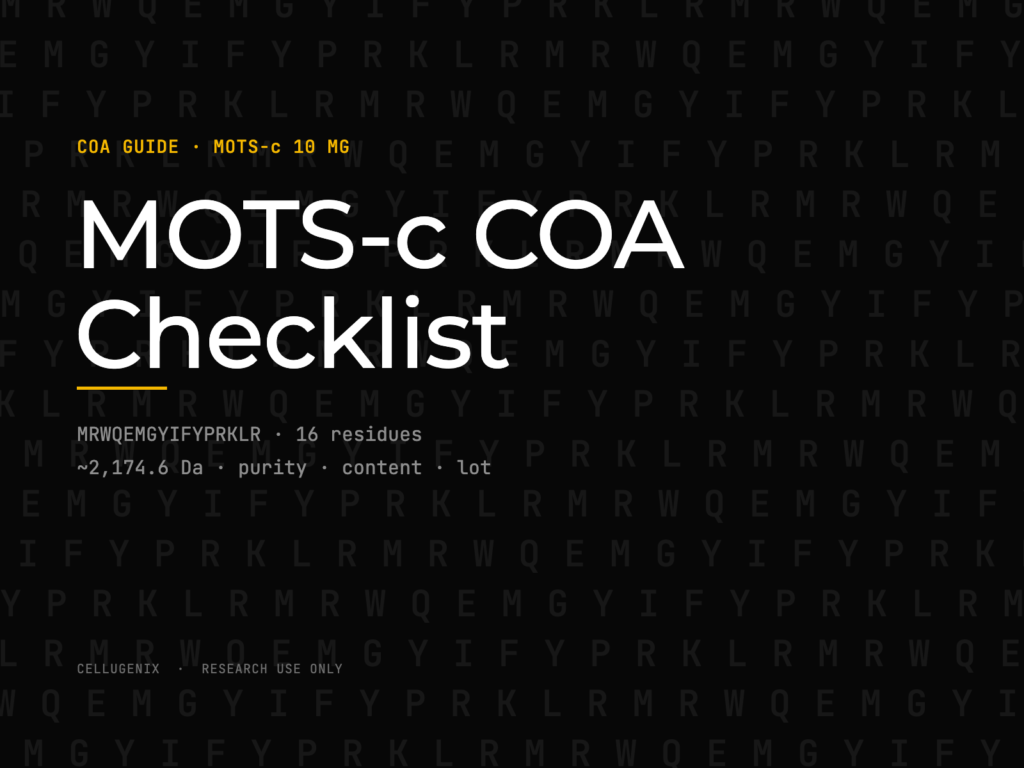
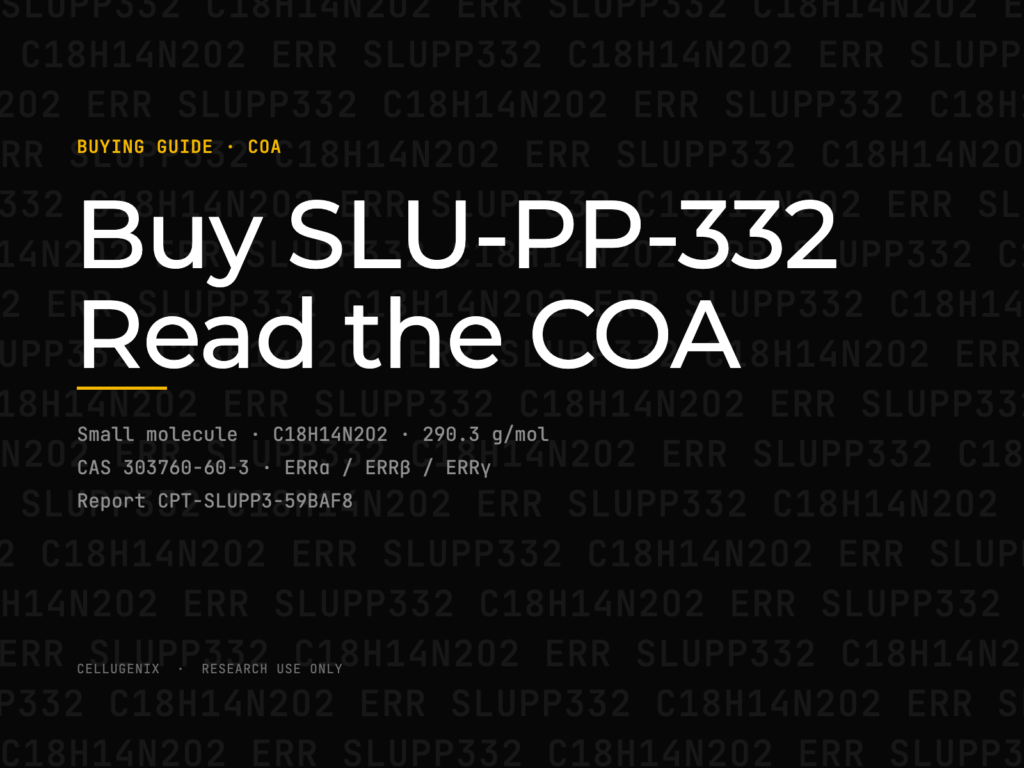
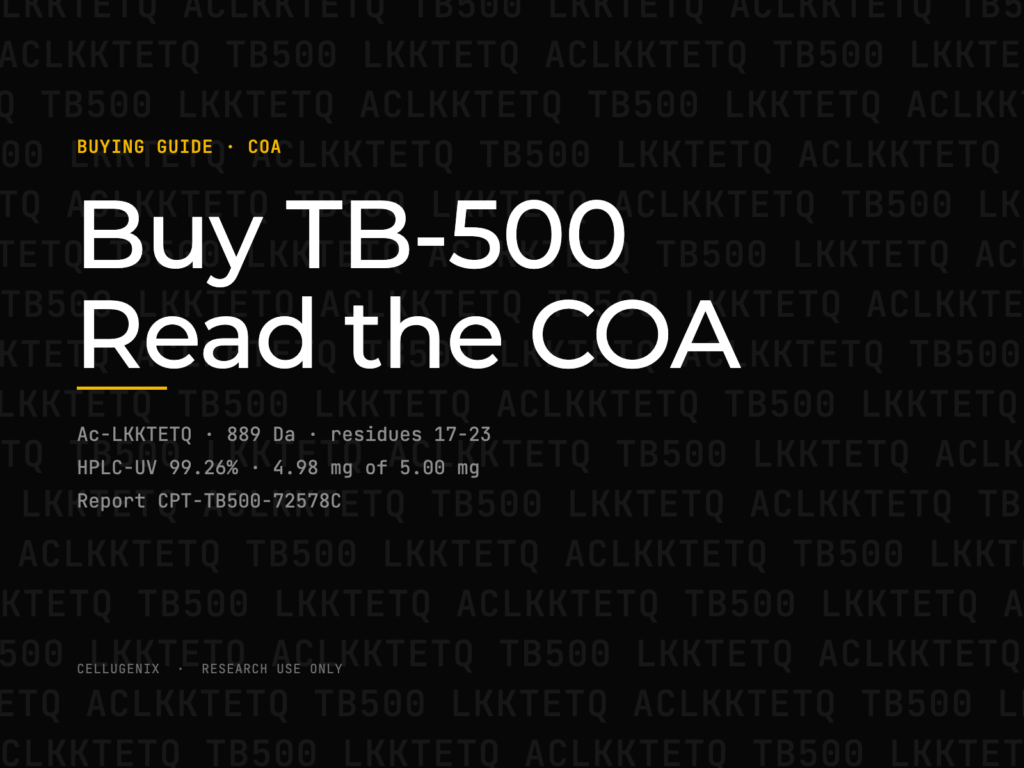
Flags two and four travel together on a peptide this light: 60 g/mol is a big share of 342, so a report with no counter-ion and no mass leaves both identity and arithmetic unresolved. Seven fields decide any certificate, which is why the TB-500 COA checklist turns on a mass near 889 and the SLU-PP-332 COA checklist on 291.
Example: Our KPV 10 mg COA
Quick answer: This is what the current KPV 10 mg certificate reports, field by field, including the fields it leaves blank.
| Field | Result |
| Report number | LK-KPV-10-032626 |
| Laboratory | Testides (independent) |
| Appearance | White lyophilized powder |
| Method | HPLC-UV, 214 nm |
| Purity | 99.35% on this report |
| Measured content | 10.75 mg against a 10 mg label, fill accuracy 107.5% |
| Timeline | Received 26 Mar, tested 28 Mar, reported 29 Mar, generated 3 Apr 2026 |
| Verification | QR code on the document, plus a “Verify on Testides” link |
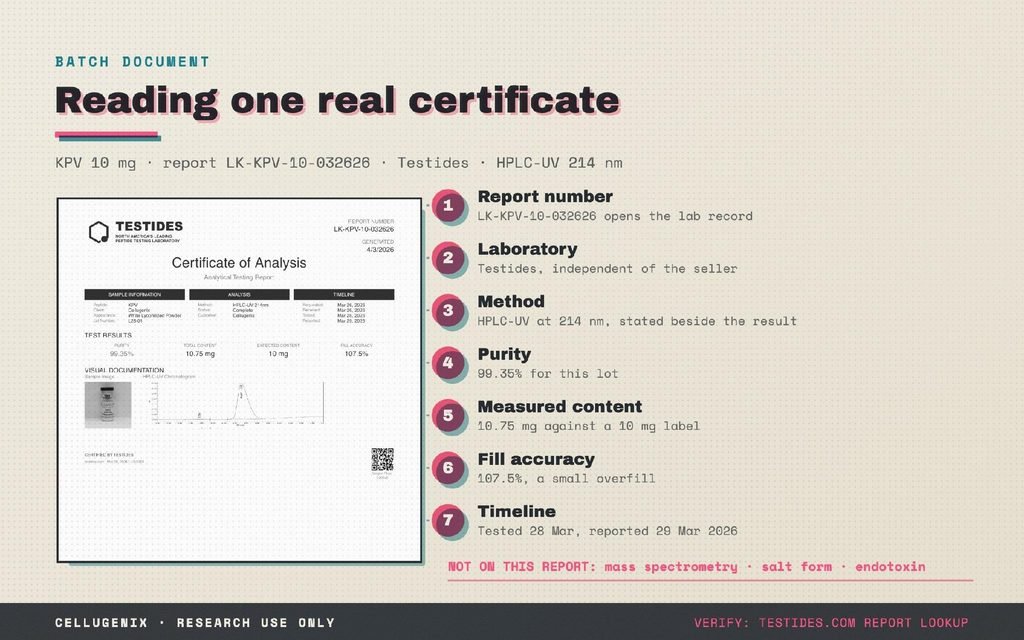
KPV 10 mg certificate of analysis, report LK-KPV-10-032626, HPLC purity and content
Three of those rows are blanks, and saying so is the point of publishing the document. It establishes purity and content by HPLC-UV; identity by mass, and the counter-ion stays open. The KPV 10 mg certificate carries the chromatogram and the QR code behind this table, the buy KPV peptide 10 mg listing shows the vial it belongs to, and the COA library files every other current report by product and lot.
Can You Buy KPV Legally?
Quick answer: In the United States, KPV is not an FDA-approved drug and is not sold over the counter. It is supplied as a research chemical, labelled For Research Use Only, to laboratories.
FDA stated in May 2026 that there is “no applicable United States Pharmacopeia (USP) or National Formulary (NF) drug substance monograph for KPV (free base) or its acetate form, and neither are a component of an FDA-approved drug”. That position is current as of 10 November 2026.
Research peptides and US law in 2026 separate two questions that get mixed together: what a reagent may be sold as, and what an approved medicine may be prescribed for.
KPV and the FDA Compounding Review
A Federal Register notice of 16 April 2026 (Docket FDA-2025-N-6895) scheduled “KPV-related bulk drug substances (KPV (free base)/KPV acetate)” for discussion at the Pharmacy Compounding Advisory Committee meeting on 23 July 2026. FDA’s own reviewers concluded that the criteria “weigh against” placing either form on the 503A bulk drug substances list, and the committee’s 8 to 6 vote the other way, with one abstention, is advisory. A separate HHS enforcement-discretion policy for certain peptide bulk substances was announced in the Federal Register on 30 October 2026 (Docket HHS-OASH-2026-0496), while the 503A list is still being developed through rulemaking. None of this changes the status of research-grade material.
Why Suppliers Ask for Research Confirmation
Most suppliers put a confirmation step in front of the catalogue: an age check and a statement that the order is for in vitro laboratory research. Checkout terms repeat it, and what Research Use Only means is set by how material is labelled and sold.
What Affects the Price of KPV?
Quick answer: Five things move the number: vial size, measured content, purity grade, salt form, and how much testing each lot receives.
A lot released with HPLC purity, content, a mass result and an impurity profile costs more to document than one with purity alone.
Divide by the measured milligrams on the certificate: a 107.5% fill and a 93% fill are different purchases. Then check the published certificate covers the lot shipping today.
Storage When Your KPV Arrives
Quick answer: FDA’s review cites reported stability for lyophilized KPV of up to three years at -20 °C, two years at 4 °C, and three months at 15 °C in a tightly closed container.
Those figures are for the sealed vial. Record the lot and arrival date against the certificate on day one, because the question six months later is which vial produced an odd result.
For assay preparation, the same review puts water solubility for the free base at up to 0.70 mg/mL. Some listings say KPV needs no cold chain in transit, a claim about transit alone. Ranges differ by compound in the storage and handling guide, and what lyophilized means for water content is why a sealed powder tolerates warmer conditions than a solution.
What Is KPV Used For in the Lab?
Quick answer: In vitro, KPV is used as a defined alpha-MSH fragment in cell-based assays, mainly PepT1 transporter uptake work and NF-κB pathway reporter and cytokine-release assays in cultured cell lines.
- PepT1 transporter uptake studies: Dalmasso and colleagues, Gastroenterology, 2008 (PMID 18061177) measured labelled KPV uptake in Caco2-BBE and HT29-Cl.19A epithelial cell lines.
- NF-κB pathway reporter and cytokine-release assays: Land, International Journal of Physiology, Pathophysiology and Pharmacology, 2012 (PMID 22837805) used reporter readouts and p65 translocation in the 16HBE14o cell line.
Both are cell-model studies reporting activity at low concentrations, which puts weight on content accuracy. Protocols running a second reference peptide reach for KPV vs TB-500 compared by structure, or GHK-Cu vs KPV tripeptides where two three-residue sequences are wanted on one plate.
FAQs
Where can I buy KPV peptide online for research?
From a supplier that publishes a certificate for the exact lot shipped, showing purity with its method, measured content, and a lab you can verify independently. The KPV peptide for sale listing should link to that exact report.
How much does KPV cost?
Divide by measured milligrams from the certificate, then confirm it covers the lot on sale. Vial size, salt form, and testing depth explain most of the spread.
Is KPV peptide over the counter?
No. KPV is not an approved drug in the United States and is supplied For Research Use Only. FDA records no USP or NF monograph for either the free base or the acetate.
What is the molecular weight of KPV?
342.43 g/mol for the free base, formula C16H30N4O4, with a monoisotopic mass of 342.23 Da. The 1:1 KPV acetate salt weighs 402.5 g/mol, so the same labelled milligrams contain less peptide.
What mass should a KPV COA show?
For the free base, [M+H]⁺ is near 343.23 m/z. For an acetate salt, the peptide ion stays at 343.23 while the formula weight on the report rises to 402.5.
Is KPV the same as alpha-MSH?
No. KPV is a three-residue fragment, positions 11 to 13, of a 13-residue hormone, and the parent carries a receptor-binding core the fragment lacks.
Where can I get a COA for peptides?
From the supplier’s own COA library, filed by product and lot, then verified with the issuing laboratory using the report number.
Bottom Line
KPV is a roughly 342 Da tripeptide, small enough that a certificate has nowhere to hide. Check purity with its method, a mass near 343, measured milligrams against the label, the salt form, the lot, the test date, and the lab. Where a field is blank, the honest document says so. Check the KPV 10 mg specification and batch COA before ordering.
For laboratory research use only. Not for human or animal use. Full terms are on the legal notice page.
Sources
- PubChem, Lys-Pro-Val, CID 125672, National Library of Medicine. Last checked 10 November 2026. https://pubchem.ncbi.nlm.nih.gov/compound/125672
- FDA, Evaluation of KPV-related Bulk Drug Substances (KPV (free base) and KPV acetate), memo dated 12 May 2026, PCAC briefing package, 23-24 July 2026. Last checked 10 November 2026. https://www.fda.gov/media/193346/download
- Federal Register, Pharmacy Compounding Advisory Committee; Notice of Meeting, 16 April 2026, Docket FDA-2025-N-6895. Last checked 10 November 2026. https://www.federalregister.gov/documents/2026/04/16/2026-07361/pharmacy-compounding-advisory-committee-notice-of-meeting-establishment-of-a-public-docket-request
- Federal Register, Enforcement Discretion Policy Regarding 503A Compounding Using Certain Peptide Bulk Drug Substances, 30 October 2026, Docket HHS-OASH-2026-0496. Last checked 10 November 2026. https://www.federalregister.gov/documents/2026/10/30/2026-22192/enforcement-discretion-policy-regarding-503a-compounding-using-certain-peptide-bulk-drug-substances
- Mendias CL, Awan TM. Preprints.org, posted 24 April 2026, DOI 10.20944/preprints202604.1748.v1 (not peer-reviewed; analytical sections only, n=6,285 Finnrick Analytics reports). Last checked 10 November 2026. https://www.preprints.org/manuscript/202604.1748/v1
- Bachem, Quality Control of Amino Acids and Peptides: A Guide. Last checked 10 November 2026. https://www.bachem.com/knowledge-center/quality-control-of-amino-acids-peptides-a-guide/
- Dalmasso G, Charrier-Hisamuddin L, Nguyen HT, et al. Gastroenterology, 2008;134(1):166-178, PMID 18061177 (cell-assay sections). Last checked 10 November 2026. https://pubmed.ncbi.nlm.nih.gov/18061177/
- Land SC. International Journal of Physiology, Pathophysiology and Pharmacology, 2012;4(2):59-73, PMID 22837805 (cell-assay sections). Last checked 10 November 2026. https://pubmed.ncbi.nlm.nih.gov/22837805/
For laboratory research use only. Not for human or animal use.