Epitalon (Epithalon, AEDG): Identity, Lab Assays and Regulatory Status
Four amino acids, no aromatic ring and one fragile bond: epitalon is about as small as a research peptide gets, and that small size creates most of its lab headaches. This page is a bench-side reference for its identity, its chemistry, the assays it shows up in and its regulatory position as of October 2026. Cellugenix supplies epitalon 10 mg as a laboratory reagent.
Quick answer: What is Epitalon?
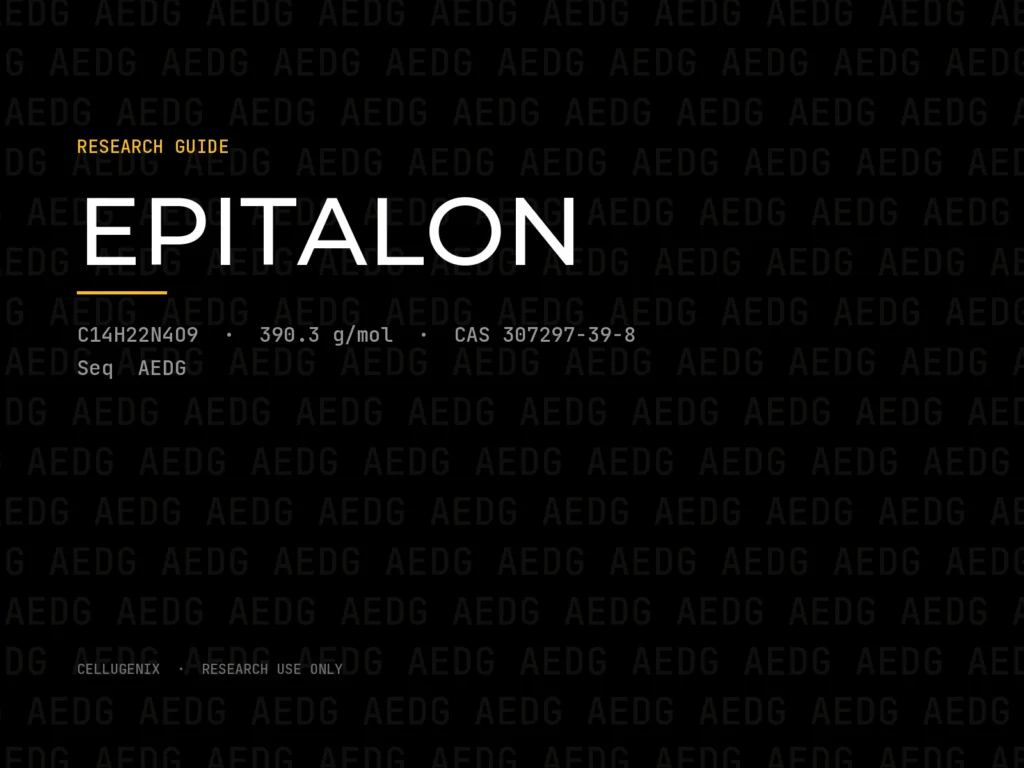
Epitalon is the synthetic tetrapeptide Ala-Glu-Asp-Gly (AEDG), formula C14H22N4O9, average molecular weight 390.35 g/mol, CAS 307297-39-8. Its sequence was modelled on epithalamin, a bovine tissue extract. In the literature it appears mainly in telomerase-activity (TRAP) assays and related cell-culture work.
✓ Four residues, none of them aromatic
✓ Not FDA-approved
✓ Purity is measured by HPLC; see the batch result below
Epitalon at a Glance
Every identifier below comes from PubChem CID 219042 or FDA’s July 2026 epitalon briefing document, except the lot line, which comes from the batch certificate.
| Field | Value |
| Names | Epitalon, epithalon, epithalone, AEDG peptide |
| Sequence | H-Ala-Glu-Asp-Gly-OH (AEDG) |
| IUPAC name | (4S)-4-[[(2S)-2-aminopropanoyl]amino]-5-[[(2S)-3-carboxy-1-(carboxymethylamino)-1-oxopropan-2-yl]amino]-5-oxopentanoic acid |
| Formula | C14H22N4O9 |
| Average molecular weight | 390.35 g/mol |
| Monoisotopic mass | 390.1387 Da |
| CAS (free base) | 307297-39-8 |
| PubChem CID | 219042 |
| FDA UNII | O65P17785G |
| Aromatic residues | None |
| Form | White lyophilized powder in a sealed vial |
| Salt form | Free base or acetate; the certificate should say which |
| Regulatory status | Not FDA-approved; sold for laboratory research only |
| Cellugenix lot | Report CP-EPIT-10-122925, HPLC purity 99.9% |
One detail trips up a lot of buyers. The two salt forms carry different CAS numbers. FDA lists epitalon acetate as CAS 307297-40-1, formula C14H22N4O9·C2H4O2, MW 450.40, and gives it no UNII of its own. A certificate that quotes 390.35 for an acetate salt, or 307297-39-8 for an acetate, has mixed up its forms.
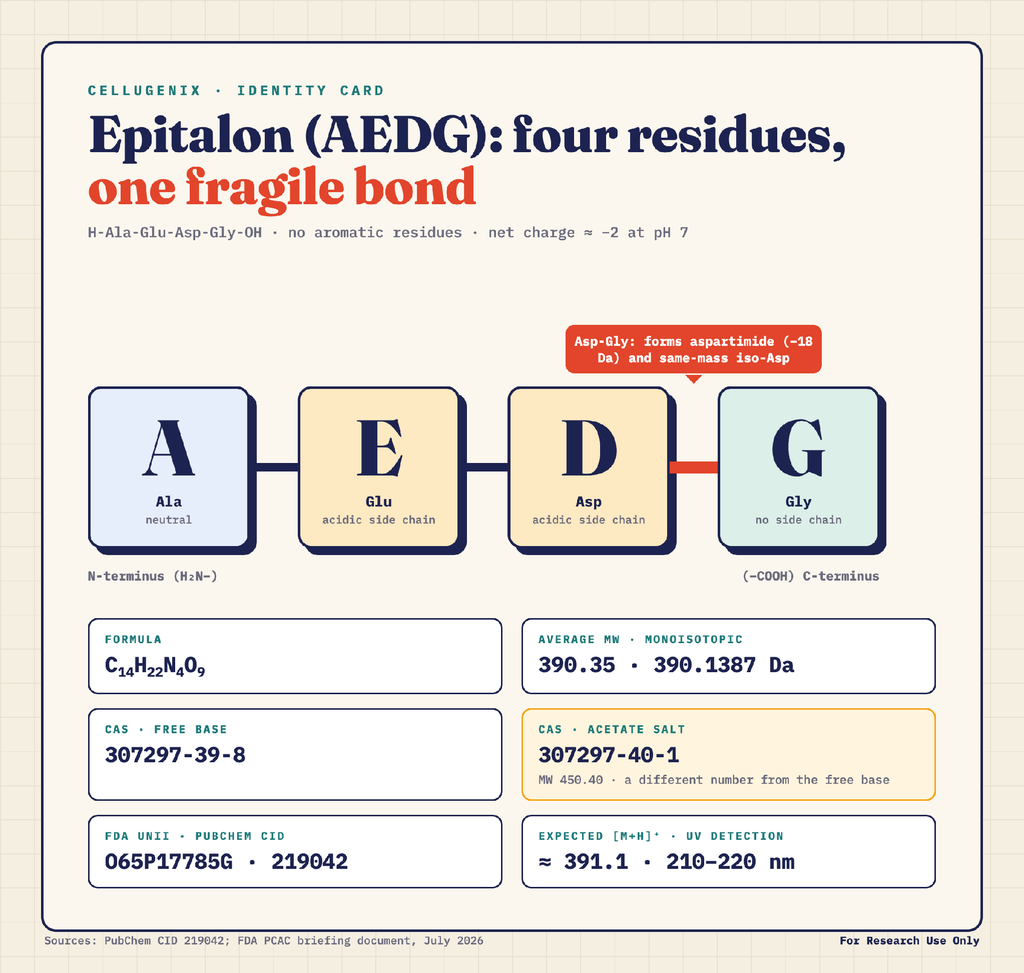
Epitalon identity card: A-E-D-G residue tiles with the Asp-Gly bond marked, formula, masses, CAS numbers for both salt forms, UNII and PubChem CID
What Is Epitalon?
Epitalon is a defined, synthetic four-residue peptide that labs buy as a characterised reagent. The sections below sort out the naming, the origin story, and why a fixed sequence makes the lab side easier.
Epitalon or Epithalon? One Molecule, Two Spellings
Both spellings name the same molecule, Ala-Glu-Asp-Gly. “Epitalon” is the more common form in English papers, while “epithalon” and “epithalone” follow transliterations from Russian. FDA’s briefing treats epitalon, epithalon, and Ala-Glu-Asp-Gly as interchangeable terms. Search all three when you run a literature review.
Where Epitalon Came From
The story starts with epithalamin, a polypeptide complex extracted from bovine pineal tissue. According to FDA’s briefing, epitalon was first synthesized in the late 1980s by researchers led by Professor Vladimir Khavinson in Saint Petersburg, Russia. They built the tetrapeptide from an amino-acid analysis of the extract, so the synthetic peptide has a fixed sequence, and the extract has a variable mix.
Why a Defined Sequence Helps in the Lab
A fixed sequence gives every batch one target mass, one main HPLC peak, and one identity to check. That still leaves room for error. The 2025 review by Araj and colleagues describes a published “double-gamma” variant built from the same atoms but linked through side-chain carboxyl groups. It has the same mass, and the backbone is different.
Epitalon vs Epithalamin: Synthetic Peptide vs Tissue Extract
Epitalon and epithalamin are two different test materials. FDA says so directly: it “considers epitalon and epithalamin as different substances” and notes that epithalamin isn’t listed as a synonym for epitalon’s UNII in its substance registry. The table compares them as materials only.
| Feature | Epitalon | Epithalamin |
| Source | Solid-phase chemical synthesis | Extracted from bovine tissue |
| Composition | One tetrapeptide, Ala-Glu-Asp-Gly | A polypeptide complex |
| Formula | C14H22N4O9 | None (a mixture) |
| CAS | 307297-39-8 (free base) | No single CAS for a mixture |
| Identity check | HPLC retention plus mass, against one target | Fingerprint profile of many components |
| Batch consistency | Set by synthesis and purification | Depends on the source tissue and extraction |
| US availability | Research suppliers, labelled RUO | No US supply route identified |
The practical upshot is simple. Data generated with epithalamin can’t be carried over to epitalon, or the other way round, because the two materials differ in composition. When a paper’s methods section says “tissue peptide preparation” without a sequence, check which one the authors used before comparing results.
Epitalon’s Chemistry and the Asp-Gly Bond
Epitalon’s chemistry comes down to three facts. It’s very polar, it carries no chromophore that absorbs near 280 nm, and its Asp-Gly junction is one of the most reaction-prone links in peptide chemistry. Each one shapes how the peptide is stored, separated, and checked.
Residues, Charge and Solubility
The four residues are alanine, glutamic acid, aspartic acid, and glycine. Three of the five ionizable groups are acids (the Glu and Asp side chains plus the C-terminal carboxyl), so at neutral pH the peptide carries a net charge of about −2. PubChem gives it a computed XLogP of −5.5, which marks it as strongly water-loving.
Solubility data is thin. FDA’s July 2026 briefing says there’s “limited reliable aqueous solubility data in the literature” for the free base. The batch documentation is the place to check solubility for assay preparation.
The Asp-Gly Hotspot: Aspartimide and iso-Asp
Aspartimide forms when the aspartic acid side chain attacks the backbone nitrogen of the next residue and closes into a five-membered ring, losing one water molecule (−18 Da). Water then reopens that ring at either carbonyl. One path restores normal Asp, and the other gives iso-aspartate, where the chain runs through the side-chain carbon.
Glycine makes this fast. It has no side chain to block the attack, and an ab initio study in the Journal of the American Chemical Society found Asp-Gly and Asn-Gly peptides degrade about an order of magnitude faster than their size alone predicts.
This is why a COA needs a good separation. Iso-Asp epitalon has the same formula and mass as the intact peptide, so only chromatography can tell the two apart.
Why Epitalon Is Hard to See by UV
No tryptophan, tyrosine, or phenylalanine means nothing in epitalon absorbs well at 280 nm. Labs detect it through the peptide bonds at 210 to 220 nm, where solvents and buffers also absorb. Being so polar, it elutes early on a standard C18 column, close to the solvent front, where retention is weakest, and small impurities can hide in baseline noise.
What Is Epitalon Used For in Research? Assays and Models
In research, epitalon is used as a test compound in telomerase-activity (TRAP) assays, telomere-length measurements, gene-expression and chromatin studies, antioxidant-enzyme assays, and docking models. It also serves as a reference peptide in HPLC and mass-spectrometry identity work. The subsections describe what each method measures.
Telomerase-Activity Assays (TRAP)
TRAP stands for Telomeric Repeat Amplification Protocol, introduced by Kim and colleagues in Science in 1994. Cell extract is mixed with a short DNA primer. Any active telomerase in the extract adds TTAGGG repeats to it, and PCR then amplifies those products for reading on a gel or in real time.
Good TRAP runs carry three controls:
- Negative: heat-treated or RNase-treated extract, which should show no ladder.
- Positive: extract from a telomerase-positive line such as HeLa.
- Internal standard: an amplification control that catches PCR inhibition.
Telomere-Length Measurement
Three methods dominate, and each has a blind spot.
- qPCR (T/S ratio): Cawthon’s 2002 method compares telomere signal with a single-copy gene. It’s fast and needs little DNA, but it reports a relative average.
- Q-FISH: fluorescent probes on metaphase chromosomes give length per chromosome arm. It needs dividing cells and imaging.
- TRF (Southern blot): the reference method. It needs micrograms of DNA and includes some subtelomeric DNA in the length.
Gene-Expression and Chromatin-Binding Studies
Gene-expression work measures transcript levels, usually by RT-qPCR or array panels, in cultured cells and rodent tissue samples. Chromatin studies look at condensation and heterochromatin staining in cultured lymphocytes. On the binding side, researchers have tracked DNA melting temperature by UV absorbance at 260 nm and run docking and molecular-dynamics models of epitalon against DNA sequences and histone proteins, with the H1 variants as the focus.
Other Assays
Antioxidant-enzyme assays measure superoxide dismutase, catalase, and glutathione peroxidase activity in tissue or cell samples. Epitalon also works as an analytical standard. A 2015 study in Drug Testing and Analysis used a reference sample and LC-MS/MS to confirm the peptide’s identity in seized products.
How the Literature Is Organized
Sorting the papers by what was measured gives a cleaner map than sorting by headline claims. This table lists endpoint names only, drawn from the Araj review and FDA’s briefing.
| Model | Endpoints measured |
| Cell cultures (HeLa, human fetal lung fibroblasts 602/17) | Telomerase activity (TRAP), telomere length |
| Drosophila melanogaster | Lipid peroxidation, antioxidant-enzyme activity |
| Rodents (mice, rats) | Tissue gene expression, SOD, catalase and glutathione peroxidase activity |
| Rhesus monkeys | Plasma markers sampled across the 24-hour cycle |
| Human-derived material, in vitro | Chromatin condensation in cultured lymphocytes; LC-MS identity in tissue extract |
| In silico and biophysical | Docking to DNA and histone H1; DNA melting temperature |
One pattern stands out. FDA’s briefing notes that most pharmacological studies of epitalon “have been conducted and published by Dr. Khavinson’s research group in Russia.” Independent replication is thin, so a single lab’s protocol often defines the method for a whole endpoint. The Araj review adds that physico-chemical and structural studies of the peptide “remain quite limited.”
Is Epitalon FDA-Approved? Regulatory Status (October 2026)
No. Epitalon isn’t an FDA-approved drug, and a Drugs@FDA search run on October 13, 2026 returns no approved product. In July 2026, FDA’s own staff proposed against adding it to the list of bulk substances that pharmacies can compound, and no final FDA action has followed.
FDA Approval
Drugs@FDA lists no application for epitalon, epithalon, or Ala-Glu-Asp-Gly. With no approved product, no FDA-approved labelling exists either. Research suppliers sell it as a laboratory reagent marked Research Use Only.
The July 2026 PCAC Review and the 503A List
FDA’s Pharmacy Compounding Advisory Committee (PCAC) met on July 23 and 24, 2026, with epitalon free base and epitalon acetate on the July 24 agenda. The original nominations had been withdrawn, so FDA evaluated both forms on its own initiative.
The briefing document gives FDA’s position plainly: “we propose not adding epitalon (free base) or epitalon acetate to the 503A Bulks List.” Its chemistry review flagged no certificate for the free base, limited solubility data, and possible aggregation.
Committee votes are advisory, and FDA makes the final call through rulemaking. As of October 13, 2026, the meeting page posts no minutes or vote record, and 21 CFR 216.23, the codified 503A list, doesn’t include epitalon.
What This Means for Research-Grade Epitalon
The PCAC process covers pharmacy compounding only. Research-grade epitalon stays a laboratory reagent, supplied to qualified researchers.
| Item | Status (October 13, 2026) | Source |
| FDA-approved product | None | Drugs@FDA |
| FDA staff proposal, July 2026 | Do not add to the 503A Bulks List | FDA briefing document |
| PCAC minutes and vote record | Not posted | FDA meeting page |
| Codified 503A Bulks List | Epitalon not listed | 21 CFR 216.23 (eCFR) |
Storage of the Sealed Vial
Epitalon ships as a lyophilized (freeze-dried) solid in a sealed vial. Store sealed vials as stated on the label, protected from light and moisture, following cold, dry, dark storage for the temperature range. Each vial is labelled with its lot number, which ties it to its certificate.
Moisture is what drives the Asp-Gly reaction, so log each lot’s test date next to the date you received it. The current certificate was tested in January 2026.
How to Verify Research-Grade Epitalon
To verify epitalon, match the vial’s report number to a lab record you can open yourself. Then check the sequence, purity, content and method on that record. For a peptide this small and polar, the chromatogram tells you more than the headline percentage.
The COA Checklist
- Report number. It matches the vial label and opens a live record on the testing lab’s own site.
- Compound and sequence. The record names epitalon and, ideally, Ala-Glu-Asp-Gly.
- Salt form. Free base (390.35) or acetate (450.40), with the matching CAS.
- HPLC purity with the trace. A purity figure should come with its chromatogram.
- Content. Measured milligrams against the labelled amount.
- Method details. Column type and detection wavelength, ideally 210 to 220 nm.
- Dates. Sample received, tested and reported, all in a sensible order.
Reading the Chromatogram for a Polar Tetrapeptide
Expect the main peak early in the run, close to the solvent front. Look closely at its shoulders, since iso-Asp epitalon and other same-mass impurities tend to elute right beside the parent. A clean, symmetrical peak backed by a flat baseline at low wavelength is a good sign; a figure of 99.9% with no trace attached is only half the evidence.
Mass Identity
The expected protonated ion is [M+H]+ ≈ 391.1. An aspartimide impurity would show 18 Da lower, and iso-Asp shows no mass change at all. The Vanhee study also flagged a same-mass sequence swap (Glu-Ala-Asp-Gly) and separated it using pyroglutamate formation. The current Cellugenix certificate doesn’t include a mass-spectrometry result.
The Current Cellugenix Lot
Report CP-EPIT-10-122925 verifies on the testing lab’s archive at 99.9% HPLC purity. It measured 10.92 mg against 10 mg expected, and it was tested on January 6, 2026. The same report appears in our COA library, and our guide on how to read a COA covers each field.
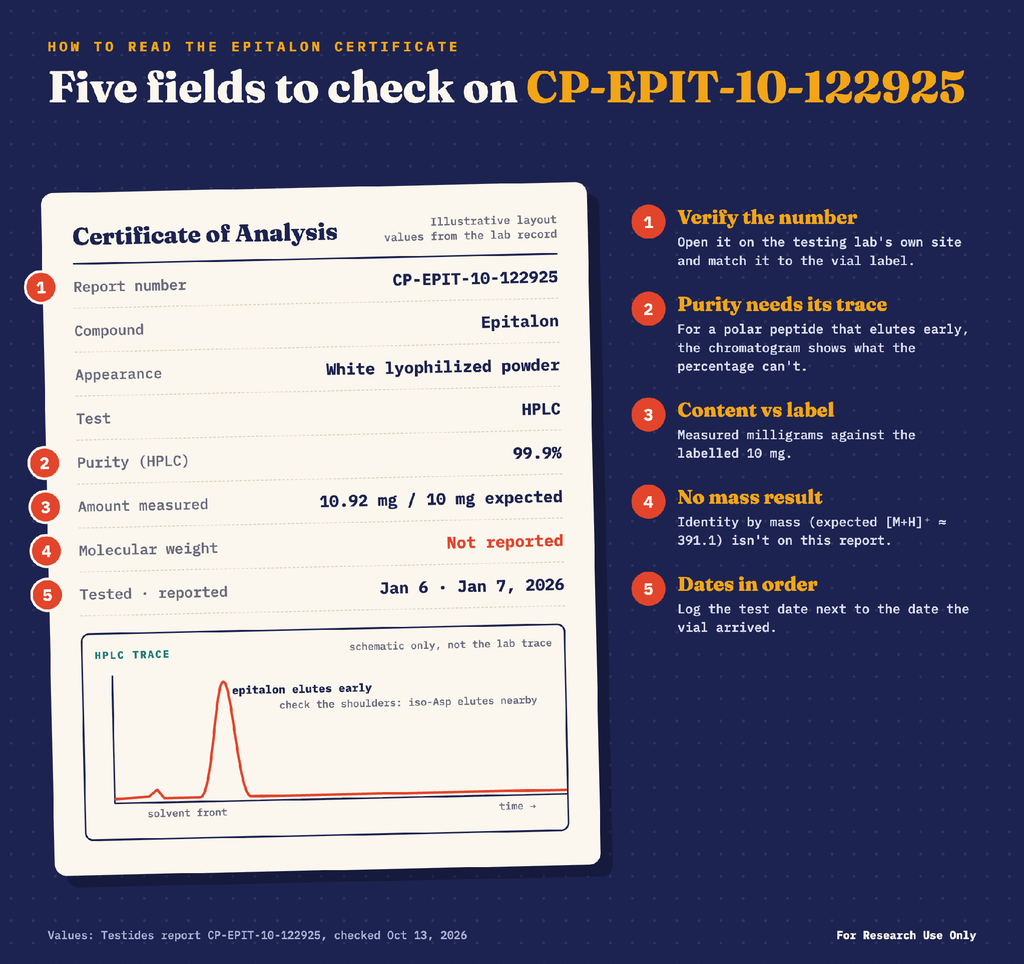
Annotated certificate layout for report CP-EPIT-10-122925, marking report number, HPLC purity, content, test dates and the missing molecular-weight field
FAQ
What is epitalon?
Epitalon is a synthetic tetrapeptide with the sequence Ala-Glu-Asp-Gly (AEDG). Its formula is C14H22N4O9 and its average molecular weight is 390.35 g/mol. Researchers designed it in the late 1980s from an amino-acid analysis of epithalamin, a tissue extract. Today it’s supplied as a lyophilized laboratory reagent and is used mainly in cell-culture and analytical research.
Is epitalon the same as epithalon?
Yes. Epitalon, epithalon, and epithalone all name the same four-residue peptide, Ala-Glu-Asp-Gly, with CAS 307297-39-8 for the free base. The spellings come from different transliterations of the Russian name. FDA’s July 2026 briefing document treats the terms as interchangeable, so search all three spellings in literature databases to catch every paper.
What is the molecular weight and CAS number of epitalon?
Epitalon free base has an average molecular weight of 390.35 g/mol and a monoisotopic mass of 390.1387 Da. Its CAS number is 307297-39-8. The acetate salt is a separate entry: CAS 307297-40-1, molecular weight 450.40. Check which form your certificate reports, because the two numbers aren’t interchangeable.
What is the difference between epitalon and epithalamin?
Epitalon is one synthetic peptide with a fixed sequence, formula and CAS number. Epithalamin is a polypeptide mixture extracted from bovine tissue, with no single formula. FDA classes them as different substances. In practice, results gathered with one material can’t be applied to the other, since the compositions differ.
What is epitalon used for in research?
Epitalon is a test compound in telomerase-activity (TRAP) assays, telomere-length measurements by qPCR, Q-FISH or TRF, gene-expression and chromatin studies, and antioxidant-enzyme assays. Models range from HeLa cells and fibroblasts to Drosophila, rodents and docking simulations. Analytical labs also use it as a reference standard for HPLC and LC-MS identity checks.
Is epitalon FDA-approved?
No. Drugs@FDA lists no approved epitalon product as of October 13, 2026. FDA reviewed epitalon for its 503A compounding list in July 2026, and its staff briefing proposed not adding either the free base or the acetate. The codified list doesn’t include it. Research suppliers sell epitalon for laboratory use only.
The Bottom Line
Epitalon is a small, polar, aromatic-free tetrapeptide with an Asp-Gly bond that can quietly turn into a same-mass impurity. Those traits make the certificate the most useful thing you’ll check: a verifiable report number, a chromatogram and a clear salt form. New to reagent peptides? Start with our overview of what research peptides are.
For laboratory research use only. Not for human or animal use. Products are supplied to qualified purchasers under our Terms of Service.
References
- Araj SK, Brzezik J, Mądra-Gackowska K, Szeleszczuk Ł. International Journal of Molecular Sciences, 2025; 26(6): 2691. doi:10.3390/ijms26062691.
- FDA. Briefing document, epitalon-related bulk drug substances, Pharmacy Compounding Advisory Committee, July 23-24, 2026.
- FDA. Pharmacy Compounding Advisory Committee meeting page, July 23-24, 2026, accessed October 13, 2026.
- FDA. Drugs@FDA database, searched October 13, 2026.
- eCFR. 21 CFR 216.23, accessed October 13, 2026.
- PubChem. Epitalon, CID 219042.
- Kim NW, Piatyszek MA, Prowse KR, et al. Science, 1994; 266(5193): 2011-2015. PMID 7605428.
- Cawthon RM. Nucleic Acids Research, 2002; 30(10): e47. PMID 12000852.
- Radkiewicz JL, Zipse H, Clarke S, Houk KN. Journal of the American Chemical Society, 2001; 123(15): 3499-3506. PMID 11472122.
- Vanhee C, Moens G, Van Hoeck E, et al. Drug Testing and Analysis, 2015; 7(3): 259-264. PMID 25535022.
- Testides. Report CP-EPIT-10-122925.
For laboratory research use only. Not for human or animal use.