Buying Selank Peptide for Research: What the COA Should Show
Selank is a chain of seven amino acids, sold to labs as a white powder in small glass vials. A vial labelled 5 mg might hold 5 mg of it, or it might hold 4.31 mg, and both labels are honest. The difference is a salt.
Selank comes in three versions: the compound on its own, and two more with acetate attached, a small molecule that gets weighed along with it. So anyone about to buy Selank peptide is choosing between 4.31 mg and 5.00 mg of actual compound under the same number, and the batch certificate is the only place that difference is written down.
The certificate details the rest of it too: how pure the batch was, how much was really in the vial, which lab ran the test, and when. Our own Selank report is the worked example below, including the two fields it leaves blank.
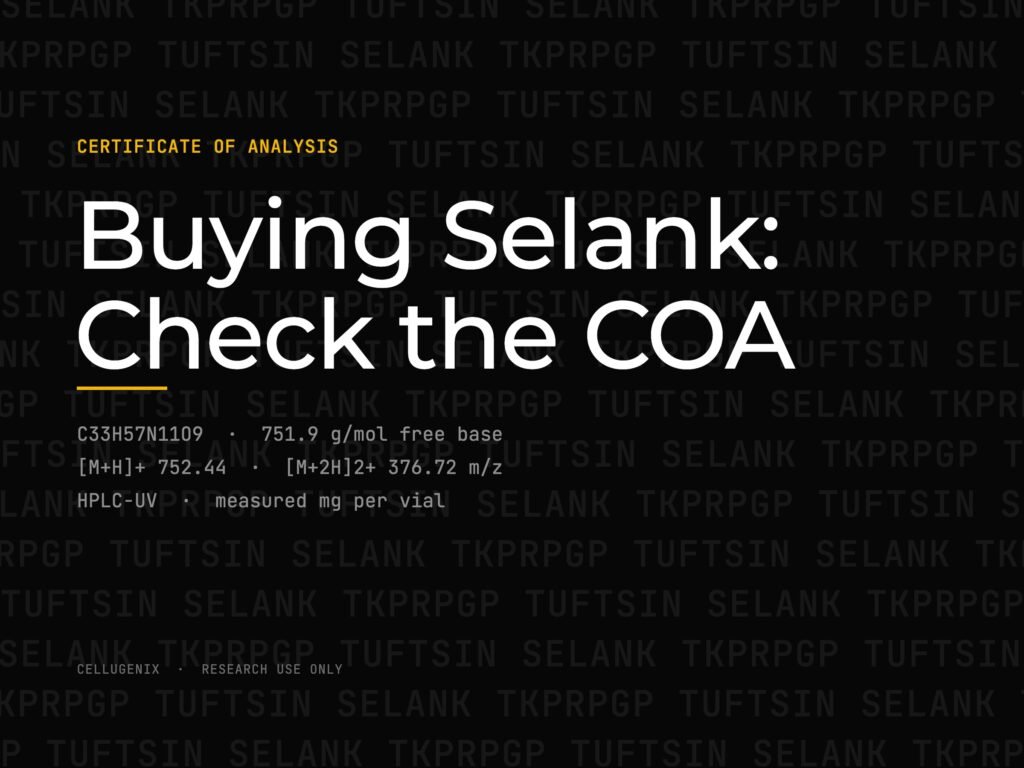
Quick answer: Before you buy Selank, check the batch COA. Selank is the heptapeptide Thr-Lys-Pro-Arg-Pro-Gly-Pro (C33H57N11O9, about 752 Da). The COA should show HPLC purity with a chromatogram, a mass matching about 752 m/z for [M+H]⁺, the measured mg in the vial, the salt form, a lot number that matches your vial, a test date, and an independent lab you can verify.
Seven things to check before ordering
- The mass: about 752 for [M+H]⁺, or 376.7 for [M+2H]²⁺
- HPLC purity, with the chromatogram
- The measured mg per vial
- The salt form, stated
- The lot on the vial matching the lot on the COA
- The test date and the laboratory
- A verifiable link or report number that opens the lab’s own record
This guide covers identification and documentation only. Selank is sold For Research Use Only.
What You’re Buying: Selank (TKPRPGP) at a Glance
Quick answer: Selank is a synthetic seven-residue peptide: tuftsin (Thr-Lys-Pro-Arg) extended with Pro-Gly-Pro. At about 752 Da it gives one main HPLC peak and a clean mass signal, leaving a certificate few places to be vague.
| Identifier | Value | Why it matters on a certificate |
| Sequence | H-Thr-Lys-Pro-Arg-Pro-Gly-Pro-OH (TKPRPGP) | The report should print the sequence in full |
| Origin | Tuftsin (TKPR) extended with Pro-Gly-Pro | Explains the two catalogue names |
| CAS (free base) | 129954-34-3 | Each salt form has its own CAS; this one means free base |
| PubChem CID | 11765600 | The public record to check against |
| Formula (free base) | C33H57N11O9 | A different formula means a different form |
| Molecular weight (free base) | 751.9 g/mol | Every content calculation runs from it |
| Monoisotopic mass | 751.43 Da | The basis for both expected ions |
| Expected ions | [M+H]⁺ 752.44, [M+2H]²⁺ 376.72 | Two charge states, one compound |
| Appearance | White lyophilized powder | A form note is a real data point |
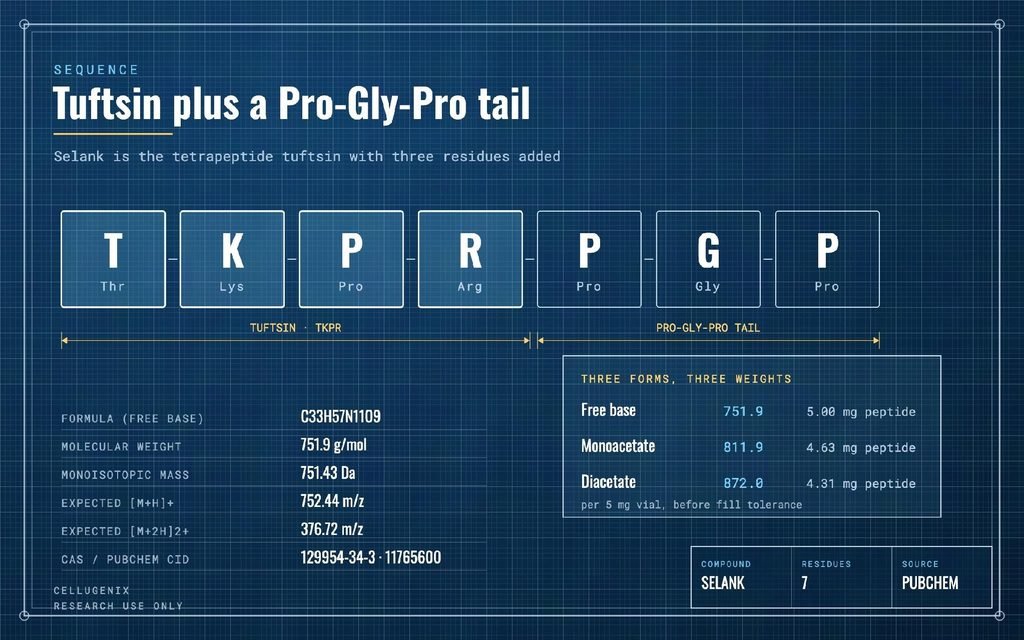
Sequence graphic showing tuftsin TKPR plus Pro-Gly-Pro making the Selank heptapeptide, with formula C33H57N11O9 and molecular weight 751.9 g/mol
Those values come from PubChem CID 11765600, where CAS 129954-34-3 resolves to the same record. A monoisotopic mass of 751.43 gives 752.44 for the singly protonated ion and 376.72 for the doubly protonated one, because the second charge halves the measured value.
Free Base or Diacetate: Why the Salt Changes the mg
Selank is supplied as a free base and as an acetate salt, and the acetate comes in two versions. Each acetate group adds about 60 g/mol, and each has its own catalogue identity.
| Form | Formula | Weight | Identifier | Peptide in a 5 mg vial |
| Free base | C33H57N11O9 | 751.9 g/mol | CAS 129954-34-3 | 5.00 mg |
| Monoacetate | C35H61N11O11 | 811.9 g/mol | CAS 2703745-90-6 | 4.63 mg |
| Diacetate | C37H65N11O13 | 872.0 g/mol | PubChem CID 155804769 | 4.31 mg |
Cayman Chemical lists its Selank as the monoacetate at 811.9 under that separate CAS number, and the diacetate is a distinct PubChem record again. So a weight near 812 on a listing names a real form, and the same “5 mg” covers 4.31 mg to 5.00 mg of peptide depending on which shipped. That spread is wider than the fill tolerance most certificates report.
A good report names the form and says whether “content” counts peptide or salt. Where it does neither, only the supplier has the Selank diacetate or free-base answer.
Selank vs Semax vs N-acetyl Selank
Three names travel together in catalogues and cover three substances. Semax is an ACTH(4-10) analogue carrying a sulfur atom, about 62 Da heavier. N-acetyl Selank amidate has a modified terminus and a different mass again. Semax vs Selank compared sets the sequences and expected ions side by side; it’s the check to run when a certificate’s name and its formula disagree.
What a Selank COA Should Show: The Checklist
Quick answer: One lot, one report, one named laboratory, showing purity by HPLC with its chromatogram, identity by mass, and content in milligrams. A purity figure describes the chromatogram. Naming the peak as Selank is a separate test, and so is weighing the vial.
| COA field | What it tells you | What to look for | Red flag |
| Purity (HPLC-UV) | Share of the main peak | A percentage with the chromatogram, method, and wavelength | “Pending”, a round 100%, or no chromatogram |
| Identity (LC-MS) | Mass of the main peak | [M+H]⁺ near 752.4, or [M+2H]²⁺ near 376.7 | A mass fitting no form in the table above |
| Content | Milligrams of peptide in the vial | A measured figure next to the labelled one | Content not reported |
| Salt / counter-ion | Free base, monoacetate or diacetate | Named, with content counted as peptide or salt | Absent from every field |
| Lot number | Which vials were tested | A code matching the vial label | Missing, or one code across unrelated products |
| Dates | When the sample was run | Test and report dates consistent with the batch on sale | A report older than the batch, or a date left as N/A |
| Laboratory and verification | Who ran it | A named lab, a report number, and a verify link | In-house testing only |
| Form | What was tested | “Lyophilized powder” for a vial | A liquid’s report used for a powder, or the reverse |
| Endotoxin (optional) | Bacterial endotoxin | Units stated as EU/mg | Methods listed with no results |
That form row matters more for Selank than for most compounds: the same label quantity is sold as powder in a vial and as a solution in millilitres, and a report on one cannot describe the other.
Purity: Reading the HPLC Chromatogram
A usable chromatogram shows one tall main peak with small, well-separated side peaks, each labelled with its retention time. On the current Selank report, the main peak sits at 6.62 minutes, with small peaks at 6.96 and 7.42 minutes.
The printed trace has an edge worth noticing: its window begins at 5.00 minutes, so anything eluting earlier sits outside the picture, and short polar fragments are the impurities that run early. The integration table settles what the image cannot. Working through how to read purity on a COA is mostly this kind of close reading.
Identity: Which Mass to Look For
Expect [M+H]⁺ near 752.44, or the doubly charged ion near 376.72. A seven-residue peptide with two basic residues picks up the second charge readily, so a report quoting 376.7 is describing the same molecule. A figure near 812 or 872 fits the mono- and diacetate salts; anything matching none of the three is worth querying. Purity and identity answer separate questions, and the split between HPLC vs mass spectrometry decides whether the main peak was identified or only measured.
Lot, Date and Lab Verification
Match the lot on the vial to the lot on the certificate, then open the lab’s record through the QR code or report number. Suppliers who publish independent lab testing records make that quick, and a certificate with no route back to the signing lab leaves the claim unchecked.
Date fields reward a second look. A report with a test date but “N/A” where the reported date belongs is still a valid test, and a prompt to ask when it was issued and against which batch.
Endotoxin Units
EU/mg, EU/mL, and a bare pass or fail are three different statements, and converting between them needs the measured content. Endotoxin stays optional for most cell-culture work: across 6,285 publicly posted third-party reports it appeared on fewer than 4%, so its absence is the norm. Reading how to read a COA field by field covers the unit housekeeping.
Purity, Content and Label: Three Different Numbers
These three get quoted as if they were interchangeable.
Purity: The main peak’s share of everything the detector saw.
Content: The milligrams measured in the vial.
Label: The intended fill printed on the sticker.
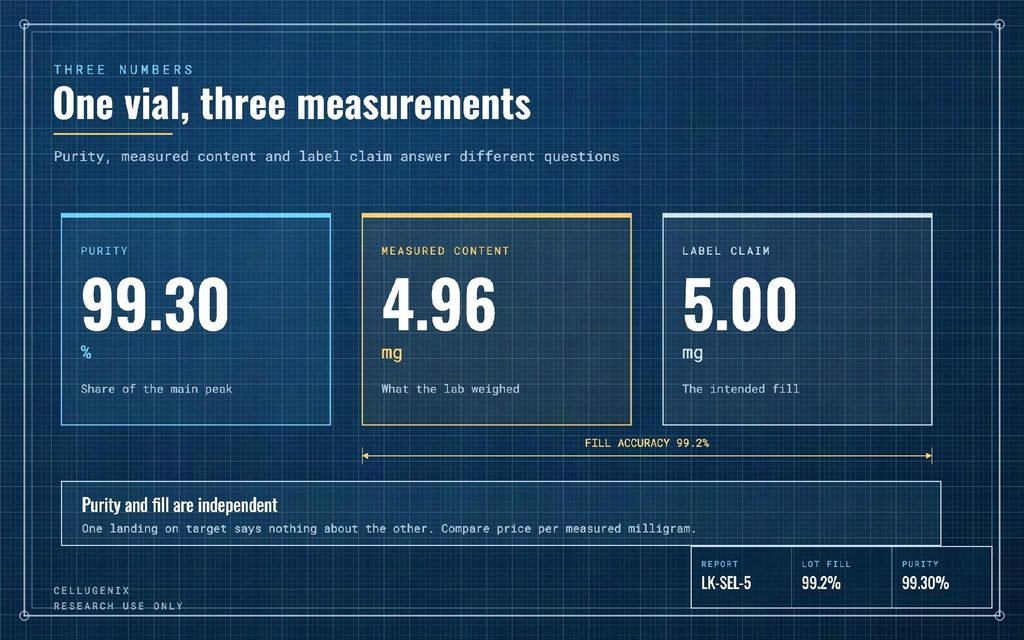
Three gauges comparing 99.30% HPLC purity, 4.96 mg measured content, and a 5 mg label claim on the Selank certificate
The current Selank certificate reads 99.30% purity with 4.96 mg measured against a 5 mg label, a fill accuracy of 99.2%. Both land close to target on that lot, which is the useful case to study: the two numbers are independent, and one landing well says nothing about the other.
Across 6,285 publicly posted third-party reports from 203 suppliers, 44.3% of samples met a 99.5% purity bar and still fell outside a 95% to 105% window on measured amount (Mendias and Awan, preprint, 2026). A further 2.4% covered material that did not contain the stated peptide, which is what identity testing catches.
Compare price per measured milligram of peptide, after the salt form is settled.
7 Red Flags on a Selank COA
- Purity or the lot marked “Pending” for the batch currently on sale.
- A missing mass, or a formula matching none of the three forms above.
- No measured content, with only the labelled milligrams repeated.
- No salt form anywhere, on the report or the product page.
- No lot number, or one lot code appearing across unrelated products.
- No laboratory named, no report number, and no way to verify the document.
- A report covering a different form or size, a liquid standing in for a powder or a 10 mg run reused for a 5 mg vial.
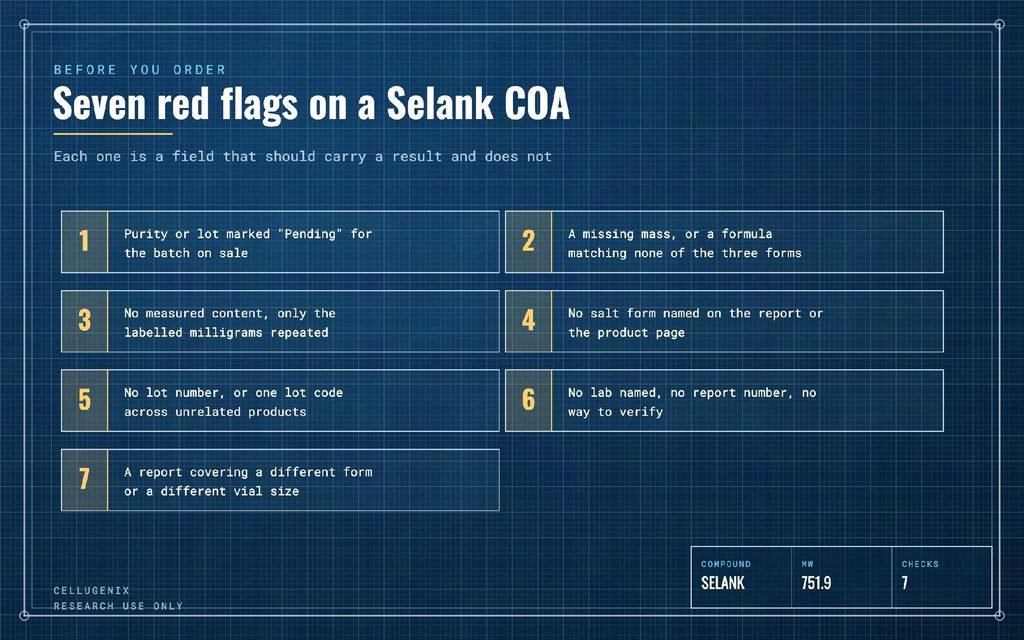
Checklist graphic of seven red flags to look for on a Selank certificate of analysis
The seven fields stay the same whatever is in the vial; only the target numbers move, which is why the KPV COA checklist turns on a mass near 343 and the TB-500 COA checklist on 889.
Example: Our Selank 5 mg COA
Quick answer: This is what the current Selank 5 mg certificate reports, field by field, including the fields it leaves blank.
| Field | Result |
| Report number | LK-SEL-5-021126 |
| Laboratory | Testides (independent) |
| Appearance | White lyophilized powder |
| Method | HPLC-UV, with no wavelength stated |
| Purity | 99.30% on this report |
| Measured content | 4.96 mg against a 5 mg label, fill accuracy 99.2% |
| Chromatogram | Main peak 6.62 min, small peaks 6.96 and 7.42 min, window from 5.00 min |
| Timeline | Requested and received 11 Feb, tested 23 Feb, reported N/A, generated 25 Feb 2026 |
| Verification | QR code on the document, plus a “Verify on Testides” link |
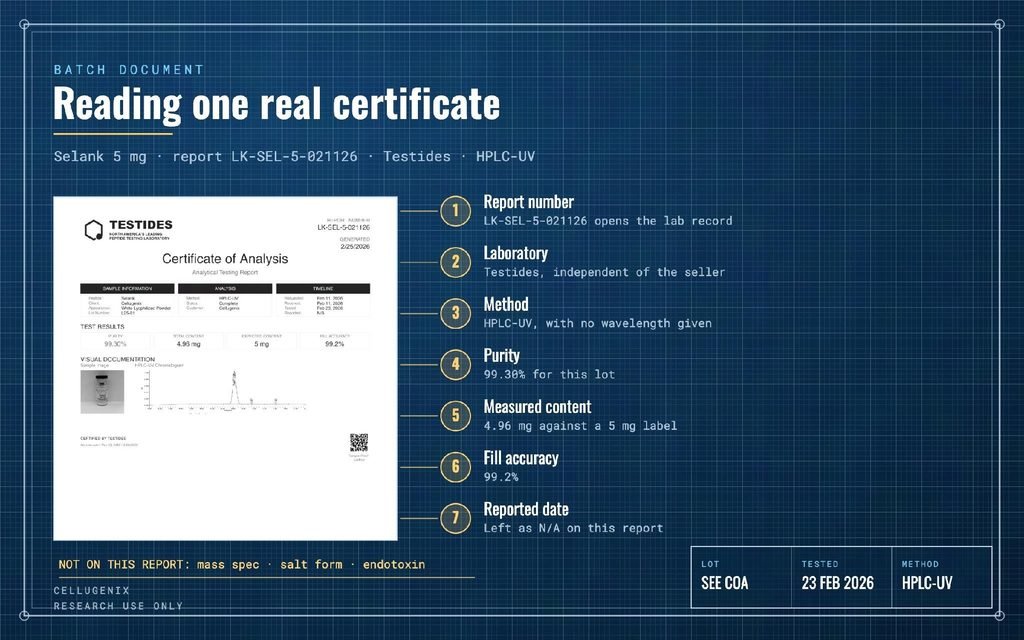
Selank 5 mg certificate of analysis, report LK-SEL-5-021126, HPLC purity and content
Two details in that table are why it is published. The method line reads HPLC-UV with no wavelength, while our KPV COA checklist covers a report from the same laboratory that specifies 214 nm. The reported-date field reads N/A here and carries a date there. Same lab, same client, five weeks apart, two fields filled differently.
That is the argument for reading fields, one at a time. A laboratory that names itself and publishes a verifiable record is doing the part that matters, and the gaps are things to ask about. The Selank 5 mg certificate carries the chromatogram and the QR code behind this table, the buy Selank peptide 5 mg listing shows the vial it belongs to, and the COA library files every other current report by product and lot.
Is Selank Legal to Buy in the US?
Quick answer: In the United States, Selank is not an FDA-approved prescription drug, an over-the-counter product, or a dietary supplement. It is supplied as a research chemical, labelled For Research Use Only.
FDA’s own drug label database returns no record for Selank in any form, checked on 10 November 2026. Research peptides and US law in 2026 separate two questions that get mixed together: what a reagent may be sold as, and what an approved medicine may be prescribed for.
Why Selank Isn’t FDA Approved
No US drug application has been approved for it, and no monograph covers it. Selank also stayed outside the compounding review several neighbouring peptides went through: the Federal Register notice of 16 April 2026 listing substances for the Pharmacy Compounding Advisory Committee’s July 2026 meeting names seven, among them Semax, and Selank appears nowhere in it.
Account checks and research-use terms at checkout follow from that, and what Research Use Only means is set by how material is labelled and sold.
What Affects the Price of Selank?
Quick answer: Five things move the number: vial size, measured content, salt form, purity grade, and testing depth per lot.
Salt form does more work here than on most compounds. A diacetate vial is 86% peptide by weight, so the same labelled milligrams cost more per milligram of actual compound than a free-base vial at the same price. Divide by the measured milligrams of peptide, then confirm the certificate covers both the lot and the form shipping today.
Storage When Your Selank Arrives
Quick answer: Keep sealed vials cold, dry, and dark, and log the lot and arrival date against the certificate on day one.
Listings disagree on temperature. Cayman Chemical specifies -20 °C for its acetate while other catalogues list 2 to 8 °C, so the label and the supplier’s sheet decide it. Ranges by compound sit in the storage and handling guide, and what lyophilized means for water content is why a sealed powder tolerates warmer conditions than a solution.
For assay preparation, Cayman reports solubility in PBS at pH 7.2 at 10 mg/mL, the figure to work from.
What Is Selank Used For in the Lab?
Quick answer: In vitro, Selank appears as a defined tuftsin-derived peptide in enzyme-activity assays, radioligand receptor-binding work, and gene-expression studies in cultured cells.
- Enkephalin-degrading enzyme assays: Zolotarev and colleagues, Russian Journal of Bioorganic Chemistry, 2004 (PMID 15344652) measured enkephalinase activity using tritium-labelled Leu-enkephalin with HPLC separation of the resulting fragments.
- Receptor-binding assays: Vyunova and colleagues, Protein and Peptide Letters, 2018 (PMID 30255741) used radioligand receptor analysis, and ran HPLC first to confirm the purity of the peptide going into the assay.
- Gene-expression studies in cell models: Filatova and colleagues, Frontiers in Pharmacology, 2017 (PMID 28293190) tracked 84 genes of the GABAergic system by qPCR in cultured IMR-32 cells.
All three are bench work on enzymes, membranes, and cell lines, and the second is a reminder that purity documentation is part of the method. Where a second Pro-Gly-Pro peptide runs on the same plate, Semax vs Selank: two Pro-Gly-Pro peptides sets out the masses that keep them apart.
FAQs
Where can I buy Selank peptide online for research?
From a supplier that publishes a certificate for the exact lot and form being shipped, showing purity with its chromatogram, measured content, and a lab you can verify. The Selank peptide for sale listing should link to that exact report.
How much does Selank peptide cost?
Compare price per measured milligram of peptide, which means settling the salt form first. Then check the certificate covers your lot.
Why is Selank not FDA approved?
No US drug application has been approved for it, and no monograph covers it, so it is supplied For Research Use Only. It was also absent from the substances the FDA’s compounding committee reviewed in July 2026.
What is the molecular weight of Selank?
751.9 g/mol as the free base, formula C33H57N11O9, with a monoisotopic mass of 751.43 Da. The monoacetate is 811.9 and the diacetate is about 872.0.
What mass should a Selank COA show?
[M+H]⁺ near 752.44, or [M+2H]²⁺ near 376.72.
What is the CAS number of Selank?
129954-34-3 for the free base. The monoacetate carries its own, 2703745-90-6, which is one way a listing reveals the form.
Is Selank the same as Semax?
No. Selank is a tuftsin analogue, and Semax is an ACTH(4-10) analogue. Both end in Pro-Gly-Pro, and Semax vs Selank: two Pro-Gly-Pro peptides cover where the two sequences diverge.
Concluding
Selank is a 752 Da heptapeptide sold in three forms with three different weights. Check the purity and its chromatogram, the mass near 752, the measured milligrams, the salt form, the lot, the test date and the lab. Where a field is blank or reads N/A, that is a question for the supplier. Check the Selank 5 mg specification and batch COA before ordering.
For laboratory research use only. Not for human or animal use. Full terms are on the legal notice page.
Sources
- PubChem, Selank, CID 11765600; Selank acetate, CID 155489759; Selank diacetate, CID 155804769. Last checked 10 November 2026. https://pubchem.ncbi.nlm.nih.gov/compound/11765600
- Cayman Chemical, Selank (acetate), item 27720, CAS 2703745-90-6. Last checked 10 November 2026. https://www.caymanchem.com/product/27720/selank-(acetate)
- openFDA drug label API, queried for Selank, no record returned. Last checked 10 November 2026. https://api.fda.gov/drug/label.json
- Federal Register, Pharmacy Compounding Advisory Committee; Notice of Meeting, 16 April 2026, Docket FDA-2025-N-6895. Last checked 10 November 2026. https://www.federalregister.gov/documents/2026/04/16/2026-07361/pharmacy-compounding-advisory-committee-notice-of-meeting-establishment-of-a-public-docket-request
- Mendias CL, Awan TM. Preprints.org, posted 24 April 2026, DOI 10.20944/preprints202604.1748.v1 (not peer-reviewed; analytical sections only). Last checked 10 November 2026. https://www.preprints.org/manuscript/202604.1748/v1
- Zolotarev YuA, Sokolov OYu, Kost NV, et al. Russian Journal of Bioorganic Chemistry, 2004, PMID 15344652 (enzyme-assay sections). Last checked 10 November 2026. https://pubmed.ncbi.nlm.nih.gov/15344652/
- Vyunova TV, Andreeva L, Shevchenko K, Myasoedov N. Protein and Peptide Letters, 2018, PMID 30255741 (binding-assay sections). Last checked 10 November 2026. https://pubmed.ncbi.nlm.nih.gov/30255741/
- Filatova E, Kasian A, Kolomin T, et al. Frontiers in Pharmacology, 2017, PMID 28293190 (cell-culture sections). Last checked 10 November 2026. https://pubmed.ncbi.nlm.nih.gov/28293190/
For laboratory research use only. Not for human or animal use.