Hexarelin: Structure, GHS-R1a Pharmacology and COA Checks
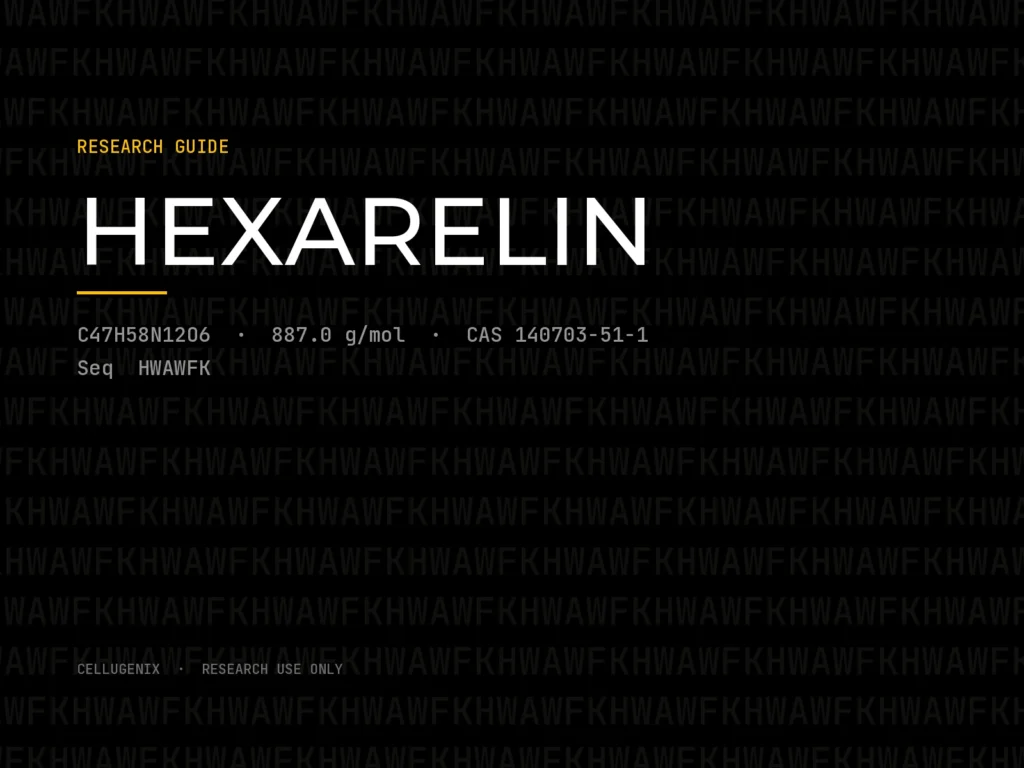
Hexarelin, also known as examorelin, is a synthetic hexapeptide in the growth hormone secretagogue (GHS) family. In research it is studied as a ligand of the growth hormone secretagogue receptor type 1a (GHS-R1a), the receptor that ghrelin binds. This article covers what the molecule is, which receptors and in-vitro assays it appears in, how it compares with related peptides, and the analytical documentation and vial storage information to expect from a supplier.
What Hexarelin Is
Hexarelin is a six-residue peptide with a C-terminal amide: His-D-2-Me-Trp-Ala-Trp-D-Phe-Lys-NH2. It is structurally related to GHRP-6 (His-D-Trp-Ala-Trp-D-Phe-Lys-NH2). The single difference is a methyl group on the indole ring of the D-tryptophan at position 2, which makes hexarelin a useful partner to GHRP-6 in structure-activity work. It is not a fragment of ghrelin; it is a small synthetic ligand that engages the same receptor.
Research-grade hexarelin is supplied as a lyophilized (freeze-dried) powder for laboratory use.
Receptor Pharmacology
GHS-R1a
GHS-R1a is a class A G protein-coupled receptor (GPCR). It couples mainly to Gq/11, so activation drives inositol phosphate turnover and release of calcium from intracellular stores, and it also recruits beta-arrestin. The receptor is known for high constitutive (ligand-independent) activity, which is worth accounting for in assay design.
CD36
Hexarelin has also been studied as a ligand of CD36, a scavenger receptor that is unrelated to GHS-R1a. This second binding site is one reason hexarelin is examined separately from other GHS peptides, and it is a variable to keep in mind when choosing cell lines and controls.
Receptor desensitisation
A concept that comes up repeatedly in GHS-R1a pharmacology is desensitisation. When the receptor is stimulated repeatedly, its signaling response can attenuate as the receptor is phosphorylated, bound by arrestin and internalised. In cell-based work this is measured directly with internalisation and repeat-stimulation protocols, and it matters when interpreting any time-course experiment.
Assay Types
Hexarelin typically appears in the following in-vitro formats:
- Radioligand competition binding: displacement of labelled ghrelin or another labelled GHS from membranes of GHS-R1a-expressing cells.
- Calcium mobilisation: fluorescent dye or aequorin readouts in HEK293 or CHO cells expressing GHS-R1a.
- IP1 accumulation and beta-arrestin recruitment: used to compare G protein signaling with arrestin signaling.
- Internalisation and desensitisation studies: tagged-receptor imaging or surface-receptor assays in cultured cells.
- CD36 binding assays: used where the second binding site is the subject of study.
Differences in cell line, receptor expression level, buffer composition and incubation time all influence results. Read full methods, include a reference ligand such as ghrelin as a positive control, and replicate with rigorous controls.
How Hexarelin Differs From Related Peptides
- GHRP-6: same length and near-identical sequence; hexarelin carries the 2-methyl D-Trp. Useful as a matched pair in structure-activity studies.
- Ipamorelin: a shorter pentapeptide with non-natural residues (Aib, D-2-Nal), also studied at GHS-R1a.
- GHRH analogues such as CJC-1295: a different receptor entirely (the class B GHRH receptor, coupled to Gs and cAMP). See our CJC-1295 vs. Ipamorelin comparison for how the two receptor classes are studied.
Analytical Verification and Documentation
Before a vial goes into an experiment, review the paperwork.
- Certificate of Analysis (COA): purity by HPLC, see the batch COA; identity by mass spectrometry; batch or lot number; test date.
- Chromatogram and spectra: check that the main HPLC peak matches the reported purity and that the observed mass matches the theoretical mass for the sequence.
- Storage statement: clear label guidance on temperature, light and moisture for the sealed vial.
- Safety Data Sheet (SDS): follow the safe-handling practices it describes.
Batch COAs for our materials are published in the COA Library. If documentation is incomplete, unclear or inconsistent with the label, consider that a red flag.
Storage of the Sealed Vial
Lyophilized peptides are sensitive to heat, moisture and light.
- Store the sealed lyophilized vial as stated on the label, protected from light and moisture.
- Keep the vial tightly capped, ideally in a sealed container with desiccant.
- Avoid repeated temperature cycling.
- Label storage locations with the lot or batch number and date received, and keep a simple logbook so results can be traced to a specific batch.
Compliance Corner (RUO)
Hexarelin is sold as a Research Use Only (RUO) material for in-vitro laboratory work:
- No claims for diagnosis or for human or veterinary use.
- Clear RUO labeling on product pages, vials and invoice documents.
- Easy access to COAs and quality statements for every lot.
Bottom Line
Hexarelin is a well-characterised synthetic hexapeptide, a methylated GHRP-6 analogue studied at GHS-R1a and, separately, at CD36. For credible in-vitro data, pair an understanding of receptor behaviour (including constitutive activity and desensitisation) with verified material: purity by HPLC and identity by MS on the batch COA, and a sealed vial stored as the label states.
For Research Use Only. Not for use in diagnostic or therapeutic procedures.