How to Evaluate a Research Peptide Vendor: COAs, Testing, Shipping, and Transparency
Quick Answer
To evaluate a research peptide vendor, check that every product has a batch-specific, third-party COA with a verifiable report number; that the lot numbers on certificates match the vials; that the vendor states purity and identity methods (HPLC and mass spectrometry); that shipping, refunds and contact details are clear; and that products are sold strictly for research use.
About Cellugenix certificates: our current third-party reports (Testides and Canada Peptide Testing) cover HPLC-UV purity and measured content. They do not include mass spectrometry identity or endotoxin testing, and some older Testides reports list no lot number. Each certificate in the COA library shows exactly what was tested.
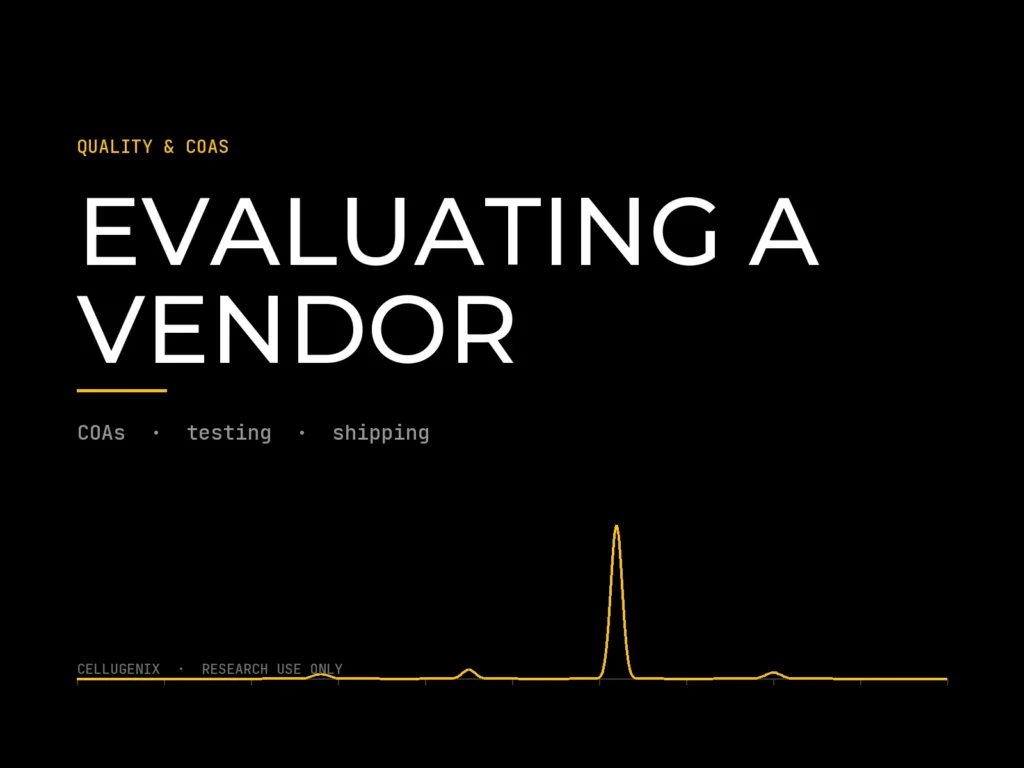
To evaluate a research peptide vendor, check for batch-specific Certificates of Analysis (COAs) from an independent third-party lab, clear testing methods, identifiable lab data, transparent shipping details, and consistent research-use-only language. A trustworthy vendor documents all of this in the open. A risky one makes you dig for it, or hides it entirely. This guide walks through exactly what to look for, in the order we would check it ourselves.
Quick checklist: is this vendor worth your trust?
• Batch-specific COA you can see before you buy
• Named, identifiable testing lab
• Both a purity method (HPLC) and an identity method (mass spec)
• Lot number on the vial that matches the COA
• Clear research-use-only labeling, no medical claims
• Specific shipping, packaging, and storage details
• A product page that reads like documentation, not a sales pitch
What Makes a Research Peptide Vendor Trustworthy?
A trustworthy research peptide vendor is built on four things: documentation, transparency, method clarity, and consistency. Everything they publish, from the product page to the COA to the shipping policy, should tell the same story with no gaps and no contradictions.
Documentation means the paperwork exists and you can actually see it. Transparency means the vendor names its lab, its methods, and its testing dates instead of hiding behind vague reassurance. Method clarity means they say which test proves what. Consistency ties it together: the lot number, purity figure, and product name should match across every page.
When even one of those breaks down, trust should drop with it. On Reddit’s r/ScienceBioTechnology, the community’s most-upvoted advice for spotting a legitimate vendor comes down to the same idea: a real supplier publishes a batch-specific COA and lets you verify it, while a weak one leans on marketing language. We hold ourselves to that standard, which is why we publish independent third-party COAs in an open library you can check before you order.
What Should Be Included in a Batch-Specific COA?
A batch-specific COA is a test report tied to one exact production lot, and a complete one includes eight elements. If any are missing, the document is weaker than it looks.
- Product name that matches the vial and the product page.
- Lot or batch number unique to that production run.
- Date of testing, so you know the result is current.
- Purity result, usually a percentage from HPLC.
- Identity confirmation, showing the compound is what the label says.
- Analytical method, naming how each result was produced.
- Lab name and contact details, so the testing is traceable.
- Signature or analyst attribution, tying the report to a person.
A generic COA that could apply to any batch is close to useless, because it does not describe the vial in your hand. The whole point of a batch-specific document is that it maps to one run and one lot number. Our COA guide breaks down each field in more detail.
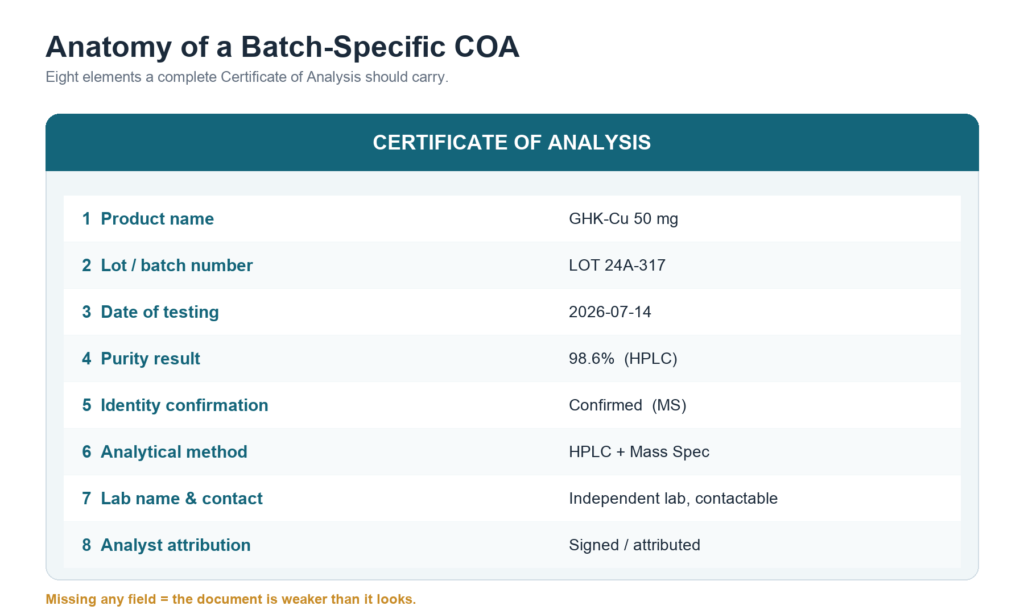
Figure 1: the eight elements of a complete batch-specific COA.
How Do You Verify a Peptide COA?
Verifying a peptide COA takes about a minute, and it starts with the lot number.
- Find the lot printed on the vial, then find the lot on the COA. They have to match exactly. If they do not, the document does not describe your product, and that is a stop sign.
- Next, confirm the testing lab is identifiable. A real COA names the lab and gives a way to reach it, so the result can be traced back to a source. A report with no lab name, no contact details, and no analyst attribution is a document you cannot check, which defeats its purpose.
- Finally, treat generic or missing documentation as a red flag in its own right. A vendor that shows a single, undated, lot-free certificate for its entire catalog is telling you something.
- Two quick cross-checks tighten this further: confirm the testing date is recent, since purity can drift over a long shelf life, and check that the purity figure is tied to a named method, because a percentage with no method behind it is just a number.
Each published report is listed in our COA library so the purity, content and method are in one place.
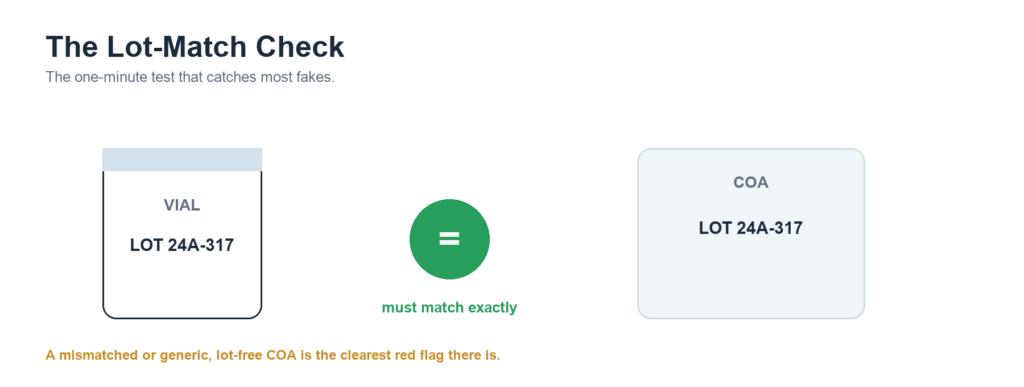
Figure 2: the lot-match check, the fastest COA verification.
HPLC vs. Mass Spectrometry: What Each Test Proves
HPLC and mass spectrometry answer two different questions, and a strong vendor is clear about which method backs which claim. HPLC tells you how much. Mass spectrometry tells you what it is. You want both.
High-performance liquid chromatography (HPLC) separates a sample into its parts and measures them, which is how a purity percentage is produced. It is the standard method behind a “Purity by HPLC” figure. What HPLC does not do on its own is prove the main peak is the exact peptide you ordered.
Mass spectrometry (MS) fills that gap by measuring the molecular mass and comparing it to the expected value, which confirms identity. Purity without identity leaves a question open, and identity without purity leaves another. Together they give a complete picture, which is why we publish third-party HPLC-UV purity and content results and say plainly what each report covers. Our HPLC vs. mass spectrometry explainer goes deeper on each.
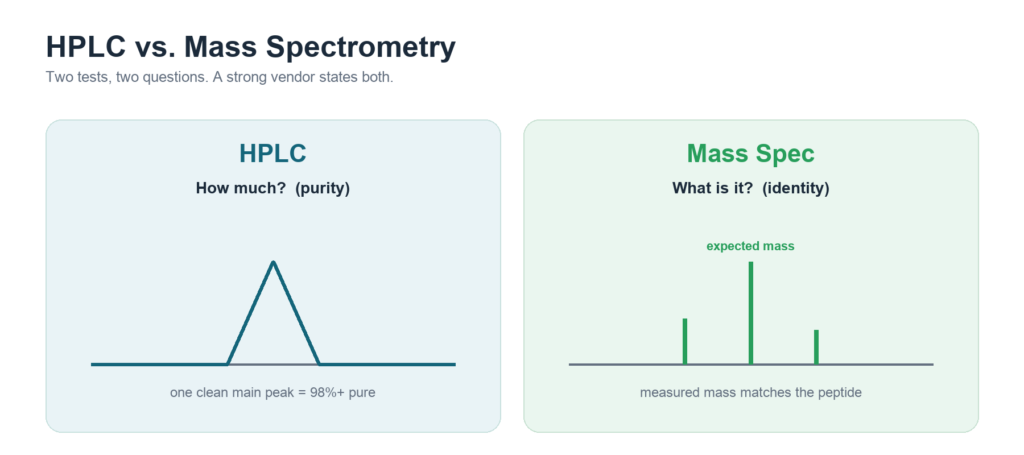
Figure 3: HPLC proves purity; mass spectrometry proves identity.
What Shipping Details Should a Peptide Vendor Disclose?
A transparent research peptide vendor describes shipping in specific terms: packaging, tracking, dispatch timing, and how the product should be handled and stored on arrival. Vague reassurance like “fast, discreet shipping” is not a detail. Real logistics are.
Look for four things. Packaging that protects the material, such as insulated shipping. Tracking that reaches you when the order ships. A stated dispatch window so you know when to expect it. And clear storage guidance for the moment the package lands on your bench, since peptides are sensitive to heat and light. Storage on arrival matters as much as the box: a vendor should tell you whether a compound needs refrigeration or freezing once it lands, and add insulation for warm-weather transit so a summer delivery does not sit on a hot doorstep unprotected.
We spell ours out rather than gesture at it. Orders dispatch within one business day, US deliveries typically arrive in two days, tracking is emailed as soon as the order ships, and every shipment goes out in insulated packaging. Full terms live on our shipping policy page, and handling steps for arrival are covered in our storage and documentation guide.
What Should a Research Peptide Product Page Include?
A clean research peptide product page reads like documentation, and it should line up with the COA and the lab data behind it. The signals to look for are consistent research-use-only language, lot specificity, matching product names, and an absence of overstated claims.
Research-use-only labeling should be plain and repeated, making clear the material is for laboratory work by qualified professionals. The product name on the page should match the vial and the COA word for word, and the page should point to the specific lot documentation rather than a single catalog-wide certificate.
The tell for a weak vendor is a page that sounds like a marketing landing page: benefit promises, health or dosing language, and no link to the underlying data. A page that describes what the compound is, what it tested at, and how it ships is doing its job. To see the baseline we work to, our quality standards page lays out the testing behind every listing, and what research peptides are covers the category framing.
What Are the Biggest Red Flags When Choosing a Vendor?
The biggest red flags are the ones a vendor cannot easily fake around, and most of them are about missing or inconsistent documentation. Treat any of the following as a reason to walk.
- No batch-specific COA, or a COA hidden behind an account wall.
- Missing lab name, so the testing cannot be traced.
- No visible testing method, leaving purity and identity unproven.
- Lot number mismatch between the vial and the COA.
- Therapeutic or medical language, which crosses research-use-only lines.
- Vague shipping or storage information with no specifics.
- Overpromising claims that sound like a sales page, not a spec sheet.
Any single one of these should slow you down. Two or more together is usually your answer.
How Do You Compare Two Research Peptide Vendors?
To compare two research peptide vendors, score each one on the same five criteria and see who documents more. We call it a vendor trust scorecard, and it turns a gut feeling into a side-by-side you can actually defend.
Score each vendor on these:
- COA accessibility: can you see a batch-specific COA before you buy, without an account?
- Lab transparency: is the testing lab named and reachable?
- Method disclosure: are HPLC and mass spectrometry both stated, with the right claim on each?
- Shipping clarity: are packaging, tracking, and dispatch timing specific?
- Product-page consistency: do the name, lot, and purity match across page and COA?
A sixth criterion, customer support quality, is worth adding if you plan to order repeatedly, since a vendor that answers documentation questions quickly tends to run a tighter operation. Weight the criteria to your work: a lab running quantitative assays should lean hardest on method disclosure and COA access, while a team ordering in volume may care more about shipping clarity and support. Whoever checks more boxes with less friction is the safer choice, even if they are not the cheapest.
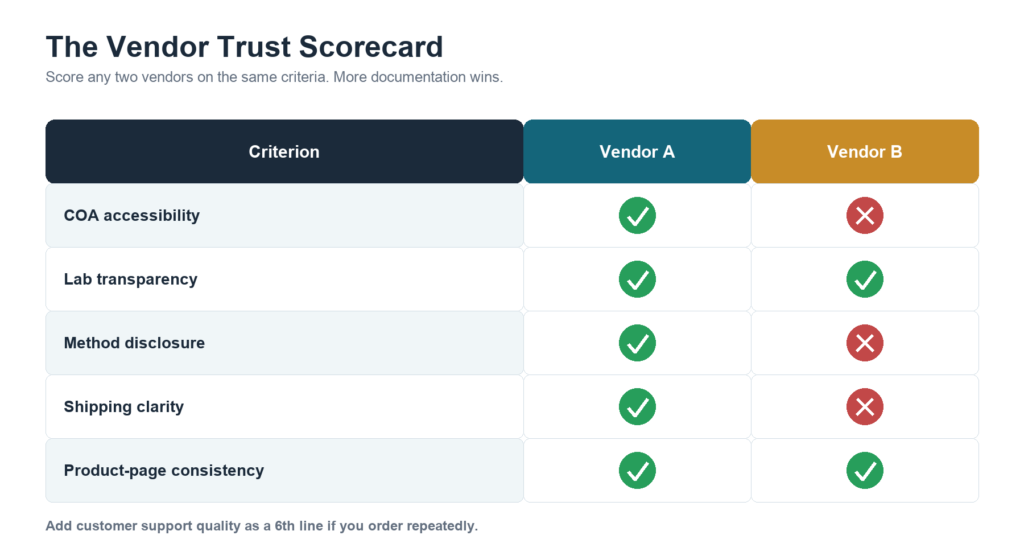
Figure 4: The Vendor Trust Scorecard, applied to two vendors.
Frequently Asked Questions About Research Peptide Vendors
How do you know if a research peptide vendor is legit?
A legitimate research peptide vendor publishes a batch-specific COA you can view before buying, names its testing lab, states its methods (HPLC and mass spec), and uses consistent research-use-only language. If documentation is generic, hidden, or missing, treat the vendor as unproven.
Who is the most reputable research peptide vendor?
There is no single answer, because reputability comes down to documentation you can verify, not a brand name. Score any vendor on COA access, lab transparency, method disclosure, and shipping clarity. The most reputable option is the one that proves the most, in the open.
Can you legally sell research peptides?
Research peptides can be sold as research-use-only laboratory reagents for qualified professionals, and per FDA research-use-only guidance, that labeling means they are not cleared for human or clinical use. A compliant vendor keeps its language and product pages inside that research-only lane.
How do I get a Certificate of Analysis from a research peptide vendor?
A good vendor makes the COA available on the product page or a searchable library, tied to your lot number. If you cannot find it, ask support for the batch-specific COA that matches your lot. A vendor that will not provide one is a vendor to skip.
What is the difference between a batch-specific COA and a generic COA?
A batch-specific COA reports results for one exact production lot and carries that lot number. A generic COA is a single certificate reused across batches, so it does not describe the vial you received. Only the batch-specific version actually verifies your product.
Evaluating a research peptide vendor comes down to one habit: trust what is documented, question what is not. Look for a batch-specific COA you can verify, both testing methods with the right claim on each, specific shipping and storage details, and consistent research-use-only language. That is the standard we hold ourselves to, and it is the one worth holding any vendor to.
Research-use-only: All products and information referenced here are for laboratory research use only by qualified professionals, and are not for human or animal consumption, diagnostic, or therapeutic use.
Frequently Asked Questions
What should I look for in a research peptide vendor?
Batch-specific third-party COAs with verifiable report numbers, matching lot numbers, clear test methods, transparent shipping and refund policies, and research-use-only labelling.
How do I know if a peptide vendor is legitimate?
Verify a COA with the issuing laboratory, check that the report matches the lot you receive, and look for a reachable business with published policies.
What is a batch COA?
A certificate that reports test results for one specific production lot, identified by its lot number.
For Research Use Only. Not for use in diagnostic or therapeutic procedures.