Thymosin Alpha-1 vs Thymosin Beta-4 (TB-500): Two Unrelated Peptides Compared
Thymosin alpha-1 and thymosin beta-4 sound like siblings. Line up their sequences, though, and you won’t find a single shared stretch of amino acids. The common name goes back to the 1970s, when both turned up in the same crude tissue extract and got their Greek letters from how they ran on a gel. TB-500 then adds a third identity: a seven-residue piece of thymosin beta-4.
Below are the sequences and masses, what each peptide binds in vitro, how the literature breaks down by study type, where each stands with US regulators this October, and how a certificate of analysis (COA) tells the three apart. Nothing on this page describes use in people or animals.
What’s the difference between thymosin alpha-1 and thymosin beta-4?
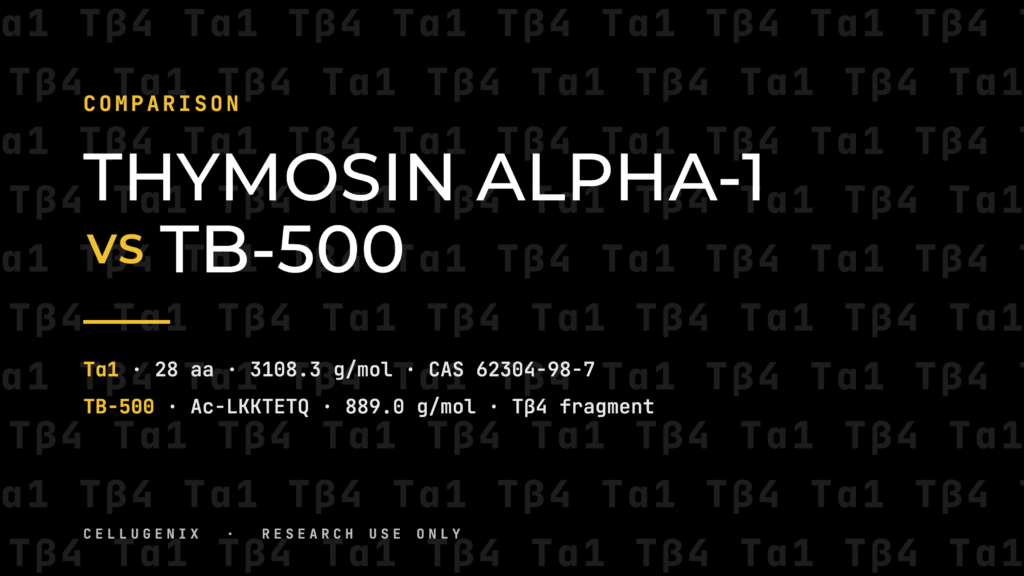
Thymosin alpha-1 (Tα1) is a 28-residue acetylated peptide cut from prothymosin alpha and studied in Toll-like receptor signaling and T-cell and dendritic-cell culture assays. Thymosin beta-4 (Tβ4) is a 43-residue protein that binds monomeric G-actin. TB-500 is a synthetic seven-residue Tβ4 fragment (Ac-LKKTETQ) studied in actin-binding and cell-migration assays.
✓ Different genes, sequences and lengths; only the name is shared
✓ TB-500 is not full-length Tβ4, and neither is Tα1
✓ None is FDA-approved; all are sold here as lab reagents
Contents
- Thymosin alpha-1 vs thymosin beta-4 at a glance
- Why both are called “thymosin”
- What is thymosin alpha-1?
- What is thymosin beta-4, and is TB-500 the same thing?
- Is TB-500 the same as thymosin alpha-1?
- How their mechanisms differ
- What the literature covers
- FDA and US status
- How to tell them apart on a COA
- FAQ
- The bottom line
Thymosin Alpha-1 vs Thymosin Beta-4 at a Glance
Thymosin alpha-1, TB-500 and full-length thymosin beta-4 are three separate molecules. Tα1 has 28 residues, TB-500 has 7 and Tβ4 has 43. They come from two different genes, weigh between about 889 and 4,963 g/mol, and labs study them against two unrelated targets: Toll-like receptor pathways for Tα1 and G-actin for the beta-4 pair.
| Thymosin alpha-1 | TB-500 fragment | Full-length thymosin beta-4 | |
|---|---|---|---|
| Length | 28 aa | 7 aa | 43 aa |
| Sequence | Ac-SDAAVDTSSEITTKDLKEKKEVVEEAEN | Ac-LKKTETQ (Tβ4 residues 17-23) | Ac-SDKPDMAEIEKFDKSKLKKTETQEKNPLPSKETIEQEKQAGES |
| Precursor / gene | Prothymosin alpha (PTMA) | Synthetic copy of a Tβ4 segment | TMSB4X |
| Molecular weight | 3,108.3 g/mol | 889.0 g/mol | ~4,963 g/mol |
| Main targets studied | TLR9 and TLR2 signaling, MyD88, NF-κB | G-actin binding motif | G-actin sequestration |
| Main assays | Dendritic-cell and T-cell cultures, cytokine gene expression | Actin-binding and migration assays | Pyrene-actin, DNase I, migration, HUVEC tube formation |
| US status | Not FDA-approved | Not FDA-approved | Not FDA-approved |
Two numbers do most of the sorting in any Tα1 vs Tβ4 comparison. Tα1 outweighs TB-500 by about 2,219 g/mol, and full-length Tβ4 is roughly 5.6 times heavier than the fragment. So even the beta-4 pair, which shares residues 17 to 23, can’t stand in for each other in an assay. Current lot results are on the Thymosin Alpha-1 and TB-500 batch COAs.
Why Are Both Called “Thymosin”?
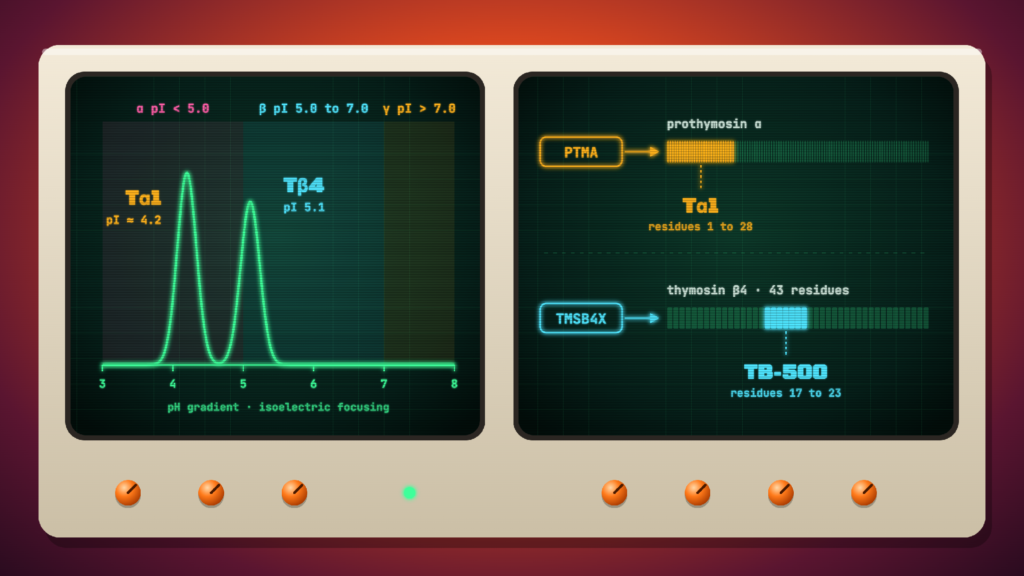
Both peptides were first purified from thymosin fraction 5, a rough calf-thymus extract fractionated in Allan Goldstein’s laboratory. Tα1 was isolated and sequenced in 1977 (Goldstein et al., PNAS, PMID 265536), and the full Tβ4 sequence followed in 1981 (Low et al., PNAS, PMID 6940133). The Greek letters only record each peptide’s position on an isoelectric focusing gel.
A lecture summary from Ewald Hannappel’s group at the University of Erlangen-Nürnberg puts the rule plainly: “The thymosins are divided into three main groups according to their isoelectric points.” Alpha marks the acidic end, beta the near-neutral middle and gamma the basic end. The letters say nothing about structure.
Later work found Tβ4 in most cell types examined. Tα1 turned out to be the first 28 residues of prothymosin alpha, a protein made well beyond the tissue it was first extracted from. So the name is a piece of lab history, and that shared word is the only real link between the two. A 2020 review by Dominari and colleagues (PMID 33362999) notes that the pair “have vastly different chemical compositions.”
What Is Thymosin Alpha-1?
Thymosin alpha-1 is an N-terminally acetylated chain of 28 residues: Ac-SDAAVDTSSEITTKDLKEKKEVVEEAEN. It matches the first 28 residues of prothymosin alpha, encoded by the PTMA gene. The synthetic version carries the International Nonproprietary Name (INN) thymalfasin and the CAS number 62304-98-7.
The chain is strongly acidic, with glutamate and aspartate residues spread along its length. In plain water it has no settled shape. A 1998 NMR and circular dichroism study (Grottesi et al., Peptides, PMID 9880079) found it folds partly once moved into a membrane-like environment: a beta-turn forms between residues 5 and 8, and a helix runs from residue 17 to 24.
Most in vitro Tα1 work sticks to receptors, pathways and readouts:
- TLR9 and MyD88: Romani and colleagues (Blood, 2004, PMID 14982877) traced Tα1 activity in cultured dendritic cells through TLR9 and the MyD88 adaptor. Later reviews add TLR2 to the receptor list.
- NF-κB and p38 MAPK: reporter and phosphorylation assays measure how far the signal travels downstream in the same culture systems.
- Cytokine gene expression: qPCR and ELISA panels in T-cell and dendritic-cell cultures, where cytokines are simply the transcripts and proteins being measured.
That last point shapes how to read the papers. A cytokine panel is an assay output in a dish, and the cell type, receptor and readout are the facts that carry over between labs. For sequence, salt-form and COA detail on this peptide alone, see the Thymosin Alpha-1 research overview.
What Is Thymosin Alpha-1 Peptide?
As a catalog item, thymosin alpha-1 peptide is a synthetic, N-acetylated 28-mer supplied as a lyophilized research reagent. The free base (C129H215N33O55) weighs 3,108.3 g/mol. Labs order it as a defined reference compound for receptor-signaling and cell-culture assays. Lot details are on the Thymosin Alpha-1 10 mg specification and COA page.
What Is Thymosin Beta-4, and Is TB-500 the Same Thing?
Thymosin beta-4 (Tβ4) is a 43-residue, N-acetylated protein from the TMSB4X gene and the main G-actin-sequestering peptide in many cell types. In most catalogs, TB-500 names a lab-made seven-residue piece of that protein, Ac-LKKTETQ (residues 17 to 23), the stretch that contacts actin. They’re different molecules, at about 4,963 and 889 g/mol.
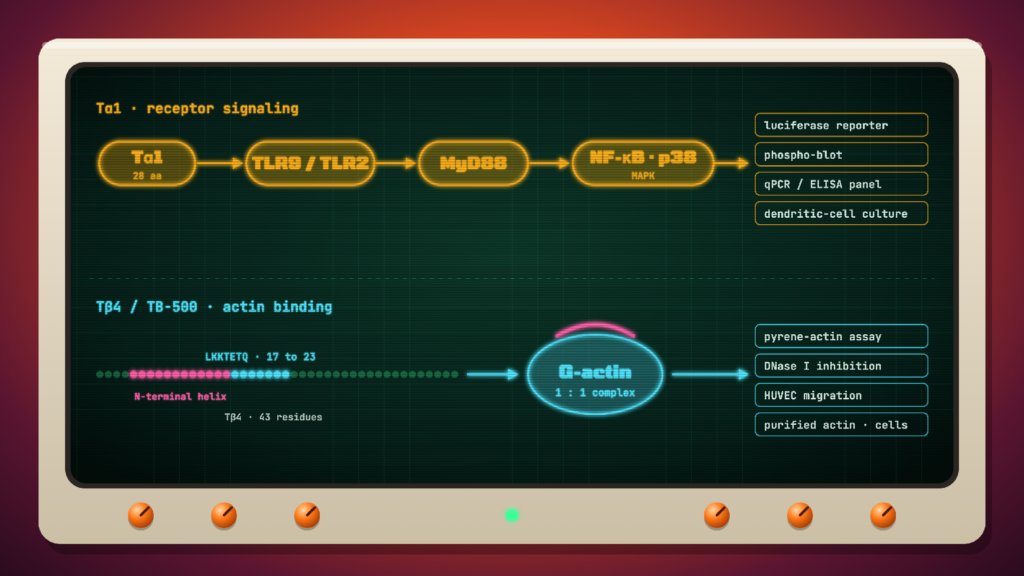
Full-length Tβ4. The protein binds one actin monomer at a time, a 1:1 complex that keeps that monomer out of filaments. Safer, Elzinga and Nachmias identified it as an actin-sequestering peptide in 1991 (Journal of Biological Chemistry, PMID 1999398). Two classic readouts show the effect:
- Pyrene-actin assay: fluorescence climbs as labeled actin polymerizes, so a sequestering peptide flattens the curve.
- DNase I inhibition assay: free G-actin blocks DNase I, which gives a handle on how much monomer is available.
Endothelial labs also run Tβ4 through HUVEC migration and tube-formation assays.
TB-500. As a thymosin beta-4 fragment, TB-500 isolates the actin-binding motif. In a 2003 study (Philp et al., FASEB Journal, PMID 14500546), a synthetic peptide carrying LKKTETQ matched the full protein in HUVEC migration and sprouting assays. Structural work adds a caveat. A 2004 crystal structure (Irobi et al., EMBO Journal, PMID 15329672) showed Tβ4 touching actin along far more than seven residues. Whether the fragment reproduces every in vitro property of the whole protein is still an open question.
For a closer look at that question, see our guide to the TB-500 fragment vs full-length thymosin beta-4. Lot results for the fragment appear on the TB-500 5 mg specification and COA page.
Is Thymosin Beta-4 Better Than TB-500?
Thymosin beta-4 vs TB-500 is a whole protein against one of its fragments, so neither ranks above the other. Full-length Tβ4 suits studies of the whole 43-residue protein, including binding surfaces outside residues 17 to 23. The fragment suits studies of the actin-binding motif on its own. A mass reading confirms what the vial holds.
Thymosin Beta-4 Acetate vs TB-500
Acetate is the counter-ion a peptide carries after purification, so it changes the salt form and leaves the sequence alone. “Thymosin beta-4 acetate” is the 43-residue protein as an acetate salt; “TB-500 acetate” is the fragment. Every acetate brings roughly 60 g/mol, so check the COA for both the peptide and its salt form.
Is TB-500 the Same as Thymosin Alpha-1?
No. TB-500 is a seven-residue fragment of thymosin beta-4, and thymosin alpha-1 is a 28-residue fragment of prothymosin alpha. They come from different genes, share no sequence, differ in mass by roughly 2,200 Da and are studied against different targets. Data for one never transfers to the other.
Three contrasts settle any thymosin alpha-1 vs TB-500 mix-up, whichever way round the question gets asked:
- Gene and precursor: TMSB4X gives Tβ4, and TB-500 copies its residues 17 to 23. PTMA gives prothymosin alpha, and Tα1 is its residues 1 to 28.
- Sequence and mass: LKKTETQ appears nowhere in the Tα1 chain. The fragment weighs 889.0 g/mol against 3,108.3 g/mol for Tα1.
- Targets and assays: TB-500 goes into G-actin binding and migration assays. Tα1 goes into TLR signaling and cytokine gene readouts in cultured dendritic cells and T cells.
So in a TB-500 vs thymosin alpha-1 comparison, which is better? Neither, since each one answers a different research question.
How Do Their Mechanisms Differ at the Molecular Level?
In assays, Tα1 acts as a signal that starts a receptor pathway: Toll-like receptors on cultured dendritic cells, then MyD88 and NF-κB. Tβ4 and TB-500 act as structural binders that grab actin monomers inside cells. One works on a signaling cascade and the other on the cytoskeleton, which is why their assay menus barely overlap.
Thymosin alpha-1: receptor signaling. The best-supported route in the papers cited here runs from TLR9 and TLR2 to MyD88, then on to NF-κB and p38 MAPK. Some summaries also list TLR7, though the primary dendritic-cell data most often cited names TLR9. Readouts include luciferase reporters, phospho-specific blots and cytokine transcripts.
Thymosin beta-4 and TB-500: actin binding. Tβ4 carries a β-thymosin domain related to the WH2 actin-binding module. Its N-terminal helix and the LKKTET stretch both contact the actin monomer, which explains why the fragment keeps part of the binding behavior. Pyrene-actin and DNase I assays measure that contact directly.
Tβ4 also turns up in cell-signaling papers. A 2004 study (Bock-Marquette et al., Nature, PMID 15565145) linked it to integrin-linked kinase (ILK) and Akt activation in cultured cells. Those experiments were run on the full protein, so they describe Tβ4 and leave the fragment’s behavior as a separate question.
What Does the Literature Cover for Each Peptide?
Both peptides have decades of published work, but of different kinds. Tα1 has cell, animal and human clinical studies, the human ones using synthetic thymalfasin. Tβ4’s record is mostly cell and animal studies, along with a handful of human trials. TB-500, as a fragment, is mostly in vitro and analytical, with one registered human study.
The record counts show the difference in scale. A PubMed title-and-abstract search on October 18, 2026 returned 887 records for thymosin alpha-1 or thymalfasin, 1,132 for thymosin beta-4 and 39 for TB-500 or LKKTETQ. The same day, ClinicalTrials.gov listed 65 studies with Tα1 or thymalfasin as an intervention and 18 for thymosin beta-4. One of those 18 is a Phase 1/2 study of the 17-23 fragment (NCT07487363), recruiting since February 2026.
| Study type | Thymosin alpha-1 | TB-500 fragment | Full-length thymosin beta-4 |
|---|---|---|---|
| Cell / in vitro | TLR signaling, cytokine gene expression in dendritic-cell and T-cell cultures | Actin-binding and migration assays; analytical (LC-MS) | G-actin binding, polymerization, HUVEC migration |
| Animal | Rodent studies (endpoints not summarized here) | Limited | Rodent studies (endpoints not summarized here) |
| Human | Clinical studies of thymalfasin outside the US | One registered Phase 1/2 study, recruiting | A small number of registered trials |
Key papers, labeled by model:
- Tα1, cell: Romani L et al., Blood, 2004, PMID 14982877 (dendritic-cell TLR9 and MyD88 assays)
- Tα1, structural: Grottesi A et al., Peptides, 1998, PMID 9880079 (NMR and circular dichroism)
- Tβ4, biochemical: Safer D et al., Journal of Biological Chemistry, 1991, PMID 1999398 (G-actin sequestration)
- LKKTETQ motif, cell: Philp D et al., FASEB Journal, 2003, PMID 14500546 (HUVEC migration)
- Reviews: Dominari A et al., World Journal of Virology, 2020, PMID 33362999 (Tα1); Huff T et al., International Journal of Biochemistry & Cell Biology, 2001, PMID 11311852 (β-thymosins)
One caution applies to the beta-4 side. Much of its data comes from the full protein, so those results can’t be assumed for the seven-residue fragment. A 2026 scoping review by McGuire, Hughes, Maak and Cushman in Applied Sciences (DOI 10.3390/app16126202) found that “most studies evaluated TB4 rather than TB-500.”
Are Thymosin Alpha-1 and TB-500 FDA-Approved? US Status
The FDA hasn’t approved thymosin alpha-1, thymosin beta-4 or TB-500 for any purpose in the US. Research-grade versions are sold as laboratory reagents, outside the drug approval system. Every status point below is current as of October 18, 2026, and each one comes from a dated public record.
- Tα1 outside the US: synthetic thymalfasin, sold under the brand Zadaxin, is approved in more than 35 countries, according to the 2020 Dominari review.
- Tα1 and compounding: the FDA’s Pharmacy Compounding Advisory Committee (PCAC) voted 4 to 17 on December 4, 2024 against putting either salt form of Tα1 on the 503A bulks list, per the FDA’s final summary minutes. The July 2026 meeting didn’t take up Tα1.
- TB-500 and compounding: the PCAC reviewed TB-500, in free-base and acetate forms, on July 23, 2026, per the FDA’s meeting agenda. Legal coverage of the meeting reported an 8-6-1 vote to recommend inclusion. That vote is advisory, and any listing needs FDA notice-and-comment rulemaking first. TB-500 isn’t on the 503A list today.
- Full-length Tβ4: it wasn’t among the substances reviewed in July 2026.
- WADA: the 2026 Prohibited List names thymosin-β4 and its derivatives, such as TB-500, under class S2. Tα1 isn’t named.
None of these steps change how lab reagents are sold. For more, see our overview of research peptides in the USA and the page on what research use only means.
How to Tell Thymosin Alpha-1, TB-500 and Tβ4 Apart on a COA
Mass is the fastest identity check. Expect about 3,108 Da for Tα1, 889 Da for TB-500 and 4,963 Da for full-length Tβ4, so one LC-MS reading names the molecule. Pair that with purity by HPLC from the batch certificate (see the batch result for the current figure).
| Thymosin alpha-1 | TB-500 fragment | Full-length thymosin beta-4 | |
|---|---|---|---|
| Residues | 28 | 7 | 43 |
| Formula | C129H215N33O55 | C38H68N10O14 | C212H350N56O78S |
| Molecular weight | 3,108.3 g/mol | 889.0 g/mol | ~4,963 g/mol |
| CAS | 62304-98-7 | No single CAS in common use (PubChem CID 62707662) | 77591-33-4 |
| Purity by HPLC | See the batch COA | See the batch COA | n/a (not sold) |
Cellugenix’s current certificates for both products come from independent labs. Each one reports HPLC-UV purity and measured content, with a report number, test date and a link to verify it on the lab’s site. Mass isn’t part of those reports, so confirming the molecule by mass is a separate LC-MS step in the receiving lab.
Run through five checks on any certificate:
- The vial’s lot code appears on the certificate.
- The certificate names its HPLC method and gives a figure.
- An LC-MS mass, from the COA or an in-house run, matches the expected molecule.
- Measured content is given against the label amount.
- The lab, report number and test date are listed and verifiable.
Field-by-field help is in how to read a peptide COA, and HPLC vs mass spectrometry compares what the two techniques pick up.
How Should Sealed Vials Be Stored?
Keep each vial sealed in its lyophilized (freeze-dried) form, kept cold and dry and shielded from light, at the temperature printed on its label. Record the vial’s lot code in the lab notebook beside each experiment, so every result points back to one certificate. Temperature guidance for every product family is in our guide to lyophilized peptide storage.
Frequently Asked Questions
Are thymosin alpha-1 and thymosin beta-4 related?
Only by name and by the extract they were first purified from. Fraction 5 contained many peptides, labeled alpha, beta or gamma by isoelectric point. Tα1 comes from the PTMA gene and Tβ4 from TMSB4X. Their sequences, lengths and lab targets have nothing in common.
What is the sequence of TB-500?
Most suppliers use Ac-LKKTETQ: leucine, lysine, lysine, threonine, glutamate, threonine and glutamine, with an acetyl group on the leucine. It copies residues 17 to 23 of thymosin beta-4. The free base, C38H68N10O14, weighs 889.0 g/mol.
What is thymalfasin?
Thymalfasin is the generic (INN) name given to synthetic thymosin alpha-1. It’s the same 28-residue, N-acetylated chain, with CAS number 62304-98-7.
Why do some TB-500 products have a different mass?
The TB-500 name has no fixed definition. Some products contain the seven-residue fragment, others longer Tβ4 pieces or the full 43-residue protein. Salt forms change the number too: each acetate ion contributes close to 60 g/mol. An LC-MS mass near 889 Da confirms the standard fragment.
Does Cellugenix publish COAs for Thymosin Alpha-1 and TB-500?
Yes. Both products have batch-specific certificates in the COA library. Each lists the report number, test date, testing lab, HPLC-UV purity and measured content, plus a link to verify the record on the lab’s own website.
Summing it Up
Thymosin alpha-1, TB-500 and full-length thymosin beta-4 are three molecules from two genes that share one historical name. They aren’t interchangeable, a mass reading tells them apart, and none of them is FDA-approved. Cellugenix supplies Tα1 and TB-500 as laboratory reagents with a batch certificate for each lot.
For Research Use Only. Not for use in diagnostic or therapeutic procedures.
Full specifications are on each product page: the Thymosin Alpha-1 10 mg and TB-500 5 mg specifications and COAs.
Sources
- Goldstein AL, Low TL, McAdoo M, et al. Proc Natl Acad Sci USA, 1977. PMID 265536.
- Low TL, Hu SK, Goldstein AL. Proc Natl Acad Sci USA, 1981. PMID 6940133.
- Grottesi A, et al. Peptides, 1998. PMID 9880079.
- Romani L, et al. Blood, 2004. PMID 14982877.
- Safer D, Elzinga M, Nachmias VT. J Biol Chem, 1991. PMID 1999398.
- Philp D, et al. FASEB J, 2003. PMID 14500546.
- Irobi E, et al. EMBO J, 2004. PMID 15329672.
- Bock-Marquette I, et al. Nature, 2004. PMID 15565145.
- Huff T, et al. Int J Biochem Cell Biol, 2001. PMID 11311852.
- Dominari A, et al. World J Virol, 2020. PMID 33362999 (PMC7747025).
- McGuire, Hughes, Maak, Cushman. Applied Sciences, 2026. DOI 10.3390/app16126202.
- UniProt P06454 (PTMA) and P62328 (TMSB4X).
- PubChem CID 16130571 (thymosin alpha-1), 62707662 (Ac-LKKTETQ), 16132341 (thymosin beta-4).
- FDA. PCAC final summary minutes, December 4, 2024.
- FDA. PCAC agenda, July 23-24, 2026; vote summary from Luma Law, July 25, 2026.
- WADA Prohibited List 2026.
- ClinicalTrials.gov and PubMed searches, October 18, 2026.
For Research Use Only. Not for use in diagnostic or therapeutic procedures.