NAD+ in Research: Mechanism, Assays, COA and Storage
Quick answer
NAD+ (nicotinamide adenine dinucleotide, oxidized form) is a coenzyme present in all living cells. In the laboratory it is used as a redox cofactor in enzyme assays and as a substrate for NAD+-consuming enzymes such as sirtuins and PARPs, in cell-free and cell-culture systems. We supply it as a lyophilized, research-use-only reagent with a batch-specific certificate of analysis.
Key points
- NAD+ is a dinucleotide coenzyme, not a peptide. It belongs to the nucleotide family.
- It cycles between an oxidized form (NAD+) and a reduced form (NADH), which is why it appears in so many dehydrogenase reactions.
- It is also the substrate for sirtuin (SIRT1 to SIRT7) deacylases and PARP enzymes, which makes it a standard reagent in those enzyme assays.
- Identity and purity are confirmed per batch by HPLC and mass spectrometry and reported on the COA.
- It is supplied as a sealed lyophilized vial for laboratory research only, not for human or veterinary use.
What is NAD+?
NAD+ is the oxidized form of nicotinamide adenine dinucleotide, a coenzyme built from two nucleotides joined through their phosphate groups. One nucleotide carries a nicotinamide ring, the part that accepts and releases electrons. The other carries an adenine base.
It is sometimes grouped with research peptides, but the chemistry is different. Peptides are chains of amino acids; NAD+ is a dinucleotide. That difference affects how it is analyzed, how its documentation reads and how the vial should be stored.
How NAD+ is studied: mechanism
Redox cofactor
NAD+ accepts a hydride (two electrons and a proton) to become NADH, and NADH can pass those electrons on and return to NAD+. Dehydrogenase enzymes use this pair constantly, so many enzyme assays either supply NAD+ as a cofactor or follow the conversion of NAD+ to NADH spectrophotometrically, since NADH absorbs at 340 nm and NAD+ does not. In cell-culture work, the NAD+/NADH ratio is measured as a readout of cellular redox state.
Substrate for NAD+-consuming enzymes
NAD+ is also consumed as a substrate. Sirtuins (SIRT1 to SIRT7) use it in deacylation reactions, and PARP enzymes use it as the ADP-ribose donor in poly(ADP-ribosyl)ation. Each reaction uses up one molecule of NAD+, so assays for these enzyme families need a defined, well-characterized NAD+ supply.
A 2025 review describes NAD+ as “a ubiquitous redox coenzyme central to energy production and an essential co-substrate for numerous NAD+-dependent enzymes” (chemrxiv, July 2025). Those two roles, cofactor and substrate, are the reason it turns up in so many assay formats.
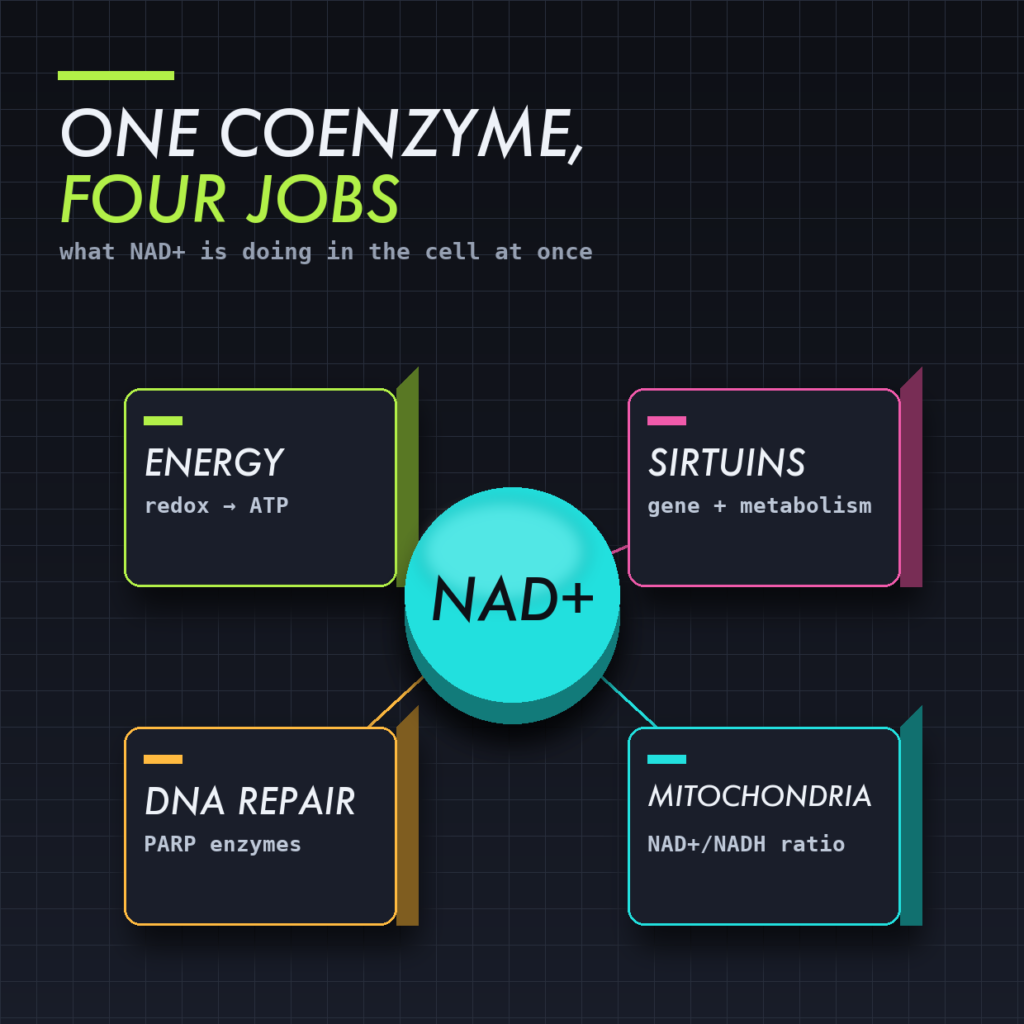
Where NAD+ appears in laboratory assays
Where NAD+ appears in laboratory research
- Dehydrogenase enzyme assays. NAD+ is supplied as the cofactor, and the rate of NADH formation is read at 340 nm.
- Sirtuin assays. NAD+ is the co-substrate for SIRT1 to SIRT7 in deacylation assays run on purified enzyme.
- PARP assays. NAD+ is the ADP-ribose donor in poly(ADP-ribosyl)ation assays.
- Cell-culture studies of mitochondrial and metabolic pathways. Labs measure the NAD+/NADH ratio and NAD+ pool size as variables within defined culture models.
In each case the concentration of NAD+ has to be known for the numbers to mean anything, which is why identity and purity are checked before an experiment starts.
NAD+ precursors (NMN, NR) vs NAD+
Cells can make NAD+ from smaller precursors. Two of them, NMN (nicotinamide mononucleotide) and NR (nicotinamide riboside), are studied as reagents in their own right.
| Compound | What it is | Common research angle |
|---|---|---|
| NAD+ | The coenzyme itself | Used directly as a redox cofactor and as a co-substrate in enzyme assays |
| NMN | A direct NAD+ precursor | Studied for how cultured cells convert it into NAD+ |
| NR | A vitamin B3-derived precursor | Studied for cellular uptake and conversion into NAD+ |
Precursor studies ask how a cell builds its NAD+ pool. Assays that need NAD+ as a reactant use the coenzyme itself, because a precursor adds a conversion step and every extra step is another place a result can drift.
Stability and storage of the sealed vial
NAD+ is one of the less stable reagents a lab keeps. In solution it degrades over time, and the published data show the rate depends on pH and buffer: the oxidized form “undergoes base-catalyzed degradation at high pH” (Wolfe et al., 2024). This is one reason it is supplied lyophilized.
Store the sealed lyophilized vial as stated on the label, protected from light and moisture, and keep the lot number with it so any result can be traced to the exact material used. Our note on storage and documentation practices covers lot records in more detail.
NAD+ stability in solution depends on pH (Wolfe et al., 2024)
Analytical verification and the COA
A degraded or off-spec lot can shift a redox reading before anyone notices, so the certificate of analysis is the first document to check. A COA reports identity and purity for one specific lot, tied to the batch number printed on the vial.
Two methods carry the weight. HPLC separates the sample and shows how much of it is intact NAD+ against related species such as NADH, ADP-ribose or nicotinamide. Mass spectrometry confirms the molecular identity. The two answer different questions, so read both: purity by HPLC, see the batch COA, and identity by MS on the same document.
Our guides to reading a COA and to HPLC versus mass spectrometry explain what each figure covers, and current batch reports are in the COA library. Match the lot number on your vial to its COA before use.
Documentation and research-use-only status
NAD+ supplied here is a laboratory reagent. It is not a drug, it is not approved by the U.S. Food and Drug Administration for any use in people, and it is not for human or veterinary use. It belongs in controlled laboratory settings run by qualified researchers.
- Handle the powder with standard laboratory precautions and appropriate protective equipment.
- Record the lot number, COA reference and date received for every vial.
- Keep the COA with your experimental records so results stay traceable to the material used.
Frequently asked questions
What is NAD+ used for in research?
It is used as a redox cofactor in dehydrogenase assays, as the co-substrate in sirtuin and PARP enzyme assays, and as a measured variable (the NAD+/NADH ratio) in cell-culture studies of mitochondrial and metabolic pathways.
Is NAD+ a peptide?
No. NAD+ is a dinucleotide coenzyme built from two nucleotides, while peptides are chains of amino acids.
How is NAD+ stored?
Store the sealed lyophilized vial as stated on the label, protected from light and moisture.
NMN vs NAD+: what is the difference?
NMN is a precursor that cells convert into NAD+, so it is studied for how the NAD+ pool is built. NAD+ is the finished coenzyme, used directly in redox and enzyme assays.
How do I confirm a batch?
Match the lot number on the vial to its COA in the COA library and check both the HPLC purity result and the mass spectrometry identity result.
Bottom line
NAD+ is a standard laboratory reagent because it does two chemical jobs: it carries electrons as a redox cofactor, and it is consumed as a substrate by sirtuins and PARPs. It is also less stable than many reagents, so it ships lyophilized and each lot comes with a COA. Read the label for identity, read the COA for purity and mass confirmation, and keep the sealed vial stored as labeled.
For Research Use Only. Not for use in diagnostic or therapeutic procedures.