SS-31 Peptide: Research Overview, Structure and Identifiers
The SS-31 peptide is only four amino acids long, yet it is one of the most studied tools in mitochondrial membrane research. It was designed to cross membranes on its own and bind cardiolipin, a lipid found almost only in the inner mitochondrial membrane, which makes it useful for studying how that membrane is organized.
This guide covers SS-31’s identity, the structure behind its targeting, the in-vitro assays it appears in, how it compares with MOTS-c and NAD+, and how a batch certificate can be checked.
Sold for in-vitro laboratory research only. Not for human or animal use and not for diagnostic or therapeutic procedures. Nothing here describes or suggests use in people.
Quick answer: What is SS-31 peptide?
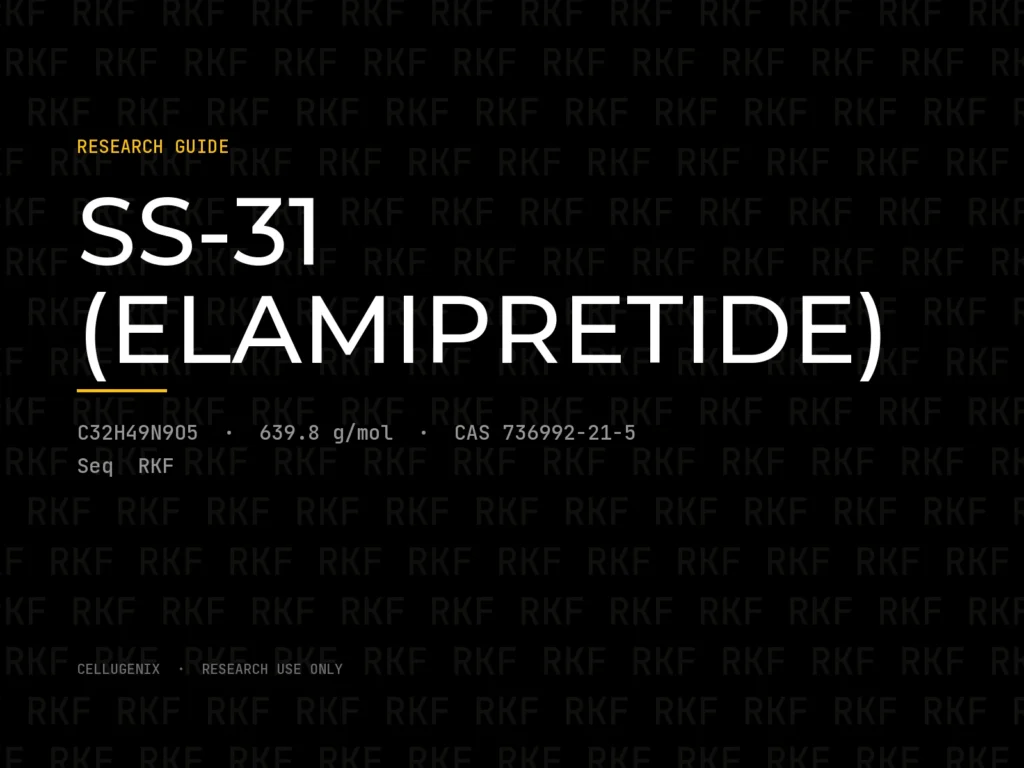
SS-31 (Elamipretide, MTP-131) is a synthetic, cell-permeable tetrapeptide of the Szeto-Schiller family with the residue string D-Arg-Dmt-Lys-Phe-NH2 (C32H49N9O5, 639.8 g/mol, CAS 736992-21-5). It attaches to cardiolipin on the mitochondrion’s inner membrane, and labs use it in membrane-potential, electron-transport and reactive-oxygen-species research.
✓ Docks on cardiolipin in the mitochondrion’s inner membrane
✓ Used in isolated-mitochondria and cell-culture assays of membrane potential, respiration and reactive oxygen species
Contents
- SS-31 at a glance
- What is SS-31 peptide?
- How does SS-31 work?
- What is SS-31 used for in research?
- SS-31 vs MOTS-c and NAD+
- Storage of the sealed vial
- How to verify a batch
- FAQs
SS-31 at a Glance
Quick answer: Four residues make up the SS-31 peptide (D-Arg-Dmt-Lys-Phe-NH2), giving the formula C32H49N9O5, a molecular weight of 639.8 g/mol and CAS number 736992-21-5. It also goes by Elamipretide, MTP-131 and Bendavia. Its target is cardiolipin, found in the mitochondrion’s inner membrane.
| Field | Value |
| Sequence | D-Arg-Dmt-Lys-Phe-NH2 |
| Other names | Elamipretide, MTP-131, Bendavia |
| Class | Szeto-Schiller (SS) mitochondria-targeting tetrapeptide |
| Molecular formula | C32H49N9O5 |
| Molecular weight | 639.8 g/mol |
| CAS number | 736992-21-5 |
| Target | Cardiolipin in the mitochondrion’s inner membrane |
| Main research areas | Membrane potential, reactive oxygen species, electron transport, cardiolipin binding |
| Cellugenix supply | SS-31 10 mg, lyophilized, batch COA 99.97% (HPLC) |
Two identifiers do most of the work when you match documents: the CAS number and the sequence. Names vary between suppliers and papers, while those two stay fixed. Every identifier in this table matches our SS-31 10 mg specification and COA page, so the overview and the vial in your lab describe the same compound.
What Is SS-31 Peptide?
Quick answer: Built to reach mitochondria, SS-31 is a four-residue synthetic peptide. It came out of Szeto and Schiller’s peptide work and was later developed as Elamipretide by Stealth BioTherapeutics. SS-31, MTP-131, Bendavia and Elamipretide all name the same sequence at different stages of its development.
The story starts with a happy accident. Weill Cornell’s Hazel Szeto and Montreal’s Peter Schiller were working on small synthetic peptides, and some of their designs turned out to collect inside mitochondria. Szeto later described it in Clinical Pharmacology & Therapeutics as “the serendipitous discovery of a novel class of compounds that selectively target cardiolipin.”
Szeto founded Stealth Peptides in 2006 to develop the compound, and the company later became Stealth BioTherapeutics. Each name marks a stage in the peptide’s history:
- SS-31: the Szeto-Schiller series code, and still the name labs use
- MTP-131 and Bendavia: development codes used by Stealth BioTherapeutics in early clinical work
- Elamipretide: the international nonproprietary name
Is SS-31 the Same as Elamipretide?
Yes. SS-31, Elamipretide, MTP-131 and Bendavia are names for the same tetrapeptide sequence. The material described on this page is a laboratory reagent, made, labeled and sold for in-vitro research only.
How Does SS-31 Work?
Quick answer: The SS-31 mechanism of action starts with its shape. Its alternating aromatic and positively charged residues let it cross cell membranes and pile up on the mitochondrion’s inner membrane, where it associates with cardiolipin, the phospholipid that organizes the electron transport complexes and the folded cristae. In isolated mitochondria and cultured cells, it is used to study membrane potential, electron flow and reactive-oxygen-species formation.

SS-31 binding cardiolipin in the inner mitochondrial membrane
The Structure Behind the Targeting
Every residue has a job. D-arginine is the mirror-image form of arginine, which peptidases struggle to cut, so the peptide lasts longer in biological samples. Dmt (2′,6′-dimethyltyrosine) carries a phenol ring that can scavenge free radicals. Lysine adds a second positive charge, and the amidated phenylalanine at the end removes a negative one. The result is a small molecule carrying a net charge of +3 at physiological pH, which helps it cross membranes with no transporter protein. Weill Cornell’s account of the discovery notes the same odd pairing: a water-soluble chain of four amino acids that still entered cells.
Cardiolipin, Cristae and the Electron Transport Chain
Cardiolipin is an unusual lipid with four fatty-acid tails, confined almost entirely to the inner membrane of mitochondria. It helps bend that membrane into cristae and holds the electron transport complexes close together so electrons pass between them efficiently. When cardiolipin oxidizes, the cristae lose shape and the complexes drift apart. Electron flow then slows and leaks, and more reactive oxygen species form. SS-31 research focuses on that weak point, testing whether a peptide bound to cardiolipin keeps the structure intact in stressed cells.
What Proteomics Adds
A 2020 study in PNAS from James Bruce’s group at the University of Washington mapped which proteins SS-31 touches inside mitochondria. Using chemical cross-linking with mass spectrometry, the team found that all its protein partners were known cardiolipin binders, mainly from ATP production and 2-oxoglutarate metabolism. The authors reported “the SS-31-interacting proteins, all known cardiolipin binders,” which fits the cardiolipin model from a new direction.
What Is SS-31 Used For in Research?
Quick answer: SS-31 is used as a research tool for mitochondrial membrane function. Typical formats are isolated mitochondria and cultured cells, where studies measure membrane potential, oxygen consumption, ATP output and reactive oxygen species.
- Isolated mitochondria: membrane potential, respiration and hydrogen peroxide output
- Cultured cells under oxidative stress: mitochondrial membrane potential, reactive oxygen species and cristae imaging
- Cardiolipin binding: lipid-binding assays and model membranes containing cardiolipin
- Protein interaction mapping: cross-linking mass spectrometry of cardiolipin-associated proteins
- Bioenergetics: ATP production and electron transport chain activity
Isolated-mitochondria work is the most direct test. Researchers add SS-31 to mitochondria pulled from tissue, then track membrane potential with fluorescent dyes, oxygen use with respirometry and hydrogen peroxide output with probe assays.
SS-31 vs MOTS-c and NAD+
Quick answer: Labs often pair SS-31 with MOTS-c and NAD+, and each acts at a different level. SS-31 binds the inner membrane, MOTS-c works as a mitochondrial-derived signaling peptide, and NAD+ is a coenzyme shuttling electrons between metabolic reactions. Our SS-31 vs MOTS-c guide compares them side by side.
For each compound on its own, see the MOTS-c research overview and the NAD+ research overview. The three answer different questions: membrane structure, mitochondria-to-nucleus signaling and the electron supply itself. Labs comparing all three in one study design can source them through our NAD+, MOTS-c and SS-31 research bundle.
Storage of the Sealed Vial
The compound ships as a lyophilized (freeze-dried) solid in a sealed vial labeled with its lot number. Store sealed vials as stated on the label, protected from light and moisture. Researchers can see our storage and handling guide for temperature ranges. Keeping the seal intact until the day of use protects the powder from humidity. Record the vial label details and the COA report number in your lab notes when the vial arrives, so every result traces back to the tested material.
How to Verify Research-Grade SS-31
Quick answer: Check the batch certificate. For SS-31 10 mg, the current report from Testides, an independent laboratory, lists HPLC-UV purity of 99.97% and the measured content, tested March 28, 2026. Its report number links to the lab’s own record, so you can confirm the certificate is genuine.
A quick checklist for the certificate:
- Report number: LK-SS31-10-032626 on the current certificate, matching the record on testides.com
- Purity and method: 99.97% by HPLC-UV
- Content: the measured amount in the vial compared with the 10 mg label
- Test date: March 28, 2026 for the current report
- Laboratory: Testides, independent of Cellugenix
A certificate covers the tested lot only, so the report number tells you more than the product name does. The full record is on our SS-31 10 mg certificate page. If a lot has no report listed yet, Cellugenix provides the certificate on request. New to certificates? Read how to read a COA.
Frequently Asked Questions
What is SS-31?
SS-31 is a four-residue synthetic peptide from the Szeto-Schiller family, built to reach mitochondria. It crosses cell membranes on its own, collects where the inner membrane is rich in cardiolipin and binds that lipid. Labs use it in membrane-potential, electron-transport and reactive-oxygen-species research.
What is the molecular weight of SS-31?
SS-31 has a molecular weight of 639.8 g/mol, from the formula C32H49N9O5. Its monoisotopic mass is about 639.39, so in LC-MS the singly protonated ion appears near m/z 640.4. Salt forms such as the acetate weigh more, so a certificate’s figure depends on the form tested.
What is the CAS number of SS-31?
The CAS registry number of SS-31 is 736992-21-5. Other identifiers point to the same compound: the names Elamipretide, MTP-131 and Bendavia, and the residue string D-Arg-Dmt-Lys-Phe-NH2. Matching the CAS number across documents is a quick check that two sources describe one molecule.
Is SS-31 the same as Elamipretide?
Yes. SS-31, Elamipretide, MTP-131 and Bendavia all name the same tetrapeptide sequence. SS-31 is the original Szeto-Schiller code and the name used in laboratory research.
What does “SS” in SS-31 stand for?
“SS” stands for Szeto-Schiller, after the two scientists who developed the series: Peter Schiller (Montreal Clinical Research Institute) and Hazel Szeto (Weill Cornell Medicine). Sister compounds such as SS-02 and SS-20 appear in the early research literature.
The Bottom Line
SS-31 is a cardiolipin-binding tetrapeptide with a large in-vitro literature on mitochondrial membrane structure, membrane potential and reactive oxygen species. For labs, its value lies in how precisely it marks the inner mitochondrial membrane. Cellugenix supplies research-grade SS-31 for in-vitro laboratory study only, with a published third-party certificate.
SS-31 10 mg specification and COA
References
- Szeto HH, Birk AV. Clinical Pharmacology & Therapeutics, 2014; 96(6): 672–683. PMID 25188726.
- Chavez JD et al. PNAS, 2020; 117(26): 15363–15373. PMID 32554501.
For Research Use Only. Not for use in diagnostic or therapeutic procedures.