Three separate lot records
GHK-Cu, BPC-157, and TB-500 each carry independent documentation.

$144.97
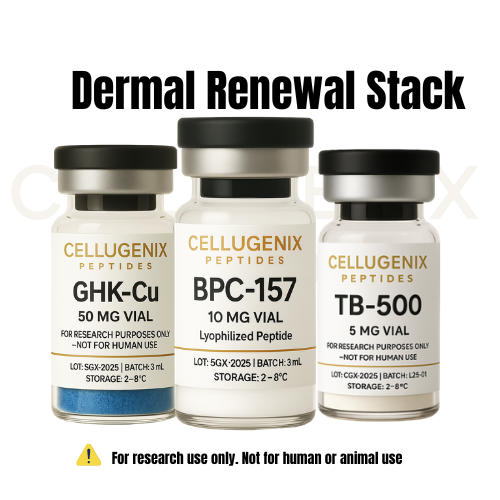
GHK-Cu, BPC-157, and TB-500 each show up in skin and tissue literature for a different reason: one drives collagen synthesis at the fibroblast level, one modulates nitric oxide and growth factor pathways, and one governs cell migration through actin binding.
Specifications for the three compounds in the Dermal Repair Research Stack are listed separately.
| Specification | GHK-Cu | BPC-157 | TB-500 |
|---|---|---|---|
| Compound | GHK-Cu | BPC-157 | TB-500 |
| Quantity | 50mg | 10mg | 5mg |
| Product format | Research-grade copper tripeptide complex | Research-grade pentadecapeptide | Research-grade synthetic peptide fragment |
| Intended use | Laboratory research only | Laboratory research only | Laboratory research only |
| Documentation | COA available through our COA library | COA available through our COA library | COA available through our COA library |
| Related category | Tissue, Skin & Matrix Research | Tissue Repair & Regeneration Research | Tissue Repair & Regeneration Research |
| Support | Contact Cellugenix before ordering if documentation is needed | Contact Cellugenix before ordering if documentation is needed | Contact Cellugenix before ordering if documentation is needed |
This bundle is sold only for scientific study by qualified professionals. Not for use in diagnostic or therapeutic procedures. Not for human or veterinary use.
Review the compliance section and per-compound storage instructions before you complete checkout.
The three compounds in this bundle target skin repair from mechanistically separate angles rather than duplicating one pathway. GHK-Cu is a copper-binding tripeptide studied for its effect on fibroblast collagen output, upregulating collagen types I and III alongside glycosaminoglycans and decorin at nanomolar concentrations.
BPC-157 works largely through nitric oxide signaling and growth factor upregulation, a mechanism distinct from the other two peptides in the set. TB-500 operates through actin sequestration, which drives keratinocyte migration and accelerates re-epithelialization in dermal wound models.
As none of the three peptides duplicate each other's mechanism, researchers use this combination to map how collagen synthesis, vascular/growth factor signaling, and cell migration interact across the same wound-healing timeline.
Each compound occupies a distinct position in dermal repair research, which is what makes the three worth studying as a set rather than individually.
All three vials arrive with independent lot documentation, letting a lab confirm identity and purity against the specific batch received rather than a single bundle-wide certificate.
This bundle follows the same batch-tracking approach applied to every listing in the Cellugenix catalog.
GHK-Cu, BPC-157, and TB-500 each carry independent documentation.
Identity and purity for every batch are confirmed by a third party.
The bundle is restricted to research buyers.
Orders typically leave with tracking within days of confirmation.
All three vials are secured individually inside one shipment.
The three peptides differ in stability profile, so treat this as three separate storage tasks rather than one shared routine.
This bundle spans two categories within the Cellugenix catalog.
Reference pages covering testing and compliance for this Cellular Research Bundle.
GHK-Cu 50mg, BPC-157 10mg, and TB-500 5mg, shipped as three separately documented vials.
No. GHK-Cu acts on fibroblast collagen synthesis, BPC-157 works through nitric oxide and growth factor pathways, and TB-500 drives cell migration via actin binding.
Yes, every vial has its own batch record available through the COA library.
No, each peptide has a different stability profile, so check the individual handling page for each one before use.
Skin repair involves multiple overlapping processes, and studying complementary mechanisms side by side gives researchers a fuller picture than any single peptide alone.
Trying to work out how collagen synthesis, growth factor signaling, and cell migration fit together in a dermal repair study design? Reach out and we'll help you think it through.
