PT-141 vs Melanotan II: Structure and Receptor Research Compared
Quick Answer
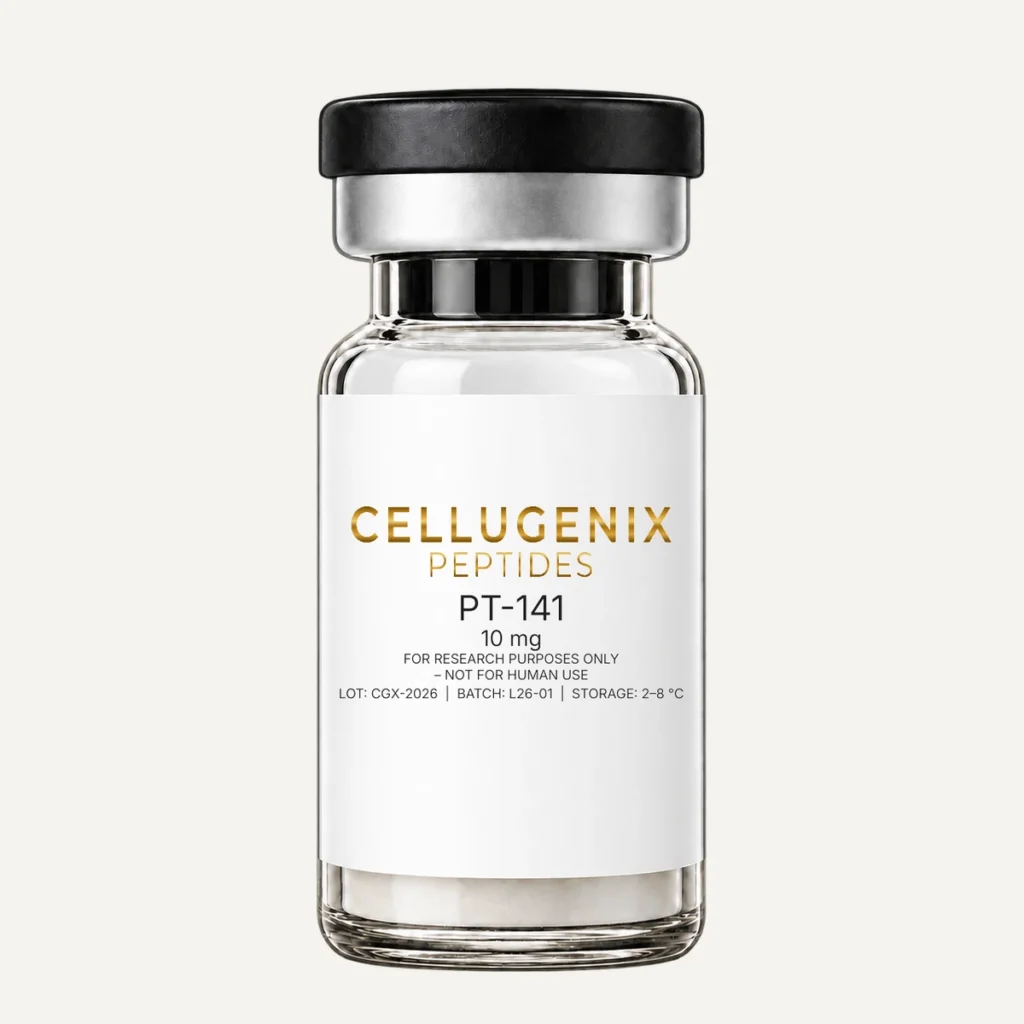
PT-141 and Melanotan II are cyclic heptapeptides with the same ring: Ac-Nle-cyclo[Asp-His-D-Phe-Arg-Trp-Lys]. The difference is the C-terminus. Melanotan II ends in an amide (-NH2) and PT-141 in a free acid (-OH), which makes PT-141 a metabolite-like form of Melanotan II. Both are synthetic analogues of alpha-melanocyte-stimulating hormone (alpha-MSH) studied in melanocortin-receptor research: Melanotan II across the MC1, MC3 and MC4 receptors, PT-141 mainly at MC3R and MC4R.
Key Takeaways
- Same cyclic core, different C-terminal group.
- Melanotan II: C50H69N15O9, 1024.2 g/mol. PT-141: C50H68N14O10, 1025.2 g/mol.
- Both are alpha-MSH analogues used in melanocortin-receptor pharmacology.
- Melanotan (MT-1, afamelanotide) is a different, linear peptide selective for MC1R.
PT-141 vs Melanotan II at a Glance
| PT-141 | Melanotan II | |
|---|---|---|
| Structure | Ac-Nle-cyclo[Asp-His-D-Phe-Arg-Trp-Lys]-OH | Ac-Nle-cyclo[Asp-His-D-Phe-Arg-Trp-Lys]-NH2 |
| Other names | Bremelanotide | MT-II |
| Molecular formula | C50H68N14O10 | C50H69N15O9 |
| Molecular weight | 1025.2 g/mol | 1024.2 g/mol |
| CAS number | 189691-06-3 | 121062-08-6 |
| Receptor research focus | MC3R, MC4R | MC1R, MC3R, MC4R |
What Is Melanotan II?
Melanotan II is a lactam-bridged cyclic analogue of alpha-MSH. Cyclization and the D-phenylalanine substitution make it far more resistant to enzymatic breakdown than the native hormone. Because it binds several melanocortin receptors, it is used as a broad reference agonist in receptor pharmacology and in melanogenesis studies with cultured melanocytes.
What Is PT-141?
PT-141 has the same ring as Melanotan II but carries a free carboxylic acid at the C-terminus instead of an amide. That small change shifts its receptor profile toward MC3R and MC4R, and it is the compound most often used when a study is focused on central melanocortin signaling rather than pigmentation pathways.
And Melanotan (MT-1)?
Melanotan (afamelanotide, [Nle4, D-Phe7]-alpha-MSH) is often confused with Melanotan II, but it is a linear 13-residue peptide (1646.8 g/mol, CAS 75921-69-6) and is selective for MC1R. It belongs in pigmentation and MC1R signaling work rather than MC3R/MC4R studies.
Storage of the Sealed Vial
All of these compounds ship as lyophilized (freeze-dried) solids in sealed vials. Store sealed vials as stated on the label, protected from light and moisture, and see our storage and handling guide for temperature ranges. Each vial is labelled with its lot number, which ties it to its certificate.
Analytical Verification and Documentation
Each lot is tested by Testides, an independent laboratory, for HPLC purity and content. Certificates are published with their report numbers so they can be checked against the lab’s own record:
New to certificates? Our guide on how to read a COA walks through each field.
Frequently Asked Questions
What is the difference between PT-141 and Melanotan II?
They share a cyclic core, but Melanotan II ends in an amide and PT-141 in a free acid. The change gives PT-141 a narrower receptor profile focused on MC3R and MC4R.
Is PT-141 the same as Melanotan II?
No. PT-141 is structurally derived from Melanotan II, but it is a distinct compound with a different C-terminus, formula (C50H68N14O10) and CAS number (189691-06-3).
What is the CAS number of Melanotan II?
The CAS number of Melanotan II is 121062-08-6. Its molecular weight is 1024.2 g/mol.
Is Melanotan the same as Melanotan II?
No. Melanotan (MT-1) is a linear 13-residue peptide selective for MC1R; Melanotan II is a cyclic 7-residue peptide that binds several melanocortin receptors.
All compounds discussed are sold for in-vitro laboratory research only. They are not for human or animal use and not for diagnostic or therapeutic procedures. Nothing here describes or suggests use in people.
For Research Use Only. Not for use in diagnostic or therapeutic procedures.