Are Research Peptides Legal in the US? The 2026 FDA Update
Few corners of US drug policy moved as fast in 2026 as peptides. In February, the Secretary of Health and Human Services said most restricted peptides would be cleared for review. By July, an FDA advisory committee had voted on seven of them, and headlines started calling it an “unban.” So where does that leave a laboratory that orders research peptides today?
This guide walks through what makes a research peptide legal, the three legal channels peptides move through, what 2026 changed (and what it left alone), and the rules on possession, imports, sport, and military service. It closes with how a compliant supplier runs its business.
This is general information, not legal advice. Cellugenix supplies peptides strictly for laboratory research. They are not for human or veterinary use.
Quick answer: Are research peptides legal in the US?
Yes, when they’re sold and used for laboratory research. Peptides labeled “For Research Use Only. Not for human or veterinary use” can legally be sold and bought for lab study. Selling or using unapproved peptides for human consumption, or making health claims about them, breaks the FD&C Act.
✓ Legal for lab research when labeled and sold as Research Use Only
✓ Illegal to market or sell unapproved peptides for human use
✓ The July 2026 FDA advisory vote approved no peptide as a drug
Last updated: October 2, 2026
Contents
- The short answer
- The three legal channels
- What changed in 2026
- The seven peptides discussed in July
- Buying research peptides
- Possession
- Importing
- Sport and the military
- How a compliant supplier operates
- FAQs
Are Research Peptides Legal in the US? The Short Answer
Quick answer: Yes, for research. Research peptides are legal to sell, buy, and hold in the US when they’re labeled, sold, and used for laboratory study. Their legal status comes down to three things: the label, the way they’re marketed, and the use they’re sold for. Human-use marketing turns the same vial into an unapproved new drug.
Peptides aren’t illegal in the US as a class. People asking whether peptides are legal in the US usually mean one of three different products, and the next section sorts them out. For research peptides, the line falls in a clear place.
Lawful
- Peptides labeled Research Use Only (RUO), sold to researchers and used in laboratory work
- Product pages that describe identity, purity, and storage, with no health claims
Unlawful
- Selling or promoting unapproved peptides for human use, including anti-aging, weight loss, or recovery
- Using research-grade peptides in people
The reason comes from how federal law defines a drug. Under the Federal Food, Drug, and Cosmetic Act (FD&C Act), a product’s intended use decides how it’s regulated, and FDA rule 21 CFR 201.128 says intended use shows up in labeling, advertising, and the seller’s statements. A peptide described as a lab reagent is regulated as a lab reagent. Describe a health benefit, and the FDA treats it as a drug that needs approval.
Picture two identical vials of BPC-157. One ships with an RUO label, a purity certificate and a product page about storage. The other comes with a website promising faster recovery. Chemically, they match, yet the second one is an unapproved drug in the eyes of the FDA because its seller told buyers what it’s for.
The RUO label carries weight only when everything around it says the same thing. Our explainer on what Research Use Only means covers the label wording itself.
The Three Legal Channels for Peptides in the US
Quick answer: In the US, peptides reach people through three legally distinct channels: FDA-approved prescription drugs, peptides compounded by pharmacies under Section 503A, and research-use-only compounds sold for laboratory study. Each channel has its own rules, and research peptides belong only in the third.
| FDA-approved drugs | Compounded (Section 503A) | Research Use Only | |
| Examples | Semaglutide, tesamorelin (Egrifta), bremelanotide (Vyleesi), elamipretide (Forzinity) | Bulk substances on the 503A Bulks List or in FDA Category 1 | BPC-157, TB-500, MOTS-c and others sold as lab reagents |
| Who supplies | Pharmacies, with a prescription | Licensed compounding pharmacies, with a prescription | Research suppliers, to laboratories |
| Human use | Yes, as prescribed | Yes, as prescribed | No |
| Main rules | FDA approval (NDA or BLA) | FD&C Act §503A, FDA categories, state boards of pharmacy | FD&C Act intended-use rules, FTC advertising rules |
| Claims allowed | The approved label | Directed by the prescriber | No health or therapeutic claims |
Compounded peptides and research use only peptides often share a name, and the same molecule can turn up in more than one column. Elamipretide (SS-31) is the clearest case: Forzinity is an approved medicine for Barth syndrome, while research-grade SS-31 is a laboratory reagent with the same sequence. What separates them is the channel, the label, and the paperwork behind each vial.
The middle column covers two kinds of facilities. A 503A pharmacy compounds for an individual patient’s prescription, while a 503B outsourcing facility makes larger batches under separate FDA rules. That’s why the FDA’s Category 2 page tags each substance as 503A or 503B.
Most of the 2026 news concerns the middle column. That’s the part the FDA is reviewing, and it explains why a compounding vote gets reported as if it changed research supply.
What Changed for Peptides in 2026?
Quick answer: The FDA peptide reclassification of 2026 ran in three steps. In February, HHS Secretary Robert F. Kennedy Jr. announced plans to move most restricted peptides out of the FDA’s Category 2 (“do not compound”) list. In April, the FDA removed 12. In July, its Pharmacy Compounding Advisory Committee discussed seven peptides for the 503A Bulks List. The votes are non-binding, and no peptide was approved as a drug.
| Date | What happened | Source |
| Sep 29, 2023 | The FDA placed a group of peptide bulk substances in Category 2 | FDA Category 2 page |
| Feb 27, 2026 | HHS Secretary Kennedy said about 14 of 19 restricted peptides would move back toward compounding eligibility | Pharmacy Times |
| Apr 15 and 16, 2026 | A Federal Register notice removed 12 peptides from Category 2 after their original nominators withdrew them, and set PCAC review dates | Federal Register / FDA |
| Jul 23, 2026 | PCAC discussed BPC-157, KPV, TB-500 and MOTS-c | FDA meeting page |
| Jul 24, 2026 | PCAC discussed DSIP (emideltide), Semax and Epitalon | FDA meeting page |
| Next | FDA notice-and-comment rulemaking, expected late 2026 or 2027 | Law-firm analysis |
The July votes also went against the agency’s own staff on several peptides. FDA reviewers had proposed leaving emideltide and Epitalon off the 503A Bulks List, and the committee backed Epitalon anyway. Those staff views now feed into the FDA’s final decision alongside the votes.
Pharmacist Mohammed Chammout, PharmD, summed up the pace in Pharmacy Times: “the regulatory mechanics are still working their way through the system.”

Where 2026’s reviewed peptides stand on the road to the 503A Bulks List
What Is FDA Category 2?
The FDA Category 2 peptides list currently includes Ipamorelin, GHRP-2, GHRP-6 and Kisspeptin-10. Category 2 is the FDA’s interim list of bulk drug substances that compounding pharmacies shouldn’t use while the agency evaluates them, because they raised significant safety concerns. Category 1 substances can be compounded during review.
The FDA started removing peptides from Category 2 in April 2026, yet leaving the list is a procedural step. A peptide still needs Category 1 status or a place on the 503A Bulks List before a pharmacy can compound it. The FDA’s page lists the concern behind each entry, which is often immunogenicity or impurities tied to how the peptide is made.
Did the FDA “Unban” Peptides?
No. Advisory committee votes are recommendations, and the FDA still has to act through rulemaking. Even a final listing on the 503A Bulks List would allow prescription compounding by licensed pharmacies. It wouldn’t approve any peptide as a drug, and it wouldn’t change the rules for research-use-only supply. Headlines that say peptides are “legal now” usually blur these separate steps into one.
Which Peptides Did the FDA Committee Discuss in July 2026?
Quick answer: The FDA’s compounding advisory committee reviewed seven peptides on July 23 and 24, 2026: BPC-157, KPV, TB-500 and MOTS-c on day one, then DSIP (emideltide), Semax and Epitalon on day two. It recommended six for the 503A Bulks List and voted against emideltide. Each was reviewed for specific compounding uses.
The “uses reviewed” column below lists the conditions the FDA examined for prescription compounding. They describe the agency’s review and have no connection to Cellugenix products, which are supplied for laboratory research only.
| Peptide | Use(s) the FDA reviewed for compounding | Committee outcome | Research overview |
| BPC-157 | Ulcerative colitis | Recommended | BPC-157 |
| KPV | Wound healing, inflammatory conditions | Recommended | KPV |
| TB-500 | Wound healing | Recommended | TB-500 |
| MOTS-c | Obesity, osteoporosis | Recommended | MOTS-c |
| DSIP (emideltide) | Opioid withdrawal, chronic insomnia, narcolepsy | Not recommended | DSIP |
| Semax | Cerebral ischemia, migraine, trigeminal neuralgia | Recommended | Semax |
| Epitalon | Insomnia | Recommended | Epitalon |
So which peptides are now legal in the US for compounding? None yet. None of the seven became an approved drug, and none can be compounded until the FDA finishes rulemaking. Scott Brunner, CEO of the Alliance for Pharmacy Compounding, told AJMC that the “FDA still must formally adopt the advisers’ recommendations.” That process runs through a proposed rule in the Federal Register, a public comment period and a final rule, and law firms tracking it expect the first step in late 2026 or 2027.
Several other well-known names were left out of this review. CJC-1295 and Melanotan II left Category 2 when their nominations were withdrawn, yet neither is on the 503A Bulks List or in Category 1. Ipamorelin, GHRP-2, and GHRP-6 still appear on the FDA’s Category 2 page, where the agency cites immunogenicity risk for certain routes.
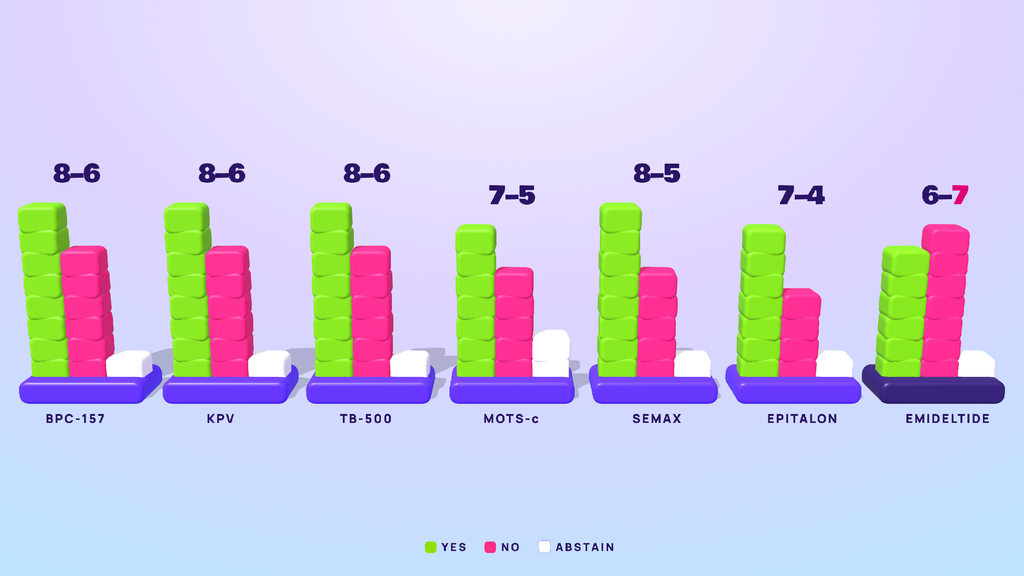
The yes, no, and abstain votes for each of the seven peptides
Is It Legal to Buy Research Peptides in the US?
Quick answer: Yes, buying research peptides for research purposes is legal, from a supplier that sells them as Research Use Only. They’re legal to sell on the same terms. A sale becomes unlawful when unapproved peptides are marketed or sold for human use. Buyers are expected to use research peptides only in research settings.
A compliant sale has a recognizable shape:
- The label: “For Research Use Only. Not for human or veterinary use” on the vial and the product page
- The product page: identity, purity, and storage, with no claims about effects in people
- The buyer: a researcher, confirming the material is for laboratory study
- The paperwork: a batch-specific certificate of analysis that travels with the order
Reputable suppliers also set a minimum buyer age and ask for confirmation of the research purpose before an order goes through.
FDA enforcement in 2026 shows how this works in practice. In warning letters to peptide sellers, the agency has pointed to website claims about effects in people as proof of intended use, even where the labels read “research use only.”
Our page on ordering research peptides in the USA covers delivery and documentation for US laboratories.
Is It Illegal to Possess Peptides?
Quick answer: Most research peptides aren’t controlled substances under the federal Controlled Substances Act (CSA), so holding them for research isn’t a DEA drug offense. The FDA regulates how they’re labeled, marketed, and sold. A few hormones carry their own federal rules, and states can add more, so check the specific compound and state.
Two federal agencies cover different ground here. The DEA enforces the CSA schedules, which list substances by abuse potential, and the common research peptides discussed in this guide aren’t on those schedules. Human growth hormone is a well-known exception with its own rule: 21 U.S.C. §333(e) restricts how it can be distributed, separate from the CSA. The FDA oversees what sellers say and how products reach the market.
State law adds a second layer. State boards of pharmacy and legislatures can regulate specific substances more tightly than federal law does, and their rules on compounding vary from one state to the next.
For a specific compound, two checks cover most questions: its CSA status on the DEA’s schedules and the state’s own pharmacy rules. Anything beyond that is a question for a lawyer licensed in the state. Possession also leaves the terms of sale in place: a research peptide bought for laboratory study stays a laboratory reagent.
Importing Peptides: Customs and FDA Rules
Quick answer: Imported peptides are subject to FDA and US Customs and Border Protection review. Under Section 801(a) of the FD&C Act, shipments that look intended for human use or arrive without proper labeling can be detained or refused. Laboratories avoid most import trouble by ordering from suppliers that ship with batch documentation.
The FDA can also place a foreign supplier on an import alert, which lets agents detain that supplier’s shipments without examining each one.
That answers the common question about buying peptides from China: the country of origin isn’t the deciding factor. The FDA looks at the labeling, the paperwork, and the apparent intended use, and an unlabeled bulk powder with no documentation draws far more attention than a labeled vial with a COA. Customs questions usually come down to two things: what the material is and who it’s for, and an RUO invoice with a matching certificate answers both.
Cellugenix ships US orders by FedEx or UPS Express with tracking, and the details are in our shipping policy.
Peptides in Sport and the Military
Quick answer: Many research peptides are prohibited in sport. WADA bans non-approved substances (S0) and peptide hormones and growth factors (S2) at all times. US service members also fall under Department of Defense rules, and Operation Supplement Safety (OPSS) maintains the DoD Prohibited Dietary Supplement Ingredients List.
Are peptides illegal in sports? For drug-tested athletes, many are. Are peptides legal in the military? Service members face similar limits through the DoD list. The WADA Prohibited List names several research peptides directly:
| Category | Covers | Named examples |
| S0 | Non-approved substances | BPC-157 |
| S2 | Peptide hormones, growth factors and releasing factors | TB-500, CJC-1295 |
| S4.4 | Metabolic modulators (AMPK activators) | MOTS-c |
On the military side, OPSS lists BPC-157 on the DoD prohibited ingredients list under DoD Instruction 6130.06, after the peptide turned up in products sold as health and wellness supplements. WADA applies strict liability, so a positive test counts regardless of where the substance came from. WADA publishes a new list every January 1, and OPSS revises its list as new ingredients appear, so the current editions are the ones to check.
How a Compliant Research Peptide Supplier Operates
Quick answer: A compliant US research supplier labels every product “For Research Use Only. Not for human or veterinary use,” makes no health or therapeutic claims, publishes batch-specific certificates of analysis, and sells to researchers.
Use these six points to judge any supplier, including us:
- RUO labeling on every vial, product page and invoice
- No human-use claims on the website, social media or affiliate content
- Independent batch testing from a third-party lab
- Lot traceability from the COA back to the vial
- Storage guidance for lyophilized material
- Buyer confirmation of age and research purpose at checkout
At Cellugenix, every batch is independently tested for purity and identity before release, and the results go into a COA library organized by product and batch. Our guides on how to evaluate a research peptide vendor, batch certificates of analysis, and independent third-party testing cover each point in more depth.
Record-keeping helps on the lab side too. Filing each batch COA with the experiment notes ties every result to a documented vial, which is the same trail an auditor or journal reviewer would ask to see.
Frequently Asked Questions
What does “Research Use Only” mean on a peptide?
“Research Use Only” means the product is supplied for laboratory study and isn’t intended for diagnosis, treatment or any use in people or animals. The full label usually reads “For Research Use Only. Not for human or veterinary use.” The FDA weighs that label alongside the seller’s marketing, so the wording has to match how the product is sold.
Are peptides FDA-approved?
Some are. Insulin, semaglutide, tesamorelin (Egrifta), bremelanotide (Vyleesi), and elamipretide (Forzinity) are FDA-approved peptide drugs, available by prescription. Peptides sold as research reagents, such as BPC-157, TB-500, and MOTS-c, have no FDA approval. They’re supplied for laboratory study under research-use-only labeling. The FDA’s Drugs@FDA database lists every approved product.
Did the FDA ban peptides in 2026?
No. The 2026 changes ran the other way. The FDA removed 12 peptides from its Category 2 compounding list in April, and an advisory committee recommended six for the 503A Bulks List in July. Final listing still needs FDA rulemaking. Research-use-only supply continued under the same FD&C Act rules throughout.
Can a doctor prescribe BPC-157?
Not as an approved drug, because no BPC-157 product has FDA approval. Compounded BPC-157 also isn’t available yet: it left Category 2 in April 2026 but hasn’t been added to the 503A Bulks List or Category 1. The July 2026 committee recommendation is the first step, and FDA rulemaking comes next.
Are peptide state laws different?
They can be. Federal law sets the baseline through the FD&C Act and the CSA, and states regulate pharmacy practice, compounding and certain substances on top of that. Rules for a specific compound in a specific state are best confirmed with that state’s board of pharmacy.
Are research peptides legal in Canada or Europe?
Canada regulates drugs under the Food and Drugs Act, and research reagents are supplied there for laboratory use. In Europe, each country applies its own rules alongside EU medicines law. Our guide to ordering outside the US covers shipping, documentation and currency for international laboratories.
The Bottom Line
Research peptides are legal in the US for laboratory research when they’re labeled and sold as Research Use Only, and selling them for human use breaks federal law. The 2026 FDA process concerns prescription compounding, and it hasn’t approved any peptide or changed the rules for research supply. We’ll update this guide as the FDA acts.
This is general information, not legal advice. Cellugenix supplies peptides strictly for laboratory research.
Browse research compounds, each with a batch COA
Sources
- US FDA. July 23 and 24, 2026 Meeting of the Pharmacy Compounding Advisory Committee (agenda checked October 2, 2026).
- US FDA. Certain Bulk Drug Substances for Use in Compounding that May Present Significant Safety Risks (Category 2 page, current as of April 22, 2026).
- Federal Register, April 2026 notice on 503A Category 2 peptide removals and PCAC scheduling (document 2026-07361).
- Federal Food, Drug, and Cosmetic Act, §201(g), §503A and §801(a); 21 CFR 201.128.
- DEA. Controlled Substances Act schedules (21 CFR Part 1308).
- World Anti-Doping Agency. Prohibited List, 2026.
- Operation Supplement Safety. DoD Prohibited Dietary Supplement Ingredients List.
- Chammout M. Pharmacy Times, June 4, 2026.
- AJMC, July 2026; McDermott Will & Schulte, July 2026 (committee vote tallies).
- Context: Johns Hopkins Bloomberg School of Public Health, “How the FDA Regulates Peptides” (August 3, 2026); Healthline, “Are Peptides Legal?” (July 30, 2026).
For Research Use Only. Not for use in diagnostic or therapeutic procedures.