
SS-31 vs MOTS-c: Mitochondrial Peptides in Research (2026)

SS-31 and MOTS-c turn up together in nearly every conversation about mitochondrial peptides, so people start to treat them as a matched pair. Put SS-31 vs MOTS-c side by side, though, and the resemblance ends at the address label. One is a four-unit peptide built by chemists to cling to the inner mitochondrial membrane. The other is a 16-unit messenger written in mitochondrial DNA, and it can travel all the way to the cell’s nucleus.
Cellugenix supplies SS-31 and MOTS-c strictly for laboratory research. They are not for human or veterinary use. This is general information, not medical advice.
Quick answer: What’s the difference between SS-31 and MOTS-c?
SS-31 is a synthetic four-amino-acid peptide that binds cardiolipin in the inner mitochondrial membrane and is studied for membrane stability. MOTS-c is a 16-amino-acid peptide encoded in mitochondrial DNA and studied as a metabolic signal that activates AMPK. Both target mitochondria through different and complementary mechanisms.
✓ Different targets: the membrane (SS-31) and cell signaling (MOTS-c)
✓ They aren’t interchangeable
Contents
- SS-31 vs MOTS-c at a glance
- What is SS-31?
- What is MOTS-c?
- The difference between SS-31 and MOTS-c
- Where each one acts
- Where NAD+ fits
- Are they studied together?
- How to verify a research batch
- FAQs
SS-31 vs MOTS-c at a Glance
| SS-31 | MOTS-c | |
| What it is | Synthetic tetrapeptide (Szeto-Schiller peptide) | Mitochondrial-derived peptide (MDP) |
| Natural or synthetic | Synthetic | Encoded in mitochondrial DNA (12S rRNA region) |
| Size | 4 amino acids | 16 amino acids |
| Primary action | Membrane stabilization | Metabolic signaling |
| Cellular target | Cardiolipin, inner mitochondrial membrane | AMPK pathway; moves to the nucleus under stress |
The table hides one striking contrast. SS-31 was drawn up at a lab bench, one careful tweak at a time. MOTS-c was already in every cell, waiting for someone to read the right stretch of DNA.
Values like purity change from batch to batch, so pair this overview with the SS-31 and MOTS-c batch COAs for the vials you’re working with.
What Is SS-31?
Quick answer: SS-31 is a synthetic tetrapeptide, D-Arg-Dmt-Lys-Phe-NH2, that crosses cell membranes and gathers at the inner mitochondrial membrane. There it binds cardiolipin, the lipid that holds the electron transport chain’s protein complexes in position. Researchers study it for membrane stability and oxidative stress.
Lab work on SS-31 clusters around three questions:
- Cardiolipin binding: how the peptide holds the folded inner membrane (the cristae) in shape.
- Electron transport: whether energy-producing complexes run more efficiently when cardiolipin is protected.
- Reactive oxygen species: how much oxidative damage builds up in stressed cells with and without the peptide.
Batch details for the research-grade compound are on the SS-31 10 mg specification and COA page.
What Is MOTS-c?
Quick answer: MOTS-c is a 16-amino-acid mitochondrial-derived peptide encoded in the 12S rRNA gene (MT-RNR1) of mitochondrial DNA. A USC team led by Changhan David Lee and Pinchas Cohen first described it in Cell Metabolism in 2015. It acts as a metabolic signal that reaches well beyond the mitochondrion.
The 12S rRNA gene was long thought to do one job: build part of the mitochondrial ribosome. Tucked inside it are short open reading frames that produce their own peptides. Humanin was the first one found, followed by six small humanin-like peptides (SHLP1 to SHLP6), and MOTS-c joined the family in 2015.
MOTS-c research falls into two threads:
- AMPK activation: MOTS-c slows the folate cycle, which lets AICAR build up. AICAR switches on AMPK, the enzyme that acts as the cell’s fuel gauge.
- Nuclear signaling: Kim et al. (2018, Cell Metabolism) showed it moving into the nucleus under metabolic stress, where it binds genes controlled by the antioxidant regulator NRF2.
Both research sizes have batch pages: the MOTS-c 40 mg specification and COA and the MOTS-c 10 mg listing.
What Is the Difference Between SS-31 and MOTS-c?
Three contrasts go deeper than the summary table:
- Origin: SS-31 uses two unusual building blocks, D-arginine and dimethyltyrosine, which help it resist breakdown by enzymes. MOTS-c is made from the standard amino acids your cells already use.
- Structure: SS-31 alternates positive charges with ring-shaped aromatic groups, a pattern that lets it pass through membranes without a transporter. MOTS-c is four times longer and behaves more like a hormone, showing up in blood plasma.
- Target: SS-31 stays anchored in one membrane. MOTS-c travels from mitochondria to cytoplasm to nucleus.
So is MOTS-c or SS-31 better? Neither one comes out ahead, because each answers a different research question. SS-31 fits studies of membrane integrity, cardiolipin and oxidative stress. MOTS-c fits studies of AMPK signaling, glucose handling and the mitochondria-to-nucleus conversation. Think of a structural engineer and a dispatcher: both keep the building running, from different rooms.
Where Does Each One Act in the Mitochondrion?
Quick answer: SS-31 works at the inner mitochondrial membrane, right beside the electron transport chain, where it binds cardiolipin. MOTS-c starts inside the mitochondrion and then leaves. Under metabolic stress it signals through AMPK in the cytoplasm and crosses into the nucleus to influence gene expression.
| Location | Mitochondrial peptide | What happens there |
| Inner mitochondrial membrane | SS-31 | Binds cardiolipin beside the electron transport chain complexes |
| Mitochondria → cytoplasm → nucleus | MOTS-c | Activates AMPK, then enters the nucleus and binds stress-response genes |
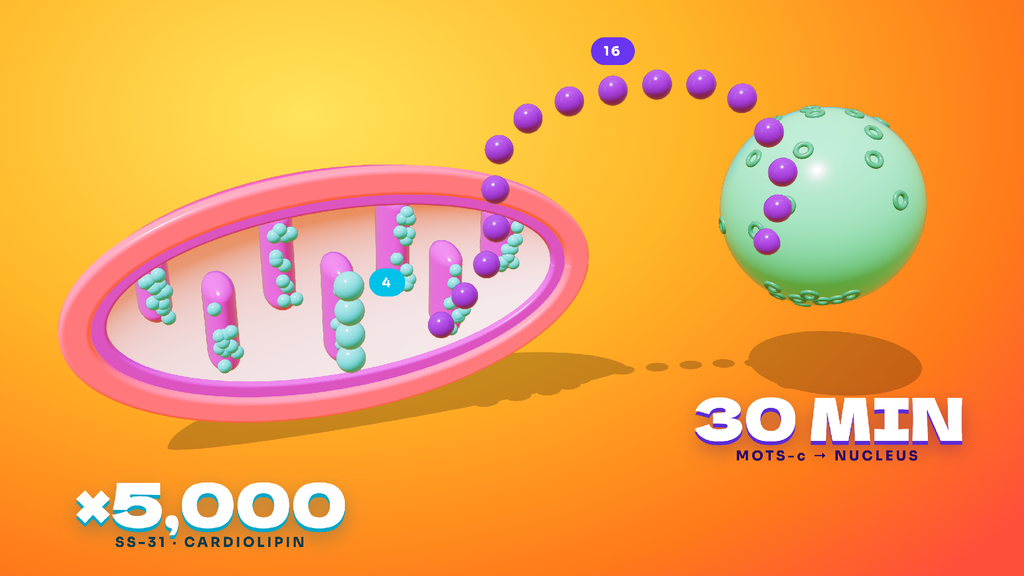
SS-31 binding cardiolipin at the inner mitochondrial membrane and MOTS-c signalling to the nucleus
Size helps explain the difference in reach. SS-31 is small and charged enough to slip through membranes on its own and pool wherever cardiolipin is dense. MOTS-c relies on the cell’s signaling machinery to carry its message, which is why its effects show up far from the place it’s made.
SS-31 vs MOTS-c vs NAD+: Where Does NAD+ Fit?
Quick answer: NAD+ appears next to SS-31 and MOTS-c in almost every mitochondrial discussion, yet it belongs to a different chemical family. It’s a coenzyme that carries electrons in energy metabolism, cycling between NAD+ and NADH, and enzymes called sirtuins and PARPs consume it. That puts it one level below both peptides, in the fuel supply itself.
| What it is | Where it acts | Peptide? | |
| SS-31 | Synthetic tetrapeptide | Inner mitochondrial membrane | Yes |
| MOTS-c | Mitochondrial-derived peptide | Mitochondria, cytoplasm, nucleus | Yes |
| NAD+ | Coenzyme (dinucleotide) | Energy metabolism across the cell | No |
The NAD+ research overview goes further into sirtuins and NAD+ decline, and the NAD+ 500 mg specification and COA page list batch data.
Is NAD+ a Peptide?
No, NAD+ (nicotinamide adenine dinucleotide) is a dinucleotide: two nucleotides joined through their phosphate groups, one carrying nicotinamide and the other adenine. Peptides are chains of amino acids linked by peptide bonds, and NAD+ contains none. Cells build it from vitamin B3 precursors such as niacin and nicotinamide riboside.
Are SS-31 and MOTS-c Studied Together?
Quick answer: They’re discussed together far more often than they’re tested together. SS-31 targets membrane structure and MOTS-c targets metabolic signaling, so the pairing makes intuitive sense, but published studies of the combination are very limited. A lab comparing them would run each peptide alone, both together and a vehicle control.
A four-arm design is the only clean way to see whether the two effects add up, overlap or cancel out. Useful readouts would cover both sides: cardiolipin content and oxygen consumption for SS-31, and AMPK activity and glucose uptake for MOTS-c.
Cell conditions need matching too. MOTS-c responses depend heavily on metabolic state, such as how much glucose the cells have, while SS-31 effects show most clearly under oxidative stress. Keeping those conditions identical across all four arms keeps the comparison fair.
Labs planning that kind of comparison can source all three compounds through the NAD+, MOTS-c and SS-31 research bundle.
How to Verify Research-Grade SS-31 and MOTS-c
Quick answer: Start with the batch COA. SS-31 and MOTS-c are so different in size that a mass result tells them apart at a glance: about 640 daltons against about 2,175. Read that identity figure alongside HPLC purity, and confirm both belong to the batch in your hands.
| SS-31 | MOTS-c | |
| Sequence | D-Arg-Dmt-Lys-Phe-NH2 | MRWQEMGYIFYPRKLR |
| Formula | C32H49N9O5 | C101H152N28O22S2 |
| Molecular weight | ~639.8 g/mol | ~2,174.6 g/mol |
| Cellugenix batch purity (HPLC) | See the batch COA | See the batch COA |
The two tests answer different questions. HPLC shows how much of the vial is the main compound, and a mass result confirms that compound is the right one. A Purity by HPLC vial of the wrong peptide would pass the first check and fail the second.
A five-point COA check:
- Compound and strength: they match the label on the vial.
- HPLC purity: the figure appears with the method named.
- Mass: when a mass result is reported, it lands near the fact-sheet weight.
- Lab and date: the testing laboratory and test date are both stated.
- Storage line: lyophilized powder stays sealed, cold, dry and dark.
Our guides on how to read a peptide COA and HPLC vs mass spectrometry walk through each line in more depth.
Frequently Asked Questions
What are mitochondrial-derived peptides?
Mitochondrial-derived peptides (MDPs) are short peptides encoded in mitochondrial DNA, the small circular genome inside each mitochondrion. They come from small open reading frames hidden inside mitochondrial genes, mainly the 12S and 16S rRNA genes. Humanin, the six SHLPs and MOTS-c are the best-studied members, and researchers examine them as signals linking mitochondria to the rest of the body.
What does MOTS-c stand for?
MOTS-c stands for “mitochondrial open reading frame of the 12S rRNA type-c.” The name describes where the peptide is coded: a short readable stretch inside the gene for the mitochondrial ribosome’s 12S RNA.
What other mitochondrial peptides are studied?
Humanin, first reported in 2001, is the oldest known mitochondrial-derived peptide and is studied in cell-survival and neuroprotection models. SHLP1 to SHLP6 come from the 16S rRNA gene. Epitalon is a useful comparison for SS-31: another synthetic tetrapeptide, studied for telomerase and pineal signaling.
Does Cellugenix publish COAs for SS-31 and MOTS-c?
Yes. SS-31 and MOTS-c are tested by an independent laboratory, and the reports are published in the Cellugenix COA library. Each product page links its report, so you can match the compound and strength to the vial you receive and file the COA with your lab records.
How should lyophilized SS-31 and MOTS-c be stored?
Keep sealed lyophilized vials cold, dry and away from light, and follow the storage line on the product page and batch COA. Limit how often vials warm up and cool down again, since repeated temperature swings and moisture speed up degradation. Our lyophilized peptide storage guide covers handling in more detail.
The Bottom Line
SS-31 and MOTS-c both work at the mitochondrion, but through different structures and signaling routes, so each answers a different research question. Before either compound reaches the bench, check the batch COA for the vial in hand.
Browse Cellugenix’s mitochondrial research compounds
Sources
- Birk AV et al. The mitochondrial-targeted compound SS-31 re-energizes ischemic mitochondria by interacting with cardiolipin. Journal of the American Society of Nephrology, 2013. PMID 23813215.
- Kim KH et al. The mitochondrial-encoded peptide MOTS-c translocates to the nucleus to regulate nuclear gene expression in response to metabolic stress. Cell Metabolism, 2018. PMID 29983246.
- Zheng Y et al. Mitochondria-derived peptide MOTS-c: effects and mechanisms related to stress, metabolism and aging. Journal of Translational Medicine, 2023. PMC9854231.
For Research Use Only. Not for use in diagnostic or therapeutic procedures.