Third-Party Peptide Testing Explained: What Labs Check and How to Verify a Report
Quick Answer
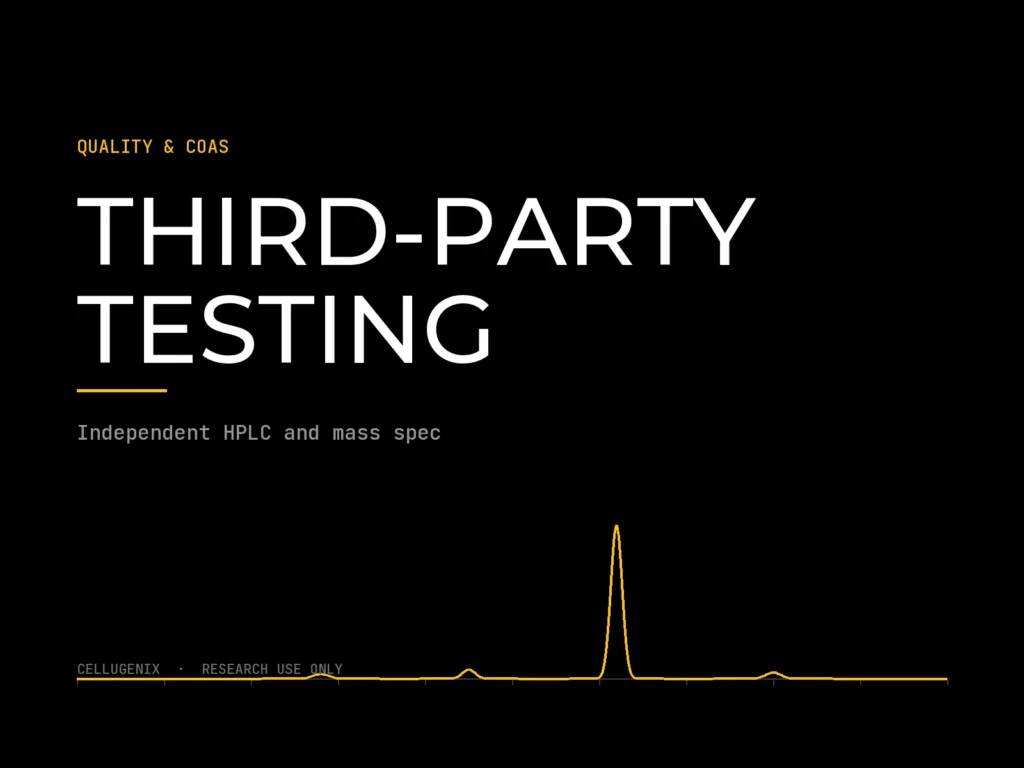
Third-party peptide testing means an independent lab, owned by neither the seller nor the manufacturer, analyzes a sample from one specific batch of research peptides and reports what it found. The two core tests are purity by HPLC and identity by mass spectrometry. Fuller panels add endotoxin, residual solvents, and heavy metals. Everything lands on a Certificate of Analysis carrying a report number the lab itself can confirm.
What our reports cover: Current Cellugenix reports measure HPLC-UV purity and measured content. Testides tested earlier lots, and Canada Peptide Testing tests newer ones. You’ll find every certificate in the COA library.
Contents
- Quick Answer
- Key Takeaways
- What Does Third-Party Lab Testing Mean?
- What Do Third-Party Labs Test Peptides For?
- Independent Confirmation of Sample Identity
- How the Third-Party Testing Process Works
- How Much Does Third-Party Peptide Testing Cost?
- How to Verify a Third-Party Testing Claim
- How to Choose a Third-Party Testing Lab
- What Third-Party Testing Does and Doesn’t Confirm
- Who Tests Cellugenix Compounds?
- Frequently Asked Questions
- Research Use Only Notice
Key Takeaways
- “Third-party” means the lab answers to neither the company selling the peptide nor the one that made it.
- Purity (HPLC) and identity (MS) answer different questions, and knowing what’s in a vial takes both.
- A report describes only the lot it names.
- A genuine report shows a named lab, its methods, dates and a report number that can be looked up.
- Testing confirms chemical quality. It doesn’t establish safety or approval for any use.
What Does Third-Party Lab Testing Mean?
Third-party lab testing is analysis by an outside lab that neither owns nor is owned by the seller or manufacturer, and earns nothing from a good result. With no reason to favor a flattering number, its report works as evidence, while a seller’s own figure is closer to a claim.
That independence is the whole value of third-party lab testing. A vendor testing its own stock has every reason to round up, retest a failing sample, or quietly skip an inconvenient method. An outside lab that bills the same fee whatever the result has no such pull.
Third-Party vs In-House vs “Lab Tested”
The labels on product pages sound alike, so the third-party lab-tested meaning gets blurred. Here’s how they compare:
| Label | Who tests | What it tells you |
| In-house tested | The seller or manufacturer | Their own result, with no independent check |
| “Lab tested” | Unstated | Could be in-house; ask who ran it |
| Third-party tested | An independent lab | An outside result tied to a lot and a report number |
What Do Third-Party Labs Test Peptides For?
Each question about a sample needs its own method. HPLC measures purity, mass spectrometry confirms identity, a content assay measures how much material is in the vial, and contaminant panels screen for endotoxin, residual solvents, and heavy metals. Every result should name the method behind it. Peptide purity testing, in other words, is only one line of a full panel.
| Test | Method | Question it answers | What it can’t tell you |
| Purity | HPLC-UV | What share of the signal is the main compound? | Whether the main peak is the right molecule |
| Identity | LC-MS (intact mass) | Does the mass match the expected molecule? | Some sequence errors that share a mass |
| Sequence confirmation | MS/MS | Is the amino-acid order correct? | Purity or content |
| Content / net peptide | Quantitative HPLC or amino-acid analysis | How many mg are actually in the vial? | Identity |
| Endotoxin | LAL assay (USP <85>) | Bacterial endotoxin level, in EU/mg | Other contaminants |
| Residual solvents | GC (ICH Q3C classes) | Leftover synthesis solvents | Purity |
| Heavy metals | ICP-MS | Elemental impurities | Identity or purity |
| Counter-ion (e.g. TFA) | Ion chromatography or NMR | Salt content | Identity |
The standards behind those rows are public. USP chapter <85> sets out the bacterial endotoxin test, and FDA’s Pyrogen and Endotoxins Testing Q&A, revised in March 2026, still points to it. Endotoxin is a material specification, a measured number on the report. Residual solvents follow the ICH Q3C guideline, whose current revision, Q3C(R9), sorts solvents into three classes by toxicity, each with its own ceiling.
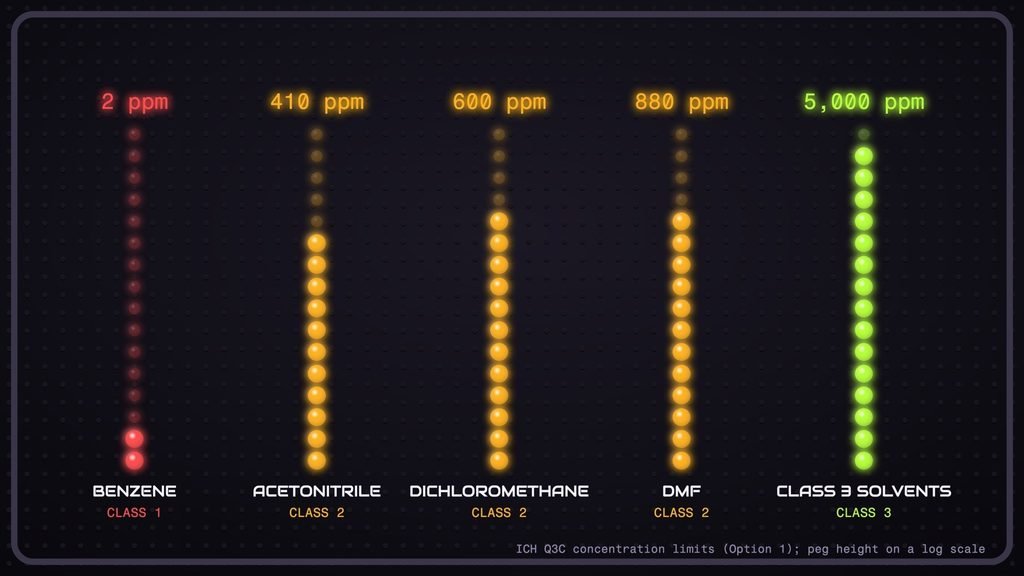
Residual-solvent ceilings under ICH Q3C: one Class 1 example, three Class 2 solvents common in peptide work, and the general Class 3 limit.
Purity and identity get separate rows for a reason: a 99% HPLC result on the wrong molecule is still the wrong molecule. Our guide to HPLC vs mass spectrometry covers the two instruments side by side.
Independent Confirmation of Sample Identity
Independent confirmation of sample identity means an outside lab has demonstrated the vial holds the molecule named on its label, usually by matching its measured mass to the expected value. Stronger confirmation uses two orthogonal methods, such as LC-MS intact mass plus MS/MS sequencing, or HPLC retention time checked against a reference standard.
To be plain about our own reports: current Cellugenix certificates don’t include MS, so they don’t provide this kind of identity confirmation.
Why a Mass Match Alone Isn’t Always Enough
Two peptides can weigh exactly the same. The same residues in a different order give an identical intact mass, and leucine and isoleucine are a perfect match by mass, so a swap between them leaves the number unchanged. MS/MS breaks the peptide into fragments and reads the order from the pieces.
Telling leucine from isoleucine takes specialized fragmentation beyond standard MS/MS, as a West Virginia University study on charge transfer dissociation shows. A reference standard run on the same system adds one more check: if the sample and the standard elute at the same retention time and give the same fragments, two independent lines of evidence agree.
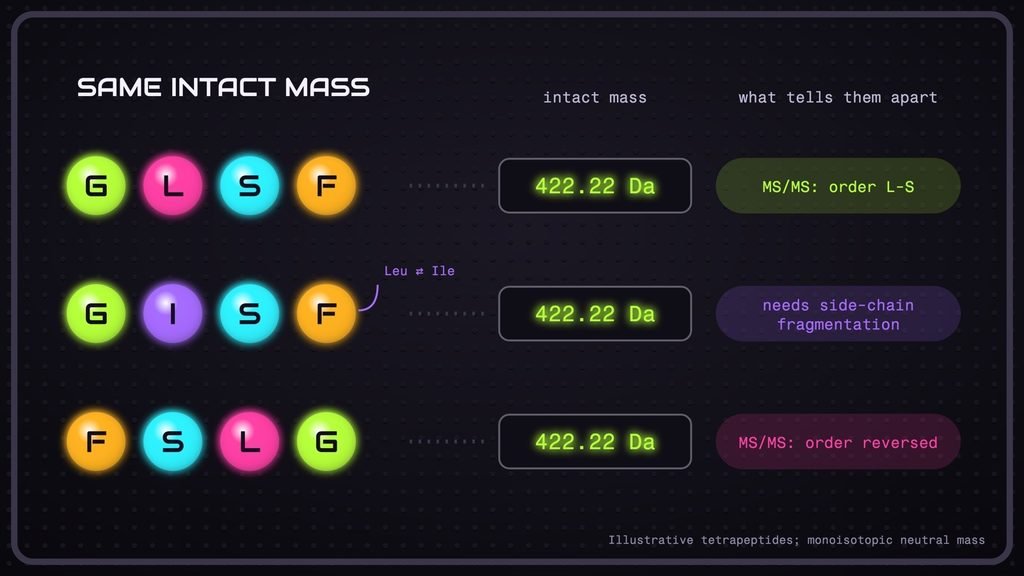
Three tetrapeptides with one intact mass: what each takes to tell apart.
Why Home “Purity Test Kits” Can’t Confirm Identity
Color-change or reagent kits can hint that a peptide-like substance is present. They can’t put a number on purity, and they can’t say which peptide it is. Those answers come only from instruments such as HPLC and mass spectrometry, so a kit result can’t stand in for a lab report.
How the Third-Party Testing Process Works
Most 3rd party peptide testing follows the same path. A sample is drawn from one specific batch, sent to an independent lab, analyzed by stated methods, and reported on a COA that carries the lab’s name, the lot number, dates, and a report number.
- Sampling from a named lot. Ideally, the sample is pulled blind or witnessed, with a chain of custody, so the lab tests material from the real batch and not a hand-picked vial. For background on the material itself, see lyophilized peptides explained.
- Submission. The sample is logged under a task or report number.
- Analysis. Validated methods run on calibrated instruments, and the raw data (chromatograms, spectra) is kept on file.
- Reporting. The COA lists methods, results, specifications, dates, and the analyst. Here’s what a Certificate of Analysis is in more detail.
- Verification access. The report number or QR code can be looked up on the lab’s site, or confirmed with the lab directly.
How Researchers Submit a Sample Themselves
Most analytical labs accept mail-in samples, so third-party testing peptides isn’t limited to suppliers. You pick the tests, such as purity and identity, send a sealed sample with a submission form, and get back a report with its own tracking number. That lets a lab check a supplier’s claim on its own terms.
How Much Does Third-Party Peptide Testing Cost?
Third-party testing cost depends on the panel. A single HPLC purity test is the cheapest option. Adding MS identity, content, endotoxin, or a full contaminant panel raises the price, and turnaround usually runs from a few days to a few weeks.
| Panel | Typical range* | Typical turnaround* |
| HPLC purity only | About $100 to $200 | 5 to 10 business days |
| HPLC + LC-MS identity | About $130 to $300 | 5 to 10 business days |
| + content / net peptide | Often $25 to $75 more | Usually no extra time |
| + endotoxin, solvents, metals | About $75 to $300 per test; solvents often quoted on request | 1 to 3 weeks |
Three things drive the bill: how many methods run, how much instrument time each needs, and how many samples share one submission. Labs often discount batches of several samples, while rush service can double the price.
*Approximate per-sample US list prices from published lab price pages, November 2026, with no lab named. Prices vary by peptide and change often, so check the lab’s current price list before submitting.
How to Verify a Third-Party Testing Claim
A “third-party tested” badge means little on its own. Check that the report names a real lab, matches the lot number on the vial, lists methods and dates, and carries a report number the lab itself can confirm.
Seven checks cover most of it:
- A named, independent lab, and not the seller’s own.
- The lot or batch number on the COA matches the vial, character for character.
- The test date fits the lot’s manufacture date.
- Each result names its method (HPLC, LC-MS, and so on).
- A chromatogram is attached, not just a percentage.
- The report number, task ID, or QR code can be looked up on the lab’s site.
- Results differ from lot to lot. Identical figures on every lot are a warning sign.
For a field-by-field walk-through, see how to read a COA and how to read peptide purity on a COA. For the wider picture, there’s our guide on how to evaluate a research peptide vendor.
Is the Lab Accredited? (ISO/IEC 17025)
ISO/IEC 17025:2017 is the international standard for testing-lab competence, impartiality, and consistent operation, last reviewed and confirmed by ISO in 2023. Accreditation bodies such as A2LA assess labs against it. Accreditation adds weight, and a verifiable report number is still the deciding check.
Red Flags
- No lab name, or no lot number.
- The same document reused across lots.
- A high purity figure with no chromatogram behind it.
- A report that can’t be looked up.
- A test date earlier than the batch itself.
How to Choose a Third-Party Testing Lab
Pick a lab by its methods, accreditation, and how easily its reports can be verified, with price as a secondary factor. Make sure it offers both purity and identity testing for peptides.
A strong candidate:
- offers HPLC and LC-MS for peptides
- holds ISO/IEC 17025 accreditation or runs a documented QA system
- issues reports with a lookup number or QR code
- attaches raw data such as chromatograms and spectra
- publishes its methods, turnaround, and pricing
It also helps to ask how the lab handles a failing or borderline result. A lab that retests on request, explains its specification and keeps raw data on file for later questions is easier to work with than one that only sends a single-page certificate.
What Third-Party Testing Does and Doesn’t Confirm
Testing confirms what’s in a specific lot and how pure it is, within the tests that were run. It doesn’t establish safety, efficacy, or suitability for any use, and it isn’t regulatory approval.
- Confirms: identity, purity, content, and contaminants, where each was tested, for the named lot only.
- Doesn’t confirm: other lots, tests that weren’t run, safety, approval, or fitness for human or animal use.
Supplement seals from consumer-product certification programs follow a different model from research-reagent COAs, which are batch-level analytical reports.
Who Tests Cellugenix Compounds?
Cellugenix lots are tested by independent labs: Testides for earlier lots and Canada Peptide Testing for newer ones. Each report appears in the COA library under its report number, alongside a link to verify it with the lab.
In the library today, the Testides reports date from December 2025 to May 2026, and the Canada Peptide Testing reports date from September and October 2026. Both labs report HPLC-UV purity plus the measured amount in the vial, and neither runs MS identity or contaminant panels on our lots. Purity by HPLC: see the batch result. Browse every certificate in the COA library, and see our quality standards and testing page for how lots are handled.
Frequently Asked Questions
What does third-party lab testing mean?
An independent lab, with no tie to the seller or manufacturer, analyzes a sample from a batch and reports its results. An outside lab bills the same whether a lot passes or fails, so its numbers carry more weight than an in-house figure.
Is “lab tested” the same as “third-party tested”?
No. “Lab tested” can describe the seller’s own lab, and the label rarely says which. Third-party tested means an independent lab ran the analysis and issued a report you can trace.
What does independent confirmation of sample identity mean?
It means an outside lab, usually using mass spectrometry, has matched the material to the molecule on the label. Pairing two methods, such as intact mass with MS/MS sequencing, gives stronger confirmation than either one alone.
What’s the difference between purity and identity testing?
Purity, measured by HPLC, is the share of the sample made up by the main compound. Identity, measured by MS, is whether that main compound is the right molecule. A sample needs both answers.
How much does third-party peptide testing cost?
It depends on the panel. Purity alone typically runs about $100 to $200 per sample, and adding identity by LC-MS brings most panels to about $130 to $300. Content and contaminant tests add more, so check a lab’s current price list before sending a sample.
How can I confirm a test report is genuine?
Match the lot number to the vial, check that a real lab is named, and look up the report number or QR code with that lab. A report the lab can’t find shouldn’t be relied on.
Does third-party testing cover every batch?
No. A report applies only to the lot it names. Each new batch needs its own analysis, which is why results should differ slightly from lot to lot.
Does third-party testing mean a compound is safe or approved?
No. Testing confirms chemical quality for research material only. It isn’t safety data, and it isn’t regulatory approval for any use.
Research Use Only Notice
Testing verifies the identity, purity and quality specifications of research compounds only. None of it amounts to evidence of safety or efficacy, or to approval by any regulator. See our Legal notice.
For laboratory research use only. Not for human or animal use.
Sources (accessed 2 November 2026):
- ISO. ISO/IEC 17025:2017, General requirements for the competence of testing and calibration laboratories (confirmed 2023).
- A2LA, American Association for Laboratory Accreditation.
- ICH. Q3C(R9) Impurities: Guideline for Residual Solvents (Step 4, January 2024).
- FDA. Pyrogen and Endotoxins Testing: Questions and Answers (revised March 2026), referencing USP <85> Bacterial Endotoxins Test.
- Jackson lab, West Virginia University. Differentiation of leucine and isoleucine residues in peptides using charge transfer dissociation mass spectrometry.
For laboratory research use only. Not for human or animal use.