SLU-PP-332: Research Overview of a Synthetic ERR Agonist
PubChem logged the structure of SLU-PP-332 on February 2, 2006, as one more entry in a vast chemical library. Seventeen years later, a Saint Louis University team showed that this small molecule switches on the estrogen-related receptors (ERRs), and its name started appearing on peptide shelves. It isn’t a peptide. It’s a synthetic compound of 18 carbon atoms that activates a family of orphan nuclear receptors.
This overview covers its chemical identity, how it acts on ERRα, ERRβ and ERRγ in assays, the published studies by type and date, related ERR ligands, US status and the checks a batch should pass. The page sticks to chemistry and assays, and it describes no use in people or animals.
What is SLU-PP-332?
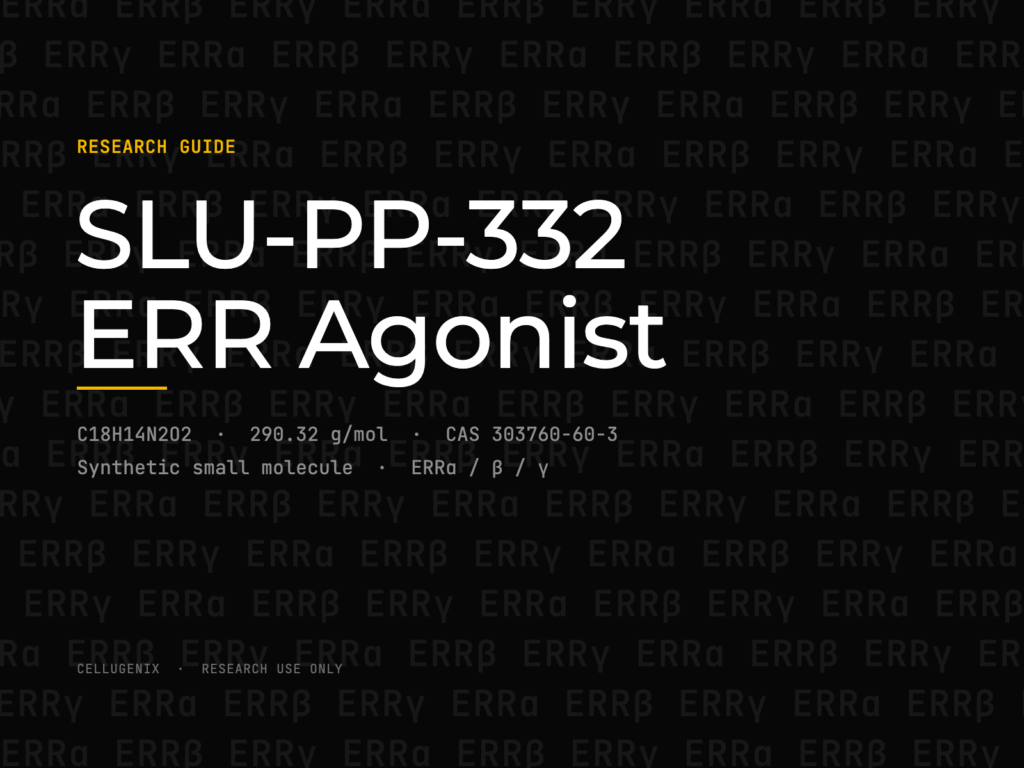
SLU-PP-332 is a synthetic small-molecule acyl hydrazone (C18H14N2O2, 290.3 g/mol) developed at Saint Louis University as an agonist of the estrogen-related receptors. In cell-based reporter assays, it activates ERRα, ERRβ, and ERRγ, with the highest potency at ERRα (reported EC50 98 nM), and it leaves the classical estrogen receptors unchanged.
✓ A small molecule with no amino acids
✓ Studied in receptor, reporter and gene-expression assays; published in vivo work is in mice only
✓ Not FDA-approved; sold here as a lab reagent
Contents
1. What is SLU-PP-332?
2. Identity and specifications
3. What are estrogen-related receptors?
4. How SLU-PP-332 acts on ERRα, ERRβ and ERRγ
5. Published research by study type
6. Comparison with other research ligands
7. FDA and US status
8. How to verify a batch
9. FAQ
10. The bottom line
What Is SLU-PP-332?
SLU-PP-332 is a lab-made small molecule, (E)-4-hydroxy-N’-(naphthalen-2-ylmethylene)benzohydrazide, built to activate ERRα, ERRβ and ERRγ. It came from Thomas Burris’s and John Walker’s research groups at Saint Louis University, which explains the “SLU” at the front of the code (it also appears as SLU PP 332 or SLUPP-332). The series it belongs to now spans several numbered analogues.
The SLU-PP-332 structure is an acyl hydrazone. A naphthalene ring connects through a C=N-NH linker to a 4-hydroxybenzoyl group, and that’s the whole molecule: two aromatic ends and a short bridge.
The design started from GSK4716, one of the phenolic acyl hydrazones that Zuercher and colleagues reported as ERRβ and ERRγ agonists in 2005 (Journal of Medicinal Chemistry, PMID 15857113). It barely touched ERRα. In their 2023 ACS Chemical Biology paper, Billon and colleagues (PMID 36988910) described the problem plainly: “there have been significant difficulties in designing compounds with ERRα agonist activity.” Their fix was to swap GSK4716’s isopropylphenyl group for a naphthalene ring, guided by the receptor’s crystal structure. That single change brought ERRα into range.
The same program has produced compounds that push in the other direction too. SLU-PP-1072, for example, is an ERRα/γ inverse agonist from the series, reported by Schoepke and colleagues in 2020 (PMID 32897058). The shared prefix tells you where a compound came from, and the receptor data tell you which way it pushes.
The program’s ERR chemistry is also on the patent record. Saint Louis University holds US 11,795,162 B2, “Modulators of the estrogen-related receptor,” with Burris, Walker and Billon among the inventors. It was filed in 2018 from a 2017 priority date and granted on October 24, 2023. Its claims center on a related thiophene-carboxamide series, and the hydrazone work appears in its background section.
Current lot details are on the SLU-PP-332 5 mg specification and COA page.
Is SLU-PP-332 a Peptide?
No. SLU-PP-332 contains no amino acids and no peptide bonds. At 290.3 g/mol it’s about a tenth the mass of a small peptide such as thymosin alpha-1 (3,108 g/mol). It turns up beside research peptides because the same labs order both. Its identity is confirmed the way any small molecule’s is: HPLC, mass spectrometry and NMR. Calling it a peptide also sets the wrong expectations for a COA, since peptide checks such as sequence, counter-ions and net content don’t apply here.
SLU-PP-332 Identity and Specifications
These are the identifiers a batch should match. Check the CAS number, formula and expected mass against the certificate of analysis (COA) before any lot goes into an assay.
| Property | Value |
| Systematic name | (E)-4-hydroxy-N’-(naphthalen-2-ylmethylene)benzohydrazide |
| CAS number | 303760-60-3 |
| PubChem CID | 5338394 |
| Molecular formula | C18H14N2O2 |
| Molecular weight | 290.3 g/mol (monoisotopic 290.106 Da) |
| Compound class | Small-molecule acyl hydrazone |
| Target | ERRα, ERRβ, ERRγ (agonist) |
| Form supplied | Solid in a sealed vial |
| Solubility | Soluble in DMSO for assay preparation |
| Purity | Purity by HPLC, see the batch result |
PubChem files the same structure under the IUPAC-style name 4-hydroxy-N-[(E)-naphthalen-2-ylmethylideneamino]benzamide. The wording differs, but the atoms and the (E) geometry match.
Each identifier catches a different kind of mistake. The CAS number and PubChem CID pin down the exact structure, so they flag a mislabeled compound. The formula and mass flag a wrong or degraded molecule, since a lost hydroxyl or a broken hydrazone changes the mass by a predictable amount. HPLC purity then tells you what share of the vial is that one compound. The current lot’s results are on the SLU-PP-332 batch COA.
What Are Estrogen-Related Receptors (ERRs)?
ERRα, ERRβ and ERRγ (gene codes NR3B1, NR3B2 and NR3B3) are nuclear receptors that resemble the estrogen receptors in sequence but don’t respond to estrogen. They’re called orphan receptors because no natural ligand has been confirmed. They’re also constitutively active, so they switch on target genes with co-activators such as PGC-1α even when nothing is bound.
The first family member turned up in 1988. Vincent Giguère and colleagues found it by screening for genes resembling the estrogen receptor (Nature, PMID 3267207), and that resemblance gave the family its name.
Here’s how they work in a cell-based system:
- DNA binding: each ERR binds short DNA sequences called ERR response elements (ERREs) near its target genes.
- Co-activator recruitment: the ligand-binding domain docks partners such as PGC-1α, which help start transcription.
- A dimmer, already on: because activity starts above zero, an agonist turns it higher and an inverse agonist turns it lower.
For years, the inverse-agonist direction had better tools. XCT790, an ERRα inverse agonist described in 2004 (Busch et al., Journal of Medicinal Chemistry, PMID 15509154), became the standard comparator. Agonists were scarcer. A 2026 analysis from Okda and colleagues still notes that “only a limited number of synthetic agonists with suitable potency and drug-like properties have been reported.”
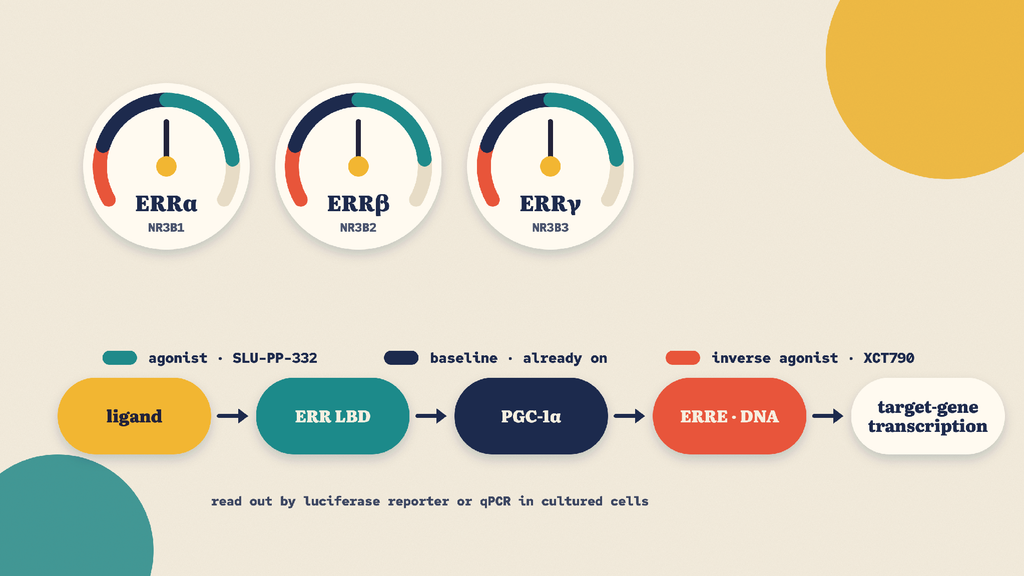
Synthetic ligand binding an estrogen-related receptor and recruiting a co-activator to an ERR response element
How Does SLU-PP-332 Act on ERRα, ERRβ and ERRγ?
In cotransfection luciferase-reporter assays, SLU-PP-332 raises the activity of all three ERRs, with the highest potency at ERRα. It shows no measurable effect at ERα or ERβ. That profile makes it a selective pan-ERR agonist with a preference for ERRα, about 2.3-fold over ERRβ and 4.4-fold over ERRγ.
| Receptor | Reported EC50 | Assay type |
| ERRα | 98 nM | Full-length ERR cotransfection luciferase reporter, HEK293 cells |
| ERRβ | 230 nM | Same |
| ERRγ | 430 nM | Same |
| ERα / ERβ | No change in activity | Selectivity counter-screen |
The figures come from Billon et al. (2023). The team also ran a Gal4-ligand-binding-domain version of the assay, which showed the same activation without separate EC50 values. EC50 is the concentration that gives half the maximum response, so a lower number means more potent.
The two assay formats answer slightly different questions. A Gal4-LBD assay fuses only the ERR ligand-binding domain to a yeast DNA-binding domain, so it isolates what the ligand does at its binding pocket. A full-length assay uses the whole receptor on its own response element, closer to how the receptor behaves on DNA. Agreement between the two strengthens the case that the signal runs through the ERR itself.
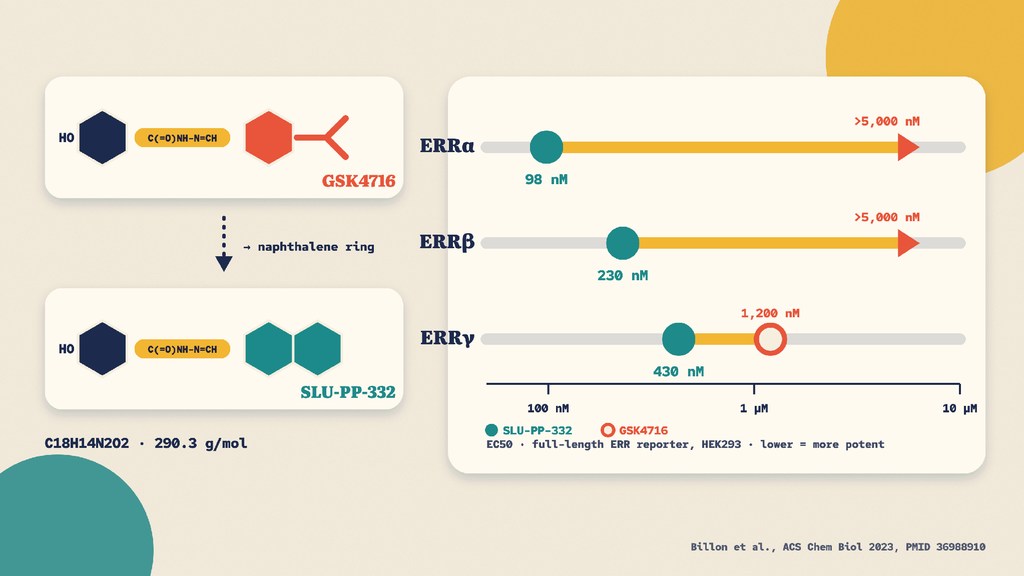
Comparing reporter-assay EC50 values of GSK4716 and SLU-PP-332 at ERRα, ERRβ and ERRγ, beside simplified structures showing the naphthalene ring swap
Reporter data alone can’t prove a compound touches the receptor. The authors added two binding checks:
- ERRα: limited proteolysis, where a bound ligand changes how an enzyme cuts the receptor
- ERRγ: differential scanning fluorimetry, where binding raised the purified ligand-binding domain’s melting temperature
Downstream, the paper tracked gene and assay readouts in C2C12 cells. qPCR showed higher expression of Pdk4 and Ddit4, both ERR target genes, within hours. A Seahorse assay measured a higher maximal oxygen-consumption rate after 24 hours of treatment.
What Is the Mechanism of Action of SLU-PP-332?
SLU-PP-332 binds the ligand-binding domain of an ERR, which increases co-activator recruitment to ERR response elements on DNA. Transcription of ERR target genes then rises. In assays, the chain is ligand, receptor, co-activator, DNA element and gene, measured by luciferase signal or qPCR.
What Research Has Been Published on SLU-PP-332?
The published literature is small and recent: cell-based receptor assays plus a handful of mouse studies, nearly all from 2023 onward. ClinicalTrials.gov listed no registered human studies on October 18, 2026, and no human data have been published. A PubMed title-and-abstract search on the same day returned 10 records naming the compound.
Read the table by its third column. “In vitro” means cells or purified protein in a dish, “mouse” means whole-animal work, and “analytical” means chemistry on the compound itself. Each row stops at the assay level, which is as far as the data travel between labs.
| Year | Work | Study type | What it measured (assay level) |
| 2005 | Zuercher et al., J Med Chem, PMID 15857113 | Chemistry, in vitro | Phenolic acyl hydrazones (GSK4716 series) at ERRβ and ERRγ |
| 2006 | PubChem CID 5338394 created | Database record | Structure registered |
| 2023 | Billon et al., ACS Chem Biol, PMID 36988910 | In vitro + mouse | ERR reporter EC50s, selectivity, binding, target-gene qPCR, oxygen consumption |
| 2023 | Hampton et al., Eur J Med Chem, PMID 37421886 | Chemistry, in vitro + mouse | New pan-ERR series including SLU-PP-915 |
| 2023 | Wang et al., Am J Pathol, PMID 37717940 | Mouse | Not named here |
| 2023 | US 11,795,162 B2 granted to Saint Louis University (priority 2017) | Patent | ERR modulator chemical series |
| 2024 | Billon et al., J Pharmacol Exp Ther, PMID 37739806 | Mouse | Gene expression and whole-animal measures (not named here) |
| 2024 | Xu et al., Circulation, PMID 37961903 | Mouse + cultured cells | Not named here; tested SLU-PP-332 alongside SLU-PP-915 |
| 2025 | Bonanni et al., Front Physiol, PMID 40692696 | Human-derived cells, in vitro | ERRα and PGC-1α expression |
| 2025 | WO 2025/096683 A1, published May 8, 2025 (priority 2023) | Patent application | New ERR modulators, assayed alongside SLU-PP-332 |
| 2026 | Möller, Krug, Thevis, Rapid Commun Mass Spectrom, PMID 41588687 | Analytical, in vitro | Metabolite identification by LC-MS |
| 2026 | Avliyakulov et al., Drug Test Anal, PMID 41688415 | Analytical, in vitro | Metabolite identification |
| 2026 | Okda et al., Int J Biol Macromol, PMID 41850449 | Chemistry, cell assays, in silico | Structure-activity of SLU-PP-332 analogues |
Two patterns run through that list. First, most papers come from the Burris, Walker and Elgendy groups and their collaborators, so independent replication is still building; the Houston and Cologne papers are early outside contributions. Second, the 2026 work has moved toward chemistry and analysis. Okda’s team calls SLU-PP-332 “a strong benchmark for ERR activation” while mapping which parts of the scaffold set potency and selectivity.
The analytical papers deserve a closer look, because they serve labs directly. Using LC-MS, the Cologne and UCLA groups catalogued the breakdown products that form when SLU-PP-332 meets enzyme fractions in vitro. Those reference spectra give any lab a way to tell intact compound from degradation products in its own samples.
Mouse data, however detailed, establish nothing about people.
What about the SLU-PP-332 half-life? Only limited exposure data exist, all from mice. The 2023 paper measured compound levels at a few time points after a single administration and didn’t report a formal half-life. No human pharmacokinetic figure exists for SLU-PP-332.
How Does SLU-PP-332 Compare With Other Research Ligands?
SLU-PP-332 belongs to a small group of synthetic ERR ligands. MOTS-c and 5-Amino-1MQ, which are also listed on this site, differ in kind and target: one is a peptide, the other an enzyme inhibitor, and neither acts on ERRs.
| Compound | Type | Primary target studied | Relationship to SLU-PP-332 |
| SLU-PP-332 | Small molecule | ERRα, ERRβ, ERRγ agonist | Reference compound |
| SLU-PP-915 | Small molecule | Pan-ERR agonist | Separate chemical series from the same program (Hampton 2023) |
| GSK4716 | Small molecule | ERRβ and ERRγ agonist | The scaffold SLU-PP-332 was optimized from |
| XCT790 | Small molecule | ERRα inverse agonist | Opposite activity; common comparator |
| MOTS-c | 16-residue mitochondrial-derived peptide | AMPK pathway assays | Unrelated class |
| 5-Amino-1MQ | Small-molecule methylquinolinium | NNMT enzyme inhibitor | Unrelated target |
The SLU-PP-332 vs MOTS-c and SLU-PP-332 vs 5-Amino-1MQ comparisons come up because the three share catalog pages while acting on separate targets. MOTS-c is a 16-residue peptide of about 2,174.6 g/mol, first studied in AMPK-pathway assays by Lee et al. (Cell Metab, 2015, PMID 25738459); our MOTS-c research overview has the details. 5-Amino-1MQ is a charged quinolinium of about 159.2 g/mol (cation) that inhibits the NNMT enzyme (Neelakantan et al., Biochemical Pharmacology, 2018, PMID 29155147); our 5-Amino-1MQ research overview covers its salt forms. Neither has reported ERR activity.
XCT790 and SLU-PP-332 often turn up in the same experiment. If an agonist raises a readout and the inverse agonist lowers it, the readout most likely depends on ERRα. That paired design is one of the simplest controls in ERR work.
A table like this keeps catalog neighbors from being treated as interchangeable. Shelf position says nothing about the receptor a compound hits.
SLU-PP-332 vs SLU-PP-915
SLU-PP-915 came out of a new pan-ERR series that Hampton and colleagues reported in 2023 (European Journal of Medicinal Chemistry, PMID 37421886). It’s chemically distinct from SLU-PP-332 and carries a boronic acid group. Both are research compounds, and they were tested side by side in the 2024 Xu study.
Is SLU-PP-332 FDA-Approved? US Status
No. The FDA hasn’t approved SLU-PP-332 for any use, and ClinicalTrials.gov lists no human trials of it. In the US it’s sold only as a laboratory research chemical. Each status point was checked on October 18, 2026 against a primary record.
- FDA approval: none. SLU-PP-332 has no approved drug application.
- Compounding: it wasn’t on the agenda of the FDA’s July 23-24, 2026 compounding advisory meeting. The FDA’s 503A bulk-substances page, current as of May 14, 2026, doesn’t name it.
- Is it legal for lab work? It isn’t a federally controlled substance, and it’s supplied to US laboratories as an unapproved research chemical.
- Clinical trials: a ClinicalTrials.gov search for “SLU-PP-332” returned zero studies on October 18, 2026.
- WADA: the 2026 Prohibited List has no entry for SLU-PP-332 and no class entry for ERR agonists. Its S0 section covers substances without approval for human therapeutic use.
For background, read about research compounds in the USA and what research use only means.
How to Verify Research-Grade SLU-PP-332
Start with the batch COA and make sure the vial matches it. A complete identity check for SLU-PP-332 rests on four points:
- purity by HPLC, with the method stated
- a mass matching 290.3 Da, seen as [M+H]+ near 291.1 by LC-MS
- the lot number
- the testing lab and the date of testing
On an LC-MS trace, the expected ions are easy to predict from the formula:
- [M+H]+: about 291.113 in positive mode
- [M+Na]+: about 313.095, a common sodium adduct
- [M-H]-: about 289.098 in negative mode, helped by the phenolic hydroxyl
Small molecules allow a second identity check that’s harder with peptides. A ¹H NMR spectrum or an independent CAS match confirms the structure atom by atom.
Cellugenix publishes the current certificate in its COA library, on the SLU-PP-332 batch COA page. It comes from an independent lab. Its results cover HPLC-UV purity and the measured amount in the vial, it lists CAS 303760-60-3, and it carries a verification link back to the lab. Mass and NMR aren’t part of it, so a receiving lab that wants them runs LC-MS or NMR in-house.
COA checklist:
1. The lot printed on the vial matches the certificate.
2. The HPLC method, detection wavelength and result are shown.
3. The mass matches 290.3 Da, either on the certificate or from a run in your own lab.
4. The CAS number reads 303760-60-3.
5. The lab is named, and its report number and testing date can be checked online.
A note on E and Z. Hydrazones can exist as two geometric isomers around the C=N bond. PubChem records SLU-PP-332 as the (E) form, and a ¹H NMR spectrum tells the two apart.
Two companion guides go deeper: how to read a COA and HPLC vs mass spectrometry.
How Should SLU-PP-332 Be Stored?
Keep the solid sealed, cool, dry and dark, following the conditions on the label. Light deserves extra care with hydrazones, since UV can push some of them between E and Z forms. It’s soluble in DMSO for assay preparation. Note the lot code and report number next to every experiment, so any odd result can be traced to one certificate and, if needed, rechecked by LC-MS. General guidance is on our page on research compound storage.
Frequently Asked Questions
Who developed SLU-PP-332?
Researchers in Thomas Burris’s and John Walker’s groups at Saint Louis University. Cyrielle Billon was first author on the 2023 paper in ACS Chemical Biology that reported its ERR activity. Later papers from the same circle list affiliations at the University of Florida and Washington University in St. Louis.
What is the CAS number of SLU-PP-332?
The CAS registry number is 303760-60-3. PubChem lists the compound as CID 5338394, with the formula C18H14N2O2 and a molecular weight of 290.3 g/mol. Matching the CAS number on a COA is one of the simplest identity checks.
Is SLU-PP-332 an estrogen?
No. It targets the estrogen-related receptors, which share sequence features with estrogen receptors but don’t bind estrogen. In counter-screens, SLU-PP-332 left ERα and ERβ activity unchanged, so it’s described as selective for the ERR family.
What’s the difference between an ERR agonist and an inverse agonist?
ERRs are active even with nothing bound. An agonist such as SLU-PP-332 raises that baseline activity in reporter assays. An inverse agonist such as XCT790 lowers it. Labs often run both to test whether a readout really depends on ERR activity.
Has SLU-PP-332 been studied in humans?
No. As of October 18, 2026, there are no published human studies and no registered trials on ClinicalTrials.gov. One 2025 paper used human-derived cells in culture, and two 2026 analytical papers identified its metabolites in vitro.
Does Cellugenix publish a COA for SLU-PP-332?
Yes. The SLU-PP-332 5 mg product has a batch-specific certificate in the COA library. The certificate names the independent lab and gives the report number, testing date, HPLC-UV purity, measured content and CAS number. A verification link opens the lab’s copy of the same report.
Closing Thoughts
SLU-PP-332 is an ERR agonist, a small molecule that activates all three receptors with a preference for ERRα. Its literature is short and mostly from one research circle, built on cell and mouse work. There are no human data, and the FDA hasn’t approved it. Before any lot goes into an assay, confirm its identity by CAS, LC-MS mass and HPLC purity on the batch COA.
For laboratory research use only. Not for human or animal use.
Lot data and the full specification are on the SLU-PP-332 5 mg specification and COA page.
Sources
- PubChem CID 5338394 (created February 2, 2006).
- Giguère V, et al. Nature, 1988. PMID 3267207.
- Zuercher WJ, et al. J Med Chem, 2005. PMID 15857113.
- Busch BB, et al. J Med Chem, 2004. PMID 15509154.
- US 11,795,162 B2 (Saint Louis University), granted October 24, 2023.
- WO 2025/096683 A1 (University of Health Sciences and Pharmacy in St. Louis), published May 8, 2025.
- Billon C, et al. ACS Chem Biol, 2023. PMID 36988910 (PMC11584170).
- Hampton CS, et al. Eur J Med Chem, 2023. PMID 37421886.
- Wang XX, et al. Am J Pathol, 2023. PMID 37717940.
- Billon C, et al. J Pharmacol Exp Ther, 2024. PMID 37739806.
- Xu W, et al. Circulation, 2024. PMID 37961903.
- Bonanni R, et al. Front Physiol, 2025. PMID 40692696.
- Möller T, Krug O, Thevis M. Rapid Commun Mass Spectrom, 2026. PMID 41588687.
- Avliyakulov NK, et al. Drug Test Anal, 2026. PMID 41688415.
- Okda HE, et al. Int J Biol Macromol, 2026. PMID 41850449.
- FDA. PCAC agenda, July 23-24, 2026; 503A bulk drug substances page (current as of May 14, 2026).
- ClinicalTrials.gov and PubMed searches, October 18, 2026.
- WADA Prohibited List 2026.
For laboratory research use only. Not for human or animal use.