GHK-Cu vs KPV: Two Research Tripeptides Compared by Structure, Target and Assay
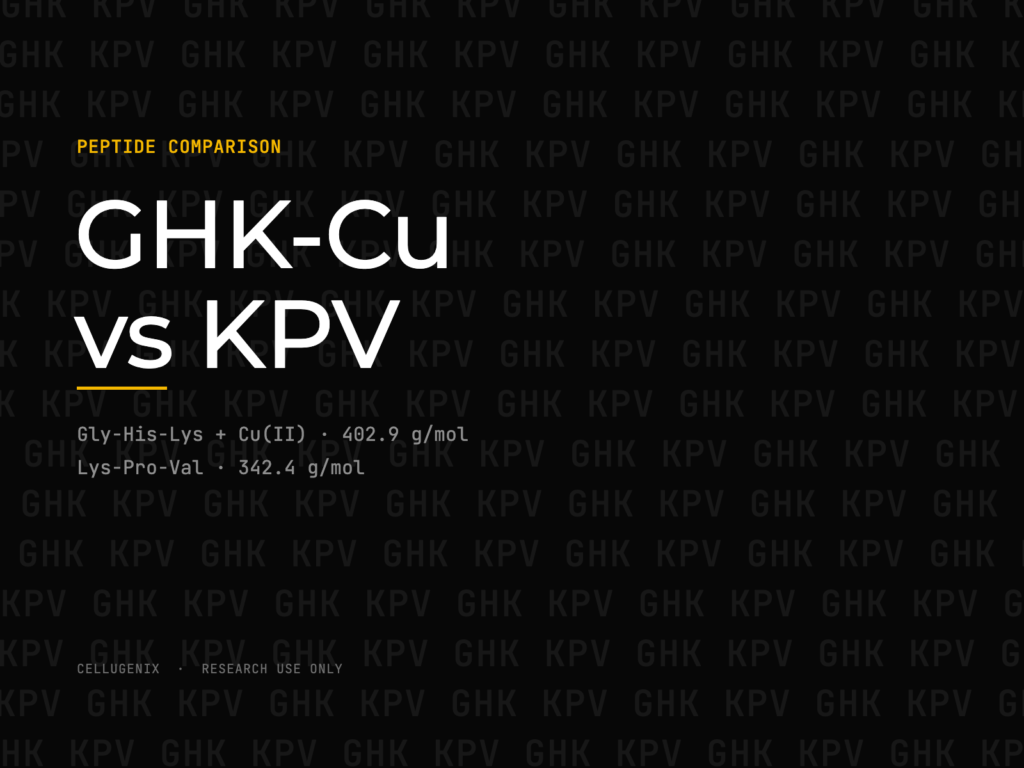
GHK-Cu is the tripeptide Gly-His-Lys holding a copper(II) ion. KPV is Lys-Pro-Val, the last three residues of alpha-MSH. Both are three residues long, both have short, catchy names, and catalogs often print them one line apart, so it’s easy to assume they’re cousins. Set side by side in a GHK-Cu vs KPV comparison, they turn out to bind different partners, run in different assays, and even come from different families of molecules. One detail makes the comparison more than trivia: strip the copper off GHK and the two free peptides weigh within two mass units of each other.
This guide covers identity and origin, what each one binds in lab assays, the cell models behind the data, salt forms, US regulatory status, and how to check a batch.
Quick answer: GHK-Cu is the tripeptide Gly-His-Lys complexed with copper(II) (~402.9 g/mol). It’s studied as a copper-binding peptide in fibroblast gene-expression and enzyme assays. KPV is Lys-Pro-Val (~342.4 g/mol), residues 11 to 13 of alpha-MSH. It’s studied in PepT1 uptake and NF-κB reporter assays in cultured cell lines. They share a lysine and little else.
✓ GHK-Cu: metal complex, Gly-His-Lys, copper binding
✓ KPV: alpha-MSH fragment, Lys-Pro-Val, transporter and NF-κB assays
✓ Both are sold as research reagents
In this guide
- GHK-Cu vs KPV at a glance
- What is GHK-Cu?
- What is KPV?
- How do their molecular targets differ?
- How are GHK-Cu and KPV studied in the lab?
- Where do GHK-Cu and KPV appear together?
- What’s their US regulatory status?
- How to check a GHK-Cu or KPV batch
- Frequently asked questions
- The bottom line
GHK-Cu vs KPV at a Glance
Read the two columns below and the KPV vs GHK-Cu question answers itself. GHK-Cu is a metal-peptide complex built around a copper(II) ion, colored blue and studied for copper binding. KPV is a plain linear tripeptide cut from a hormone, white as a powder and studied as a transporter substrate and NF-κB pathway probe.
| GHK-Cu | KPV | |
| Full name | Glycyl-L-histidyl-L-lysine copper(II) | L-Lysyl-L-prolyl-L-valine |
| Other names | Copper tripeptide-1 (INCI), copper peptide | Alpha-MSH (11 to 13) |
| Sequence | Gly-His-Lys + Cu(II) | Lys-Pro-Val |
| Type | Metal-peptide complex | Linear tripeptide (hormone fragment) |
| Formula | C14H23CuN6O4+ (complex) · GHK: C14H24N6O4 | C16H30N4O4 |
| Molecular weight | ~402.9 g/mol (complex) · 340.4 (GHK) | ~342.4 g/mol |
| CAS | 89030-95-5 (GHK-Cu) · 49557-75-7 (GHK) | 67727-97-3 |
| Appearance | Blue to violet powder | White powder |
| Origin | First reported in human plasma (1973) | C-terminal fragment of alpha-MSH |
| Studied as | Copper-binding / copper-delivery peptide | Transporter substrate and NF-κB pathway probe |
| Typical assays | Copper binding (UV-vis, EPR), fibroblast gene-expression arrays, lysyl oxidase activity | PepT1 uptake, NF-κB luciferase reporter, cytokine ELISA (IL-8) |
| Cellugenix | GHK-Cu 50 mg | KPV 10 mg |
Formula, weight, and CAS values come from PubChem records for GHK-Cu, free GHK, and KPV. One catalog detail catches people out: CAS 49557-75-7 belongs to free GHK, while the copper complex carries 89030-95-5. Check which number a label or certificate prints before filing it.
What Is GHK-Cu?
GHK-Cu is the tripeptide glycyl-histidyl-lysine bound to a copper(II) ion. GHK, reported in human plasma in 1973, grips copper tightly through the histidine imidazole, the glycine amine, and a backbone nitrogen. In the lab, the GHK-Cu peptide is studied as a copper-binding and copper-transport complex.
Loren Pickart and Martin Thaler described the tripeptide in human serum in a 1973 Nature New Biology report, and its copper chemistry became the main research thread from there. The clearest picture of the GHK-Cu copper complex comes from a 2011 structural study by Christelle Hureau’s group in Toulouse, which combined X-ray crystallography with EPR, X-ray absorption, and NMR spectroscopy. The team called GHK and its relative DAHK “naturally occurring high-affinity copper(II) chelators found in the blood plasma.”
Their data show two faces of the same complex:
- In solution: one GHK holds one Cu(II) through three nitrogens, the glycine amine, a backbone amide nitrogen, and the histidine imidazole.
- In the crystal: the complex packs as a dimer, with a carboxylate oxygen filling the fourth copper site.
- Under redox stress: Cu(II)-GHK stayed inert at moderate potentials and released copper only after reduction to Cu(I) near −0.62 V.
That loosely held fourth site lets GHK hand copper on, which is why studies of the GHK-Cu peptide describe it as a copper carrier.
Why GHK-Cu Is Blue
The color comes from the copper(II) ion, which absorbs light in the red-orange part of the visible range, so the powder looks blue to violet. Free GHK and KPV carry no metal and look white. Treat the color as a quick identity check. It confirms copper is present, and purity still needs the HPLC result.
GHK vs GHK-Cu
Free GHK weighs 340.4 g/mol. Add one copper(II) ion, and the GHK-Cu molecular weight reaches about 402.9 g/mol. Suppliers sell both, and they behave differently in copper-binding assays, so a certificate should name which one was tested. The cosmetic ingredient name, copper tripeptide-1, refers to the complex.
What Is KPV?
KPV is the tripeptide lysine-proline-valine, the three residues (11 to 13) that close alpha-melanocyte-stimulating hormone (α-MSH). It’s small enough to be carried by the peptide transporter PepT1, and in cultured cell lines, the KPV peptide is studied in NF-κB reporter and cytokine-secretion assays.
The parent hormone has 13 residues, Ac-Ser-Tyr-Ser-Met-Glu-His-Phe-Arg-Trp-Gly-Lys-Pro-Val-NH2, and the KPV sequence is simply its tail. There’s a small chemical twist here. In α-MSH, the final valine ends as an amide. The KPV recorded in PubChem (CID 125672) is the free acid, C16H30N4O4, and that’s the form the 342.4 g/mol figure describes. A research team comparing KPV alpha-MSH data across papers should note which C-terminus each group used.
Labs order the KPV peptide mainly for PepT1 and NF-κB assays, and its contrast with a 15-residue fragment is laid out in BPC-157 vs KPV.
Salt Forms: Acetate, TFA, and Free Base
KPV has two free amines, both on lysine, so it can carry up to two counter-ions. That changes the weight in the vial. The free base is 342.4 g/mol, a bis-acetate salt is about 462.5, and a bis-TFA salt is about 570.5. A COA that reports content should say which form it measured. Acetate is the usual choice for cell work, since TFA counter-ions altered proliferation readouts in cultured cells in a 1999 study.
How Do Their Molecular Targets Differ?
GHK-Cu is studied as a metal-binding peptide. Its main interaction is holding a copper(II) ion, and cell studies look at gene expression and copper-dependent enzymes. KPV is studied as a transported fragment: it’s taken up by PepT1 and examined in NF-κB pathway assays. Reports differ on whether KPV binds melanocortin receptors directly.
| GHK-Cu | KPV | |
| Primary interaction | Cu(II) coordination (Gly amine, backbone amide N, His imidazole) | PepT1 (SLC15A1) transport |
| Pathway studied | Copper-dependent enzymes (e.g. lysyl oxidase), gene-expression profiles | NF-κB signaling |
| Receptor question | No single receptor; studied as a copper carrier | Melanocortin receptor involvement reported and debated |
| Model systems | Cultured fibroblasts, cell-free copper-binding assays | Caco2-BBE and HT29-Cl.19A epithelial lines, Jurkat T cells, 16HBE14o- cells |
| Key readouts | UV-vis/EPR copper binding, mRNA arrays, enzyme activity | Uptake (radiolabel or LC-MS), luciferase reporter, IL-8 ELISA |
The KPV receptor story is the more contested of the two. Reviews of alpha-MSH and its tripeptides, such as Brzoska and colleagues’ 2008 review, discuss KPV alongside the full hormone, which signals through the melanocortin receptor family. A 2012 study by Land in 16HBE14o- epithelial cells reached a narrower result. There, MC3R was needed for gamma-MSH activity, while KPV’s effect on NF-κB reporter readings tracked its own entry into the nucleus and KPV competing for the spot where importin-α3 docks on p65 RelA.
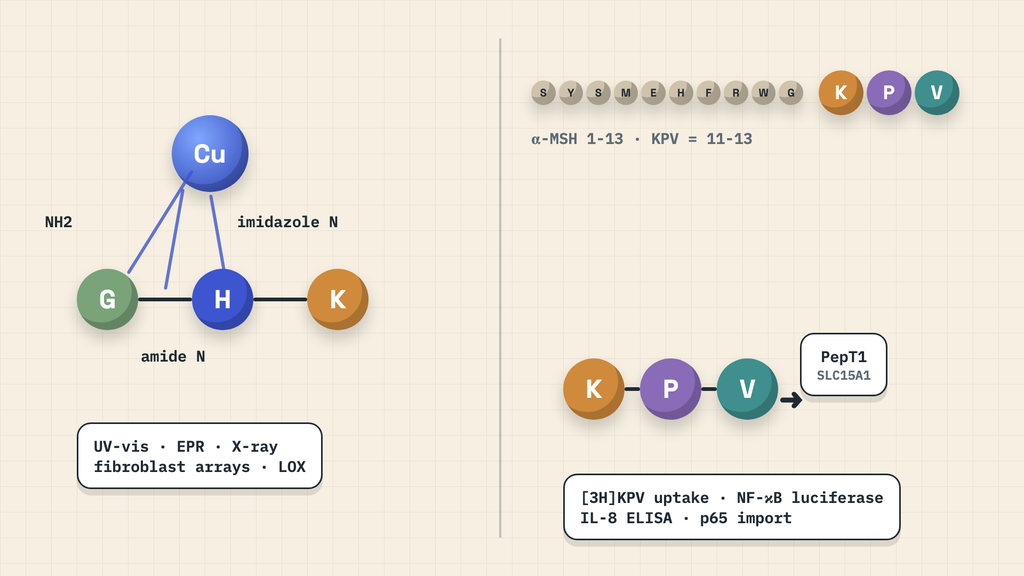
GHK holding Cu(II) through its amine, amide, and imidazole nitrogens, besides KPV cut from residues 11 to 13 of alpha-MSH and taken up by PepT1
GHK-Cu has no comparable receptor debate. Its biology runs through the copper it carries, and enzymes such as lysyl oxidase need that copper as a cofactor. The simplest way to tell them apart: a copper carrier vs. a transported hormone fragment.
How Are GHK-Cu and KPV Studied in the Lab?
GHK-Cu appears in copper-binding studies, fibroblast gene-expression arrays, and copper-enzyme assays. KPV appears in PepT1 uptake, NF-κB reporter, and cytokine-secretion assays in epithelial and lymphoid cell lines. Their assay systems barely overlap, so their data can’t be compared directly.
GHK-Cu assays, with the model named
- Copper binding by UV-vis and EPR spectroscopy, cell-free solutions (Hureau 2011)
- Gene-expression profiling, Broad Institute Connectivity Map data from cultured human cell lines, with GHK linked to a 50%-plus change for 31.2% of the human genes profiled (Pickart and Margolina 2018)
- Lysyl oxidase activity and secreted-protein output, cultured human fibroblasts
KPV assays, with the model named
- [3H]KPV uptake kinetics and cold-KPV competition against a PepT1 substrate, Caco2-BBE cells (Dalmasso 2008)
- NF-κB luciferase reporter after cytokine stimulation, Caco2-BBE and HT29-Cl.19A cells
- Cytokine secretion by ELISA, including IL-8, in the same epithelial lines and Jurkat T cells
- p65 nuclear import, 16HBE14o- cells (Land 2012)
Dalmasso’s team, working at nanomolar concentrations, “found that KPV acts via PepT1” in both their epithelial and T-cell lines. So why are GHK-Cu and KPV so often listed side by side? Both are tripeptides, and both turn up in the same supplier catalogs. That shared shelf is the whole link, with no common mechanism behind it.
Where Do GHK-Cu and KPV Appear Together?
GHK-Cu and KPV show up in the same vial mainly in multi-compound research blends, such as a four-compound blend of GHK-Cu, BPC-157, TB-500 and KPV in a fixed ratio. For a blend, the useful comparison is composition, and each component should appear on the batch COA.
Composition is the right lens because a combined HPLC purity tells you little about the share of each peptide. A blend certificate earns trust when it lists every component by name and amount. A breakdown of what the GHK-Cu + BPC-157 + TB-500 + KPV blend contains shows that per-component listing in practice, and a comparison of how the three- and four-compound blends differ shows exactly where KPV enters the formula.
What’s Their US Regulatory Status?
FDA has approved no drug containing GHK-Cu or KPV. Research-grade material is a laboratory reagent labeled Research Use Only. GHK-Cu is also a cosmetic ingredient, listed as copper tripeptide-1, and KPV was among the peptides reviewed at FDA’s July 2026 compounding advisory meeting.
| GHK-Cu | KPV | |
| FDA drug approval | None | None |
| Compounding (503A) | Named in FDA’s withdrawn-nomination list (page updated April 22, 2026); not reviewed in July | Reviewed by PCAC on July 23, 2026; panel voted 8 to 6 to recommend the 503A bulks list (advisory; no final FDA rule) |
| HHS interim policy (Oct 28, 2026) | Not covered | KPV acetate named among six covered peptides |
| Cosmetic use | Copper tripeptide-1 (cosmetic ingredient) | n/a |
| Research sale | Research Use Only | Research Use Only |
Sources: FDA’s 503A bulk substances page, the July 23 and 24, 2026 PCAC meeting page, and Baker Hostetler’s October 28, 2026 summary of the HHS policy, which is an interim enforcement-discretion notice that applies to licensed compounding pharmacies, with FDA rulemaking still open.
Cosmetic-grade and research-grade GHK-Cu differ in specifications and paperwork. The cosmetic grade follows ingredient-supply standards reviewed by the Cosmetic Ingredient Review panel, while research grade ships with a batch certificate of analysis.
How to Check a GHK-Cu or KPV Batch
Check that the COA names the exact compound (GHK-Cu or free GHK, and KPV’s salt form), reports HPLC purity with a chromatogram, and gives an MS mass that matches. GHK-Cu should be blue, and KPV should be white.
| Check | GHK-Cu | KPV |
| Expected MS | GHK [M+H]+ ~341.2 (copper is often lost in MS) | [M+H]+ ~343.2 |
| Appearance | Blue to violet | White |
| Extra check | Copper content (ICP or titration), ideally 1:1 | Salt form (acetate or TFA) and counter-ion content |
| Common issue | Free GHK or excess copper | Diketopiperazine from cyclization at the Lys-Pro bond |
The expected masses come from PubChem’s monoisotopic values plus one proton. Notice how close they sit: 341.19 for GHK and 343.23 for KPV. A low-resolution instrument with the wrong reference can mistake one for the other, so an MS identity check needs the named sequence beside it. Proline in the second position also makes KPV prone to diketopiperazine formation, a known pathway for peptides with proline second in the chain.
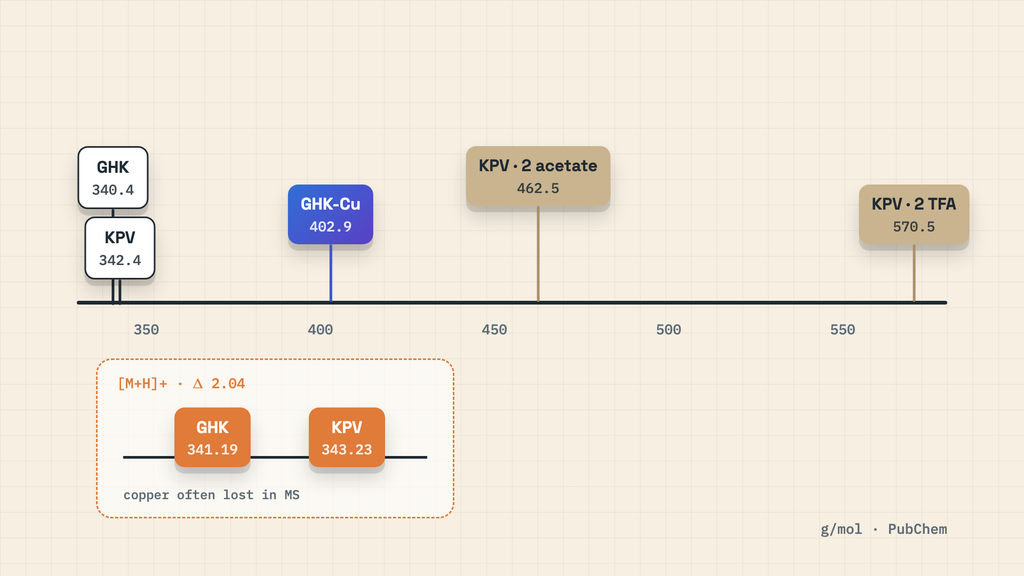
Molecular-weight ladder: free GHK 340.4, KPV 342.4, GHK-Cu 402.9, KPV bis-acetate 462.5 and bis-TFA 570.5 g/mol, with the close [M+H]+ values 341.19 and 343.23
Cellugenix examples
- GHK-Cu 50 mg: report CPT-GHKCU-1DC12D, Canada Peptide Testing, tested October 23, 2026, batch L25-01. Purity by HPLC, see the batch result on the GHK-Cu batch certificate.
- KPV 10 mg: report LK-KPV-10-032626, Testides, tested March 28, 2026. Purity by HPLC, see the batch result on the KPV batch certificate.
Both reports cover HPLC-UV purity and content. Neither includes MS identity or copper content, so those two checks remain open items for each lot. Those blanks are easy to spot once you know how to read a peptide COA line by line, and the HPLC vs mass spectrometry comparison shows why purity and identity need separate instruments.
Storage of Sealed Vials
Sealed vials belong somewhere cold, dry, and dark, at whatever temperature the vial label gives. Freeze-dried powder is happiest when no moisture reaches it, which is why the stopper stays closed until the day of the experiment. Dryness is what lets lyophilized peptides keep for long stretches, so the seal does most of the work.
Frequently Asked Questions
What’s the difference between GHK-Cu and KPV?
GHK-Cu is a copper(II) complex of the tripeptide Gly-His-Lys, studied for how it binds and carries copper. KPV is Lys-Pro-Val, the C-terminal fragment of alpha-MSH, studied in PepT1 uptake and NF-κB reporter assays. They differ in sequence, metal content, color, and binding partner.
Are GHK-Cu and KPV the same type of peptide?
Both are tripeptides, three amino acids joined by two peptide bonds. Beyond that, they belong to different classes. GHK-Cu is a metal-peptide complex, and KPV is a fragment of a peptide hormone.
Is KPV related to alpha-MSH?
Yes. The hormone’s final three amino acids, positions 11 to 13, are exactly Lys-Pro-Val. Whether KPV itself acts through melanocortin receptors is debated, and cell work in 16HBE14o- cells traced its NF-κB reporter activity to nuclear import.
Why is GHK-Cu blue and KPV white?
The copper(II) ion in GHK-Cu absorbs red-orange light, so the powder looks blue to violet. KPV carries no metal, so it’s a white powder. Color confirms copper is present and says nothing about purity.
Which is heavier, GHK-Cu or KPV?
GHK-Cu, at about 402.9 g/mol vs about 342.4 g/mol for KPV. Free GHK, at 340.4 g/mol, comes very close to KPV, so check whether a document lists the complex or the free peptide.
How can I tell GHK-Cu and KPV apart on a COA?
Look for the named sequence, the recorded appearance, and the MS mass. Because the [M+H]+ values are close (about 341 vs 343), an MS check needs the right reference compound and enough resolution to separate them.
The Bottom Line
GHK-Cu and KPV share a size and a lysine, and their chemistry runs in separate directions: a copper-binding Gly-His-Lys complex on one side, a transported Lys-Pro-Val fragment of alpha-MSH on the other. Let the target your assay studies decide which one belongs on the bench, and confirm identity with a batch report that verifies. Each lot of GHK-Cu 50 mg and KPV 10 mg carries its own report number, so that check takes a minute.
For laboratory research use only. Not for human or animal use. Not for human or veterinary use. See the legal notice.
Sources
- PubChem: GHK-Cu (CID 71587328), GHK (CID 73587), KPV (CID 125672)
- Pickart L, Thaler MM. Nature New Biology, 1973. PMID 4349963
- Hureau C et al. Chemistry: A European Journal, 2011. PMID 21780203
- Dalmasso G et al. 2008, PMID 18061177 (cell-assay sections)
- Land SC. 2012, PMID 22837805 (cell-assay sections)
- Brzoska T et al. Endocrine Reviews, 2008. PMID 18612139
- Pickart L, Margolina A. International Journal of Molecular Sciences, 2018. PMC6073405
- Cornish J et al. American Journal of Physiology, 1999. doi 10.1152/ajpendo.1999.277.5.E779
- FDA 503A bulk drug substances page (April 22, 2026) and PCAC meeting page (July 23 and 24, 2026)
- Baker Hostetler, HHS enforcement-discretion policy summary, October 28, 2026
For laboratory research use only. Not for human or animal use.