Thymosin Alpha-1 (Thymalfasin): Sequence, Origin, Receptors and Laboratory Use
Thymosin alpha-1 started life as one unnamed band in a crude calf-thymus extract. Today it’s a single defined chain of 28 residues with an acetyl cap at the front, built one amino acid at a time. That path from mixture to molecule shapes everything a lab should check in the vial.
This laboratory guide covers identity, origin, how it’s made, receptors and assays, how it differs from thymosin beta-4 and TB-500, FDA status, storage and COA checks.
In short: What is Thymosin Alpha-1?
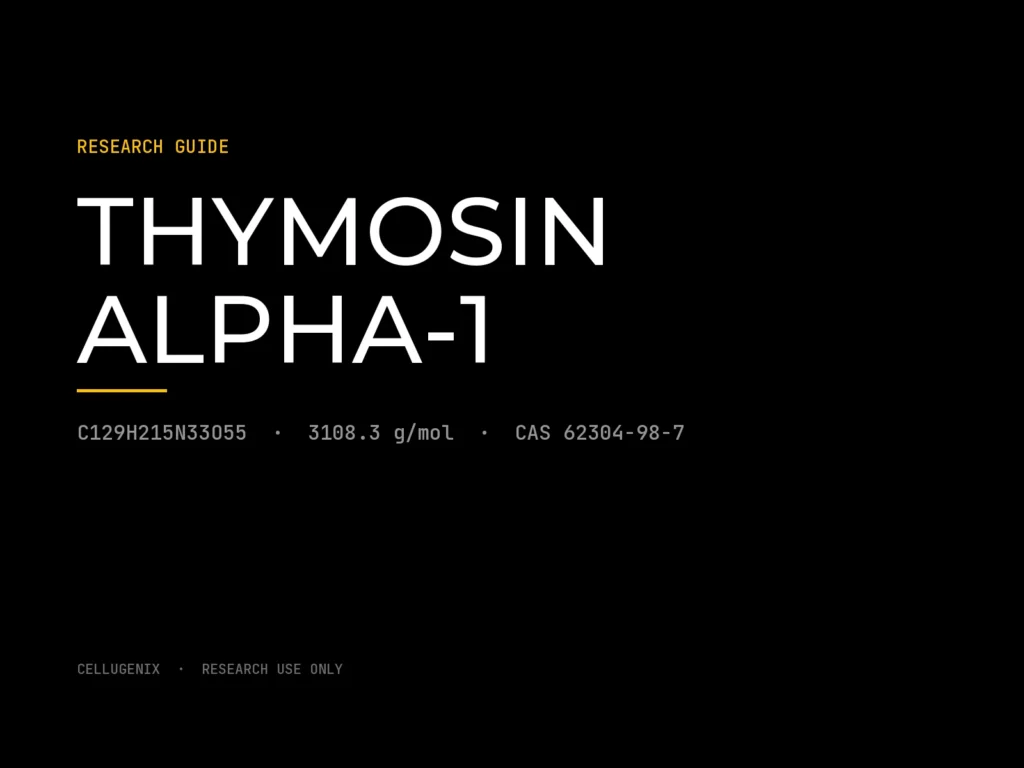
Thymosin alpha-1 (Tα1, INN thymalfasin) is a 28-residue peptide, acetylated at the N-terminus: Ac-SDAAVDTSSEITTKDLKEKKEVVEEAEN. Its formula is C129H215N33O55, its molecular weight 3108.3 g/mol and its CAS number 62304-98-7. Labs use it in toll-like receptor signalling assays and in lymphocyte and dendritic-cell cultures.
✓ 28 residues, N-acetylated
✓ INN thymalfasin, made synthetically
✓ A research reagent, not an FDA-approved drug
Thymosin Alpha-1 at a Glance
Quick answer: Thymosin alpha-1 is a linear, N-acetylated 28-mer registered with the FDA under UNII W0B22ISQ1C and listed in PubChem as CID 16130571. The free base, C129H215N33O55, weighs 3108.3 g/mol. Ten acidic residues against four lysines give it an isoelectric point near 4.2.
| Field | Value |
| Sequence | Ac-Ser-Asp-Ala-Ala-Val-Asp-Thr-Ser-Ser-Glu-Ile-Thr-Thr-Lys-Asp-Leu-Lys-Glu-Lys-Lys-Glu-Val-Val-Glu-Glu-Ala-Glu-Asn (Ac-SDAAVDTSSEITTKDLKEKKEVVEEAEN) |
| Other names | Thymalfasin (INN) · Tα1 |
| Length / modification | 28 residues · N-terminal acetyl-Ser |
| Formula | C129H215N33O55 (free base) |
| Molecular weight | 3108.3 g/mol average · 3106.50 Da monoisotopic |
| CAS | 62304-98-7; acetate listings use the same number |
| UNII / PubChem | W0B22ISQ1C · CID 16130571 |
| Net charge | Strongly acidic: 3 Asp, 6 Glu, a free C-terminus and 4 Lys; pI about 4.2 |
| Origin | N-terminal 28 residues of prothymosin alpha (109 residues) |
| Status | Not an FDA-approved drug; research reagent |
| Cellugenix | Thymosin Alpha-1 10 mg; report LK-TA1-10-032626 (Testides), purity by HPLC, see the batch result |
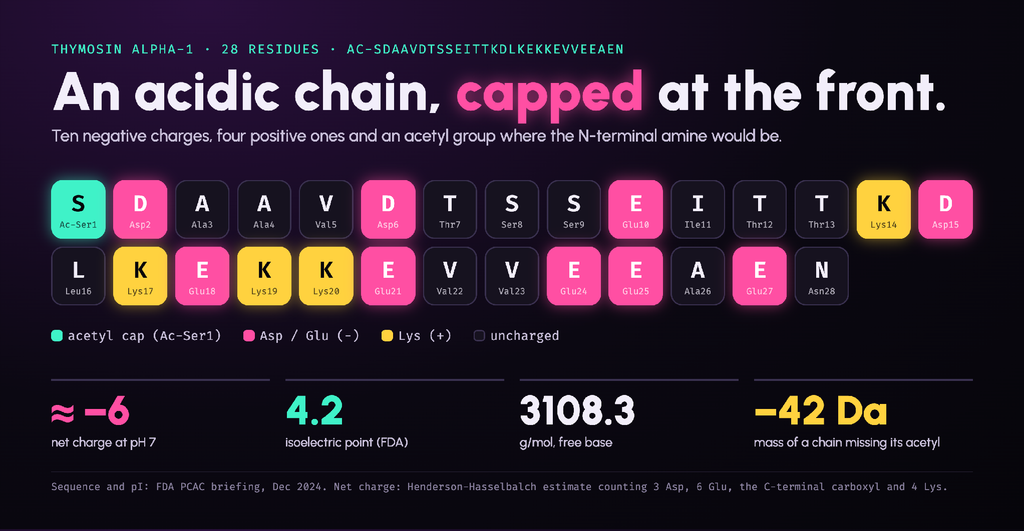
The 28 residues of thymosin alpha-1 drawn as a chain coloured by charge, with the acetyl cap, ten acidic sites, four lysines and a net charge of about minus six at pH 7
Batch details sit on the Thymosin Alpha-1 10 mg specification.
What Is Thymosin Alpha-1? From Thymosin Fraction 5 to a Defined Peptide
Quick answer: Thymosin alpha-1 was the first peptide purified and sequenced from thymosin fraction 5, a crude calf-thymus extract, in Allan Goldstein’s 1977 PNAS paper. It matches the N-terminal 28 residues of the larger protein prothymosin alpha. Today it’s made as a single defined, N-acetylated chain.
Fraction 5 held dozens of peptides, and the “alpha” and “beta” labels came from where each one ran on an isoelectric focusing gel. Thymosin alpha-1 sat at the acidic end. That naming habit explains the confusion with thymosin beta-4 covered further down.
Is Thymosin Alpha-1 a Peptide?
Yes. It’s 28 amino acids in one linear chain, with no disulfide bonds and an acetyl group on the first serine. That acetyl cap removes the usual positive charge at the N-terminus, which pushes an already acidic chain further to the acidic side. At pH 7, the net charge works out to about minus six.
Prothymosin Alpha and Thymosin Alpha-1
Prothymosin alpha is a 109-residue acidic protein, described by Haritos and colleagues in 1984 (PNAS, PMID 6583693). Its first 28 residues match thymosin alpha-1 exactly. A 2010 review in Peptides describes Tα1 as the cleavage product of prothymosin alpha by an asparaginyl endopeptidase, the enzyme that cuts after Asn28.
How Is Thymosin Alpha-1 Made? Synthetic vs Recombinant
Quick answer: Most research thymosin alpha-1 comes from solid-phase peptide synthesis, which builds the N-acetylated 28-mer directly. Recombinant expression in E. coli has also been described. It needs a fusion partner and a separate acetylation step, and each route leaves its own impurity profile behind.
| Solid-phase synthesis | Recombinant expression | |
| N-acetylation | Built in as the last coupling step | Chemical acetylation after cleavage, or a co-expressed acetyltransferase |
| Typical impurities | Deletion and truncated sequences | Host-cell proteins, fusion remnants, non-acetylated chain |
| What to check | HPLC purity, MS mass near 3108 | The same, plus MS confirmation of the acetyl group |
The 2010 Peptides review of Tα1 production lists E. coli routes that make Tα1 as fusion proteins and as concatemers, repeated copies cut apart afterwards. One route recovered 29 mg per litre of culture after cleavage, chemical acetylation and RP-HPLC. Another co-expressed RimJ, an E. coli N-terminal acetyltransferase, to add the acetyl group inside the cell.
The missing acetyl is the trap. It changes the mass by 42 Da, and HPLC alone can miss it. A missing acetyl changes the mass by 42 Da and stays invisible to a purity column, which is why a mass result settles identity.
Which Receptors and Assays Is Thymosin Alpha-1 Used In?
Quick answer: Thymosin alpha-1 is studied as a ligand at toll-like receptors, mainly TLR2 and TLR9 on dendritic cells. Labs measure downstream MyD88, NF-κB and IRF signalling, cytokine release from cultured lymphocytes and dendritic cells, and surface-marker expression in thymocyte cultures. The exact binding mode is still being worked out.
Luigina Romani’s group reported in Blood in 2004 (PMID 14982877) that Tα1 drove maturation and IL-12 production in cultured dendritic cells. The signal ran through the MyD88-dependent pathway and p38 MAPK to NF-κB. Later reviews, including PMC7747025, name TLR9 and TLR2 as the receptors involved.
| Assay | Readout |
| TLR reporter assays | NF-κB or IRF activation in TLR2- or TLR9-expressing cells |
| Dendritic-cell cultures | Activation markers (CD80, CD86) and IL-12 release |
| Lymphocyte cultures | IL-2 and IFN-γ release by ELISA |
| Thymocyte cultures | CD4 and CD8 marker expression |
| Analytical reference | HPLC retention time, MS mass, acetylation check |
Direct binding constants for Tα1 at TLR2 or TLR9 aren’t well documented. Most evidence is functional: a signal that drops when MyD88 or the receptor is knocked out. For a reporter assay, that means running receptor-null cells and a known agonist, such as Pam3CSK4 for TLR2 or a CpG oligonucleotide for TLR9, beside the peptide.
Endotoxin deserves its own control. Bacterial lipopolysaccharide triggers TLR4 at picogram levels, and recombinant material made in E. coli can carry traces of it. A TLR signal from an untested lot can come from contamination. Running polymyxin B alongside the peptide, or using a lot with a stated endotoxin result, separates the two.
Thymosin Alpha-1 vs Thymosin Beta-4 (and TB-500)
Quick answer: No, they aren’t the same. Thymosin alpha-1 is a 28-residue acidic peptide from prothymosin alpha. Thymosin beta-4 is a separate 43-residue actin-binding protein, and TB-500 is a short fragment of thymosin beta-4. They share the “thymosin” name only because both came out of thymus extracts.
| Thymosin alpha-1 | Thymosin beta-4 | TB-500 | |
| Length | 28 | 43 | 7 (Ac-LKKTETQ) |
| Parent | Prothymosin alpha | Its own gene (TMSB4X) | Thymosin beta-4, residues 17-23 |
| MW (g/mol) | 3108.3 | ~4,963 | ~889 |
| Charge character | Acidic, pI about 4.2 | Mildly acidic, lysine-rich | Near neutral (2 Lys, 1 Glu) |
| Studied in | TLR signalling assays | Actin-binding assays | Actin-binding assays |
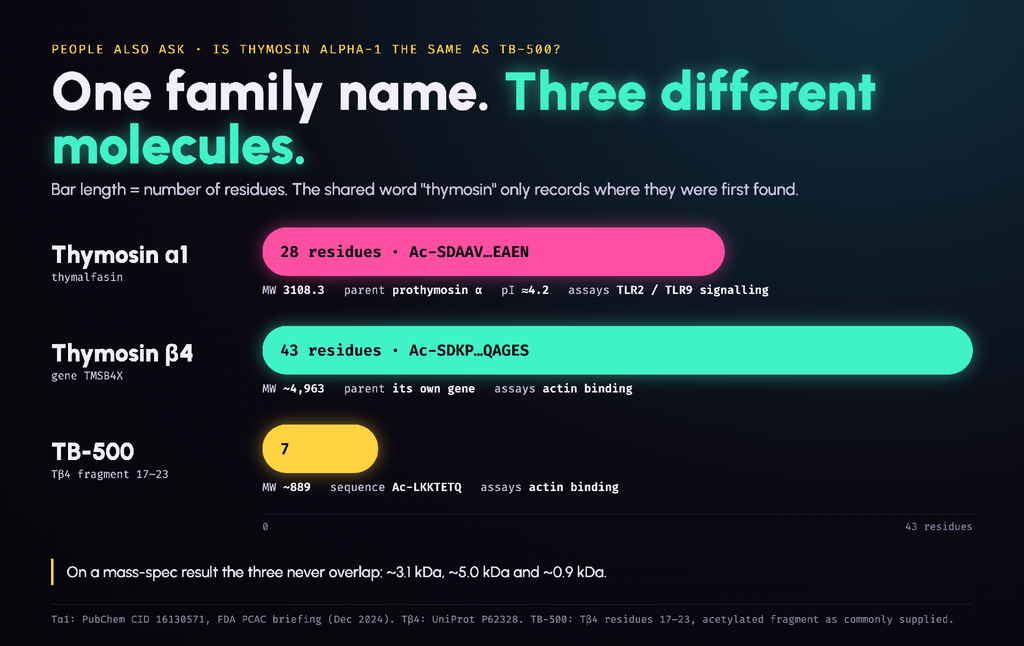
Thymosin alpha-1, thymosin beta-4 and TB-500 compared side by side as length bars: 28, 43 and 7 residues, with molecular weights, parents and assay families
The masses alone separate all three on any mass-spec result. TB-500 and thymosin beta-4 covers the actin-binding pair in more detail.
Is Thymosin Alpha-1 FDA-Approved?
Quick answer: No. Thymosin alpha-1 is not an FDA-approved drug; it’s sold for laboratory research only. At its December 4, 2024 meeting, the FDA’s Pharmacy Compounding Advisory Committee voted 4 to 17 against adding either the free base or the acetate to the 503A bulks list.
| Question | Status |
| FDA-approved (US)? | No |
| 503A compounding | Voted down 4-17 for both forms, PCAC, December 4, 2024 |
| FDA’s view | Both forms judged not well characterised; no UNII for the acetate |
| July 2026 PCAC | Not on the agenda |
| Research sale | Research Use Only |
The vote is recorded in the FDA’s final summary minutes for December 4, 2024. The FDA briefing document for that meeting lists the free base under UNII W0B22ISQ1C and says the acetate uses the same CAS number. As of October 2026, no new review has been scheduled. Our explainer on what Research Use Only means covers how lab reagents are regulated.
Storage of the Sealed Vial
Thymosin alpha-1 ships as a lyophilized (freeze-dried) solid in a sealed vial labelled with its lot number. Store sealed vials as stated on the label, protected from light and moisture. Log the lot and report number (LK-TA1-10-032626 for the current batch) next to each experiment, so every result traces back to one certificate. Temperature ranges are in the storage and handling guide.
Thymosin Alpha-1 COA: What to Check
Quick answer: A thymosin alpha-1 certificate should name the 28-residue acetylated sequence, show HPLC purity with a chromatogram, report content against the label, give a mass-spec result near 3108 that confirms acetylation, and carry a report number that verifies on the lab’s website.
- Identity: the full Ac-SDAAVDTSSEITTKDLKEKKEVVEEAEN sequence and CAS 62304-98-7
- Purity: HPLC result with the chromatogram attached
- Content: measured milligrams against the label claim
- Mass: near 3108.3, with no peak 42 Da lighter from a missing acetyl
- Traceability: a report number you can check with the lab
Salt form also changes the arithmetic. With four lysines, the chain can carry up to four acetate counter-ions, and each one adds about 60 g/mol to the 3108.3 g/mol free base. A content result well under the label, next to high HPLC purity, usually points to counter-ions or water.
The current Cellugenix batch, LK-TA1-10-032626, was tested by Testides on 28 March 2026 at 99.6% purity by HPLC. The report doesn’t include mass spec or salt form. See the full record on the Thymosin Alpha-1 10 mg COA, and our guide on how to read a COA to work through each field.
Frequently Asked Questions
What is thymosin alpha-1?
Thymosin alpha-1 is a 28-residue peptide with an acetylated N-terminus, sequence Ac-SDAAVDTSSEITTKDLKEKKEVVEEAEN, formula C129H215N33O55, and molecular weight 3108.3 g/mol. Its INN is thymalfasin, and its CAS number is 62304-98-7. Laboratories use it in toll-like receptor signalling assays and in cultured lymphocyte and dendritic-cell work.
What is the sequence of thymosin alpha-1?
Thymosin alpha-1 reads Ac-Ser-Asp-Ala-Ala-Val-Asp-Thr-Ser-Ser-Glu-Ile-Thr-Thr-Lys-Asp-Leu-Lys-Glu-Lys-Lys-Glu-Val-Val-Glu-Glu-Ala-Glu-Asn. The chain is linear and the N-terminal serine is acetylated. Those 28 residues match the first 28 of prothymosin alpha, a 109-residue acidic protein.
What is thymalfasin?
Thymalfasin is the International Nonproprietary Name for thymosin alpha-1. The FDA registers the free base under UNII W0B22ISQ1C with CAS 62304-98-7. Thymalfasin acetate is the acetate salt of the same chain; the FDA lists no separate UNII for it, and suppliers usually give it the free base’s CAS number.
Is thymosin alpha-1 the same as TB-500?
No. Thymosin alpha-1 is a 28-residue acidic peptide from prothymosin alpha, weighing 3108.3 g/mol. TB-500 is a seven-residue fragment, Ac-LKKTETQ, of thymosin beta-4, a separate 43-residue actin-binding protein. The two share only the “thymosin” name, which comes from their discovery in thymus extracts.
Is thymosin alpha-1 synthetic?
Research thymosin alpha-1 is normally synthetic. Solid-phase peptide synthesis builds the acetylated 28-mer directly. Recombinant routes in E. coli exist, using fusion proteins or concatemers plus a separate acetylation step. Either way, an MS result near 3108.3 confirms that the full acetylated chain is present.
Is thymosin alpha-1 FDA-approved?
No. Thymosin alpha-1 is not an FDA-approved drug; it’s sold for laboratory research only. On December 4, 2024, the FDA’s compounding advisory committee voted 4 to 17 against listing either the free base or the acetate for 503A compounding, and it wasn’t on the July 2026 agenda.
The Bottom Line
Thymosin alpha-1 is an acidic, N-acetylated 28-residue fragment of prothymosin alpha, studied at TLR2 and TLR9 in cell assays. For a lab, the details to pin down are that acetylated sequence, how the batch was made and a report that verifies. Start with the Thymosin Alpha-1 10 mg listing and its current certificate.
For laboratory research use only. Not for human or animal use.
Sources
- PubChem. Thymosin alpha 1, CID 16130571 (National Library of Medicine).
- FDA. Briefing Document and Final Summary Minutes, Pharmacy Compounding Advisory Committee, December 4, 2024.
- Goldstein AL, Low TL, McAdoo M, et al. Proc Natl Acad Sci USA, 1977. PMID 265536.
- Haritos AA, Goodall GJ, Horecker BL. Proc Natl Acad Sci USA, 1984. PMID 6583693.
- Li J, et al. Peptides, 2010; production sections. PMID 20699109.
- Romani L, Bistoni F, Gaziano R, et al. Blood, 2004; dendritic-cell assay sections. PMID 14982877.
- Dominari A, et al. Review, 2020; biochemistry sections. PMC7747025.
For laboratory research use only. Not for human or animal use.