Buying TB-500 Peptide for Research: What the COA Should Show
A vial of white powder looks the same regardless of what the label says. The paperwork is the only thing standing between “TB-500” as a word and TB-500 as a molecule, and the US regulator made that point in May 2026, when it reviewed a TB-500 submission and found the certificate attached described a different substance.
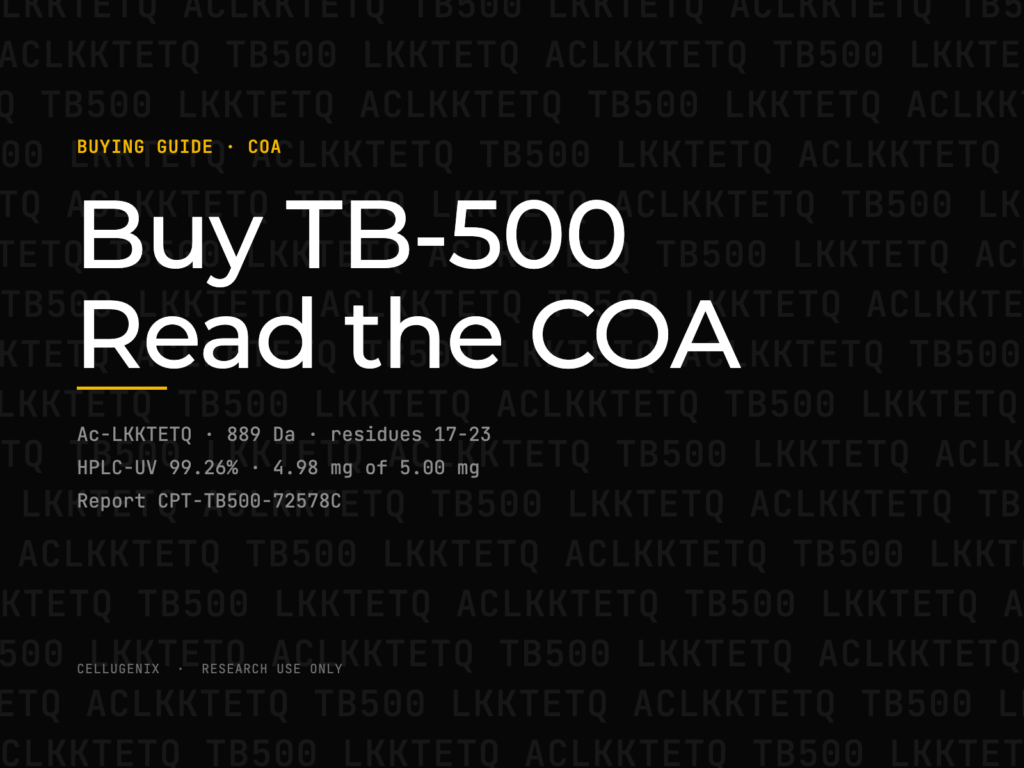
Quick answer: Before you buy TB-500, check the batch certificate of analysis (COA). It should show a mass that matches the molecule on the label, about 889 Da for the Ac-LKKTETQ fragment, HPLC purity with the method, measured vial content, a lot number that matches the vial, a test date, and a named lab you can verify with.
Six things to check before you order
- The mass matches the molecule.
- HPLC purity is given with the method.
- Measured content is close to the label.
- The lot number on the vial matches the COA.
- The test date and lab name are shown.
- You can verify the report with the lab.
This guide covers identification and documentation only. TB-500 is sold For Research Use Only.
What You’re Actually Buying When You Buy TB-500
Quick answer: “TB-500” usually means a synthetic seven-residue peptide, Ac-LKKTETQ, matching residues 17 to 23 of thymosin beta-4. The name has no registry definition behind it, so a vial carrying it can hold a longer piece of Tβ4, or the whole 43-residue protein.
The FDA put this plainly in its May 2026 evaluation of TB-500: TB-500 is a common name and not a United States Adopted Name, and the agency has encountered multiple salts and derivatives, including different active moieties, sold commercially under that one name. The label is a starting point, and the certificate is where the molecule gets pinned down.
TB-500 vs Thymosin Beta-4: Two Molecules, One Name
| TB-500 (fragment) | Thymosin beta-4 (full length) | |
| Sequence | Ac-LKKTETQ | 43 residues (Ac-SDKP…) |
| Residues | 7 | 43 |
| Approx. mass | ~889 Da (888.49 monoisotopic) | ~4,963 Da |
| CAS | 885340-08-9 | 77591-33-4 |
| What the COA mass should read | Near 889 | Near 4,963 |
Mature thymosin beta-4 runs 43 residues with an acetylated N-terminus, and the UniProt entry P62328 puts LKKTETQ at positions 17 to 23 of that chain. More than 4,000 Da separates the two, a gap no salt or solvent could account for.
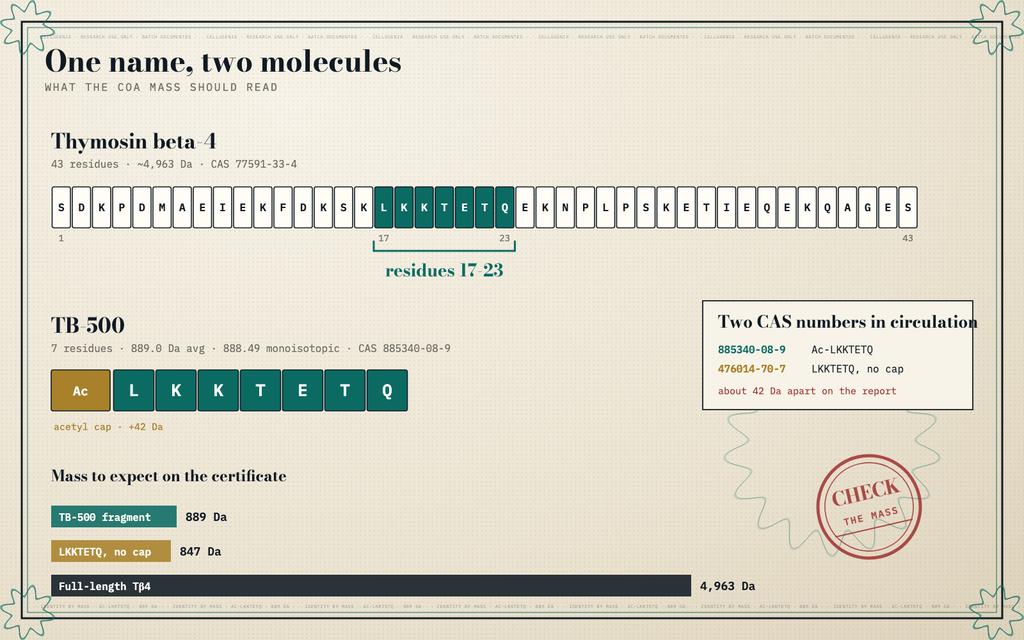
TB-500 fragment compared with full-length thymosin beta-4: sequence, residues 17 to 23, masses of 889 Da and 4,963 Da, and both CAS numbers
A second trap sits in the CAS field. PubChem CID 62707662 carries CAS 885340-08-9 for the acetylated heptapeptide, formula C₃₈H₆₈N₁₀O₁₄, average mass 889.0 g/mol. CAS 476014-70-7 belongs to plain LKKTETQ with no acetyl cap, about 42 Da lighter. Both numbers turn up on listings sold as TB-500.
Why This Matters on a Product Page
Some listings print full-length Tβ4 figures on a fragment product, and some do the reverse. A page quoting 4,963 Da beside a seven-residue sequence has copied its data from somewhere else. When the mass and the CAS on the page disagree with the certificate, that vial’s identity is undocumented, whatever the purity figure says. Checking a listing takes a minute with the TB-500 sequence and identity in front of you: seven residues, one acetyl cap, 889 Da.
What a TB-500 COA Should Show: The Checklist
Quick answer: A useful COA ties one lot to one test by one named lab, and reports identity and purity separately. Mass spectrometry answers what the compound is. HPLC answers how much of the sample is that main peak. A purity figure on its own leaves the identity of the peak open.
| COA field | What it tells you | What to look for | Red flag |
| Identity (LC-MS / ESI-MS) | The molecule’s mass | ~889 Da for Ac-LKKTETQ | Missing, or ~4,963 on a fragment product |
| Purity (HPLC) | Share of the main peak | A % with the method and chromatogram | A round “100%”, or no method |
| Net content | mg actually in the vial | Close to the label, say 4.9 to 5.0 of 5 mg | Not reported |
| Lot/batch number | Which vials were tested | Same as the vial label | Missing or generic |
| Test date | When the sample was run | Recent, and matching the batch | Older than the batch |
| Lab and report number | Who tested it | A named lab and a report you can look up | “In-house” only, no lab name |
| Endotoxin (optional) | Bacterial endotoxin level | An LAL or rFC result in EU/mg | None, which matters for cell-culture assays |
Identity: Does the Mass Match the Molecule?
LC-MS or ESI-MS measures the mass of what is in the vial, and you compare that reading with roughly 889 Da. Chromatography separates compounds by how they move through a column, so it can show one clean peak without naming the molecule that made it. That split between HPLC vs mass spectrometry is why a certificate needs both results.
Purity: HPLC With a Method and a Chromatogram
Purity on a peptide COA is the main peak’s area as a share of every peak the detector saw, written as area %. Look for the column, the wavelength, and the method beside the number, plus the trace itself. Research peptides are commonly reported at 98% or higher, and the batch result is the figure that counts.
Content: How Many mg Are Really in the Vial
Purity and content measure different things. A vial can test 99% pure and still fall short of its labelled weight, because what you weigh includes peptide, water, and counter-ions. Net peptide content tells you how much compound you have to work with.
Lot Number, Test Date and Lab
One lot, one report. Read the lot number off the vial, find the same code on the certificate, and check the test date sits with that production run. Some labs photograph the vial they tested and print it on the report, which makes that match a two-second job. A certificate without a lot number documents nothing you are holding.
Verifying the Report With the Lab
Scan the QR code on the certificate, or open the verify link on the laboratory’s own site, and read the record where the lab published it. Where no portal exists, email the lab the report number. A public record of reports makes independent lab testing checkable, and ISO/IEC 17025 accreditation adds a further signal, since it is assessed against a lab’s technical ability to produce accurate results.
Optional Extras: Endotoxin and Counter-Ion
Endotoxin results matter once the work involves cultured cells, reported in EU/mg from an LAL or rFC assay. The counter-ion, acetate or trifluoroacetate, explains part of the gap between the weight in the vial and the peptide content, so a certificate stating the salt form saves a calculation later. Water content, residual solvents, and the other fields you may meet are worked through in how to read a COA.
How to Read a TB-500 HPLC Result
Quick answer: Look for one dominant peak. Purity is that peak’s area as a share of all detected peaks, so a 99.26% result means everything else the detector saw adds up to 0.74%. The small extra peaks are impurities, often truncated sequences left behind by synthesis.
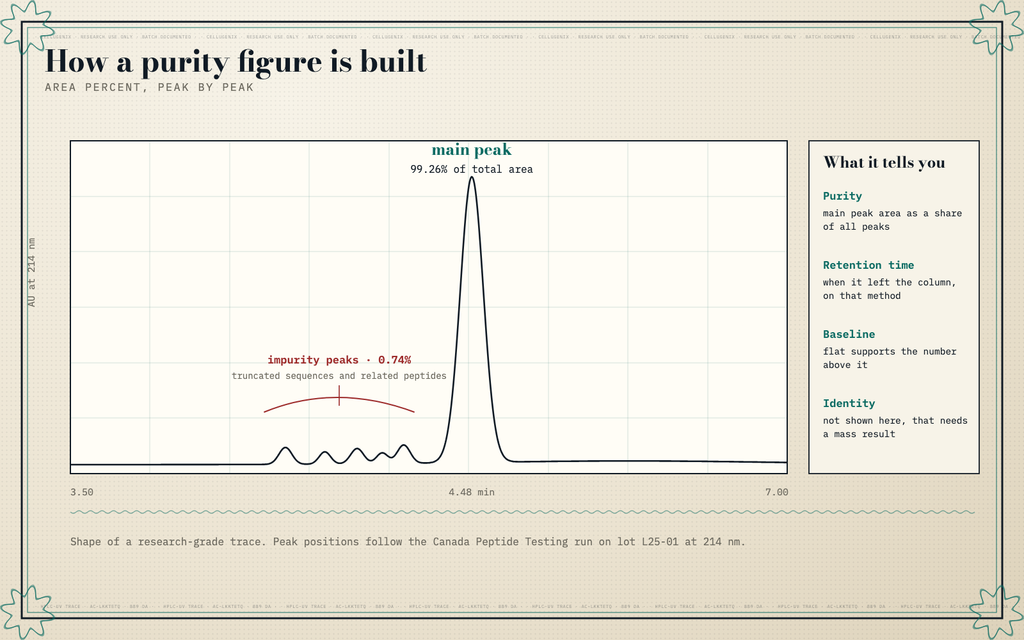
Annotated HPLC chromatogram showing one main peak at 99.26% of total area and small impurity peaks making up 0.74%
Our own batch trace is a plain example. Canada Peptide Testing ran it at 214 nm, the main peak lands at 4.481 minutes, and five small peaks sit ahead of it between 3.519 and 4.112 minutes. Those early peaks are the 0.74%.
Retention time tells you when a compound came off the column under that method, on that day. It compares one batch with another on the same system, and identifying the compound is the mass result’s job.
Read the baseline between the peaks too. A flat one supports the number printed above it, and if the figure and the picture disagree, the picture wins.
7 COA Red Flags Before You Buy TB-500
FDA’s review of TB-500 is the best worked example of a certificate failing. The agency found the submission’s COA was for the acetate while the substance submitted was the free base, that the CAS number, molecular formula, and molecular weight on the certificate belonged to the acetate, and that the formula printed on the COA was not legible. Those were paperwork problems, and they were enough to leave the substance undocumented.
- No laboratory named, or testing described as in-house only.
- No lot number, or a lot that does not match the vial.
- The same report reused across several products or years.
- Mass missing, or a mass for the wrong molecule, such as ~4,963 Da on a 7-residue product.
- Purity given as a round 100%, or with no method beside it.
- A test date older than the batch, or no date at all.
- A COA available on request only, with no way to verify it with the lab.
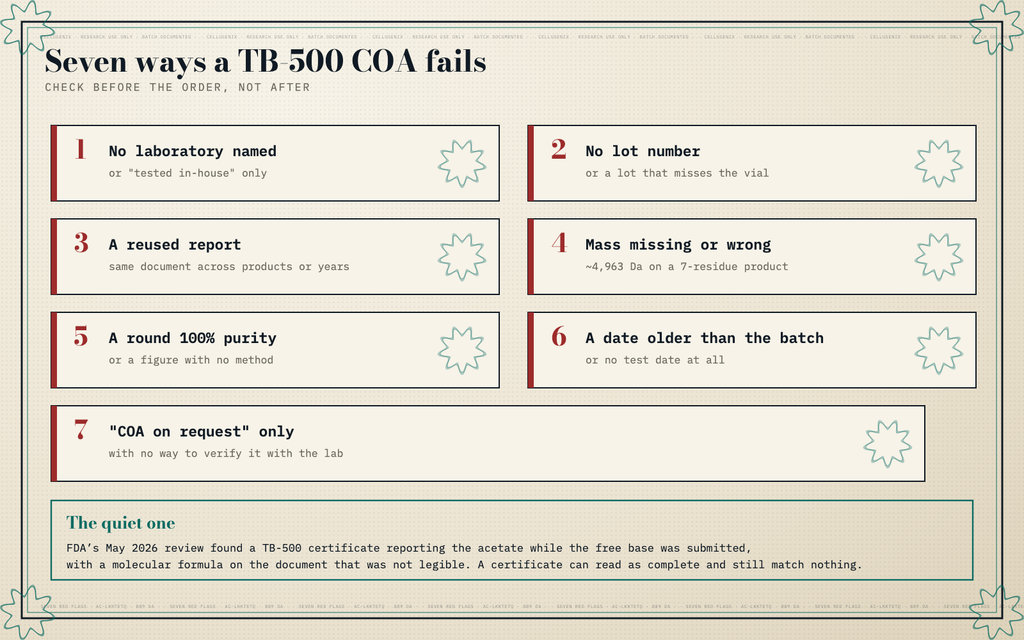
Checklist of seven red flags on a TB-500 certificate of analysis
Number four hides a quieter version of itself. Free base and acetate share an active moiety and carry different molecular weights, so a certificate naming one and reporting the other reads as complete until you check the arithmetic.
Example: Our TB-500 5 mg Batch COA
Quick answer: Here is what the current Cellugenix TB-500 5 mg certificate reports, field by field, including what it leaves out.
| Field | Result |
| Report number | CPT-TB500-72578C |
| Lot | Batch L25-01 · Lot CGX-2025 |
| Laboratory | Canada Peptide Testing (independent) |
| Method | HPLC-UV purity and content, chromatogram at 214 nm |
| Purity | See the batch result, 99.26% on this report |
| Measured content | 4.98 mg of 5.00 mg, a fill accuracy of 99.6% |
| Tested/reported | Sep 28, 2026 / Oct 2, 2026 |
| Appearance | White lyophilized powder |
| Verification | QR code and Verify link on the lab’s site |
This report covers purity and content by HPLC. It does not include a mass-spec identity result or endotoxin testing. For work that turns on confirmed identity, run your own LC-MS check on receipt and expect a mass near 889 Da, and for cell-culture assays, source an endotoxin result separately.
The product has test history too. An earlier 5 mg lot was tested by Testides on Dec 8, 2025 and reported at 98.43% under CEP-TB5-5-112625, which still sits beside the current result on the TB-500 5 mg certificate. Reports for every other compound sit in the COA library, searchable by compound or lot, and the specification, current lot, and certificate appear together if you want to buy TB-500 5 mg for research.
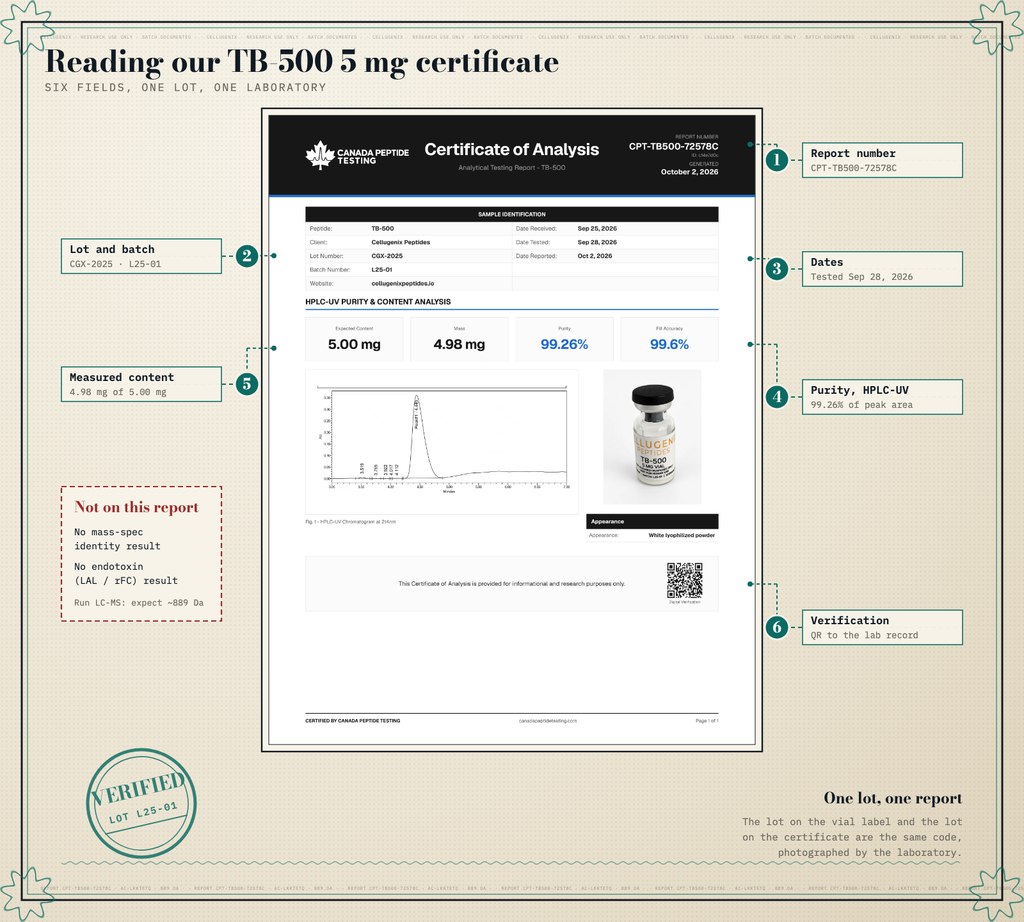
TB-500 5 mg certificate of analysis, report CPT-TB500-72578C, with the six fields to check numbered and the missing mass-spec and endotoxin results marked
Can You Buy TB-500 Legally?
Quick answer: In the United States, TB-500 is not an FDA-approved drug and is not sold in pharmacies or over the counter as a medicine. It is supplied as a research chemical, labelled For Research Use Only, for laboratory work. This reflects the position as of November 9, 2026.
FDA’s evaluation states there is no applicable United States Pharmacopeia or National Formulary drug substance monograph for TB-500 free base or its acetate form, and that neither is a component of an FDA-approved drug.
Can You Buy TB-500 Over the Counter?
No. An over-the-counter medicine needs either an approved application or an OTC monograph behind it, and TB-500 has neither. Any vial you find is research material, and the RUO label governs how it may be used, however the listing is worded.
Can You Buy Research Peptides Online?
Research-use-only sales run on documentation. The supplier publishes a batch certificate, the buyer confirms the material is for laboratory research, and the paperwork travels with the order so the vial stays tied to its test record. Import and handling rules sit with the buyer and differ by country and institution, which is where research peptides and US law in 2026 get practical. The phrase printed on the vial carries a specific meaning too, so what Research Use Only means is worth reading before an order goes in.
Thymosin beta-4 and its derivatives, TB-500 among them, also appear in section S2.3 of the WADA 2026 Prohibited List, under growth factors and growth factor modulators, prohibited at all times.
What Affects the Price of TB-500?
Quick answer: The price per vial tracks three things: the measured content in the vial, how much testing each lot receives, and whether a certificate exists for that exact lot.
Compare on price per verified mg. A 5 mg vial measured at 4.98 mg and a 5 mg vial with no content result are different purchases at the same price, because only one has a number behind the label.
Testing depth is the second lever. HPLC purity alone costs less than HPLC plus a mass-spec identity check plus an endotoxin assay, and that difference lands in the price. Cheap listings often skip identity testing or lean on an older lot’s report, which moves the cost of confirming what you bought onto your own instrument time.
Storage When Your TB-500 Arrives
Quick answer: TB-500 ships as a lyophilized, freeze-dried powder. Keep sealed vials cold, dry, and out of the light, with −20 °C suited to long-term storage, and log the lot number and arrival date against the certificate when the box lands.
Freeze-drying is what buys that stability, and lyophilized peptides hold up in the vial far longer than material in solution. Each product family has its own temperature range, set out in the storage and handling guide.
Logging the lot on arrival pays off months later. When a result looks odd, the first question is which vial produced it, and the record answers in seconds.
What Is TB-500 Studied For in the Lab?
Quick answer: In vitro, the LKKTETQ motif is studied in the context of binding monomeric G-actin. Laboratories work with it in actin-polymerization assays and in cell-motility assays, such as transwell and scratch assays on cultured cells.
The motif’s role comes from work on the parent protein. Zoubek and Hannappel reported in 2007 that thymosin beta-4 lacking residues 17 to 23 showed no interaction with G-actin in vitro, which is why that stretch is called the actin-binding motif. Safer, Elzinga and Nachmias had identified full-length Tβ4 as the actin-sequestering peptide in the Journal of Biological Chemistry in 1991.
All of this is assay work on isolated proteins and cultured cells. Protocols running a shorter peptide alongside it usually land on KPV vs TB-500, a tripeptide against a heptapeptide, with different targets and different testing.
FAQs
Where can I buy TB-500 online for research?
From a supplier that publishes a batch certificate for the exact lot in the vial, tested by a named laboratory whose report you can look up. Match the lot number, the test date, and the report number before ordering. Our current lot, method, and measured content sit on the TB-500 peptide for sale listing.
Can you buy TB-500 over the counter?
No. Over-the-counter status in the United States requires an approved drug application or an OTC monograph. FDA’s May 2026 evaluation records that no USP or NF monograph exists for either TB-500 form, and that neither is part of an approved drug. It reaches laboratories as a research chemical.
What is the molecular weight of TB-500?
About 889 Da for Ac-LKKTETQ, the seven-residue fragment, with a monoisotopic mass of 888.49 Da and formula C₃₈H₆₈N₁₀O₁₄. Full-length thymosin beta-4 is about 4,963 Da across 43 residues, so the COA mass tells you which molecule the vial holds.
Is TB-500 the same as thymosin beta-4?
No. TB-500 is a seven-residue fragment, Ac-LKKTETQ, matching residues 17 to 23 of the 43-residue protein, and the two differ by more than 4,000 Da. A vial under that label can carry a longer piece, or the whole protein, which is what the mass result settles.
How do I verify a TB-500 COA?
Match the lot number on the vial to the lot on the certificate, then look up the report number on the laboratory’s own site or scan the QR code on the document. Where a lab has no lookup page, email it the report number and ask.
What purity should a TB-500 COA show?
Research peptides are commonly reported at 98% or higher by HPLC. The batch result is the figure that counts, and the method beside it is what makes it checkable, since a percentage with no column, wavelength, or chromatogram is a number you have to take on faith.
Does an HPLC purity result prove the vial contains TB-500?
No. HPLC measures how much of the sample sits in the main peak, and it does not identify that peak. Identity needs a mass result from LC-MS or ESI-MS, compared against roughly 889 Da for the acetylated fragment.
The Mass Is the Check
Six fields decide whether a TB-500 purchase is documented: mass, purity, content, lot, date, and lab. Mass proves which molecule arrived, and it is the field most often missing. Read the certificate before the price, match the lot to the vial on arrival, and treat any report you cannot verify with the lab as a blank page. See the TB-500 5 mg specification and batch COA.
For laboratory research use only. Not for human or animal use. Full terms are set out in our legal notice.
Sources
- FDA, Evaluation of TB-500-Related Bulk Drug Substances, May 15, 2026 (last checked November 9, 2026): https://www.fda.gov/media/193349/download
- UniProt P62328, thymosin beta-4 sequence (last checked November 9, 2026): https://www.uniprot.org/uniprotkb/P62328/entry
- PubChem CID 62707662, CAS 885340-08-9, Ac-LKKTETQ (last checked November 9, 2026): https://pubchem.ncbi.nlm.nih.gov/compound/62707662
- PubChem substance records, CAS 476014-70-7, LKKTETQ (last checked November 9, 2026): https://pubchem.ncbi.nlm.nih.gov/#query=476014-70-7
- WADA 2026 Prohibited List, section S2.3 (last checked November 9, 2026): https://www.wada-ama.org/en/prohibited-list
- Zoubek RB, Hannappel E, 2007, PubMed 17567947 (last checked November 9, 2026): https://pubmed.ncbi.nlm.nih.gov/17567947/
For laboratory research use only. Not for human or animal use.