MOTS-c: Mitochondrial-Derived Peptide Research Overview (2026)
Almost every protein a cell makes is written in the nuclear genome. MOTS-c is one of the rare exceptions. Its 16 residues are coded inside the mitochondria’s own small genome, tucked into a gene that was long thought to make only ribosomal RNA. That odd address is why MOTS-c turns up so often in mitochondrial signalling research.
This guide covers what MOTS-c is and where it’s encoded, the pathways studied, how labs study it, a literature timeline, its US and WADA status, and how to verify a research batch. Cellugenix supplies MOTS-c as a laboratory reagent.
In short: What is MOTS-c?
MOTS-c is a 16-residue peptide (MRWQEMGYIFYPRKLR) encoded by a short open reading frame in the mitochondrial 12S rRNA gene, MT-RNR1. It’s a mitochondrial-derived peptide studied in AMPK signalling, folate-methionine cycle research and mitochondrial-to-nuclear communication. Formula C101H152N28O22S2, MW 2174.6 g/mol, CAS 1627580-64-6.
✓ Encoded in mitochondrial, not nuclear, DNA
✓ Most of the literature is cell and animal research
✓ Not FDA-approved for any use
Key takeaways
- Encoded in mitochondrial, not nuclear, DNA.
- 16 residues: MRWQEMGYIFYPRKLR.
- C101H152N28O22S2, 2174.6 g/mol, CAS 1627580-64-6.
- Available as 10 mg and 40 mg vials.
- Not FDA-approved; named by WADA under S4.4.1.
Contents
- What is MOTS-c?
- Identifiers
- Where it’s encoded
- Molecular pathways
- How it’s studied
- Research timeline
- MOTS-c vs NAD+
- US and WADA status
- Storage
- Verifying a batch
- FAQs
What Is MOTS-c?
Quick answer: MOTS-c is a mitochondrial-derived peptide (MDP), a 16-residue chain encoded in the mitochondrial genome. Changhan Lee, Pinchas Cohen and colleagues first described it in Cell Metabolism in 2015 (PMID 25738459), after scanning mitochondrial DNA for short open reading frames.
The name is an acronym: Mitochondrial Open reading frame of the Twelve S rRNA, type c. The “c” marks it as one of several candidate frames the team flagged in that gene.
Lee’s group went looking because of humanin, a peptide reported in 2001 inside the neighbouring 16S rRNA gene. If one short frame in mitochondrial ribosomal RNA could encode a peptide, others might too. MOTS-c is a linear, unmodified 16-mer with a free N-terminal methionine, and it carries four basic residues (three Arg and one Lys), which give it a strong positive charge.
MOTS-c also occurs naturally. Immunoassays have detected endogenous MOTS-c in human and rodent plasma and in tissue samples, so labs that measure it need a well-characterised synthetic standard to calibrate against.
Batch details are on the MOTS-c 10 mg specification and COA and the MOTS-c 40 mg specification and COA.
Is MOTS-c a Peptide or a Hormone?
MOTS-c is a peptide: 16 amino acids joined by peptide bonds. Some reviews call it a “mitokine”, a word for signalling molecules that come from mitochondria and act elsewhere in the cell or outside it. That label describes where the peptide comes from. A classic hormone is made by a gland and carried to a distant target, and the mitokine term was coined to group signals of mitochondrial origin, whatever their range.
MOTS-c Identifiers
Quick answer: MOTS-c is H-MRWQEMGYIFYPRKLR-OH, registered by the FDA under UNII A5CV6JFB78 with CAS 1627580-64-6. The free base, C101H152N28O22S2, weighs 2174.6 g/mol. The FDA lists the mono-acetate at 2234.6 g/mol under the same CAS number.
| Field | Value |
| Sequence (three-letter) | Met-Arg-Trp-Gln-Glu-Met-Gly-Tyr-Ile-Phe-Tyr-Pro-Arg-Lys-Leu-Arg |
| Sequence (one-letter) | MRWQEMGYIFYPRKLR |
| Length | 16 residues |
| Other names | Mitochondrial open reading frame of the 12S rRNA type-c |
| Molecular formula | C101H152N28O22S2 |
| Molecular weight | 2174.6 g/mol (monoisotopic 2173.11 Da) |
| CAS number | 1627580-64-6 |
| UNII / PubChem | A5CV6JFB78 · CID 146675088 |
| Gene location | MT-RNR1 (12S rRNA), mitochondrial genome |
| Form | Lyophilized solid, sealed vial |
Salt form changes the arithmetic. MOTS-c has five basic sites (the free N-terminus, three arginines and one lysine), so a vial can carry several acetate or TFA counter-ions. Each acetate adds about 60 g/mol, and a content result well under the label, next to high HPLC purity, usually points to counter-ions or water.
Where Is MOTS-c Encoded?
Quick answer: MOTS-c is encoded inside the mitochondrial 12S rRNA gene, MT-RNR1, as a short open reading frame (sORF). The surrounding gene makes the RNA backbone of the mitochondrial ribosome, and the 51-nucleotide frame for MOTS-c lies within that sequence.
The human mitochondrial genome is a ring of about 16.6 kb. Textbooks list its contents as 13 protein-coding genes, 22 tRNAs and 2 rRNAs, the 12S (MT-RNR1) and the 16S (MT-RNR2). For decades that was the full parts list.
Short open reading frames changed the count. These are stretches of fewer than about 100 codons, too short for older gene-finding tools to flag, and several turned out to lie inside the two rRNA genes. MOTS-c is the best-known frame in the 12S gene.
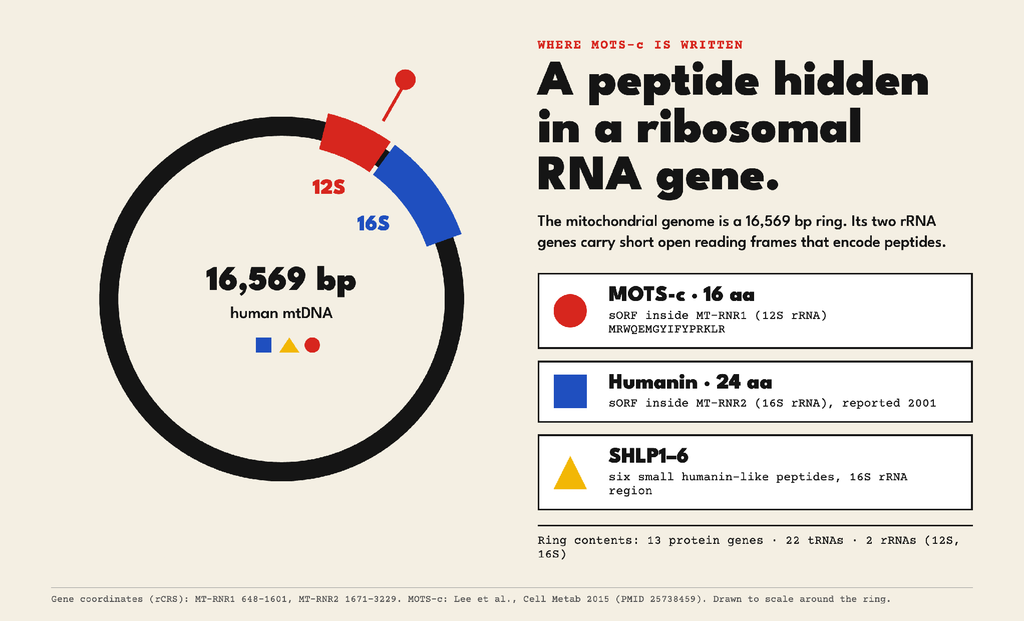
The human mitochondrial genome drawn as a ring with the 12S and 16S rRNA genes highlighted, and MOTS-c, humanin and SHLP1-6 pulled out as the peptides encoded inside them
What Are Mitochondrial-Derived Peptides?
Mitochondrial-derived peptides (MDPs) are short peptides encoded by sORFs in mitochondrial DNA. The group includes three families, sorted by where each one is encoded:
- Humanin: a 24-residue peptide encoded in the 16S rRNA gene, MT-RNR2
- SHLP1-6: six small humanin-like peptides, also from the 16S rRNA region
- MOTS-c: the one MDP encoded in the 12S rRNA gene, MT-RNR1
What Does MOTS-c Do at the Molecular Level?
Quick answer: In cultured cells, MOTS-c has been reported to inhibit the folate-methionine cycle, which raises intracellular AICAR and activates AMPK. Under cellular stress, it also moves into the nucleus, where it associates with antioxidant response element (ARE) genes and the transcription factor NRF2. Both findings come from cell models.
The Folate-AICAR-AMPK Pathway
Lee’s 2015 paper traced the first pathway. In cultured cells, MOTS-c slowed the folate cycle and the de novo purine synthesis tied to it. One intermediate on that route, AICAR (5-aminoimidazole-4-carboxamide ribonucleotide), then built up. AICAR mimics AMP, so its build-up switched on AMPK, which labs read as phosphorylation at Thr172. That chain, from folate cycle to AICAR to p-AMPK, is the pathway most MOTS-c assays still measure. Labs usually quantify AICAR by LC-MS metabolomics and read AMPK by Western blot, with an AMPK inhibitor such as compound C (dorsomorphin) or AMPK knockdown as the control that shows the signal runs through that kinase.
Nuclear Translocation
In 2018, Kyung Hwa Kim and Changhan Lee reported in Cell Metabolism (PMID 29983246) that MOTS-c moves from the cytoplasm into the nucleus of stressed cells. The move depended on AMPK. Once in the nucleus, MOTS-c changed the expression of many genes, including ARE-containing genes, and interacted with stress-responsive transcription factors such as NRF2. This made MOTS-c one of the first mitochondrially encoded factors shown to act on the nuclear genome. Localisation work typically pairs nuclear and cytoplasmic fractionation with immunofluorescence, using a tagged or antibody-detected peptide and a nuclear stain to confirm where it ends up.
How Is MOTS-c Studied in the Lab?
Quick answer: MOTS-c work falls into three kinds: cell studies of pathways and localisation; rodent studies in which the peptide is given to the animal; and human observational studies that only measure natural MOTS-c. One registered human interventional study of the native peptide is recruiting, and none has published data yet.
| Study type | What’s measured | Typical methods |
| In vitro (cell lines) | AMPK phosphorylation, AICAR levels, nuclear localisation, gene expression | Western blot (p-AMPK Thr172), LC-MS metabolomics, immunofluorescence, RNA-seq |
| Animal (rodent) | Pathway markers in tissue after the peptide is given | Western blot, metabolomics, histology |
| Human observational | Endogenous MOTS-c levels in plasma or tissue samples | ELISA / immunoassay, LC-MS |
| Human interventional | No published data for native MOTS-c. A randomised, quadruple-masked Phase 2 study (NCT07505745) has been recruiting since February 2026 | n/a |
A modified analogue, CB4211, went further first. Its Phase 1a/1b study (NCT03998514) ran from July 2018 to April 2021, and the developer, CohBar, later said in SEC filings that the formulation used wasn’t suitable for further development.
Two lab details deserve attention. Commercial MOTS-c ELISAs rely on antibodies whose cross-reactivity with related peptides isn’t always reported, so LC-MS confirmation strengthens any measured level. Calibration needs care too: a spike-and-recovery check, adding a known amount of synthetic MOTS-c to the sample matrix, shows whether the assay reads it back accurately. And MOTS-c contains two methionines, Met1 and Met6, which oxidise during handling and show up in LC-MS as +16 Da peaks.
MOTS-c Research Timeline, 2015-2026
Quick answer: MOTS-c was first described in 2015. Pathway and nuclear-signalling work followed in 2018, and from 2021 studies began measuring natural MOTS-c levels in samples. Several reviews appeared in 2023. In 2026, the first randomised trial of the native peptide was registered, and an FDA advisory committee voted on it.
| Year | Publication / event | Study type | What it reported (molecular terms only) |
| 2015 | Lee et al., Cell Metab, PMID 25738459 | Cell + mouse | Identification in MT-RNR1; folate cycle, AICAR, AMPK |
| 2018 | Kim et al., Cell Metab, PMID 29983246 | Cell | AMPK-dependent nuclear translocation under stress; ARE/NRF2 |
| 2021 | Reynolds et al., Nat Commun, PMID 33473109 | Mouse + human observational | Endogenous MOTS-c levels measured in plasma and tissue samples |
| 2021 | CB4211 Phase 1a/1b completed (NCT03998514) | Analogue, interventional | Modified analogue; development later halted |
| 2023 | Wan et al., J Transl Med, PMID 36670507 | Review | Literature summary |
| 2023 | Zheng et al., Front Endocrinol, PMC9905433 | Review | Summary of MDP and MOTS-c research |
| Feb 2026 | NCT07505745 registered and recruiting | Native peptide, Phase 2 | Randomised, quadruple-masked; no data yet |
| Jul 2026 | FDA Pharmacy Compounding Advisory Committee | Regulatory | Voted 7-5 to recommend MOTS-c for the 503A bulks list |
Read as a whole, the record has a clear shape. The mechanism comes from cell work, the in-vivo data from rodents, and nearly all human data from measuring natural levels. The analogue route stalled, and the first randomised study of the native peptide hasn’t reported.
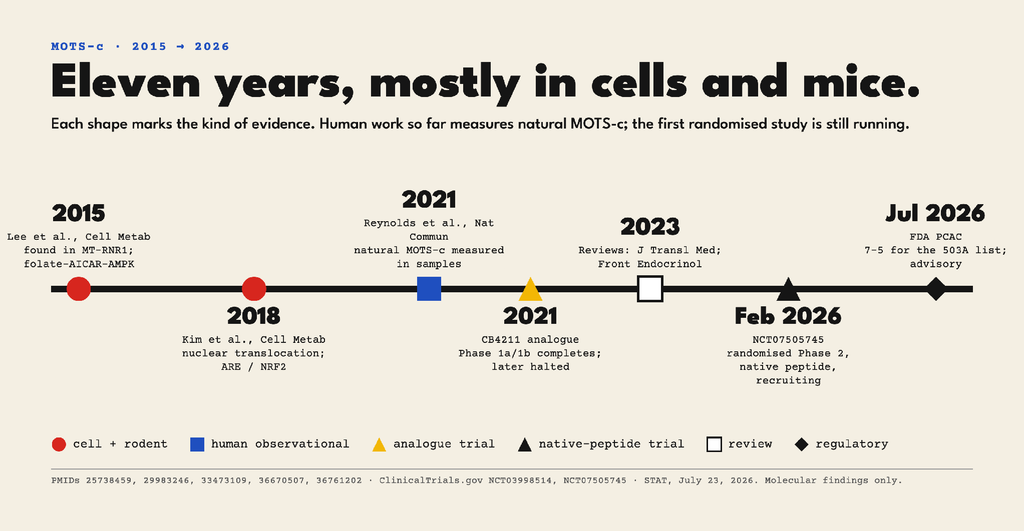
Timeline of MOTS-c research from 2015 to 2026, marking cell, animal, human observational, analogue and regulatory milestones
MOTS-c vs NAD+: What’s the Difference?
Quick answer: MOTS-c is a 16-residue peptide encoded in mitochondrial DNA. NAD+ is a dinucleotide coenzyme, not a peptide. It carries electrons in redox reactions and serves as a substrate for sirtuins and PARPs. The two are different classes of molecule studied at different levels of mitochondrial biology.
| MOTS-c | NAD+ | |
| What it is | 16-residue peptide, encoded in MT-RNR1 | Dinucleotide coenzyme (nicotinamide adenine dinucleotide) |
| Where it acts in assays | Folate cycle, AMPK, nuclear gene expression | Redox reactions, sirtuin and PARP enzymes |
| Peptide? | Yes | No |
They’re measured differently too. MOTS-c is quantified by immunoassay or LC-MS of the intact peptide, while NAD+ is usually read with an enzymatic cycling assay or LC-MS alongside NADH, since the ratio between the two is often the number that counts.
The NAD+ research overview covers the coenzyme in depth. SS-31 is a mitochondria-targeted peptide that binds cardiolipin in the inner membrane, and the SS-31 research overview profiles it alone. MOTS-c and SS-31 compared sets the two side by side.
Is MOTS-c FDA Approved? US Regulatory Status (2026)
Quick answer: No. MOTS-c isn’t approved by the FDA for any use, and no approved drug contains it. On July 23, 2026, an FDA advisory committee voted 7-5 to recommend it for the 503A bulks list. The vote is advisory, and research-grade MOTS-c is sold as a laboratory reagent.
| Question | Status (as of October 2026) |
| FDA-approved? | No; no approved drug contains MOTS-c |
| PCAC, July 23, 2026 | Recommended for the 503A bulks list, 7-5 |
| FDA staff view | Both forms judged not well characterised; staff advised against listing |
| Final FDA action | None; any listing still needs rulemaking |
| Research sale | Research Use Only |
The FDA briefing document on MOTS-c found no USP monograph for either form and lists the free base under UNII A5CV6JFB78. As with all seven peptides on the July 2026 agenda, the committee voted on the free base and the acetate as separate substances, and the agency judged both not well characterised. STAT’s report on the July 23 vote put MOTS-c alongside BPC-157, KPV and TB-500 on the first day. US peptide regulation in 2026 places that vote in context. For the supply side there is the US research-supply picture, and for the label wording, the research-use-only label.
Is MOTS-c on the WADA Prohibited List?
Yes. WADA’s Prohibited List names MOTS-c, alongside AICAR, as an example under S4.4.1, activators of AMP-activated protein kinase (AMPK). That class belongs to S4 metabolic modulators and is prohibited at all times.
Storage of the Sealed Vial
MOTS-c ships as a lyophilized (freeze-dried) solid in a sealed vial labelled with its lot number. Store sealed vials cold, dry and dark, as stated on the label. Its two methionines oxidise with air and moisture over time, so keeping the vial sealed until it’s needed also protects the mass result on any later LC-MS check. Record the lot and report number (LK-MOTS-10-021126 or LK-MOTS-40-021126 for the current batches) beside each experiment. Temperature ranges are in the storage and handling guide.
How to Verify Research-Grade MOTS-c
Quick answer: Check the batch-specific COA for HPLC purity and for an LC-MS mass that matches MOTS-c: average MW 2174.6, with multiply charged ions such as [M+3H]3+ near m/z 725.9 and [M+4H]4+ near m/z 544.7. Then match the lot number on the vial to the certificate.
Those multiply charged ions are normal for MOTS-c. Its five basic sites pick up several protons under electrospray, so the intact mass shows up as a ladder of peaks between about m/z 540 and 1,090.
- Lot number: printed on the vial and on the certificate
- HPLC purity and method: see the batch result
- LC-MS mass: [M+3H]3+ near 725.9, [M+4H]4+ near 544.7, and no +16 Da oxidation peaks
- Testing lab and report number: Testides, verifiable on the lab’s site
- Test date: the same date as the lab’s record for that report
- Storage guidance: stated for the sealed vial
The current Cellugenix certificates, LK-MOTS-10-021126 and LK-MOTS-40-021126, come from Testides, tested February 23, 2026. They report HPLC-UV purity and content and don’t yet include an LC-MS mass. See the MOTS-c 10 mg certificate and the MOTS-c 40 mg certificate. Our guides on how to read a COA and HPLC vs mass spectrometry explain each line.
Frequently Asked Questions
What is MOTS-c?
MOTS-c is a 16-residue mitochondrial-derived peptide, MRWQEMGYIFYPRKLR, encoded by a short open reading frame in the mitochondrial 12S rRNA gene. Lee and colleagues described it in 2015. Labs study it in folate-cycle, AMPK and nuclear-translocation assays, mostly in cultured cells and rodents. Research-grade MOTS-c is a laboratory reagent.
What does MOTS-c stand for?
MOTS-c stands for Mitochondrial Open reading frame of the Twelve S rRNA, type c. “Twelve S” refers to the 12S ribosomal RNA gene, MT-RNR1, in mitochondrial DNA. The “c” marks it as one of several candidate open reading frames the discovering team identified inside that gene.
What is the molecular weight of MOTS-c?
The free base, C101H152N28O22S2, has an average molecular weight of 2174.6 g/mol and a monoisotopic mass of 2173.11 Da. On LC-MS it usually appears as multiply charged ions: [M+3H]3+ near m/z 725.9 and [M+4H]4+ near m/z 544.7. The mono-acetate weighs about 2234.6 g/mol.
What is the CAS number of MOTS-c?
MOTS-c is registered under CAS 1627580-64-6. The FDA lists the free base under UNII A5CV6JFB78, and PubChem gives it CID 146675088. The acetate salt has no separate UNII and is usually sold under the free base’s CAS number, so the COA’s formula weight shows which form a vial holds.
What is the sequence of MOTS-c?
MOTS-c reads MRWQEMGYIFYPRKLR in one-letter code, or Met-Arg-Trp-Gln-Glu-Met-Gly-Tyr-Ile-Phe-Tyr-Pro-Arg-Lys-Leu-Arg. Those 16 residues are encoded by a 51-nucleotide frame in the mitochondrial 12S rRNA gene, MT-RNR1. The chain is linear, with two methionines that can oxidise during handling.
Is MOTS-c produced naturally?
Yes. MOTS-c is encoded in mitochondrial DNA, and immunoassays have detected endogenous MOTS-c in human and rodent plasma and in tissue samples. Research-grade MOTS-c is a synthetic copy of that 16-residue sequence, made by solid-phase peptide synthesis for laboratory use as a reagent and reference standard.
The Bottom Line
MOTS-c is a 16-residue mitochondrial-derived peptide studied mainly in cell and rodent work on AMPK and folate-cycle signalling, plus its move into the nucleus under stress. It isn’t FDA-approved, and Cellugenix supplies it for laboratory research only. Compare the MOTS-c 10 mg and 40 mg specifications and COAs before ordering.
For laboratory research use only. Not for human or animal use.
References
- Lee C, Zeng J, Drew BG, et al. Cell Metabolism, 2015; 21(3): 443-454. doi:10.1016/j.cmet.2015.02.009. PMID 25738459.
- Kim KH, Son JM, Benayoun BA, Lee C. Cell Metabolism, 2018; 28(3): 516-524. doi:10.1016/j.cmet.2018.06.008. PMID 29983246.
- Reynolds JC, Lai RW, Woodhead JST, et al. Nature Communications, 2021; 12: 470. doi:10.1038/s41467-020-20790-0. PMID 33473109.
- Wan W, et al. Journal of Translational Medicine, 2023. PMID 36670507.
- Zheng Y, Wei Z, Wang T. Frontiers in Endocrinology, 2023. PMID 36761202 (PMC9905433).
- FDA. Briefing Document, MOTS-c-Related Bulk Drug Substances, Pharmacy Compounding Advisory Committee, July 23-24, 2026.
- ClinicalTrials.gov records NCT07505745 and NCT03998514.
- WADA. Prohibited List, S4.4.1.
- PubChem. MOTS-c, CID 146675088.
Related research guides
For laboratory research use only. Not for human or animal use.