Tesamorelin vs CJC-1295 (without DAC): Structure, Identity and Lab Use Compared
Tesamorelin and CJC-1295 without DAC start from the same 44-residue hormone and then go in opposite directions. One keeps the whole chain and caps its front end. The other trims to the first 29 residues and rewrites four of them. Here’s how the two compare as molecules, assay tools, and certificates. CJC-1295 without DAC 5 mg is listed in our catalogue as a research-use vial.
Quick answer: Tesamorelin vs CJC-1295 (without DAC)
Both are synthetic analogues of growth hormone-releasing hormone (GHRH) that bind the GHRH receptor. Tesamorelin is the full GHRH(1-44) sequence with a trans-3-hexenoyl cap on tyrosine 1 (MW 5,135.8). CJC-1295 without DAC, also called Modified GRF (1-29), is the 29-residue fragment with four substitutions (MW 3,367.9).
✓ Same receptor, different lengths
✓ “Without DAC” means no albumin-binding linker
✓ Purity is measured by HPLC; see each batch result
Tesamorelin vs CJC-1295 (without DAC) at a Glance
The table puts both peptides side by side. Tesamorelin’s identifiers come from FDA’s Global Substance Registration System (GSRS) and KEGG D06655. CJC-1295’s masses are calculated from its published sequence.
| Field | Tesamorelin | CJC-1295 (without DAC) |
| Other names | TH9507, (3E)-hex-3-enoyl-somatoliberin (human) | Modified GRF (1-29), Mod GRF 1-29 |
| Parent sequence | Human GHRH(1-44) | Human GHRH(1-29) |
| Length | 44 residues, C-terminal amide | 29 residues, C-terminal amide |
| Modifications | trans-3-hexenoyl group on Tyr1 | D-Ala2, Gln8, Ala15, Leu27 |
| Formula | C221H366N72O67S | C152H252N44O42 |
| Average MW | 5,135.8 g/mol | 3,367.9 g/mol |
| CAS | 218949-48-5 (acetate: 901758-09-6) | No CAS of its own (446262-90-4 is the DAC version) |
| Receptor | GHRH receptor (GHRHR) | GHRH receptor (GHRHR) |
| Methionine at 27 | Yes (Met27) | No (Leu27) |
| Regulatory status | Active ingredient of an FDA-approved prescription drug | No FDA-approved product |
| Cellugenix lots | 5 mg: CPT-TESAMO-C75B8F; 10 mg: CP-TESA-10-122925 | Standalone certificate publishing soon |
The CAS row trips up a lot of catalogues. In FDA’s registry, the name “CJC-1295” (UNII 62RC32V9N7, CAS 446262-90-4) belongs to the version with DAC. The no-DAC peptide has no CAS of its own, so a listing that pairs “CJC-1295 no DAC” with 446262-90-4 is quoting the wrong molecule.
The Common Starting Point: GHRH(1-44) and Its 1-29 Fragment
Native human GHRH is a 44-residue peptide with an amidated C-terminus. Its sequence, YADAIFTNSYRKVLGQLSARKLLQDIMSRQQGESNQERGARARL-NH2, is listed in UniProt entry P01286. Both research peptides are built on it, so knowing its weak points explains every design choice that follows.
Both also keep the C-terminal amide. In the precursor listed by UniProt, leucine 44 is followed by a glycine that cells convert into that amide, so synthetic versions build the amide in directly. A free C-terminal acid is a separate molecule, about 1 Da heavier, and it’s a known synthesis variant to check for on a certificate.
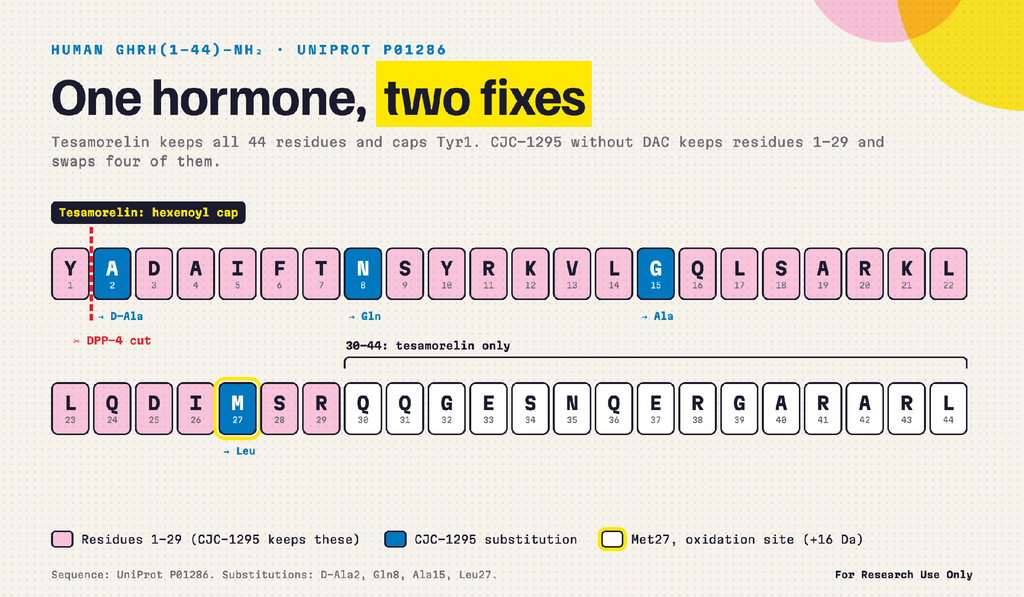
GHRH(1-44) shown as a 44-segment bar with residues 1-29 shaded, the Tyr1-Ala2 enzyme cut marked, and Met27 flagged
Why Residues 1-29 Carry the Activity
Structure-activity work in the 1980s showed that the first 29 residues, amidated at the C-terminus, keep full receptor activity in cell assays. That fragment, GHRH(1-29)-NH2, is sermorelin, and it’s the template CJC-1295 without DAC was built from. Residues 30 to 44 add length and mass while leaving receptor binding intact.
The DPP-4 Cleavage Site
Dipeptidyl peptidase-4 (DPP-4) clips two residues off any peptide whose second position is alanine or proline. Native GHRH starts Tyr-Ala, so it’s a textbook target. In plasma incubated in vitro, Frohman and colleagues (1986) found GHRH was cut to an inactive 3-44 product.
Two other weak points show up in in-vitro stability work:
- Met27: methionine oxidizes to its sulfoxide, adding 16 Da.
- Asn8: asparagine next to serine can deamidate or rearrange to iso-aspartate.
Each analogue tackles these sites differently, and that difference drives the whole comparison.
What Is Tesamorelin?
Tesamorelin is human GHRH(1-44)-NH2 with a trans-3-hexenoyl group attached to the amine of tyrosine 1. The cap blocks DPP-4, which needs a free N-terminal amine to bind, while all 44 native residues stay in place. It was developed under the code name TH9507.
Sequence and the Hexenoyl Cap
The full sequence reads:
(trans-3-hexenoyl)-YADAIFTNSYRKVLGQLSARKLLQDIMSRQQGESNQERGARARL-NH2
The hexenoyl group is six carbons with a trans double bond between carbons 3 and 4, adding 96 Da. Because the native chain is untouched, tesamorelin keeps Met27 and Asn8. Ferdinandi and colleagues (2007) reported its non-clinical pharmacology, including in vitro stability work. For the lab, Met27 is the residue to watch, since its sulfoxide is the most common oxidation impurity.
The N-terminal cap also changes how the peptide behaves on a column. Six extra carbons make the front end more hydrophobic, so tesamorelin and uncapped GHRH(1-44) separate cleanly by reversed-phase HPLC, even though the rest of the chain is identical.
Tesamorelin Identifiers
| Identifier | Tesamorelin | Tesamorelin acetate |
| Formula | C221H366N72O67S | C221H366N72O67S · (C2H4O2)x |
| Average MW / exact mass | 5,135.78 / 5,132.7166 Da | Varies with acetate content |
| CAS | 218949-48-5 | 901758-09-6 |
| FDA UNII | MQG94M5EEO | LGW5H38VE3 |
| PubChem CID | 91886675 | 44147413 |
| KEGG | D06655 | D09015 |
The salt form changes what a milligram contains. Acetate counter-ions and residual water add weight, so a vial of tesamorelin acetate holds less peptide than its label mass suggests. Certificates that report content in milligrams, and not only HPLC purity, close that divide.
What Is CJC-1295 Without DAC (Modified GRF 1-29)?
CJC-1295 without DAC is GHRH(1-29)-NH2 with four amino acids swapped to resist enzymes and oxidation: YaDAIFTQSYRKVLAQLSARKLLQDILSR-NH2, where the lowercase “a” marks D-alanine. It’s 29 residues, 3,367.9 g/mol, and it carries no linker or albumin-binding group.
The Four Substitutions
| Position | Native residue | CJC-1295 residue | Chemistry reason |
| 2 | L-Ala | D-Ala | DPP-4 can’t cleave after a D-amino acid |
| 8 | Asn | Gln | Removes the Asn-Ser deamidation site |
| 15 | Gly | Ala | Adds helix-forming character in the middle of the chain |
| 27 | Met | Leu | Removes the oxidizable sulfur, at almost the same size |
The substitutions also change the mass. Gln8 adds 14 Da, Ala15 adds 14 Da, and Leu27 takes away 18 Da, so the analogue lands 10 Da heavier than native GHRH(1-29)-NH2. D-Ala2 has exactly the same mass as L-Ala2.
CJC-1295, Mod GRF 1-29 and Sermorelin: Sorting Out the Names
Three names cover three different molecules:
- Sermorelin: native GHRH(1-29)-NH2, 3,357.9 g/mol.
- Modified GRF (1-29) / CJC-1295 without DAC: the four-substitution analogue, 3,367.9 g/mol.
- CJC-1295 (with DAC): the same analogue plus a modified lysine, 3,647.2 g/mol.
A 10 Da gap separates the first two. That’s small enough that a certificate needs a real mass result, read to one decimal place, to show which peptide is in the vial.
CJC-1295 With DAC vs Without DAC: What the “DAC” Is
DAC stands for Drug Affinity Complex. In the “with DAC” version, a lysine is added at position 30, and its side-chain amine carries a maleimidopropionyl group. Without DAC, the peptide stops at residue 29 with no linker.
The maleimide is the reactive part. It forms a covalent bond with the free thiol on cysteine-34 of serum albumin. Jetté and colleagues (2005) described this conjugation chemistry for the GRF(1-29) analogue that became CJC-1295.
| Feature | Without DAC | With DAC |
| Length | 29 residues | 30 residues (Lys30 added) |
| C-terminal group | Arg29-NH2 | Lys30(ε-maleimidopropionyl)-NH2 |
| Formula | C152H252N44O42 | C165H269N47O46 |
| Average MW | 3,367.9 g/mol | 3,647.2 g/mol |
| Albumin reactivity | None | Maleimide binds albumin Cys34 |
The mass difference is about 279 Da, which a mass result separates at a glance. One practical point: an unreacted maleimide can also bind other thiols, including buffer components such as DTT or mercaptoethanol. That makes the DAC version a different reagent to handle in an assay.
On a product listing, the molecular weight settles it. A stated 3,367.9 points to the no-DAC peptide, and 3,647.2 points to the DAC version. A listing with no mass, or one that pairs “no DAC” with CAS 446262-90-4, needs a question to the supplier before ordering.
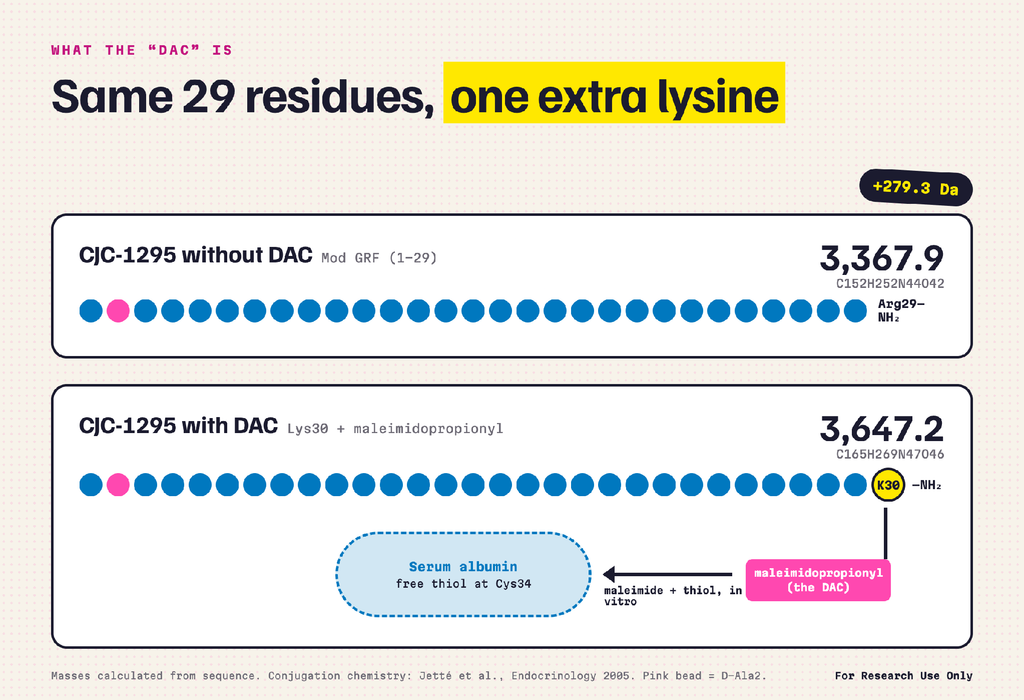
Two peptide chains side by side: CJC-1295 without DAC ending at Arg29, and the DAC version with Lys30 carrying a maleimidopropionyl group that reacts with albumin Cys34, with masses labelled
Two Ways to Resist Enzymes: Tesamorelin vs CJC-1295 Side by Side
Both peptides solve the same problem, the DPP-4 cut at Tyr1-Ala2, by different routes. Tesamorelin keeps the native residues and caps the N-terminal amine. CJC-1295 without DAC leaves the amine free and swaps in D-alanine at position 2, then edits three more sites the native sequence leaves exposed.
Sequence Alignment
The five positions that differ are 1, 2, 8, 15, and 27. Residues 30 to 44 appear only in tesamorelin.
| Position | Native GHRH | Tesamorelin | CJC-1295 (no DAC) |
| 1 (N-terminus) | Tyr, free amine | Tyr, hexenoyl-capped | Tyr, free amine |
| 2 | L-Ala | L-Ala | D-Ala |
| 8 | Asn | Asn | Gln |
| 15 | Gly | Gly | Ala |
| 27 | Met | Met | Leu |
| 30-44 | Present | Present | Absent |
What the Differences Mean for Study Design
Each difference changes what an experiment can test or control:
- Full length vs fragment: tesamorelin suits work that needs the complete 1-44 chain. CJC-1295 without DAC suits work centred on the 1-29 binding region, at about two-thirds the mass.
- Cap vs D-Ala2: both resist DPP-4 in vitro. Including native GHRH(1-29)-NH2 as a cleavable reference shows the difference in a serum-stability run.
- Met27: tesamorelin can form a +16 Da sulfoxide, while Leu27 can’t. Oxidation needs tracking in tesamorelin stocks and not in CJC-1295.
- Compare by moles: tesamorelin weighs about 1.5 times as much per mole. One milligram is about 0.195 µmol of tesamorelin and 0.297 µmol of CJC-1295 without DAC, so concentration-response curves compare fairly only on a molar basis.
- Synthesis impurities: tesamorelin’s longer chain gives more room for deletion sequences, and a missing hexenoyl step leaves uncapped GHRH(1-44). CJC-1295’s D-Ala2 can show up as an L-Ala2 diastereomer if the wrong building block slips in.
How Tesamorelin and CJC-1295 Are Used in the Lab
In the lab, both peptides serve as GHRH-receptor agonists in binding and second-messenger assays, as test articles in serum-stability studies, and as analytical reference standards. The table lists the four main assay types and what each one reads out.
| Assay | What it measures | Typical setup |
| Competitive receptor binding | Displacement of a labelled GHRH ligand | Membranes from cells expressing GHRHR |
| cAMP accumulation | Second-messenger signal after receptor activation | HEK293 or CHO cells expressing GHRHR |
| Serum or plasma stability | Intact peptide remaining over time, in vitro | Incubation followed by LC-MS or HPLC |
| Analytical reference | Retention time, mass and purity | HPLC-UV and LC-MS method development |
Good runs carry the right controls. Native GHRH(1-29)-NH2 or GHRH(1-44)-NH2 serves as the reference agonist. Parental cells without the receptor act as the negative control, and forskolin confirms the cAMP readout works. In stability studies, a DPP-4 inhibitor separates enzyme-driven loss from other breakdown.
Results from one analogue don’t transfer automatically to the other. The extra 15 residues, the cap, and the four substitutions can each change binding and stability values, so labs comparing the two run them side by side in the same assay, at matched molar concentrations.
Some research designs pair a GHRH analogue with a ghrelin-receptor agonist to compare two receptor classes. Our CJC-1295 vs ipamorelin comparison covers that receptor difference.
Analytical Differences: What Each COA Should Show
The two certificates should confirm different things. For tesamorelin, the key question is whether the cap is present and Met27 is intact. For CJC-1295 without DAC, it’s which of three similar molecules is in the vial.
Tesamorelin COA Checks
- Mass: about 5,135.8 average (exact 5,132.72). That mass confirms the hexenoyl cap, since uncapped GHRH(1-44) is 96 Da lighter.
- Oxidation: look for a +16 Da Met-sulfoxide peak, usually eluting just before the main peak.
- Salt form: free base or acetate, with the matching CAS.
CJC-1295 (without DAC) COA Checks
- Mass: about 3,367.9. That rules out the DAC version (3,647.2) and sermorelin (3,357.9).
- Chirality: D-Ala2 and L-Ala2 have the same mass, so only a validated or chiral HPLC method shows the right isomer.
- Content: like tesamorelin, it’s usually supplied as a salt, so check the measured milligrams alongside the purity figure.
Current Cellugenix Lots
- Tesamorelin 5 mg: report CPT-TESAMO-C75B8F, tested September 28, 2026. Purity by HPLC: see the batch result.
- Tesamorelin 10 mg: report CP-TESA-10-122925, tested January 6, 2026. Purity by HPLC: see the batch result.
- CJC-1295 (without DAC): a standalone certificate is being published soon.
On the chromatogram, look past the headline percentage. The Canada Peptide Testing report reads its trace at 214 nm, where every peptide bond absorbs. Deletion sequences missing one residue tend to elute right beside the main peak, so a clean, symmetrical peak with a flat baseline is a better sign than a high number alone.
Both tesamorelin reports are HPLC-UV purity and content tests. Neither includes a mass-spectrometry result. Our guide on how to read a COA covers each field.
Regulatory Status of Tesamorelin and CJC-1295 (October 2026)
The two peptides have different regulatory histories. Tesamorelin acetate is the active ingredient of an FDA-approved prescription drug, listed in Drugs@FDA under application 022505. Cellugenix’s research-grade tesamorelin is not that drug product. CJC-1295 has no FDA-approved product. FDA’s compounding safety-risk page lists it among substances previously in Category 2 whose nominations were withdrawn.
| Item | Tesamorelin | CJC-1295 | Source |
| FDA approval | Active ingredient of an approved prescription drug | No approved product | Drugs@FDA |
| 503A interim categories | Not listed | Formerly Category 2; nomination withdrawn; not on current lists | FDA category list, updated May 14, 2026 |
| WADA 2026 Prohibited List | Named under S2.2.4 | Named under S2.2.4 | WADA Prohibited List |
| Cellugenix supply | Research use only | Research use only | Cellugenix |
The Category 2 history needs one clarification. Category 2 was FDA’s interim group for nominated compounding substances that raised significant safety concerns. When the nominators withdrew CJC-1295, it left that group, and FDA’s May 14, 2026 list places it in no category at all. Leaving Category 2 this way ends the nomination and leaves the substance outside FDA’s interim lists, which is a different status from being cleared.
The WADA listing is a separate system. The 2026 Prohibited List names GHRH and its analogues, with CJC-1295 and tesamorelin as examples, under S2.2.4, which applies in and out of competition. It governs competitive sport and has no bearing on laboratory supply.
Storage of the Sealed Vial
Both peptides ship as lyophilized (freeze-dried) solids in sealed vials. Store sealed vials as stated on the label, protected from light and moisture, as storing lyophilized vials describes. Each vial is labelled with its lot number, which ties it to its certificate.
Tesamorelin keeps Met27, which oxidizes on contact with air and light. Keeping its vial sealed until the day of use limits sulfoxide formation.
FAQ
What is the difference between tesamorelin and CJC-1295?
Tesamorelin is the full 44-residue GHRH sequence with a trans-3-hexenoyl cap on tyrosine 1, weighing 5,135.8 g/mol. CJC-1295 without DAC is the 29-residue fragment with four substitutions (D-Ala2, Gln8, Ala15, Leu27), weighing 3,367.9 g/mol. Both bind the GHRH receptor, and each resists the DPP-4 enzyme in a different way.
What does “without DAC” mean?
“Without DAC” means the peptide has no Drug Affinity Complex. It ends at arginine 29 with a C-terminal amide and carries no added lysine or maleimidopropionyl linker. Researchers also call it Modified GRF (1-29) or Mod GRF 1-29. Its average molecular weight is 3,367.9 g/mol.
What is the difference between CJC-1295 with DAC and without DAC?
The DAC version adds a lysine at position 30 carrying a maleimidopropionyl group, which forms a covalent bond with cysteine-34 of albumin. That adds about 279 Da, taking the mass from 3,367.9 to 3,647.2 g/mol. In FDA’s substance registry, the name CJC-1295 and CAS 446262-90-4 refer to the DAC version.
What are the molecular weights of tesamorelin and CJC-1295?
Tesamorelin (C221H366N72O67S) has an average molecular weight of 5,135.8 g/mol and an exact mass of 5,132.72 Da. CJC-1295 without DAC (C152H252N44O42) weighs 3,367.9 g/mol. CJC-1295 with DAC (C165H269N47O46) weighs 3,647.2 g/mol. Acetate salts weigh more, depending on their acetate content.
Is tesamorelin FDA-approved?
Tesamorelin acetate is the active ingredient of an FDA-approved prescription drug, listed in Drugs@FDA under application 022505. Research-grade tesamorelin sold by peptide suppliers is a separate material, supplied for laboratory use only, and is not that approved drug product. CJC-1295 has no FDA-approved product.
Is CJC-1295 the same as Mod GRF 1-29?
CJC-1295 without DAC and Modified GRF (1-29) are the same peptide: GHRH(1-29)-NH2 with D-Ala2, Gln8, Ala15 and Leu27. CJC-1295 with DAC is a different molecule with an extra lysine and linker. Sermorelin is a third molecule, the native 1-29 sequence, 10 Da lighter at 3,357.9 g/mol.
The Bottom Line
Tesamorelin and CJC-1295 without DAC protect the same weak spot in GHRH by opposite routes: a cap on the full chain versus substitutions in a shorter fragment. The certificate settles which one you have, so check the mass, the salt form and the batch result. New to reagent peptides? Start with our overview of what research peptides are.
For laboratory research use only. Not for human or animal use. Products are supplied to qualified purchasers under our Terms of Service.
References
- UniProt. GHRH (human), entry P01286.
- FDA. Global Substance Registration System: tesamorelin (UNII MQG94M5EEO), tesamorelin acetate (UNII LGW5H38VE3), CJC-1295 (UNII 62RC32V9N7).
- KEGG DRUG. Tesamorelin, D06655; tesamorelin acetate, D09015.
- Frohman LA, Downs TR, Williams TC, et al. Journal of Clinical Investigation, 1986; 78(4): 906-913. PMID 3093533.
- Ferdinandi ES, Brazeau P, High K, et al. Basic & Clinical Pharmacology & Toxicology, 2007; 100(1): 49-58. PMID 17214611.
- Jetté L, Léger R, Thibaudeau K, et al. Endocrinology, 2005; 146(7): 3052-3058. PMID 15817669.
- FDA. Drugs@FDA, application 022505, searched October 13, 2026.
- FDA. Bulk Drug Substances Nominated for Use in Compounding Under Section 503A, updated May 14, 2026.
- FDA. Certain bulk drug substances for use in compounding that may present significant safety risks, accessed October 13, 2026.
- WADA. 2026 Prohibited List, section S2.2.4.
- Canada Peptide Testing. Report CPT-TESAMO-C75B8F.
- Testides. Report CP-TESA-10-122925.
Related research guides
For laboratory research use only. Not for human or animal use.