KPV vs TB-500: Key Differences in Structure, Targets, and Testing
KPV vs TB-500 comes up constantly, yet the two have almost nothing in common at the molecular level. KPV is a chain of just three amino acids (lysine, proline, valine) clipped from the tail of α-MSH, a melanocortin hormone. TB-500 is a capped seven-residue chain copied from the part of thymosin beta-4 that latches onto actin.
On a mass spectrum, the two main peaks are more than 500 Da apart. Their parent molecules differ, their targets differ, and the assays labs use for each barely overlap. Both are sold as research peptides, each with its own batch certificate of analysis (COA), which is where most mix-ups get caught. This guide covers the sequences, targets, published study types, the 2026 US status, and how to read each compound’s COA.
What is the difference between KPV and TB-500? KPV is the tripeptide Lys-Pro-Val (342.4 g/mol), cut from the C-terminus of α-MSH, studied in melanocortin-receptor and NF-κB cell assays. TB-500 is the acetylated heptapeptide Ac-LKKTETQ (889.0 g/mol), the actin-binding fragment of thymosin beta-4, examined in actin-binding and cell-migration assays. They share no sequence.
Key facts: 3 vs 7 residues · 342 vs 889 Da · α-MSH vs thymosin beta-4 · both RUO with a batch COA
For laboratory research use only. Not for human or animal use. Legal notice
On this page
- KPV vs TB-500 (TB500): Key Differences at a Glance
- What Is KPV?
- What Is TB-500?
- Is TB-500 the Same as TB4 (Thymosin Beta-4)?
- How KPV and TB-500 Differ: 4 Lab-Relevant Differences
- KPV or TB-500: Which Fits Which Assay?
- KPV vs BPC-157 vs TB-500: Three-Way Comparison
- Why Do KPV and TB-500 Appear in the Same Blend?
- How to Tell KPV and TB-500 Apart on a COA
- Are KPV and TB-500 FDA-Approved? US Status in 2026
- Frequently Asked Questions
- The Bottom Line
KPV vs TB-500 (TB500): Key Differences at a Glance
Five differences count in the lab: parent molecule, size, target, assay type, and how each shows on a COA. KPV is a 342 Da melanocortin fragment, read out in NF-κB and cytokine-release assays. TB-500 is an 889 Da β-thymosin fragment, read out in actin and migration assays. The table lines up with every figure.
KPV vs TB500 Comparison
| KPV | TB-500 | |
| Sequence | Lys-Pro-Val | Ac-LKKTETQ |
| Residues | 3 | 7, N-terminal acetyl |
| Formula | C16H30N4O4 | C38H68N10O14 |
| Molecular weight | 342.4 g/mol | 889.0 g/mol |
| PubChem CID | 125672 | 62707662 |
| Parent | α-MSH (residues 11-13) | Thymosin beta-4 (residues 17-23) |
| Family | Melanocortin | β-thymosin |
| Targets studied | MC1R/MC3R (proposed); NF-κB; PepT1 uptake | G-actin binding; actin dynamics |
| Assays | NF-κB reporter, cytokine release, transporter uptake | Actin binding, actin polymerization, transwell and scratch migration |
| Evidence base | In vitro + animal | In vitro + ex vivo (fragment); most animal work uses full Tβ4 |
| Main MS ion | [M+H]+ ≈ 343.2 | [M+H]+ ≈ 889.5; [M+2H]2+ ≈ 445.3 |
| Product | KPV 10 mg | TB-500 5 mg |
Size is the quickest tell. TB-500 is about 2.6 times heavier than KPV, so even a basic MS readout separates them in one run.
The evidence rows look similar at a glance, but they hide one real difference. KPV papers test KPV itself. Much of the TB-500 literature tests the full 43-residue thymosin beta-4 protein, with the seven-residue motif appearing mainly in mapping studies.
What Is KPV?
KPV is a lab-made three-residue peptide, Lys-Pro-Val, identical to positions 11 to 13 of α-melanocyte-stimulating hormone (α-MSH). Its formula, C16H30N4O4, gives a weight of 342.4 g/mol (PubChem CID 125672). Researchers use it to test what the hormone’s last three residues can do in cultured cells on their own.
KPV peptide: origin and structure
The 13 residues of α-MSH are cut from POMC (pro-opiomelanocortin), the same precursor that yields ACTH. Its chain ends in Gly-Lys-Pro-Val, and in the native hormone, that final valine carries an amide (Val-NH2).
That detail is easy to miss. The free-acid KPV listed in PubChem weighs 342.4 g/mol, while the amidated form (KPV-NH2) weighs about 341.4 g/mol. One dalton apart sounds trivial, yet it decides which molecule a paper actually tested, so check the form a study used before comparing results.
What KPV binds in lab assays
Two routes appear in the literature, and the evidence leans toward the second.
- Melanocortin receptors (proposed): Because KPV comes from α-MSH, early work asked whether it acts through MC1R or MC3R. In RAW 264.7 macrophage-like cells, Mandrika et al. (2001, in vitro) found that α-MSH(11-13) blocked NF-κB from entering the nucleus without raising cAMP, the usual sign of MC1R activation. A mouse study by Getting, Schiöth and Perretti (2003, animal) found KPV’s effect continued in the presence of the MC3/4 receptor blocker SHU9119.
- PepT1 uptake, then NF-κB: Didier Merlin’s group (Dalmasso et al., 2008, in vitro + mouse) showed that PepT1, a membrane carrier for di- and tripeptides, moves KPV inside. Once there, nanomolar KPV lowered NF-κB and MAP kinase activation in the cultured cell lines tested.
Typical readouts are NF-κB luciferase reporters, nuclear-translocation imaging, and cytokine release measured by ELISA. Uptake work often adds Gly-Sar, a classic PepT1 substrate, as a competitor.
Evidence base
Published KPV peptide research is mostly cell-line and rodent work. No approved product contains it, and FDA’s April 2026 compounding page states the agency found no human exposure data for KPV.
What Is TB-500?
TB-500 is the synthetic heptapeptide Ac-LKKTETQ: residues 17 to 23 of thymosin beta-4 (Tβ4), plus an acetyl cap on its N-terminus. Its formula, C38H68N10O14, works out to 889.0 g/mol (PubChem CID 62707662). Labs use it to study the part of Tβ4 that grabs actin, the protein cells build their internal scaffolding from.
TB-500 peptide: origin and structure
Thymosin beta-4 is a 43-amino-acid protein that nearly all cell types make (UniProt P62328). Its gene codes 44 residues, the starting methionine is removed, and the next serine is acetylated. Here’s where the fragment comes from:
Ac-SDKPDMAEIEKFDKSK LKKTETQ EKNPLPSKETIEQEKQAGES
The first four residues form Ac-SDKP, a separate peptide in its own right. Residues 17 to 23 form the LKKTETQ motif, and the TB-500 5 mg research peptide Cellugenix supplies is that motif with an acetyl cap added. Inside the native protein, those seven residues carry no cap, so the N-terminal acetyl on TB-500 is a defined part of the synthetic molecule, adding exactly 42 Da on a mass spectrum.
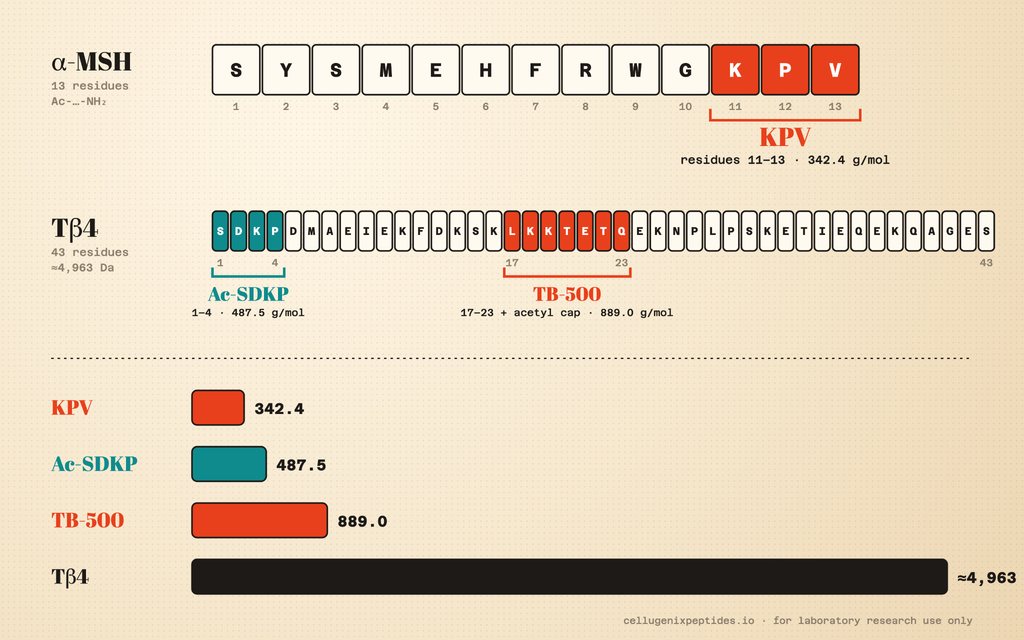
KPV inside the 13-residue alpha-MSH chain, and TB-500 and Ac-SDKP inside the 43-residue thymosin beta-4 chain, with molecular weights drawn to scale.
What TB-500 binds in lab assays
Tβ4 pairs with free actin monomers (G-actin) in a 1:1 complex and keeps them from joining filaments. Allan Goldstein, who co-discovered the thymosins at George Washington University, co-authored the 1992 study that showed this inside cells. After loading Tβ4 directly into single epithelial cells and fibroblasts, the team wrote: “Our results show that beta 4 is a potent regulator of actin assembly in living cells” (Sanders, Goldstein and Wang, PNAS 1992, in vitro).
Two later studies pinned that activity to the TB-500 stretch:
- Binding map: Van Troys et al. (1996, cell-free biochemistry) used cross-linking and actin-sequestering experiments to show that the N-terminal helix and the LKKTET motif (residues 17 to 22) form the two main contact points with actin, with lysine 18 a key electrostatic contact.
- Migration assays: Hynda Kleinman’s NIH group (Philp et al., 2003, in vitro + ex vivo) found that a synthetic peptide carrying the seven-residue motif matched full Tβ4 at about 50 nM in endothelial-cell migration and explant sprouting assays. Peptides missing part of the motif showed no activity.
Common readouts include DNase I inhibition, pyrene-labelled actin polymerization, transwell (Boyden chamber) migration, and scratch assays.
Evidence base
Published TB-500 peptide research on the fragment itself is in vitro and ex vivo, while most animal studies have used full-length Tβ4. Human trials have also tested the full protein, and FDA’s April 2026 page says it found no human exposure data for the Tβ4 fragment.
Is TB-500 the Same as TB4 (Thymosin Beta-4)?
No. TB4 is the 43-residue protein (about 4,963 Da); TB-500 is usually the 7-residue fragment. The trouble is that “TB-500” has no standardized definition, and some suppliers use the label for full-length Tβ4. The measured mass on the COA is the detail that settles what a vial actually contains.
| Tβ4 (TB4) | TB-500 | Ac-SDKP | |
| Residues | 43 (1-43) | 7 (17-23) | 4 (1-4) |
| Sequence | Ac-SDKPDMAEIEKFDKSKLKKTETQEKNPLPSKETIEQEKQAGES | Ac-LKKTETQ | Ac-SDKP |
| Mass | ≈4,963 Da | 889.0 g/mol | 487.5 g/mol |
| Studied for | Actin sequestering, migration | Actin binding, migration | Separate peptide studied in its own assays |
The Tβ4 mass is calculated from the UniProt sequence for the acetylated 43-residue chain, and the Ac-SDKP figure comes from PubChem CID 65938.
Comparisons phrased as “KPV vs TB4” really set a 3-residue fragment against a protein about 14 times its mass. The shared name causes a second mix-up: thymosin alpha-1 is a 28-residue peptide cut from prothymosin alpha, so thymosin alpha-1 vs thymosin beta-4 compares two molecules that are unrelated apart from the label.
How KPV and TB-500 Differ: 4 Lab-Relevant Differences
KPV and TB-500 differ in origin, size, target, and behavior in the vial. KPV is a melanocortin tripeptide that acts on NF-κB signaling after PepT1 uptake. TB-500 is a β-thymosin heptapeptide that binds actin. Each difference changes how an assay is designed, which controls go alongside it, and what the COA should show.
1. Origin and family
KPV belongs to the melanocortin family, the group of POMC-derived peptides that includes α-MSH and ACTH. TB-500 belongs to the β-thymosins, a family of small actin-binding proteins that share a conserved central motif. The two families evolved for different jobs, so swapping one compound in for the other tells a lab very little.
2. Size and mass
At 342 Da, KPV is a little over a third of TB-500’s 889 Da. Both pass easily through a 3 kDa cut-off filter, while full Tβ4 at about 5 kDa lands close to that limit, a useful check when a spin filter is part of sample cleanup.
On a mass spectrum, the charge patterns differ as well. KPV usually shows one main singly charged ion near 343.2. TB-500 has two lysines to pick up protons, so a doubly charged ion near 445.3 often appears beside the 889.5 peak.
3. Molecular target and pathway
KPV studies track a signal: NF-κB activation, MAP kinase activity and cytokine output in cell lines. TB-500 studies track a structure: how much G-actin stays free, how fast filaments form and how far cells move. Because the readouts barely overlap, a lab running one compound’s assay usually has no reason to add the other.
4. Chemistry in the vial
Both arrive as lyophilized peptides, and both are commonly supplied as acetate or trifluoroacetate (TFA) salts. The COA or spec sheet should state which. Leftover TFA has altered cell growth in culture (Cornish et al., 1999, in vitro), so cell-assay labs often ask for acetate.
On reversed-phase HPLC, small polar peptides come off a C18 column early, so KPV’s peak usually shows up near the start of a run, with the larger TB-500 retained longer. Both are water-soluble for assay preparation.
Evidence by study type, one paper per cell
| Study type | KPV | TB-500 (fragment) |
| In vitro | Dalmasso et al., 2008: PepT1 uptake and NF-κB in cell lines | Philp et al., 2003: endothelial-cell migration |
| Animal | Getting et al., 2003: mouse model, receptor-blocker test | Most animal papers use full Tβ4 |
| Human | None identified (FDA, April 2026) | None identified for the fragment (FDA, April 2026) |
KPV or TB-500: Which Fits Which Assay?
Choose by the target: KPV for melanocortin-receptor and NF-κB assays, TB-500 for actin-binding and migration assays. A study on transcription-factor signaling or peptide transport belongs with KPV. A study on cytoskeleton dynamics or cell movement belongs with TB-500, with full Tβ4 as the natural comparison.
KPV fits:
- NF-κB luciferase reporter and p65 nuclear-translocation assays
- Cytokine-release assays (ELISA or multiplex) in cell lines
- PepT1 uptake studies with Gly-Sar competition
- Receptor-dependence tests with MC1R or MC3R blockers, using α-MSH as the reference
TB-500 fits:
- G-actin sequestering, DNase I inhibition and pyrene-labelled polymerization assays
- Transwell and scratch migration assays
- Motif-mapping studies with full Tβ4 as a reference
Controls for either: A scrambled peptide with the same residues in a different order, plus a vehicle-only well, separates sequence-specific effects from background. For TB-500, an unacetylated LKKTETQ control shows what the acetyl cap adds.
KPV vs BPC-157 vs TB-500: Three-Way Comparison
KPV, BPC-157, and TB-500 are three unrelated synthetic peptides of 3, 15, and 7 residues. KPV comes from α-MSH, TB-500 from thymosin beta-4, and BPC-157 from a larger parent protein abbreviated BPC. Their masses range from 342 to 1,419 g/mol, and each has its own target set.
| KPV | BPC-157 | TB-500 | |
| Residues | 3 | 15 | 7 |
| Sequence | KPV | GEPPPGKPADDAGLV | Ac-LKKTETQ |
| MW | 342.4 g/mol | ≈1,419.5 g/mol | 889.0 g/mol |
| Parent | α-MSH | Larger parent protein (BPC) | Thymosin beta-4 |
| Targets studied | NF-κB; PepT1; melanocortin receptors (proposed) | VEGFR2, FAK-paxillin and nitric-oxide signaling in cultured cells | G-actin |
| Typical assays | Reporter, cytokine release, uptake | Migration, cell spreading, tube formation | Actin binding, migration |
Migration assays use both BPC-157 and TB-500, so BPC-157 vs TB-500 studies often share transwell and scratch readouts. KPV sticks to signaling readouts and overlaps with neither.
Size order is a handy COA check across all three. KPV is the smallest, TB-500 comes in the middle, and BPC-157 is the heaviest. In BPC-157 vs KPV, the masses differ by more than 1,000 Da, so the expected mass alone flags a mislabeled vial.
Why Do KPV and TB-500 Appear in the Same Blend?
KPV and TB-500 appear together in multi-compound research blends, where one vial carries several reference peptides. Cellugenix’s 80 mg blend contains GHK-Cu 50 mg, BPC-157 10 mg, TB-500 10 mg, and KPV 10 mg. A 70 mg version contains the same compounds minus KPV. The blend’s COA should list every component.
The GHK-Cu + BPC-157 + TB-500 + KPV blend 80 mg contains its four compounds in a 5:1:1:1 ratio, the composition sold under the KLOW peptide blend name. The current lot’s COA is available on request from support.
Four compounds in one vial means four separate HPLC peaks and four mass ions. A single combined purity figure can’t confirm each one, so look for per-component results.
One analytical wrinkle comes with this blend. GHK, the peptide part of GHK-Cu, weighs 340.4 g/mol, almost the same as KPV’s 342.4. On a mass spectrum, their [M+H]+ ions are only 2 Da apart (about 341.2 and 343.2), so the report needs enough resolution to tell GHK-Cu and KPV apart.
How to Tell KPV and TB-500 Apart on a COA
Mass identifies the molecule, and HPLC measures its purity. A KPV COA should point to a molecule near 342 Da, while a TB-500 COA should point to one near 889 Da. Five checks cover it, from the mass on the report to the batch number on the vial.
- Check the mass, if the report includes MS data: ≈343.2 [M+H]+ means KPV (≈342.2 suggests the amide form). ≈889.5, often with a 2+ ion near 445.3, means TB-500. A cluster of charge states adding up to about 4.96 kDa means full Tβ4.
- Confirm the acetyl on TB-500: Unacetylated LKKTETQ gives [M+H]+ near 847.5. The 42 Da step up to 889.5 confirms the cap.
- Read the HPLC purity: Purity by HPLC, see the batch result. It’s the main peak’s share of everything the column detected.
- Keep purity and content apart: Purity describes how clean the peptide is. Content is how many milligrams are in the vial, so a 99% pure vial can still be underfilled.
- Match the batch number: The number on the vial label should match the report number on the COA, and the lab’s own site should confirm the report.
| Product | Batch | Lab | Tested | Result |
| KPV 10 mg | LK-KPV-10-032626 | Testides | 28 Mar 2026 | HPLC purity 99.35% |
| TB-500 5 mg | CPT-TB500-72578C (lot L25-01) | Canada Peptide Testing | 28 Sep 2026 | HPLC purity 99.26%; content 4.98 mg (99.6% of label) |
Both reports use HPLC-UV for purity and content, and each links to a verification record the lab itself hosts. Knowing how to read a COA field by field makes both reports quick to check. The HPLC vs mass spectrometry difference explains why neither report lists a mass: HPLC-UV measures purity and amount, while identity by mass needs MS.
Content checks earn their place on TB-500 in particular. Finnrick, an independent testing group, has logged hundreds of TB-500 samples from many vendors since May 2025, and failed samples outnumbered passes in its test history (viewed 5 November 2026). Independent third-party lab testing of each batch, with the report tied to the vial’s lot number, is how a lab confirms its own vial.
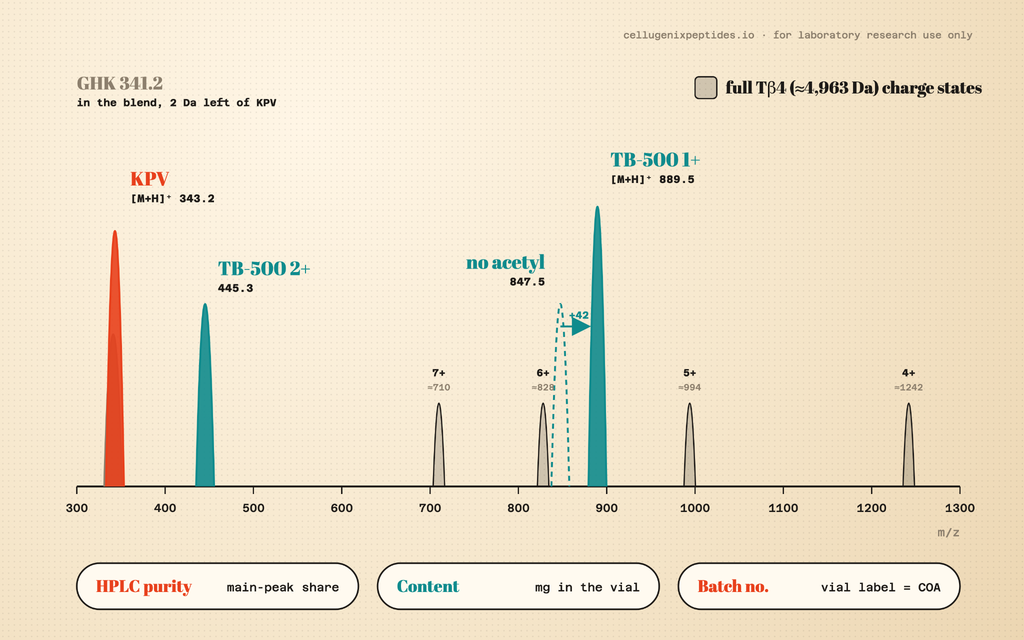
Mass spectrum guide showing KPV at 343.2, TB-500 at 445.3 and 889.5, unacetylated LKKTETQ at 847.5 and full thymosin beta-4 charge states.
Are KPV and TB-500 FDA-Approved? US Status in 2026
Neither KPV nor TB-500 is the active ingredient in any FDA-approved drug listed in Drugs@FDA. Both have come before the FDA as compounding nominations, and a July 2026 advisory vote went in their favor. As of 5 November 2026, FDA has taken no final action on either.
- FDA compounding page (current as of 22 April 2026): FDA’s Category 2 safety page lists KPV and “Thymosin Beta-4, Fragment” in its table of nominations that were withdrawn, and notes it found no human exposure data for either.
- Advisory committee (23 July 2026): An 8-6 vote at FDA’s Pharmacy Compounding Advisory Committee, with one member abstaining, backed adding BPC-157, KPV and TB-500 to the 503A bulks list, as reported by AJMC. That vote is a recommendation to FDA.
- Next step: Placement on the 503A bulks list would need formal FDA rulemaking with a public comment period. No such notice had been published by 5 November 2026.
- Sport: The WADA Prohibited List names “thymosin-β4 and its derivatives, e.g. TB-500” under section S2.
Compounding rules cover pharmacies. Laboratory supply runs on separate rules, and those rules decide when research peptides are legal in the US for purchase.
Frequently Asked Questions
Is KPV the same as TB-500?
No. KPV (Lys-Pro-Val) comes from α-MSH and weighs 342.4 g/mol. TB-500 (Ac-LKKTETQ) comes from thymosin beta-4 and weighs 889.0 g/mol. They share no amino acids in sequence, come from unrelated protein families, and are studied in different assays.
Is TB500 the same as TB4?
TB500 is usually just the 7-residue actin-binding piece of TB4, and TB4 is the complete 43-amino-acid protein at about 4,963 Da. The name isn’t standardized, so a few suppliers apply it to the full protein. A mass near 889.5 on the COA confirms the fragment.
What is KPV peptide?
Lys-Pro-Val, or KPV, is a three-residue peptide that copies the final positions of α-MSH. Researchers use it in cell-line studies of NF-κB signaling, PepT1 transport, and melanocortin-receptor pharmacology. It’s supplied as a lyophilized powder for laboratory research.
What is the molecular weight of KPV vs TB-500?
KPV weighs 342.4 g/mol (C16H30N4O4), and TB-500 weighs 889.0 g/mol (C38H68N10O14). On a mass spectrum, KPV’s main ion appears near 343.2, and TB-500 shows ions near 889.5 and 445.3.
What does published KPV and TB-500 research cover?
KPV research is mainly cell-line work plus rodent studies. TB-500 research on the fragment itself is mostly in vitro and ex vivo, while most animal and human work has used the whole Tβ4 protein. FDA reported no human exposure data for either fragment in April 2026.
Why are KPV and TB-500 in the same blend?
Some research blends package several reference peptides in one vial. Cellugenix’s 80 mg blend combines GHK-Cu, BPC-157, TB-500, and KPV at 50, 10, 10, and 10 mg. Its COA should list each component separately.
Are KPV and TB-500 FDA-approved?
Neither compound is in an FDA-approved drug. An FDA advisory committee backed both for the 503A compounding list by an 8-6 vote in July 2026, but FDA had taken no final action as of 5 November 2026.
Summing it Up
Side by side, KPV is a 342 Da melanocortin tripeptide used in NF-κB and transport assays. TB-500 is an 889 Da acetylated fragment of thymosin beta-4 studied in actin and migration assays. The fastest way to confirm what was shipped is the mass on the COA, backed by HPLC purity and a matching batch number.
View the KPV 10 mg batch COA · View the TB-500 5 mg batch COA
For laboratory research use only. Not for human or animal use. Not for human or veterinary use. Legal notice and medical disclaimer
References
1. PubChem. KPV (Lys-Pro-Val), CID 125672. Database entry. https://pubchem.ncbi.nlm.nih.gov/compound/125672
2. PubChem. TB-500 (Ac-LKKTETQ), CID 62707662. Database entry. https://pubchem.ncbi.nlm.nih.gov/compound/62707662
3. UniProt. Thymosin beta-4, P62328. Database entry. https://www.uniprot.org/uniprotkb/P62328/entry
4. Mandrika I, et al. Biochem Pharmacol. 2001;61(5):613-621. In vitro (RAW 264.7 cells). https://pubmed.ncbi.nlm.nih.gov/11239505/
5. Getting SJ, Schiöth HB, Perretti M. J Pharmacol Exp Ther. 2003;306(2):631-637. Animal (mouse). https://doi.org/10.1124/jpet.103.051623
6. Dalmasso G, et al. Gastroenterology. 2008. In vitro + animal (cell lines, mouse). https://pubmed.ncbi.nlm.nih.gov/18061177/
7. Sanders MC, Goldstein AL, Wang YL. Proc Natl Acad Sci USA. 1992;89(10):4678-4682. In vitro (living cells). https://pmc.ncbi.nlm.nih.gov/articles/PMC49146/
8. Van Troys M, et al. EMBO J. 1996;15(2):201-210. Cell-free biochemistry. https://pubmed.ncbi.nlm.nih.gov/8617195/
9. Philp D, et al. FASEB J. 2003. In vitro + ex vivo. https://doi.org/10.1096/fj.03-0121fje
10. US FDA. Certain bulk drug substances for use in compounding that may present significant safety risks. Regulatory page, current as of 22 April 2026. https://www.fda.gov/drugs/human-drug-compounding/certain-bulk-drug-substances-use-compounding-may-present-significant-safety-risks
11. World Anti-Doping Agency. Prohibited List 2026. Regulatory list. https://www.wada-ama.org/en/prohibited-list
For laboratory research use only. Not for human or animal use.