SLU-PP-332 vs MOTS-c: A Small-Molecule ERR Agonist and a Mitochondrial Peptide Compared
SLU-PP-332 is a synthetic two-ring compound designed to turn on the estrogen-related receptors (ERRs). MOTS-c is a 16-amino-acid chain spelled out in mitochondrial DNA. The two keep turning up on the same research-peptide shelves, which leads plenty of buyers to file both as peptides, and only MOTS-c fits that label. Put them on a balance in an SLU-PP-332 vs MOTS-c comparison and MOTS-c carries roughly seven and a half times the mass, with its own target, its own assays and its own analytical checklist.
Below you’ll find where each compound came from, what it acts on in cell assays, how the small-molecule vs peptide difference plays out at the bench, US and anti-doping status, and the checks a certificate should pass.
Quick answer: SLU-PP-332 is an acyl-hydrazone small molecule, C18H14N2O2, at about 290.3 g/mol. Cell-based reporter assays show it activating ERRα, ERRβ, and ERRγ. MOTS-c is the 16-residue peptide MRWQEMGYIFYPRKLR, about 2,174.6 g/mol, coded within MT-RNR1, the 12S rRNA gene of mitochondria, and studied through AMPK readouts in cultured cells.
✓ SLU-PP-332: small molecule, nuclear-receptor agonist
✓ MOTS-c: peptide encoded in mitochondrial DNA, AMPK assays
✓ Each is supplied as a laboratory reagent
In this guide
- SLU-PP-332 vs MOTS-c at a glance
- What is SLU-PP-332?
- What is MOTS-c?
- How do their molecular targets differ?
- Small molecule vs peptide: what it means in the lab
- How does SLU-PP-332 compare with 5-Amino-1MQ?
- What’s their US regulatory status?
- How to check an SLU-PP-332 or MOTS-c batch
- Frequently asked questions
- The bottom line
SLU-PP-332 vs MOTS-c at a Glance
Read from the MOTS-c vs SLU-PP-332 side, the two columns barely share a vocabulary. The left one belongs to a medicinal-chemistry project: a two-ring ligand for nuclear receptors. The right one belongs to mitochondrial genetics: a peptide coded in the organelle’s own DNA and followed through AMPK signaling.
| SLU-PP-332 | MOTS-c | |
| Compound class | Synthetic small molecule (acyl hydrazone) | Mitochondrial-derived peptide (MDP) |
| Chemical name/sequence | (E)-4-hydroxy-N’-(naphthalen-2-ylmethylene)benzohydrazide | MRWQEMGYIFYPRKLR |
| Formula | C18H14N2O2 | C101H152N28O22S2 |
| Molecular weight | ~290.3 g/mol | ~2,174.6 g/mol |
| CAS | 303760-60-3 | 1627580-64-6 |
| Origin | Designed at Saint Louis University (hence “SLU”) | Encoded in MT-RNR1 (12S rRNA), mitochondrial DNA |
| Target | ERRα, ERRβ, ERRγ (orphan nuclear receptors), agonist | AMPK signaling via the folate-methionine cycle (reported) |
| Typical assays | Gal4-LBD and full-length luciferase reporter assays, target-gene qPCR | p-AMPK (Thr172) Western blot, LC-MS metabolomics, nuclear localization |
| Analysis | HPLC + small-molecule MS | HPLC + peptide MS; peptide content vs purity |
| Cellugenix | SLU-PP-332 5 mg | MOTS-c 10 mg |
Identifiers match the PubChem records for SLU-PP-332 (CID 5338394) and MOTS-c (CID 146675088), and the same values appear on each Cellugenix batch certificate.
What Is SLU-PP-332?
SLU-PP-332 came out of the Burris and Walker laboratories at Saint Louis University, built on an acyl-hydrazone scaffold. Reporter assays show it switching on ERRα, ERRβ, and ERRγ, most potently ERRα with an EC50 near 98 nM, while ERα and ERβ stay quiet.
Those numbers come from Billon et al. (ACS Chemical Biology, 2023), who ran full-length ERR cotransfection luciferase assays in HEK293 cells:
- ERRα: EC50 98 nM
- ERRβ: EC50 230 nM
- ERRγ: EC50 430 nM
- ERα and ERβ: no measurable activation
That profile makes the SLU-PP-332 ERR agonist label a precise one: it reaches all three ERRs and favors ERRα by roughly 2- to 4-fold. The team then followed Pdk4 and other ERR-responsive genes by qPCR in C2C12 cells. Animal studies of the compound exist and aren’t summarized here. Earlier acyl hydrazones led to this compound, and the SLU-PP-332 research overview maps that lineage paper by paper.
Is SLU-PP-332 a Peptide?
No. The structure holds two aromatic ends, a naphthalene ring and a 4-hydroxybenzoyl group, linked by a short C=N-NH bridge, with no amino acid anywhere. The SLU-PP-332 molecular weight, ~290 Da, is roughly one-seventh the mass of MOTS-c. Labs that buy research peptides also buy it, and that overlap on order forms is where the mix-up begins.
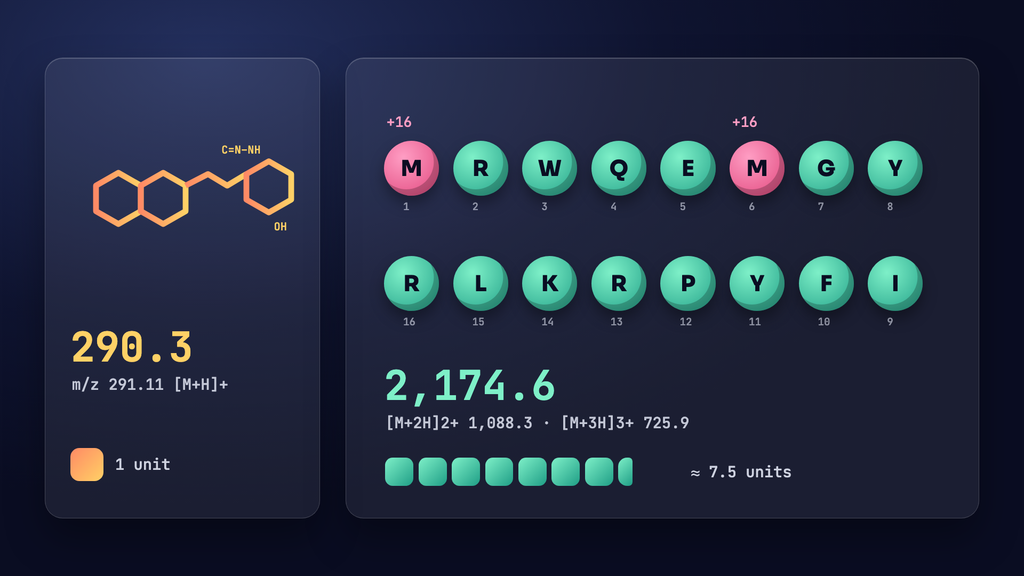
SLU-PP-332 (290.3 g/mol, m/z 291.11) drawn beside the 16 residues of MOTS-c (2,174.6 g/mol) with both methionines marked +16, showing MOTS-c at about 7.5 times the mass
What Is MOTS-c?
MOTS-c is a short peptide, 16 residues long, whose code is hidden inside MT-RNR1, the mitochondrial gene for 12S ribosomal RNA. It was described in 2015 and became the second well-known mitochondrial-derived peptide (MDP) after humanin. Cell studies follow it through folate-methionine cycle metabolites and AMPK activation.
Its name reflects where it was found: the mitochondrial open reading frame of the 12S rRNA, type c. Changhan Lee, Pinchas Cohen and colleagues reported it in Cell Metabolism in 2015, and their cell experiments connected it to the folate cycle and AMPK. Three years later, Kim and Lee showed that glucose-restricted cells shuttled MOTS-c into the nucleus, and that the move needed AMPK.
The MOTS-c sequence is easy to read off one letter at a time: M-R-W-Q-E-M-G-Y-I-F-Y-P-R-K-L-R. More than a decade of cell work has built up since 2015, laid out in order in the MOTS-c research overview, and its contrast with a cardiolipin-binding tetrapeptide is drawn in SS-31 vs MOTS-c.
Two Methionines and Oxidation
Methionine appears at positions 1 and 6, and each one can pick up an oxygen atom during storage or handling. Every oxidized methionine adds 16 Da, so an MS trace showing a partner peak at +16 or +32 points to oxidation. HPLC often resolves the oxidized form as a separate, slightly earlier peak.
How Do Their Molecular Targets Differ?
SLU-PP-332 is a receptor ligand. It occupies the ligand-binding pocket of ERRα, ERRβ, and ERRγ, three transcription factors, and luciferase reporters count the genes that switch on as a result. MOTS-c works one step removed, through biochemistry inside the cell: cultured cells treated with it show altered folate-cycle metabolites, phosphorylated AMPK, and, under stress, MOTS-c inside the nucleus.
| SLU-PP-332 | MOTS-c | |
| Target type | Ligand for nuclear receptors (ERRα/β/γ) | Pathway modulator (folate cycle → AICAR → AMPK) |
| Where it acts in assays | Nucleus (receptor ligand-binding domain) | Cytoplasm, with movement into the nucleus reported |
| Co-activator readouts | PGC-1α recruitment (reported) | n/a |
| Model systems | Transfected HEK293 reporter cells, C2C12 cells | Cultured human and mouse cell lines |
| Key readouts | Luciferase activity, EC50, ERR target-gene mRNA (qPCR), oxygen-consumption rate | p-AMPK (Thr172), metabolite levels (LC-MS), localization |
That indirect route is the heart of the MOTS-c AMPK story. Lee’s cell data showed the folate cycle slowing, purine synthesis backing up, and the intermediate AICAR accumulating. Because AICAR mimics AMP, AMPK responded, and the lab readout is phosphorylation at Thr172.
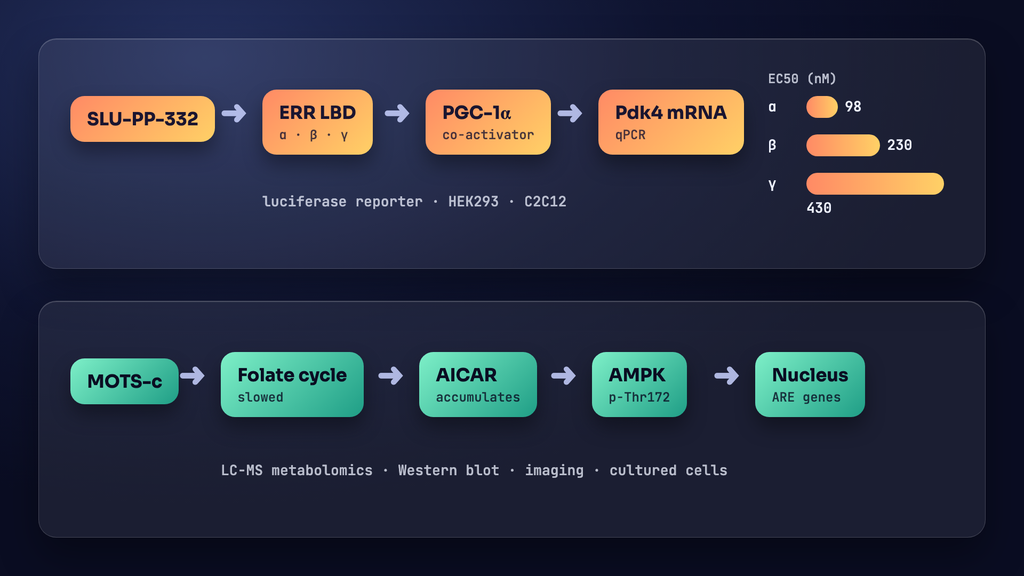
Two assay routes: SLU-PP-332 to the ERR ligand-binding domain, PGC-1 alpha and Pdk4 mRNA with EC50 bars of 98, 230 and 430 nM; MOTS-c to the folate cycle, AICAR, AMPK Thr172 and the nucleus
SLU-PP-332’s route is shorter. The ligand meets the pocket, the receptor pulls in co-activators such as PGC-1α, and ERR target genes come on. Both compounds can end up moving overlapping gene sets in cultured cells, which helps explain the shared catalog page, and chemically they belong to separate classes. Shorthand for remembering the difference: a receptor ligand vs a pathway peptide.
Small Molecule vs Peptide: What It Means in the Lab
Bench handling follows the chemistry. SLU-PP-332 is soluble in DMSO for assay preparation, and small-molecule HPLC and MS confirm its identity. MOTS-c behaves like any peptide: a good COA reports purity and peptide content as separate numbers, and two methionines give it an oxidation risk.
| SLU-PP-332 | MOTS-c | |
| Solubility for assay preparation | DMSO | Water or DMSO |
| Main stability risk | Hydrazone hydrolysis; light-driven E/Z change | Methionine oxidation, moisture |
| Purity vs content | No counter-ion, so content tracks the compound | Salt and water add mass, so content runs below purity |
| Supplied as | Dry powder | Lyophilized powder |
The hydrazone bridge is SLU-PP-332’s weak point. Hydrolysis breaks it into 2-naphthaldehyde and 4-hydroxybenzohydrazide, two fragments with their own retention times and masses, and the C=N bond can also flip between E and Z forms. MOTS-c carries the usual concerns of lyophilized peptides: moisture and air are what wear a freeze-dried powder down.
How Does SLU-PP-332 Compare With 5-Amino-1MQ?
Both are small molecules, and they act on different targets. SLU-PP-332 is an ERR agonist, working at a nuclear receptor. 5-Amino-1MQ is a quinolinium compound that inhibits the enzyme NNMT in enzyme and cell assays. Neither one is a peptide.
| SLU-PP-332 | 5-Amino-1MQ | |
| Class | Acyl hydrazone | Methylquinolinium salt |
| Target | ERRα/β/γ (agonist) | NNMT (enzyme inhibitor) |
| MW | ~290.3 | ~159.2 (cation) · 286.1 (iodide salt) |
The SLU-PP-332 vs 5-Amino-1MQ contrast is agonist vs inhibitor. One turns a receptor on, while the other blocks an enzyme, with an NNMT IC50 near 1 µM in Neelakantan and colleagues’ 2018 enzyme assays. Because 5-Amino-1MQ is sold as a salt, its mass per vial depends on the counter-ion, a point the 5-Amino-1MQ research overview works through with the iodide form.
What’s Their US Regulatory Status?
Neither SLU-PP-332 nor MOTS-c is an FDA-approved drug, and both are sold as laboratory reagents labeled Research Use Only. MOTS-c went before the FDA’s compounding advisory committee in July 2026. SLU-PP-332 remains a preclinical research compound with no registered human trials as of October 2026.
| SLU-PP-332 | MOTS-c | |
| FDA | No approved drug application | No approved drug; PCAC reviewed free base and acetate on July 23, 2026 and voted to recommend (advisory) |
| HHS interim policy (Oct 2026) | Not covered | MOTS-c acetate named among six covered peptides |
| WADA 2027 list (from Jan 1, 2027) | Named in S4.4.1 | Named in S4.4.1 (AMPK activators) |
| Research sale | Research Use Only | Research Use Only |
Sources: the FDA PCAC meeting page, the HHS notice in the Federal Register (October 30, 2026) with Baker Hostetler’s summary of the covered list, and the WADA 2027 Prohibited List. The HHS policy applies to licensed compounding pharmacies and leaves FDA rulemaking open.
The WADA entry is new. WADA’s 2027 explanatory note states that SLU-PP-332 and SLU-PP-915 “were added as examples of metabolic modulators” in section S4.4.1. MOTS-c was already named there under AMPK activators.
How to Check an SLU-PP-332 or MOTS-c Batch
Start with the name on the certificate, then the HPLC purity and its chromatogram, then the mass. For SLU-PP-332, look for the protonated ion near m/z 291.1, and MOTS-c should deconvolute to an average mass near 2,174.6. MOTS-c certificates earn extra points for a peptide-content figure and a clean region where oxidized forms would appear.
| Check | SLU-PP-332 | MOTS-c |
| Expected MS | [M+H]+ ~291.11 | ~2,174.6 average mass; seen as [M+2H]2+ ~1,088.3 and [M+3H]3+ ~725.9 |
| Impurity to watch | Z isomer, hydrolysis fragments | Met oxidation (+16 Da), truncated sequences |
| Extra field | Appearance and E/Z identity (NMR) | Peptide content, counter-ion |
A peptide this size rarely shows up as one tidy peak. Electrospray adds several protons, so MOTS-c appears as a family of multiply charged ions that software deconvolutes back to 2,174.6. SLU-PP-332 gives one main singly charged ion, which makes the small-molecule check quicker.
Cellugenix examples
- SLU-PP-332 5 mg: report CPT-SLUPP3-59BAF8, Canada Peptide Testing, tested September 29, 2026, batch L25-01. Purity by HPLC, see the batch result on the SLU-PP-332 batch certificate.
- MOTS-c 10 mg: report LK-MOTS-10-021126, Testides, tested February 23, 2026. Purity by HPLC, see the batch result on the MOTS-c batch certificate.
Each report gives HPLC-UV purity and measured content. Mass identity isn’t on either one yet, which leaves the MS checks above as the natural next request for each lot. Anyone who knows how to read a COA will notice the missing mass field at once, and HPLC vs mass spectrometry is the reason a purity number alone can’t name the compound.
Frequently Asked Questions
What’s the difference between SLU-PP-332 and MOTS-c?
Class, size, origin, and target all differ. SLU-PP-332 is a ~290 Da synthetic ligand that activates ERRα, ERRβ, and ERRγ. MOTS-c is a 2,174.6 Da peptide coded in mitochondrial DNA, followed in cultured cells through folate-cycle metabolites and AMPK phosphorylation.
Is SLU-PP-332 a peptide?
No. It’s a synthetic acyl hydrazone with two aromatic rings and no amino acids, so it’s analyzed as a small molecule.
What does SLU-PP-332 bind?
The estrogen-related receptors ERRα, ERRβ, and ERRγ. In HEK293 reporter assays, its potency is highest at ERRα (EC50 98 nM), and it showed no activity at the classical estrogen receptors.
Where does MOTS-c come from?
From MT-RNR1, the mitochondrial gene that codes 12S ribosomal RNA, where a short reading frame holds its 16 codons. Humanin, its best-known relative among mitochondrial-derived peptides, comes from the neighboring 16S rRNA gene.
Is SLU-PP-332 or MOTS-c FDA-approved?
No. As of November 2026, the FDA has approved neither compound. MOTS-c had an advisory committee review in July 2026, and each is available for labs as a research reagent.
How can I tell them apart on a COA?
Check the compound name, the MS mass (~291 for SLU-PP-332 vs ~2,175 for MOTS-c) and, for MOTS-c, a peptide-content figure. A peptide COA should also note the salt form.
Summing Up
The two names share search results and shelf space, and the chemistry diverges from the first atom. SLU-PP-332 is a compact synthetic ligand for nuclear receptors, and MOTS-c is a mitochondrial-encoded peptide read out through AMPK. Let the target in your assay make the choice, then check that the batch report verifies. The batch report for SLU-PP-332 5 mg or MOTS-c 10 mg is one click from the product listing.
For laboratory research use only. Not for human or animal use. Supplied as laboratory reagents for qualified researchers. See the legal notice.
Sources
- PubChem: SLU-PP-332 (CID 5338394), MOTS-c (CID 146675088)
- Billon C et al. ACS Chemical Biology, 2023. PMID 36988910 (receptor-assay sections)
- Lee C et al. Cell Metabolism, 2015. PMID 25738459 (identification and in-vitro sections)
- Kim KH et al. Cell Metabolism, 2018. PMID 29983246 (in-vitro sections)
- Neelakantan H et al. Biochemical Pharmacology, 2018. PMC5826726
- FDA PCAC meeting page, July 23 and 24, 2026
- HHS notice, Federal Register 2026-22192, October 30, 2026; Baker Hostetler summary, October 28, 2026
- WADA 2027 Prohibited List and explanatory note (approved September 2026)
For laboratory research use only. Not for human or animal use.