KPV Peptide (Lys-Pro-Val): Sequence, Alpha-MSH Origin and Laboratory Use
KPV is three amino acids clipped from the tail of alpha-MSH, a 13-residue hormone. You’d expect such a small piece to do nothing alone. Instead, cell assays keep showing activity that doesn’t run through the receptors its parent depends on, and that puzzle is why labs order the KPV peptide by itself.
This laboratory guide covers identity, salt forms, the receptor question, assay uses, 2026 FDA status, storage and COA checks.
In short: What is KPV?
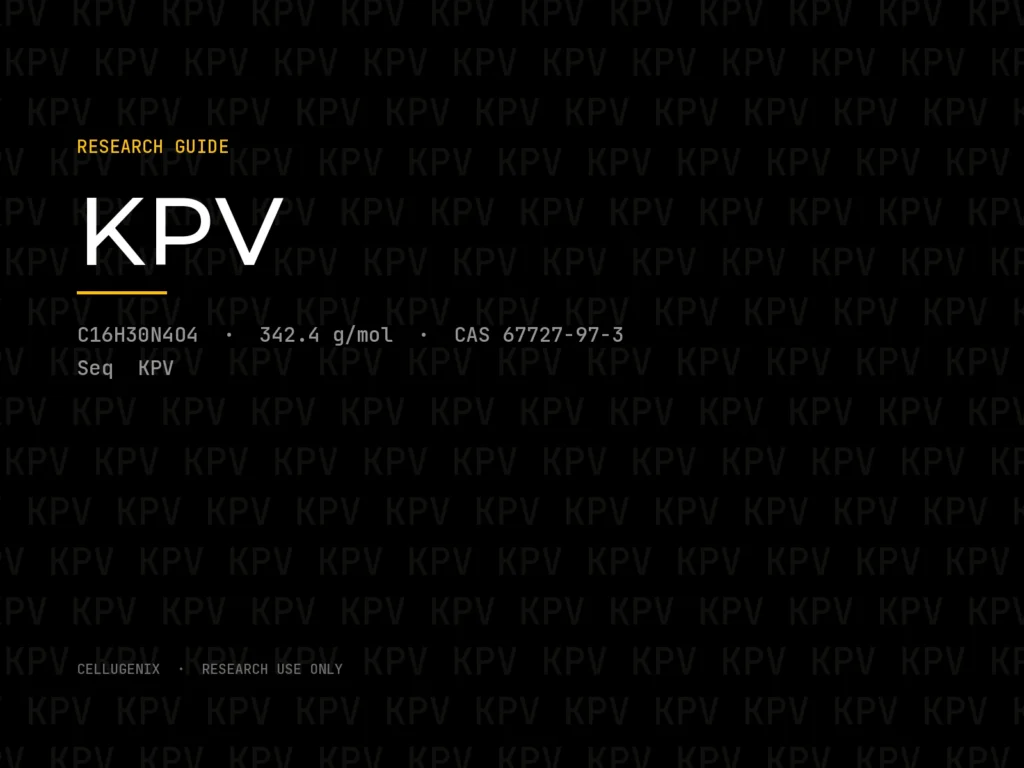
KPV is the synthetic tripeptide Lys-Pro-Val, residues 11 to 13 at the C-terminus of alpha-melanocyte-stimulating hormone (alpha-MSH). Its formula is C16H30N4O4, its molecular weight 342.4 g/mol and its CAS number 67727-97-3. Labs use it in NF-κB reporter, cytokine-release and PepT1 transporter-uptake assays in cultured cells.
✓ Three residues: Lys-Pro-Val
✓ C-terminal fragment of alpha-MSH
✓ A research reagent, not an FDA-approved drug
KPV at a Glance
Quick answer: KPV is H-Lys-Pro-Val-OH, a linear tripeptide listed in PubChem as CID 125672. The free base, C16H30N4O4, has a molecular weight of 342.4 g/mol and a monoisotopic mass of 342.23 Da. Salt forms share the same CAS number, so the formula weight on the COA tells you which form is in the vial.
| Field | Value |
| Sequence | Lys-Pro-Val (KPV) |
| Other names | alpha-MSH (11-13), ACTH (11-13), L-lysyl-L-prolyl-L-valine |
| Length | 3 amino acids |
| Formula | C16H30N4O4 (free base) |
| Molecular weight | 342.4 g/mol average · 342.23 Da monoisotopic |
| CAS | 67727-97-3; acetate listings reuse the same number |
| PubChem CID | 125672 |
| Forms supplied | Free base · acetate · TFA salt |
| Status | Not an FDA-approved drug; research reagent |
| Cellugenix | KPV 10 mg, lyophilized; report LK-KPV-10-032626 (Testides), purity by HPLC, see the batch result |
Lot details are on the KPV 10 mg specification.
What Is KPV? The Alpha-MSH 11-13 Fragment
Quick answer: Alpha-MSH is a 13-residue melanocortin peptide cut from the precursor protein POMC, and KPV is its last three residues, Lys11-Pro12-Val13. Researchers study the fragment alone to see which cell-assay activity stays with the C-terminus once the rest of the chain is gone, including the His-Phe-Arg-Trp core that melanocortin receptors recognise.
| Alpha-MSH | KPV | |
| Length | 13 residues | 3 residues |
| Sequence | Ac-SYSMEHFRWGKPV-NH2 | KPV |
| Ends | Acetylated N-terminus, amidated C-terminus | Free amine and free acid |
| Core melanocortin motif (HFRW) | Present | Absent |
| Lab use | Melanocortin receptor agonist | C-terminal fragment tool |
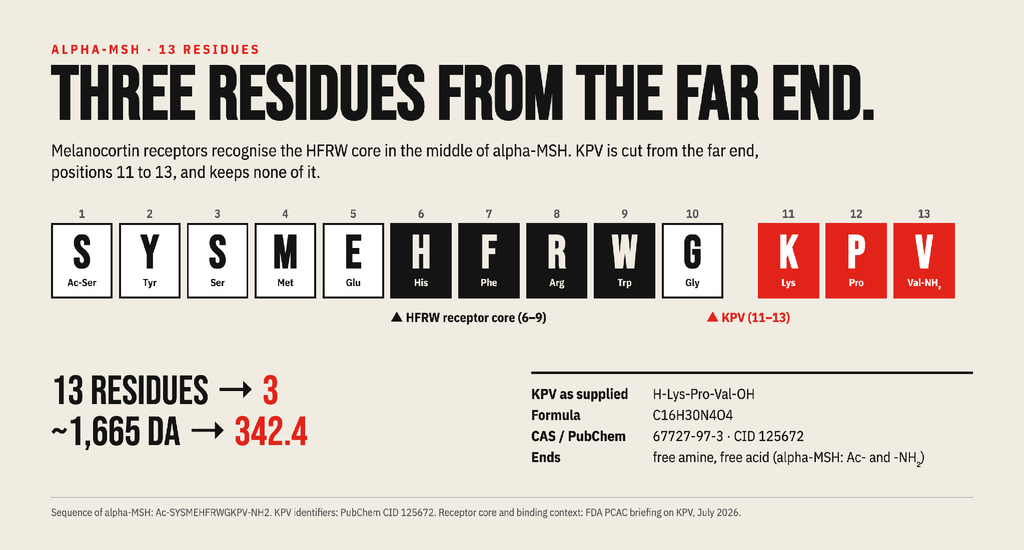
Alpha-MSH drawn as 13 lettered tiles with the HFRW receptor motif and the KPV tail highlighted, and KPV shown cut free as three tiles
Is KPV a Peptide?
Yes. Lysine, proline and valine joined by two peptide bonds make KPV a tripeptide, about the smallest unit that still counts as one. That size also makes it a substrate for PepT1, the proton-coupled transporter that carries di- and tripeptides into cells and that several KPV assays measure directly.
KPV vs KdPT
KdPT, written Lys-D-Pro-Thr, is a different tripeptide that often turns up beside KPV in papers and catalogues. It matches residues 193 to 195 of interleukin-1β, carries a D-proline in the middle, and has the formula C15H28N4O5 (about 344.4 g/mol). The two masses differ by only 2 g/mol, so confirm the sequence and stereochemistry on the COA before an order goes into an assay plan.
Does KPV Act Through Melanocortin Receptors?
Quick answer: In most cell systems tested, no. KPV failed to displace labelled alpha-MSH from melanocortin-receptor preparations and didn’t raise cAMP in MC1R-expressing cells. Its measured activity runs through intracellular routes: PepT1 uptake in epithelial cell lines, and blocked nuclear import of the NF-κB subunit p65 in bronchial epithelial cells.
| Line of evidence | Cell system | Readout | Source |
| PepT1 uptake, then NF-κB inhibition | Caco2-BBE and HT29-Cl.19A epithelial lines; Jurkat cells | [3H]KPV uptake kinetics, NF-κB luciferase reporter, cytokine ELISA | Dalmasso et al. 2008, PMC2431115 |
| Blocked p65 nuclear import | 16HBE14o- bronchial epithelial line | NF-κB reporter, YFP-p65 translocation, IL-8 secretion | Land 2012, PMC3403564 |
| No melanocortin receptor agonism | MC1R-expressing macrophages, pigment-cell lines, brain membrane preparations | Alpha-MSH displacement, cAMP | FDA PCAC briefing, 2026 |
A common misreading needs fixing here. Land’s 2012 paper is often cited as proof that KPV works through MC3R. In that study, MC3R was required for gamma-MSH. KPV’s effect came from its own nuclear import and a block at the importin-α binding site on p65RelA.
The FDA’s 2026 briefing on KPV reached a similar view, saying melanocortin receptors are “unlikely to be the molecular targets” of KPV. That still leaves gaps. The binding data come from a handful of preparations, so “never binds any melanocortin receptor” goes further than the evidence.
For assay design, that points to three controls. Run a reference PepT1 substrate such as Gly-Sar as a competitor, include an MC receptor antagonist alongside alpha-MSH as a positive control, and track p65 location along with the reporter signal.
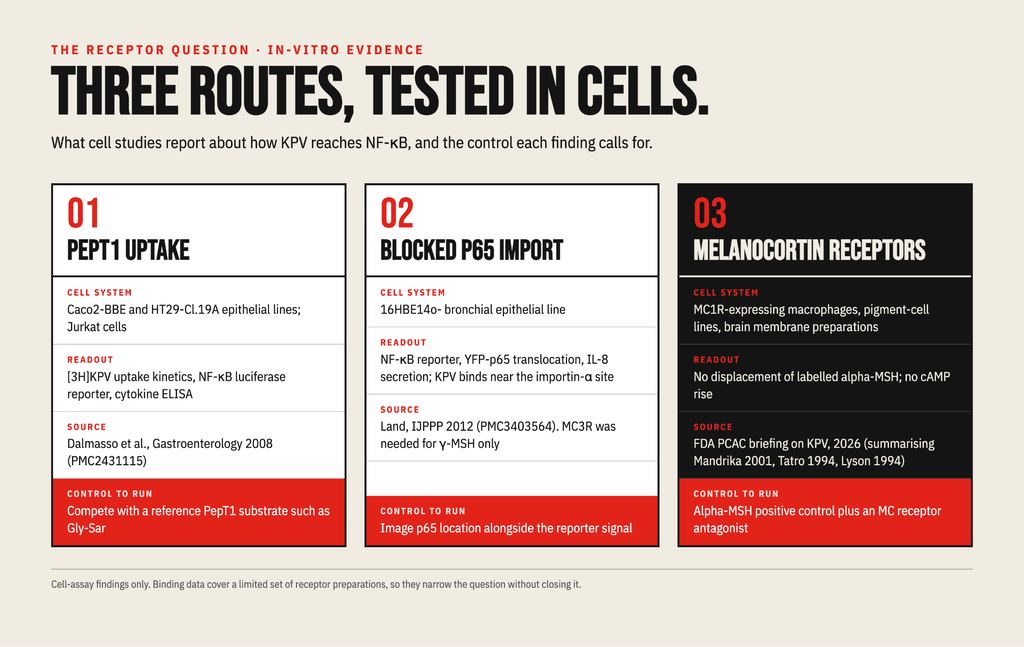
Evidence map of three in-vitro routes proposed for KPV: PepT1 uptake, blocked p65 nuclear import and no melanocortin receptor agonism, each with its cell system, readout and suggested control
How Is KPV Used in the Lab?
Quick answer: KPV appears in NF-κB reporter and translocation assays, cytokine-release assays measuring IL-6, IL-8 and TNF-α from stimulated epithelial and lymphoid cell lines, PepT1 uptake and competition assays, and as a short reference peptide for HPLC and mass spectrometry.
| Assay | What it measures |
| NF-κB reporter / translocation | Pathway activation after a TNF-α or IL-1β stimulus, with and without KPV |
| Cytokine release (ELISA) | IL-6, IL-8 and TNF-α in cell supernatants |
| PepT1 uptake / competition | Transport of radiolabelled KPV against reference di- and tripeptides |
| Analytical reference | Retention time, mass, impurity profile |
As an analytical reference, KPV is awkward in a useful way. It has no tryptophan or tyrosine, so it barely absorbs at 280 nm and has to be read at 210 to 220 nm. It’s also very polar, and on a standard C18 column it elutes early, close to the solvent front. Shallow gradients or ion-pairing agents help pull it clear of early impurities.
Dalmasso’s group reported NF-κB inhibition at nanomolar KPV concentrations in their cell lines. Activity at such low concentrations makes purity and content errors show up fast, so the batch certificate deserves the same attention as the cell passage number.
KPV Salt Forms: Free Base, Acetate and TFA
Quick answer: KPV is sold as the free base or as acetate or TFA salts. Counter-ions add weight, so 10 mg of a salt holds less peptide than 10 mg of the free base. Check which form the COA reports before comparing results between batches or suppliers.
KPV carries two basic amines, the N-terminus and the lysine side chain, so it can pick up one or two counter-ions. The FDA briefing lists the mono-acetate at 402.5 g/mol under the free base’s CAS number. TFA often enters at the cleavage step of solid-phase synthesis, which uses trifluoroacetic acid.
| Form | MW basis (g/mol) | Peptide in 10 mg |
| Free base | 342.4 | 10.00 mg |
| Mono-acetate | 402.5 | 8.51 mg |
| Di-acetate | 462.5 | 7.40 mg |
| Mono-TFA | 456.4 | 7.50 mg |
| Di-TFA | 570.5 | 6.00 mg |
The COA often hints at the form even when it doesn’t name it. A high HPLC purity paired with content well below the label usually points to counter-ions or water. Ion chromatography for acetate or 19F NMR for TFA can settle the question.
A 40% swing in peptide mass between the free base and the di-TFA salt is enough to scramble a concentration-response curve. The Cellugenix report gives HPLC purity and content but doesn’t state the salt form yet. A missing salt form is exactly what purity versus identity testing describes.
Is KPV FDA-Approved? (2026 Status)
Quick answer: No. KPV isn’t an FDA-approved drug or supplement. On 23 July 2026, the FDA’s Pharmacy Compounding Advisory Committee voted 8-6 to recommend KPV for the 503A bulk drug substances list. The vote is advisory, the FDA hasn’t acted on it, and research-grade KPV stays a laboratory reagent.
| Question | Status |
| FDA-approved? | No |
| PCAC, 23 July 2026 | Recommended for 503A by 8 votes to 6 |
| FDA staff view | Advised against listing; both forms judged not well characterised |
| What the vote means | An advisory step; it doesn’t cover research-grade material |
| Research sale | Research Use Only |
STAT’s report on the 23 July vote notes that FDA staff had opposed the proposals and that the agency isn’t bound by the panel. The committee’s materials are on the FDA’s PCAC meeting page. Any change to the 503A list still needs agency rulemaking. Our explainer on what Research Use Only means covers how lab reagents are regulated.
Storage of the Sealed Vial
KPV ships as a lyophilized solid in a sealed vial labelled with its lot number. Store sealed vials as stated on the label, protected from light and moisture. Log the lot and report number (LK-KPV-10-032626 for the current batch) next to each experiment, so every plate traces back to one certificate. KPV is soluble in water or DMSO for assay preparation, and temperature ranges are in the storage and handling guide.
KPV COA: What to Check
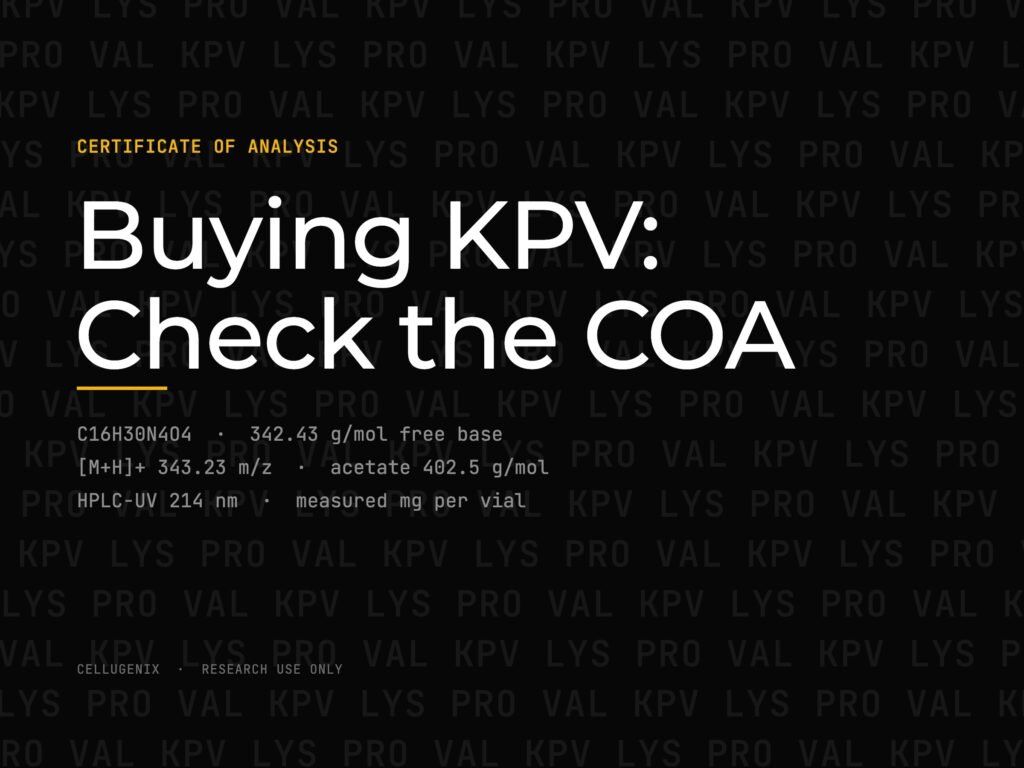
Quick answer: A KPV certificate should name Lys-Pro-Val, show HPLC purity with a chromatogram, report content against the label, give a mass-spec result near 342.4 (or the salt form’s mass) and carry a report number that verifies on the testing lab’s website.
- Identity: Lys-Pro-Val named, with CAS 67727-97-3
- Purity: HPLC result with the chromatogram attached
- Content: measured milligrams against the label claim
- Mass: [M+H]+ near 343.2, or the stated salt form
- Traceability: a report number you can check with the lab
The current Cellugenix batch, LK-KPV-10-032626, was tested by Testides on 28 March 2026 at 99.35% purity by HPLC. It shows no MS result and no salt form. Read the full record on the KPV 10 mg certificate of analysis, and use our guide on how to read a COA to work through each field.
Frequently Asked Questions
What is KPV peptide?
KPV is a synthetic tripeptide, Lys-Pro-Val, matching residues 11 to 13 of alpha-MSH. It has the formula C16H30N4O4, a molecular weight of 342.4 g/mol, and CAS number 67727-97-3. Laboratories use it in NF-κB, cytokine-release, and PepT1 transporter assays in cultured cells, and as a short analytical reference peptide.
What is the amino acid sequence of KPV?
KPV reads lysine, proline, valine: H-Lys-Pro-Val-OH. It’s linear, with a free amine at the N-terminus and a free carboxylic acid at the C-terminus. In alpha-MSH, the same three residues close the chain at positions 11 to 13, where the hormone’s C-terminus is amidated.
What is the molecular weight of KPV?
The free base weighs 342.4 g/mol, with a monoisotopic mass of 342.23 Da. Salts weigh more: about 402.5 g/mol as the mono-acetate and 456.4 g/mol as the mono-TFA salt. Two counter-ions push the TFA form to 570.5 g/mol, so always calculate from the form named on the COA.
Is KPV a fragment of alpha-MSH?
Yes. KPV matches the last three residues of alpha-MSH, Lys11-Pro12-Val13, and PubChem lists it as alpha-MSH (11-13). It lacks the His-Phe-Arg-Trp core that melanocortin receptors recognise, which is why researchers study its cell-assay activity separately from the full 13-residue hormone.
Is KPV FDA-approved?
No. KPV isn’t an FDA-approved drug. The FDA’s Pharmacy Compounding Advisory Committee voted 8-6 on 23 July 2026 to recommend it for the 503A bulks list, but the vote is advisory and the FDA hasn’t acted. Research-grade KPV is sold for laboratory use only.
What should a KPV certificate of analysis show?
A KPV COA should name Lys-Pro-Val, report HPLC purity with the chromatogram, give measured content against the label, and ideally confirm identity by mass spectrometry near 342.4 or the stated salt mass. It should also carry a report number you can verify with the issuing laboratory.
The Bottom Line
KPV is a three-residue alpha-MSH fragment whose cell-assay activity mostly bypasses the receptors its parent uses. For a lab, the details to pin down are the sequence, the salt form and whether the batch report verifies. Start with the KPV 10 mg listing and its current certificate.
For laboratory research use only. Not for human or animal use.
Sources
- PubChem. Lys-Pro-Val, CID 125672 (National Library of Medicine).
- FDA. Briefing Document, KPV-Related Bulk Drug Substances, Pharmacy Compounding Advisory Committee, July 23-24, 2026.
- Dalmasso G, Charrier-Hisamuddin L, Nguyen HT, et al. Gastroenterology, 2008; 134(1): 166-178. PMID 18061177 (cell-assay sections).
- Land SC. International Journal of Physiology, Pathophysiology and Pharmacology, 2012; 4(2): 59-73. PMID 22837805.
- STAT News, 23 July 2026, coverage of the PCAC vote.
- NLM MeSH. KdPT (Lys-D-Pro-Thr), record C056932.
Related research guides
For laboratory research use only. Not for human or animal use.