BPC-157 vs KPV: Two Research Peptides Compared by Structure
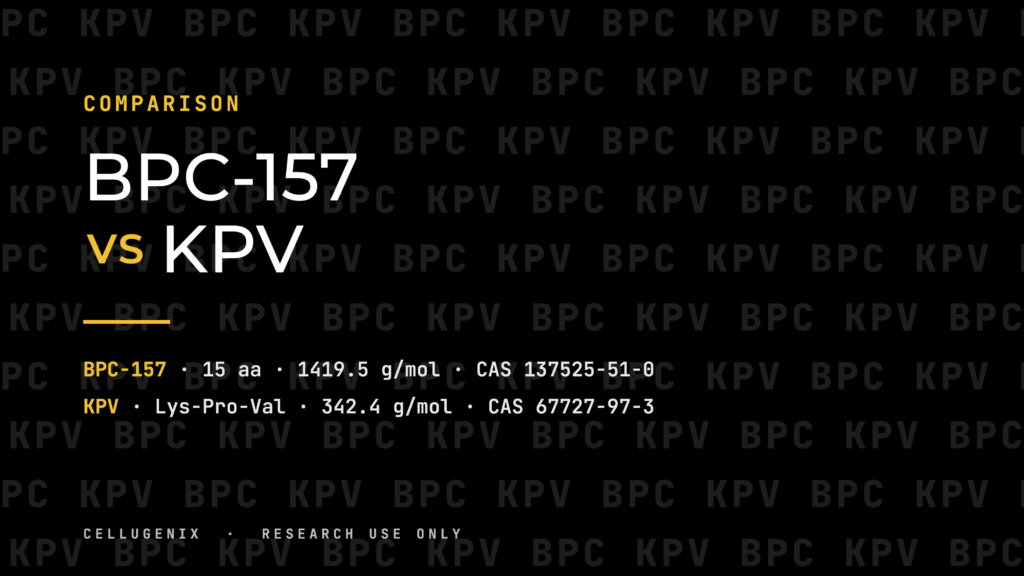
Run BPC-157 and KPV through the same mass spectrometer and their main peaks land more than 1,000 daltons apart. That’s a wide distance for two names that keep turning up in the same search results, the same supplier catalogs and the same forum threads. One is a synthetic chain of 15 amino acids. The other is three residues long, clipped from the tail of alpha-MSH.
What follows sets the two molecules next to each other: identity data, origin, size, the targets and assays each one is studied in, how a certificate of analysis (COA) tells them apart, and where US regulators stand as of October 2026.
BPC-157 vs KPV: BPC-157 (PL 14736) is a synthetic 15-residue peptide, GEPPPGKPADDAGLV (C62H98N16O22, 1419.5 g/mol). KPV is the tripeptide Lys-Pro-Val (C16H30N4O4, 342.4 g/mol), the C-terminal fragment of alpha-MSH. In vitro, BPC-157 is studied in VEGFR2 and nitric-oxide signaling assays; KPV in NF-κB reporter and PepT1 uptake assays.
✓ BPC-157: 15 residues, about four times heavier
✓ KPV: 3 residues, melanocortin-derived
✓ Both are supplied as research reagents
Contents
1. BPC-157 vs KPV at a glance
2. What is BPC-157?
3. What is KPV?
4. How do their structures compare?
5. What targets are they studied against in the lab?
6. Why are BPC-157 and KPV often mentioned together?
7. What’s their US regulatory status?
8. How to tell BPC-157 and KPV apart on a COA
9. Frequently asked questions
10. The bottom line
BPC-157 vs KPV at a Glance
BPC-157 and KPV have unrelated sequences, very different sizes and almost no assay targets in common. BPC-157 is a 15-residue synthetic peptide studied through kinase and nitric-oxide signaling in endothelial and fibroblast cultures. KPV is a three-residue piece of alpha-MSH, studied for NF-κB reporter activity and transporter uptake in epithelial cell lines.
Identity figures below come from the PubChem records for BPC-157 (CID 9941957) and KPV (CID 125672), checked on 18 October 2026.
| BPC-157 | KPV | |
| Other names | PL 14736, PLD-116 | Lys-Pro-Val, α-MSH (11-13) |
| Type | Synthetic linear pentadecapeptide | Tripeptide; C-terminal fragment of α-MSH |
| Sequence | Gly-Glu-Pro-Pro-Pro-Gly-Lys-Pro-Ala-Asp-Asp-Ala-Gly-Leu-Val | Lys-Pro-Val |
| Length | 15 residues | 3 residues |
| Formula | C62H98N16O22 (free base) | C16H30N4O4 (free acid) |
| Average molecular weight | 1419.5 g/mol | 342.4 g/mol |
| CAS | 137525-51-0 | 67727-97-3 |
| Origin | Partial sequence of a larger parent protein; made by solid-phase synthesis | Last three residues of alpha-MSH; made by synthesis |
| Studied targets (in vitro) | VEGFR2, eNOS / nitric oxide, FAK-paxillin | NF-κB, PepT1 transport |
| Typical assays | Western blot, Griess assay, tube formation, scratch and transwell migration | NF-κB luciferase reporter, IL-8 ELISA, PepT1 uptake |
| Salt forms seen | Free base or acetate | Free acid, acetate or TFA |
| Cellugenix reagent | BPC-157 10 mg | KPV 10 mg |
Read it as KPV vs BPC-157 or the other way round, and the table doesn’t change. PubChem tags the KPV entry as the free acid, which settles a question many listings leave open. The amide version is a different compound with a different mass, and that comes up again in the COA section.
What Is BPC-157?
The BPC-157 peptide, also called PL 14736, is a synthetic 15-amino-acid chain (GEPPPGKPADDAGLV) with an average mass of 1419.5 g/mol as the free base. It’s described as a partial sequence of a larger parent protein. In vitro, it’s studied in VEGFR2, nitric-oxide and FAK-paxillin signaling assays, mostly in endothelial cells and fibroblasts.
The molecule on a supplier’s shelf is built by solid-phase peptide synthesis, one residue at a time, and that route explains most of what shows up on its impurity profile. PL 14736 and PLD-116 are development codes for the same sequence, and the CAS number 137525-51-0 refers to the free base. For the wider literature, see our BPC-157 research overview.
A Proline-Rich 15-Residue Chain
Four of the 15 residues are proline, and three of them run in a row (Pro3-Pro4-Pro5). Proline runs are hard to couple cleanly during synthesis, so deletion sequences missing one Pro (about 97 Da lighter) are a classic impurity to look for by LC-MS.
The two adjacent aspartic acids (Asp10-Asp11) bring their own risk. Asp can cyclize to an aspartimide, which shows up 18 Da light, then reopen as iso-Asp, which has the same mass and can only be caught as a separate HPLC peak. Deamidation, by contrast, needs Asn or Gln, and BPC-157 has neither, so any report flagging it for this sequence deserves a second look.
Free Base vs Acetate
The same chain can be supplied as the free base or as an acetate salt. Each bound acetate adds about 60 g/mol to the formula weight without changing the peptide itself. That’s why a COA should name the form it describes: a “10 mg” fill means slightly less peptide when part of that weight is counter-ion.
What Is KPV?
The KPV peptide is the tripeptide lysine-proline-valine, the last three residues of alpha-MSH. At 342.4 g/mol it’s one of the smallest peptides in research catalogs. In cell-based assays it’s studied for effects on NF-κB signaling and for uptake through PepT1, the transporter that carries di- and tripeptides into cells.
Being so short changes how it behaves in the lab. KPV can cross a cell membrane through a nutrient transporter, then act from the inside, which is a route a 15-residue peptide can’t take. Our KPV research overview covers the published work in more depth.
Where KPV Appears in Alpha-MSH
Alpha-MSH is a 13-residue melanocortin peptide, Ac-SYSMEHFRWGKPV-NH2. KPV is positions 11 to 13, the very end of the chain.
The receptor-binding core of alpha-MSH is the His-Phe-Arg-Trp stretch at positions 6 to 9. KPV doesn’t include it. So the fragment can’t be assumed to keep the full hormone’s MC1R and MC3R binding profile, and most of the newer cell work points to receptor-independent action instead.
Free Acid or Amide?
Native alpha-MSH ends in a C-terminal amide. KPV is sold both ways: as the free acid (the PubChem entry) and as KPV-NH2. Swapping the terminal -OH for -NH2 makes the molecule about 1 Da lighter and adds a positive charge. Those two products behave as separate compounds in an assay, so the COA has to say which one is in the vial. Salt form adds another layer: reversed-phase purification often leaves KPV as a TFA salt unless the supplier exchanges it for acetate.
How Do Their Structures Compare?
BPC-157 is five times longer and about four times heavier than KPV. Line up the BPC-157 sequence against the KPV sequence and the only motif they share is a Lys-Pro pair, at residues 7-8 in BPC-157 and residues 1-2 in KPV. BPC-157 carries a net negative charge at neutral pH from one Glu and two Asp, while KPV carries a net positive charge from its single lysine.
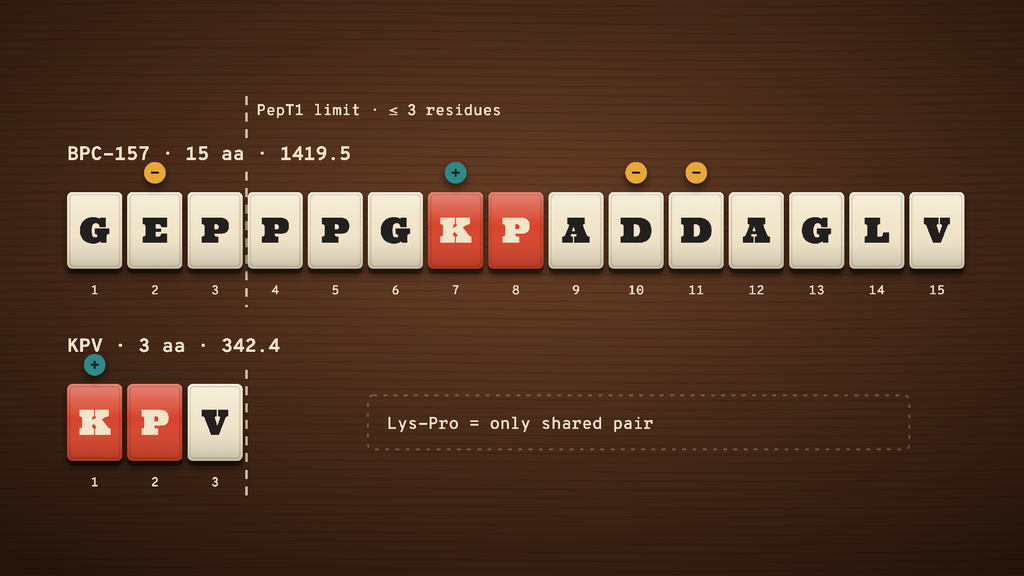
Sequence strips of BPC-157 (15 residues) and KPV (3 residues) with the shared Lys-Pro pair highlighted, charged residues marked, and the PepT1 size limit drawn between them
| Property | BPC-157 | KPV |
| Residues | 15 | 3 |
| Average molecular weight (g/mol) | 1419.5 | 342.4 |
| Charged side chains | Glu2, Lys7, Asp10, Asp11 | Lys1 |
| Net charge at pH 7 (approx.) | −2 | +1 (free acid); +2 (amide) |
| Proline content | 4 of 15 | 1 of 3 |
| Shared motif | Lys-Pro (7-8) | Lys-Pro (1-2) |
| Solubility | Soluble in water/DMSO for assay preparation | Soluble in water/DMSO for assay preparation |
Those net-charge figures count the free termini as well as the side chains. In BPC-157, four negative groups (Glu, two Asp, the C-terminal carboxyl) outweigh two positive ones (Lys and the N-terminal amine). In KPV, the lysine and the N-terminus give two positives against one carboxyl.
Size and assays: size isn’t a trivia point here. PepT1 (SLC15A1) only accepts di- and tripeptides, so KPV fits its substrate pocket and BPC-157 is far too large. The shared Lys-Pro pair doesn’t change that, because a transporter reads the whole molecule, and two matching residues inside a 15-mer give PepT1 nothing to grip.
One more coincidence is easy to miss: both chains end in valine. BPC-157 closes on Gly-Leu-Val and KPV on Pro-Val. Like the Lys-Pro pair, it’s a shared letter rather than a shared design, and it leaves the C-terminal carboxyl free in both the BPC-157 free base and KPV free acid.
What Targets Are They Studied Against in the Lab?
BPC-157 is studied in endothelial and fibroblast cultures, with readouts on VEGFR2 phosphorylation and internalization, eNOS, nitric-oxide production and FAK-paxillin. KPV is studied in epithelial cell lines and Jurkat T cells, with readouts on NF-κB reporter activity, cytokine secretion and PepT1-mediated uptake. Their assay systems barely overlap.
| BPC-157 | KPV | |
| Model systems | HUVEC and other endothelial cells; primary rat fibroblasts | Caco2-BBE, HT29-Cl.19A, Jurkat T cells, 16HBE14o- epithelial cells |
| Main readouts | p-VEGFR2, VEGFR2 internalization, p-Akt, p-eNOS, NO output, p-FAK and paxillin | NF-κB luciferase, p65 RelA nuclear translocation, IL-8 ELISA, labelled-KPV uptake |
| Receptor question | No confirmed receptor; studied through downstream kinases | Melanocortin receptors are often named; cell data points to PepT1 uptake and intracellular action |
| Key cell-assay papers | Hsieh et al. 2017; Chang et al. 2011; Hsieh et al. 2020 | Dalmasso et al. 2008; Land 2012 |
BPC-157 in endothelial cells and fibroblasts. In cultured endothelial cells, Hsieh and colleagues (J Mol Med, 2017) tracked VEGFR2 expression and internalization, and reported that “BPC 157 time dependently activated the VEGFR2-Akt-eNOS signaling.” Blocking internalization with dynasore was part of the same design. A 2020 follow-up in Scientific Reports moved one step upstream, to Src and caveolin-1 control of eNOS.
In primary rat fibroblasts, Chang et al. (J Appl Physiol, 2011) read FAK and paxillin phosphorylation by Western blot alongside cell spreading and migration.
KPV: transport first, then signaling. In Caco2-BBE cells, Dalmasso et al. (2008) showed that “KPV is transported into cells by PepT1.” Unlabelled KPV competed with the labelled tripeptide for uptake, and NF-κB reporter activity and IL-8 secretion fell at nanomolar concentrations. The same paper ran parts of the work in HT29-Cl.19A cells and Jurkat T cells as well, giving three cell lines for one tripeptide.
Land (2012) then looked inside 16HBE14o- cells. KPV’s effect on NF-κB tracked with competition at the importin-α3 binding site on p65 RelA. The MC3R dependence in that paper belonged to gamma-MSH, not KPV, a detail often miscited.
So the simplest way to put it: BPC-157 is a kinase-signaling probe, and KPV is a tripeptide that gets carried in by a transporter.
Why Are BPC-157 and KPV Often Mentioned Together?
Mostly because the same suppliers list them, and some sell blends that contain both. Structurally the two are unrelated, and the published cell work studies them in separate assay systems with different readouts. For lab purposes, comparing their identity data gets you further than treating them as a pair.
The literature is lopsided too. A PubMed title-and-abstract search on 18 October 2026 returned about 230 records for BPC-157 (including the PL 14736 code) and 47 for KPV, after filtering out unrelated uses of the initials.
Blend products are separate items with their own certificates, and this guide covers single compounds only. Two other peptides tend to appear on the same catalog pages:
- TB-500: a seven-residue synthetic fragment, covered in the TB-500 research overview.
- GHK-Cu: a copper-binding tripeptide, covered in the GHK-Cu research overview.
What’s Their US Regulatory Status?
Neither BPC-157 nor KPV is an FDA-approved drug. Research-grade material is sold as a laboratory reagent labelled Research Use Only. Both went before FDA’s Pharmacy Compounding Advisory Committee (PCAC) on 23 July 2026, a review of compounding nominations for the 503A bulks list, not of research reagent supply.
| Date | Event | Source |
| 22 Apr 2026 | FDA’s updated 503A bulks list removed BPC-157 from Category 2 after its nominations were withdrawn | FDA 503A bulks list |
| 23 Jul 2026 | PCAC reviewed BPC-157 and KPV, in free-base and acetate forms, as 503A bulks nominations | FDA meeting agenda |
| 25 Jul 2026 | Legal press reported a vote recommending inclusion for each, and called the committee’s role “advisory only” | Luma Law summary |
A few points keep those dates in proportion:
- Coming off Category 2 doesn’t move a substance into Category 1.
- Advisory votes don’t change any list; adding a substance would need FDA notice-and-comment rulemaking.
- As of 18 October 2026, FDA hadn’t posted final minutes for the July meeting.
- All of this concerns compounding pharmacies, not reagent sales.
More background is in our guide to the US status of research peptides.
How to Tell BPC-157 and KPV Apart on a COA
Check that the COA names the exact sequence, reports HPLC purity with a chromatogram, and gives a mass that matches. BPC-157’s protonated ion ([M+H]+) appears near 1420.5; KPV’s near 343.4 for the free acid. With masses that far apart, a mislabelled vial gets caught in a single LC-MS run.
| Check | BPC-157 | KPV |
| Expected [M+H]+, average mass | 1420.5 | 343.4 (free acid); 342.4 (amide) |
| Expected [M+H]+, monoisotopic | 1419.71 | 343.23 (free acid); 342.25 (amide) |
| Impurities to watch | Pro deletion sequences, aspartimide (−18 Da), iso-Asp | Diketopiperazine cyclo(Lys-Pro) from N-terminal cyclization, free amino acids |
| Form to confirm | Free base or acetate | Free acid or amide; acetate or TFA salt |
| Cellugenix report no. | LK-BPC-10-052226 | LK-KPV-10-032626 |
The chromatogram helps too. On a reversed-phase column, small polar KPV typically elutes early, while the longer, more hydrophobic BPC-157 chain comes off later, so a peak in the wrong window is an early warning before any mass is checked.
Note which mass convention a report uses. Monoisotopic and average values differ by about 0.8 Da for BPC-157 and close to 1 Da for KPV, which is the same size as the free acid vs amide difference.
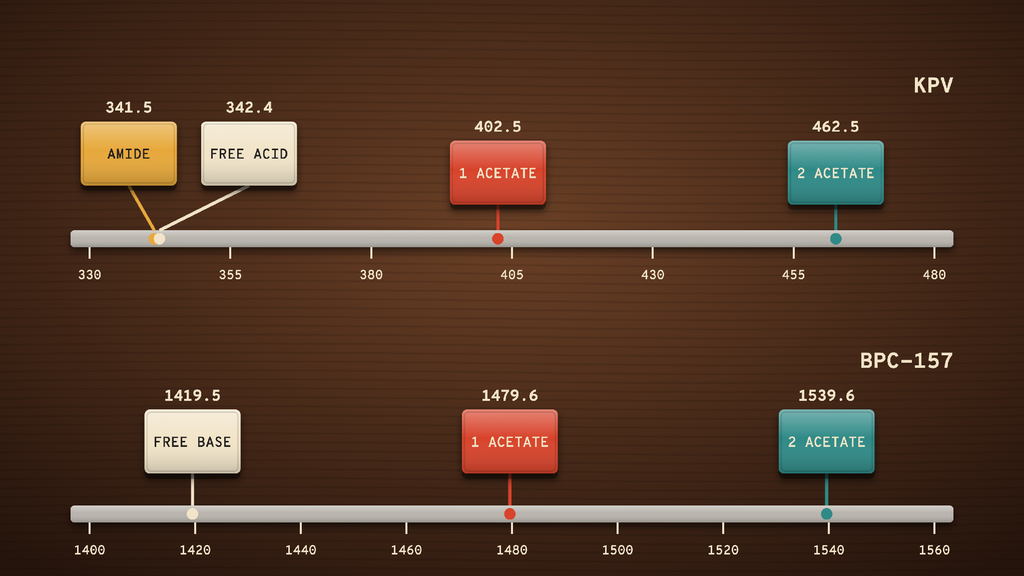
Formula-weight ladder for BPC-157 and KPV across free base, free acid, amide and acetate salt forms
Cellugenix lots, from the batch pages on 18 October 2026:
- BPC-157 10 mg: 99.32%, purity by HPLC, see the batch result (report LK-BPC-10-052226, tested 26 May 2026).
- KPV 10 mg: 99.35%, purity by HPLC, see the batch result (report LK-KPV-10-032626, tested 28 March 2026).
Our guides on how to read a COA and HPLC vs mass spectrometry explain what each test can and can’t show. Store the lyophilized reagent sealed, cold and dry as stated on the COA.
Frequently Asked Questions
What’s the difference between BPC-157 and KPV?
BPC-157 is a synthetic 15-residue peptide (GEPPPGKPADDAGLV, 1419.5 g/mol). KPV is the Lys-Pro-Val tripeptide from the end of alpha-MSH (342.4 g/mol). In vitro they’re studied against different targets: VEGFR2, eNOS and FAK-paxillin for BPC-157; NF-κB and PepT1 transport for KPV.
Is KPV part of alpha-MSH?
Yes. KPV matches residues 11 to 13 of alpha-MSH, the C-terminal end of the 13-residue chain. It leaves out the His-Phe-Arg-Trp core that the full peptide uses for melanocortin receptor binding, so the fragment isn’t treated as a stand-in for alpha-MSH in receptor assays.
Is KPV the same as BPC-157?
No. They have different sequences, lengths, formulas, CAS numbers and studied targets, and neither is derived from the other. KPV comes from alpha-MSH; BPC-157 is a partial sequence of an unrelated parent protein. A mass spectrum separates them by more than 1,000 Da.
Which is bigger, BPC-157 or KPV?
BPC-157, by a wide margin. It has 15 residues, and the BPC-157 molecular weight averages 1419.5 g/mol. The KPV molecular weight is 342.4 g/mol across 3 residues. That size difference is why KPV fits the PepT1 di/tripeptide transporter in cell assays and BPC-157 doesn’t.
Do BPC-157 and KPV share any sequence?
Only a Lys-Pro pair. It appears at residues 7 and 8 in BPC-157 and residues 1 and 2 in KPV. Nothing else lines up, and a two-residue match is common across unrelated peptides, so it doesn’t suggest a shared origin or a shared target.
What is the regulatory status of BPC-157 and KPV?
Neither is FDA-approved. Both are sold in the US as Research Use Only reagents. FDA’s Pharmacy Compounding Advisory Committee reviewed both on 23 July 2026 as compounding nominations; that advisory step doesn’t approve either one, and FDA hadn’t posted final minutes as of 18 October 2026.
Concluding BPC-157 VS KPV
BPC-157 and KPV share search results, not structure. One is a 15-residue synthetic peptide studied in kinase-signaling assays; the other is a three-residue alpha-MSH fragment studied in NF-κB and PepT1 assays. Pick the one whose target your assay measures, and confirm identity by mass with LC-MS against a batch report you can verify.
Specifications and certificates are on the BPC-157 10 mg and KPV 10 mg pages.
For Research Use Only. Not for use in diagnostic or therapeutic procedures.
Sources
- PubChem CID 9941957 (BPC-157) and CID 125672 (KPV), accessed 18 October 2026.
- Hsieh MJ, et al. J Mol Med, 2017. PMID 27847966.
- Hsieh MJ, et al. Sci Rep, 2020. PMID 33051481.
- Chang CH, et al. J Appl Physiol, 2011. PMID 21030672.
- Dalmasso G, et al. Gastroenterology, 2008. PMID 18061177 (PMC2431115).
- Land SC. Int J Physiol Pathophysiol Pharmacol, 2012. PMID 22837805 (PMC3403564).
- FDA. Bulk drug substances nominated for use in compounding under section 503A, updated 22 April 2026.
- FDA. PCAC meeting agenda, 23-24 July 2026; meeting summary from Luma Law, 25 July 2026.
- PubMed searches, 18 October 2026.
For Research Use Only. Not for use in diagnostic or therapeutic procedures.