GLOW vs KLOW Peptide Blend: 5 Key Differences Explained
GLOW is a 70 mg blend of three peptides for laboratory research: GHK-Cu, BPC-157, and TB-500. KLOW is the same three peptides at the same amounts, plus 10 mg of a fourth, the tripeptide KPV, for 80 mg in total. Placed side by side, the GLOW vs KLOW peptide question is about one added molecule and everything it changes downstream: the ratio, the molecule count, and what the certificate has to prove.
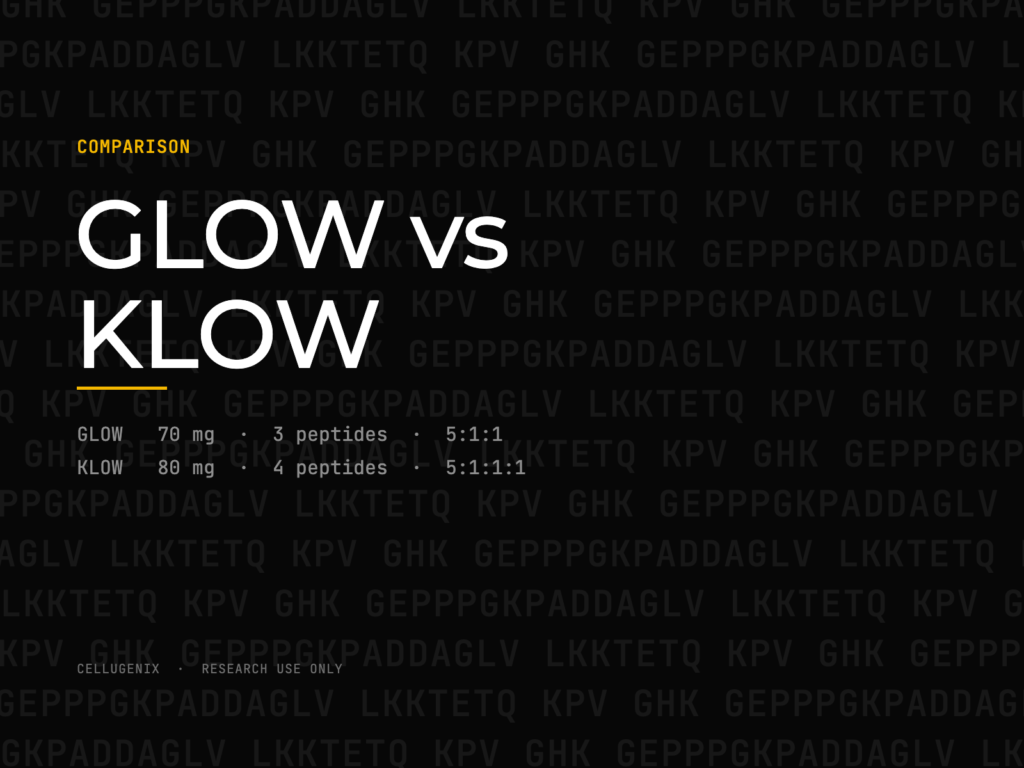
Quick answer: GLOW vs KLOW peptide. Both are research blends built on the same base of GHK-Cu 50 mg, BPC-157 10 mg, and TB-500 10 mg. GLOW stops there (70 mg, 5:1:1). KLOW adds KPV 10 mg (80 mg, 5:1:1:1). Both are supplied as Research Use Only laboratory reagents.
For laboratory research use only. Not for human or animal use. Legal notice
Key takeaways
- KLOW is GLOW plus 10 mg of KPV.
- Three of KLOW’s four components are shared with GLOW, and 70 of its 80 mg is the same base.
- KPV is 12.5% of KLOW by mass but about 17% of its molecules.
- A GLOW certificate identifies three components; a KLOW certificate identifies four.
- Both blends are sold as Research Use Only reagents, with no FDA drug approval.
Contents
- What is the difference between GLOW and KLOW?
- GLOW vs KLOW: 5 key differences at a glance
- What is in the GLOW peptide blend?
- What is in the KLOW peptide blend?
- Is KLOW just GLOW with KPV added?
- GLOW vs KLOW ratio: 5:1:1 vs 5:1:1:1 by mass and by molecule
- How are GLOW and KLOW blends tested? Reading the COA
- Why are GLOW and KLOW peptide blends blue?
- GLOW vs KLOW vs Wolverine: how the three blends compare
- GLOW or KLOW: how do researchers choose between them?
- GLOW and KLOW blends vs single peptide vials
- How should GLOW and KLOW vials be stored?
- Are GLOW and KLOW legal in the US? FDA status in 2026
- GLOW vs KLOW peptide FAQ
What Is the Difference Between GLOW and KLOW?
The difference between GLOW and KLOW is one peptide. Both contain GHK-Cu 50 mg, BPC-157 10 mg, and TB-500 10 mg. KLOW adds KPV 10 mg, raising the vial from 70 mg to 80 mg and the ratio from 5:1:1 to 5:1:1:1. The shared base is identical in both.
GLOW vs KLOW peptide blend comparison
| GLOW (70 mg) | KLOW (80 mg) | |
| Composition name | GHK-Cu + BPC-157 + TB-500 blend | GHK-Cu + BPC-157 + TB-500 + KPV blend |
| GHK-Cu | 50 mg | 50 mg |
| BPC-157 | 10 mg | 10 mg |
| TB-500 | 10 mg | 10 mg |
| KPV | None | 10 mg |
| Ratio by mass | 5:1:1 | 5:1:1:1 |
| Components to identify on COA | 3 | 4 |
| Form | Lyophilized solid, one vial | Lyophilized solid, one vial |
| Cellugenix product | GHK-Cu + BPC-157 + TB-500 Blend 70 mg | GHK-Cu + BPC-157 + TB-500 + KPV Blend 80 mg |
“GLOW” and “KLOW” are seller nicknames. Neither is a chemical name or an International Nonproprietary Name, so from here on, this guide mostly uses composition names: the GHK-Cu + BPC-157 + TB-500 blend, and the same blend with KPV. The Cellugenix versions are listed as GHK-Cu + BPC-157 + TB-500 Blend 70 mg and GHK-Cu + BPC-157 + TB-500 + KPV Blend 80 mg.
GLOW vs KLOW: 5 Key Differences at a Glance
Five measurable differences separate the two blends: the number of peptides, the total mass, the ratio by mass, the number of molecules per vial, and how many components the certificate must identify. Each one follows from the extra 10 mg of KPV.
- Number of peptides: 3 in GLOW, 4 in KLOW.
- Total mass per vial: 70 mg against 80 mg.
- Ratio by mass: 5:1:1 against 5:1:1:1.
- Molecule count: about 142 µmol against about 172 µmol per vial, roughly 20% more in KLOW (calculated from PubChem molecular weights).
- COA requirements: 3 components to resolve by HPLC and confirm by mass spectrometry, against 4.
Several things stay the same: the three base peptides and their amounts, the blue colour of the dry cake, the storage conditions, and the Research Use Only status.
What Is in the GLOW Peptide Blend?
The GLOW blend contains three synthetic peptides in one lyophilized 70 mg vial: GHK-Cu 50 mg, BPC-157 10 mg and TB-500 10 mg. Mixing leaves every peptide chemically intact, with its own formula, molecular weight, and CAS number.
GLOW peptide ingredients: identity data (PubChem, checked October 29, 2026)
| Component | Amount | Sequence | Formula | MW (g/mol) | CAS |
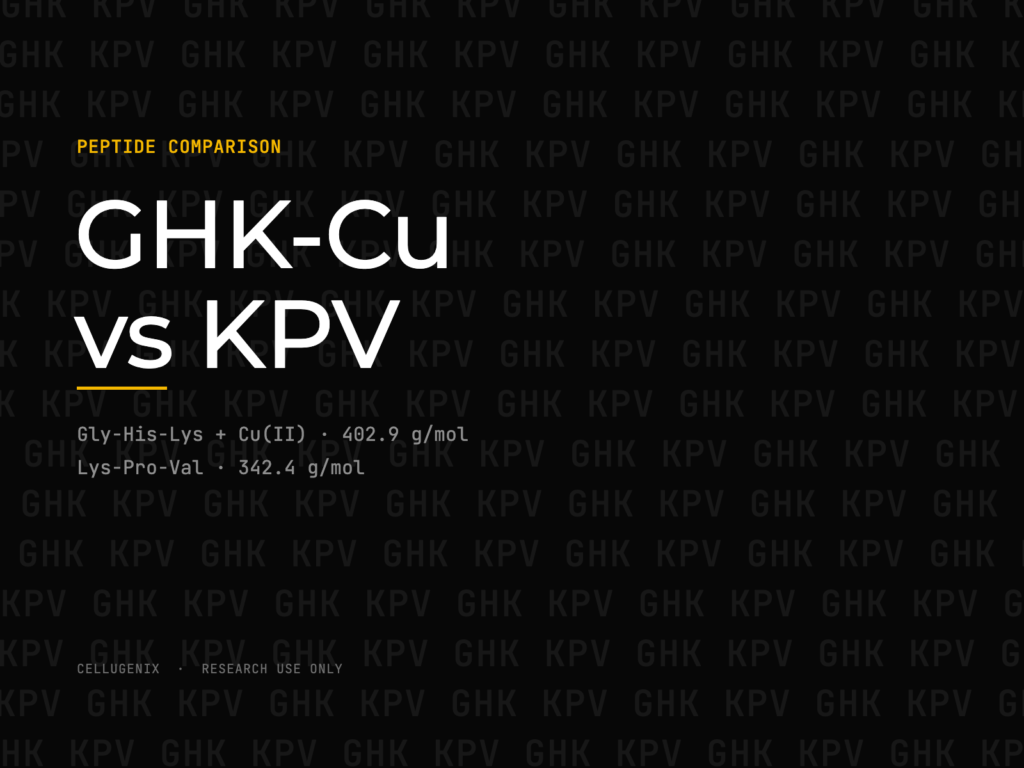
| GHK-Cu | 50 mg | Gly-His-Lys · Cu(II) | C14H23CuN6O4+ | 402.9 | 89030-95-5 |
| BPC-157 | 10 mg | GEPPPGKPADDAGLV | C62H98N16O22 | 1419.5 | 137525-51-0 |
| TB-500 | 10 mg | Ac-LKKTETQ (Tβ4 17-23) | C38H68N10O14 | 889.0 | 885340-08-9 (check against the COA) |
Our three-peptide GHK-Cu blend guide covers GLOW on its own in more depth.
GHK-Cu (50 mg): The Copper Tripeptide
GHK-Cu is glycyl-L-histidyl-L-lysine bound to a single copper(II) ion. Pickart and Thaler reported the tripeptide in human serum in 1973 (PMID 4349963). In the lab it serves copper-coordination chemistry and in-vitro gene-expression work, and it gives both blends their blue colour. More: GHK-Cu guide · GHK-Cu 50 mg.
BPC-157 (10 mg): The 15-Residue Pentadecapeptide
BPC-157 is a 15-residue synthetic peptide (GEPPPGKPADDAGLV) based on part of a larger protein’s sequence. In vitro, it appears in endothelial-cell VEGFR2 work (Hsieh et al., 2017, PMID 27847966) and in primary rat fibroblast studies of FAK and paxillin (Chang et al., 2011, PMID 21030672). More: BPC-157 research overview · BPC-157 10 mg.
TB-500 (10 mg): The Thymosin Beta-4 Fragment
TB-500 is a synthetic copy of thymosin beta-4’s actin-binding motif, most often sold as the acetylated heptapeptide Ac-LKKTETQ (residues 17-23). In a cell-free binding study, Rossenu et al. found the second and fourth residues of the LKKTET motif most important for actin binding (2003, PMID 12606551). A measured mass on the certificate confirms which “TB-500” a lot holds. More: TB-500 research overview · TB-500 5 mg.
What Is in the KLOW Peptide Blend?
The KLOW blend contains four peptides in one 80 mg vial: the same GHK-Cu 50 mg, BPC-157 10 mg, and TB-500 10 mg as GLOW, plus KPV 10 mg. KPV (Lys-Pro-Val) is the smallest of the four molecules, at 342.4 g/mol. Our four-peptide blend with KPV guide covers KLOW on its own.
What Is KPV?
KPV is Lys-Pro-Val, the C-terminal tripeptide (residues 11-13) of alpha-MSH. PubChem lists it as CID 125672: C16H30N4O4, 342.4 g/mol, CAS 67727-97-3. See the KPV research overview and KPV 10 mg.
What Has KPV Been Studied In?
KPV has been studied in cell-line signalling assays, mostly around the NF-κB pathway. Land (2012, PMID 22837805) worked in 16HBE14o- cells, reading NF-κB activity with a reporter gene, and tied KPV’s activity to its own nuclear import and to competition at the importin-α3 binding site on p65 RelA, an in-vitro result that placed its route inside the cell. In the same study, the comparison peptide γ-MSH acted through the MC3R receptor.
What Changes in the 80 mg Vial?
Adding KPV brings four practical changes: 10 more milligrams, a fourth HPLC peak, a fourth mass to confirm by mass spectrometry, and a fourth CAS number on the paperwork.
Is KLOW Just GLOW With KPV Added?
Yes, by composition. KLOW contains the same GHK-Cu, BPC-157, and TB-500 amounts as GLOW, plus 10 mg of KPV. Three of its four components are shared (75%), and 70 of its 80 mg (87.5%) is the same base. Each blend is still made and tested as a separate lot.
Separate lots mean separate certificates. A GLOW report covers a GLOW lot only, so a KLOW vial needs its own report, with its own fourth component identified.
GLOW vs KLOW Ratio: 5:1:1 vs 5:1:1:1 by Mass and by Molecule
By mass, GLOW is 5:1:1, and KLOW is 5:1:1:1. By molecule count, the picture changes: GHK-Cu makes up about 87% of the molecules in GLOW, and KPV, the lightest of the four peptides, becomes about 17% of the molecules in KLOW.
Mass Share in Each Vial
| Component | GLOW | KLOW |
| GHK-Cu | 71.4% | 62.5% |
| BPC-157 | 14.3% | 12.5% |
| TB-500 | 14.3% | 12.5% |
| KPV | None | 12.5% |
Molar Share: How Many Molecules Are in Each Vial?
Calculated from PubChem molecular weights
| Component | MW (g/mol) | µmol per vial | GLOW share | KLOW share |
| GHK-Cu | 402.9 | ~124 | ~87% | ~72% |
| KPV | 342.4 | ~29 | None | ~17% |
| TB-500 (fragment) | 889.0 | ~11 | ~8% | ~7% |
| BPC-157 | 1419.5 | ~7 | ~5% | ~4% |
| Total | ~142 µmol | ~172 µmol |
Two numbers stand out. A 14% increase in mass, from 70 to 80 mg, gives about 20% more molecules, because KPV is so light. And KLOW holds roughly 4 KPV molecules for every BPC-157 molecule, while the label ratio between them reads 1:1.
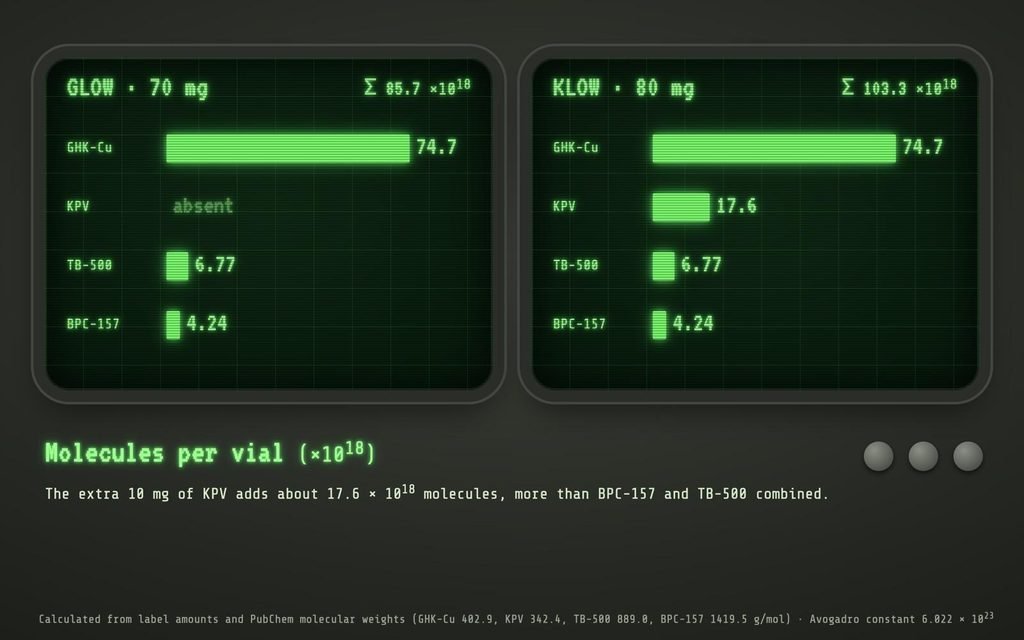
Molecules per vial in the 70 mg GLOW and 80 mg KLOW blends: KPV adds about 17.6 × 10^18 molecules, more than BPC-157 and TB-500 together
How Are GLOW and KLOW Blends Tested? Reading the COA
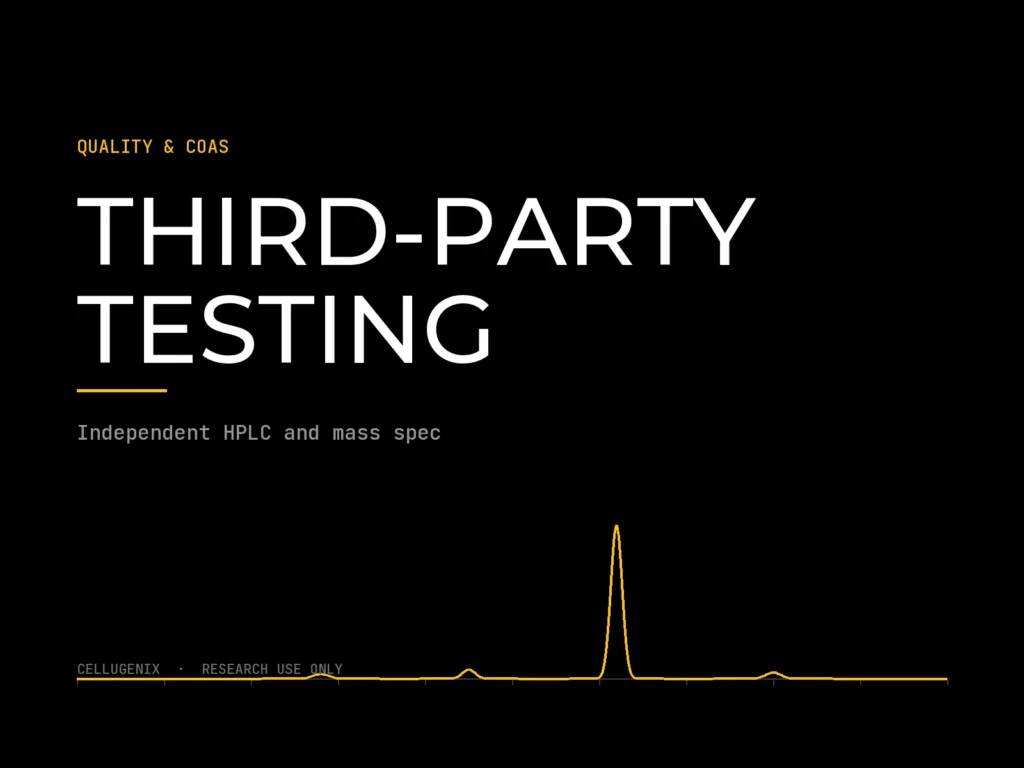
A GLOW blend should be tested by HPLC and mass spectrometry for three components, and a KLOW blend for four. The certificate should show each peptide at its own HPLC peak and expected mass, plus the lot number, test date, lab, and a report ID that can be verified online.
HPLC: One Peak per Peptide
Each peptide should appear as its own resolved peak, ideally with its own area. When a report gives only one purity number for the whole vial, the large GHK-Cu peak can mask a weak 10 mg component.
Mass Spectrometry: Confirming Each Identity
Mass spectrometry confirms what each peak is. The expected masses are about 403 for GHK-Cu, 1,419.5 for BPC-157, and 889 for TB-500, plus about 342 for KPV in KLOW.
Cellugenix GLOW and KLOW Batch Results
Both current reports come from Canada Peptide Testing and are verified on the lab’s public register (checked October 29, 2026):
| GLOW 70 mg | KLOW 80 mg | |
| Report | CPT-GLOW-C8AE19 | CPT-KLOW-E4647E |
| Batch/lot | L25-01 / CGX-2025 | L26-01 / CGX-2026 |
| HPLC purity | Purity by HPLC, see the batch result | Purity by HPLC, see the batch result |
| Measured content | 72.98 mg | 84.59 mg |
| Tested/reported | October 23 / 25, 2026 | October 23 / 25, 2026 |
| Recorded appearance | Blue lyophilized powder | Blue lyophilized powder |
Purity by HPLC, see the batch result. “Measured content” is the total weight of peptide the lab found in the vial, set against the label: 72.98 mg against 70 mg for GLOW (104.3% fill) and 84.59 mg against 80 mg for KLOW (105.7% fill). Both reports give HPLC-UV results for the blend as a whole and record a blue lyophilized powder. Mass spectrometry is outside the scope of both reports, so labs that need per-component identity run it themselves.
5-Point Blend COA Checklist
- Lot match. The lot code on the vial appears on the report.
- Every component named. Three for GLOW, four for KLOW.
- A result per component. An amount, a peak area or a mass for each peptide.
- Test date and lab. Both printed on the report.
- A verifiable report ID. The number opens the same record on the lab’s site.
Open the certificates for GLOW 70 mg and KLOW 80 mg in the COA library, and use our COA reading guide and HPLC vs mass spectrometry explainer field by field.
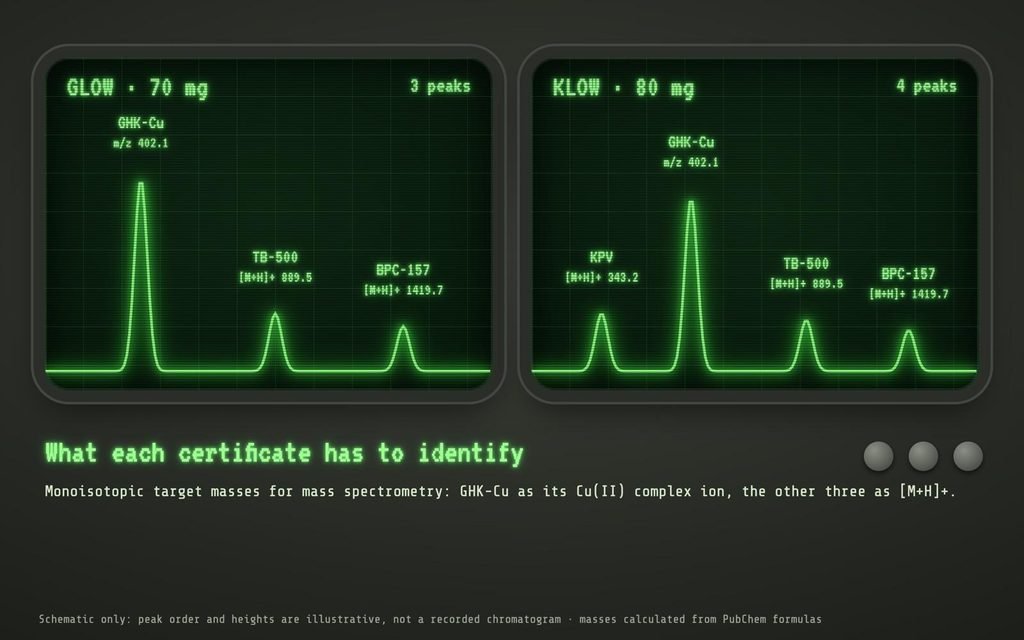
Mass spectrometry targets for a three-peptide GLOW and a four-peptide KLOW COA, shown as a schematic chromatogram
Why Are GLOW and KLOW Peptide Blends Blue?
Both blends are blue because both contain 50 mg of GHK-Cu. The copper(II) centre takes up some orange-red light (a d-d transition), leaving the dry cake looking blue. BPC-157, TB-500 and KPV are white powders.
Colour works as a quick hint. A white cake raises an identity question, and the certificate answers it: both current Cellugenix reports record a blue lyophilized powder.
GLOW vs KLOW vs Wolverine: How the Three Blends Compare
The three blends build on each other. Wolverine is BPC-157 + TB-500. Add 50 mg of GHK-Cu to that pair and the result is GLOW; add 10 mg of KPV to GLOW and the result is KLOW. The BPC-157 + TB-500 base runs through all three.
| Blend | Composition | Ratio | Total | COA components |
| Wolverine | BPC-157 + TB-500 | 1:1 | 10 mg (5/5) | 2 |
| GLOW | + GHK-Cu 50 mg | 5:1:1 | 70 mg | 3 |
| KLOW | + KPV 10 mg | 5:1:1:1 | 80 mg | 4 |
The two-peptide starting point has its own BPC-157 + TB-500 blend guide, a product page for the BPC-157 + TB-500 Blend 5/5 mg, and a molecule-by-molecule BPC-157 vs TB-500 comparison.
GLOW or KLOW: How Do Researchers Choose Between Them?
Researchers choose between the two blends by study design. The deciding questions are whether the protocol needs KPV, whether a fixed ratio from one lot is required, and whether the lab can verify three or four components.
- Does the protocol need KPV? If KPV is part of the design, the 80 mg blend carries it; if not, the 70 mg blend leaves it out.
- Does it need a fixed ratio from one lot? Both blends fix their ratios at manufacture.
- How many components can the lab’s method verify? A four-component blend asks more of the HPLC method and the mass check.
- Is a minus-KPV control needed? The 70 mg blend can serve as that comparison, since it matches the 80 mg blend in every component except KPV.
GLOW and KLOW Blends vs Single Peptide Vials
A pre-mixed blend gives a fixed ratio from one lot with one certificate. Single vials let a lab choose every amount and test any compound by itself, each backed by its own certificate.
| Pre-mixed blend | Single vials | |
| Ratio | Fixed at manufacture | Set by the lab |
| Certificates | One per lot | One per compound |
| Controls | Built into the design (70 mg vs 80 mg) | Each compound can run alone |
| Identity checks | Three or four components in one report | One compound per report |
Single-compound vials: GHK-Cu 50 mg, BPC-157 10 mg, TB-500 5 mg and KPV 10 mg.
How Should GLOW and KLOW Vials Be Stored?
Store sealed GLOW and KLOW vials cold, dry, and away from light, as stated on the label. Because GHK-Cu reacts to light, keeping the vial boxed helps.
- Keep the seal intact until the vial is needed.
- Follow the temperature printed on the label.
- Cut down on cold-to-bench trips, since each one risks condensation.
- Record the report number with every experiment that uses the vial.
Our guides to lyophilized peptides and storage and handling cover the details.
Are GLOW and KLOW Legal in the US? FDA Status in 2026
Neither GLOW nor KLOW, nor any of their four peptides, is an FDA-approved drug. In the US both blends are sold as Research Use Only laboratory reagents. The 2026 regulatory activity concerned pharmacy compounding, so the dated status below is the part to check against the headlines.
| Date | Event | Source |
| April 2026 | FDA moved 12 peptides off Category 2 after their nominators withdrew them, BPC-157, TB-500 and KPV among them | Federal Register 2026-07361; FDA page |
| July 23, 2026 | The FDA advisory committee voted 8 to 6, with one abstention, to recommend BPC-157, TB-500 and KPV for the 503A Bulks List; the votes are advisory | FDA Law Blog |
| August 24, 2026 | FDA warning letters to online peptide sellers | FDA warning letter |
| October 2026 | An interim policy on compounding certain peptides went to the White House budget office on October 14, with review meetings logged through October 27 | OMB review record |
| October 29, 2026 | No issued interim policy and no Federal Register rule adding any peptide to the 503A Bulks List | Federal Register |
GHK-Cu’s record differs: “GHK-Cu (for injectable routes)” appears among the withdrawn nominations on FDA’s page, and the July panel didn’t review it. WADA’s 2026 list names BPC-157 in S0 and places thymosin-β4 derivatives, TB-500 included, in S2.3. For the full set of US rules, read are peptides legal in the US?
GLOW vs KLOW Peptide FAQ
What is the difference between GLOW and KLOW peptide?
KLOW carries everything in GLOW and adds 10 mg of KPV. GLOW holds GHK-Cu 50 mg, BPC-157 10 mg, and TB-500 10 mg in a 70 mg vial at 5:1:1. KLOW holds the same three plus KPV, for 80 mg at 5:1:1:1, and its certificate identifies four components.
Is KLOW the same as GLOW?
They overlap heavily. Both share three peptides at identical amounts, and KLOW adds KPV 10 mg. Each is a separate product made as its own lot, so each comes with its own certificate of analysis, and a GLOW report never covers a KLOW vial.
Does GLOW contain KPV?
No. GLOW contains three peptides only: GHK-Cu 50 mg, BPC-157 10 mg, and TB-500 10 mg. KPV is the fourth component that defines the 80 mg KLOW blend, and a GLOW certificate should identify exactly three components.
Klow vs glow: which has more peptides?
KLOW, with four peptides and 80 mg in total, against GLOW’s three peptides and 70 mg. Counted in molecules, KLOW holds about 172 µmol per vial against GLOW’s 142 µmol, roughly 20% more, because the added KPV is the lightest of the four.
What has KPV been studied in?
KPV has been studied mainly in cell-line signalling assays around NF-κB. In one in-vitro study using the 16HBE14o- epithelial cell line, its activity was linked to its nuclear import and to the importin-α3 binding site on p65 RelA.
How many peaks should a GLOW or KLOW COA show?
A GLOW certificate should resolve three components and a KLOW certificate four, ideally as separate HPLC peaks, each confirmed by mass spectrometry near its expected mass: about 403, 1,419.5, 889 and, for KLOW, 342.
Is GLOW the same as “glow” skincare peptides?
No. This GLOW is a freeze-dried research reagent supplied with a batch certificate. Skincare products sold under a “glow” name are cosmetics, with ingredient lists and cosmetic rules of their own, and the copper peptide is the most they can share with the blend.
Are GLOW and KLOW FDA-approved?
No. No form of either blend, and none of the four peptides, holds FDA drug approval. On FDA’s compounding page (April 22, 2026), all four appear among withdrawn nominations, and July’s committee votes on BPC-157, TB-500, and KPV were advisory. An interim policy remained under White House review on October 29, 2026.
Compare the batch COAs and prices: GHK-Cu + BPC-157 + TB-500 Blend 70 mg and GHK-Cu + BPC-157 + TB-500 + KPV Blend 80 mg. All current reports are collected in the COA library.
For laboratory research use only. Not for human or animal use. Legal notice
References
- PubChem: GHK-Cu, CID 71587328; BPC-157, CID 9941957; TB-500, CID 62707662; KPV, CID 125672; thymosin beta-4, CID 45382195, checked October 29, 2026
- Pickart L, Thaler MM. Nature New Biology, 1973 (isolation from human serum). PMID 4349963
- Hsieh MJ, et al. J Mol Med, 2017 (in vitro section: cultured human endothelial cells). PMID 27847966
- Chang CH, et al. J Appl Physiol, 2011 (in vitro section: primary rat fibroblast cultures). PMID 21030672
- Rossenu S, et al. J Biol Chem, 2003 (in vitro: phage-display actin-binding assay). PMID 12606551
- Land SC. Int J Physiol Pathophysiol Pharmacol, 2012 (in vitro: 16HBE14o- cell line, NF-κB reporter). PMID 22837805
- FDA, bulk drug substances page, content current as of April 22, 2026
- Federal Register, notice 2026-07361, April 16, 2026
- FDA Law Blog, PCAC day 1, July 24, 2026
- FDA, warning letter dated August 24, 2026
- OMB, EO 12866 review record, RIN 0910-ZD94, checked October 29, 2026
- WADA, 2026 Prohibited List, S0 and S2.3
- Canada Peptide Testing, reports CPT-GLOW-C8AE19 and CPT-KLOW-E4647E, verified October 29, 2026
For laboratory research use only. Not for human or animal use.