KLOW Peptide Blend: What’s in It, the 5:1:1:1 Ratio and How It’s Tested
Tilt an 80 mg vial of the KLOW peptide blend toward a window, and the dry cake has a faint blue cast. One ingredient makes that color, and by molecule count that same ingredient accounts for roughly 72% of everything in the vial. The other three peptides share what’s left, and one of them makes up barely 4%.
So what is the KLOW peptide really, if four equal-looking names on a label hide numbers that lopsided? Let’s start with the short version.
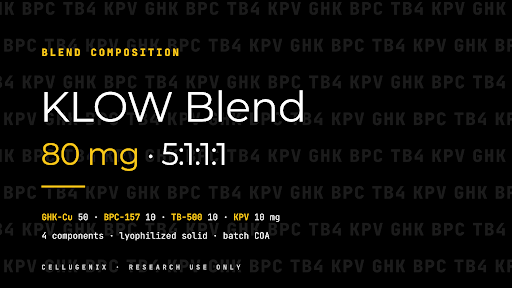
Quick answer: KLOW is the market name for a four-peptide research blend: GHK-Cu 50 mg, BPC-157 10 mg, TB-500 10 mg, and KPV 10 mg in one 80 mg lyophilized vial, a 5:1:1:1 ratio by mass. It is the GHK-Cu + BPC-157 + TB-500 blend (sold as GLOW) with KPV added. It is a research reagent with no FDA drug approval.
Key facts: 4 components · 80 mg total · 5:1:1:1 by mass · lyophilized solid · batch COA
What Is the KLOW Peptide Blend?
The KLOW peptide blend is a pre-mixed, freeze-dried powder that holds four separate synthetic research peptides in a single sealed vial. Each one keeps its own sequence and structure. Nothing is bonded together; the vial simply contains all four at set amounts.
“KLOW” itself is a seller’s nickname. It has no chemical meaning, no International Nonproprietary Name (INN), and no entry in PubChem. From here on, we’ll use the composition name, the GHK-Cu + BPC-157 + TB-500 + KPV blend, because that name tells you exactly what you’re holding.
Three facts follow from that:
- It’s a mixture. Four molecules share one vial, so there’s no single “KLOW molecule” to look up.
- It’s a laboratory reagent. The blend has no drug approval anywhere in the US.
- The name fixes nothing. Two products can both carry the nickname and still differ in milligrams per component. Only the label and the batch certificate of analysis (COA) pin those numbers down.
The GHK-Cu + BPC-157 + TB-500 + KPV Blend 80 mg follows the most common layout: 50 mg of GHK-Cu and 10 mg of each of the other three.
KLOW Ingredients: The Four Components
Every component below is described by what it is chemically and which in vitro assays it turns up in. Identity data come from PubChem, checked on 23 October 2026.
| Component | Amount | Type | Sequence | Formula | MW (g/mol) | CAS |
| GHK-Cu | 50 mg | Cu(II) tripeptide complex | Gly-His-Lys·Cu | C14H23CuN6O4+ | 402.9 | 89030-95-5 |
| BPC-157 | 10 mg | Synthetic pentadecapeptide | GEPPPGKPADDAGLV | C62H98N16O22 | 1419.5 | 137525-51-0 |
| TB-500 | 10 mg | Synthetic thymosin β4 fragment | Ac-LKKTETQ | C38H68N10O14 | 889.0 | 885340-08-9 (see note) |
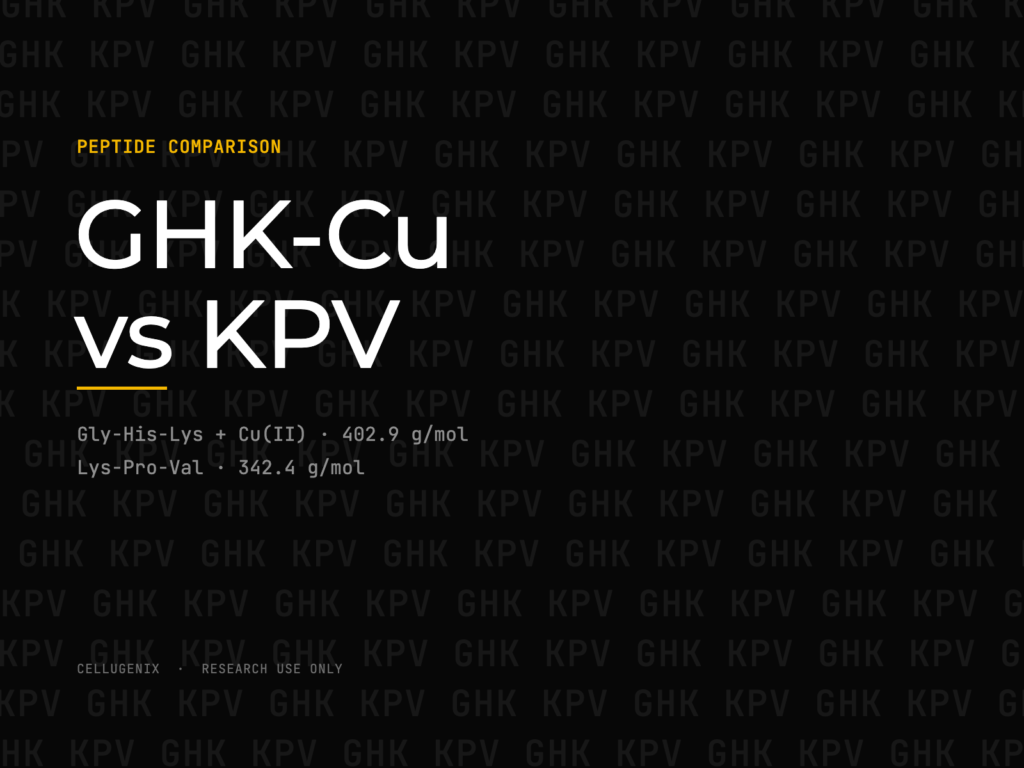
| KPV | 10 mg | Tripeptide | Lys-Pro-Val | C16H30N4O4 | 342.4 | 67727-97-3 |
GHK-Cu (50 mg)
GHK-Cu is the copper(II) complex of glycyl-L-histidyl-L-lysine, a three-residue peptide. Loren Pickart and Melvin Thaler first isolated the GHK tripeptide from human plasma in 1973, which is where the name’s history starts.
In the lab, GHK-Cu is a model for copper-coordination chemistry: the histidine side chain and the peptide backbone hold one Cu(II) ion in a tight complex. Researchers also add it to cell-culture media in gene-expression and cell-behavior assays. At 50 mg, it’s the largest share of the blend by weight and by molecule count. The single-compound GHK-Cu 50 mg carries the same amount on its own.
BPC-157 (10 mg)
BPC-157 is a synthetic 15-residue peptide, GEPPPGKPADDAGLV. Its name, “body protection compound,” comes from a parent protein isolated from gastric juice, and BPC-157 copies 15 residues of it.
Bench work on BPC-157 centers on cell migration and signalling. In cultured human umbilical vein endothelial cells, Hsieh and colleagues (2017) tracked VEGFR2 activation and its downstream signals. Chang and colleagues (2011) followed FAK and paxillin phosphorylation in cultured rat fibroblasts. The BPC-157 10 mg vial supplies the same 10 mg as a single compound.
TB-500 (10 mg)
TB-500 is a synthetic peptide built on the actin-binding stretch of thymosin β4, the seven-residue motif LKKTETQ, positions 17 through 23 of the parent chain, which runs to 43 residues. PubChem lists it as the N-acetylated heptapeptide Ac-LKKTETQ, about 889 g/mol. Full-length thymosin β4 weighs roughly 4,963 g/mol.
Labs use TB-500 in G-actin binding studies and scratch-style cell-migration assays. Rossenu and colleagues (2003) mapped how the actin-binding motifs in thymosin β4 contribute to affinity using phage display. One catch: sellers don’t all mean the same molecule by “TB-500.” Some list the heptapeptide’s CAS 885340-08-9; others list full thymosin β4’s 77591-33-4. Check the identity and mass on the COA. The TB-500 5 mg single vial is the reference compound.
KPV (10 mg)
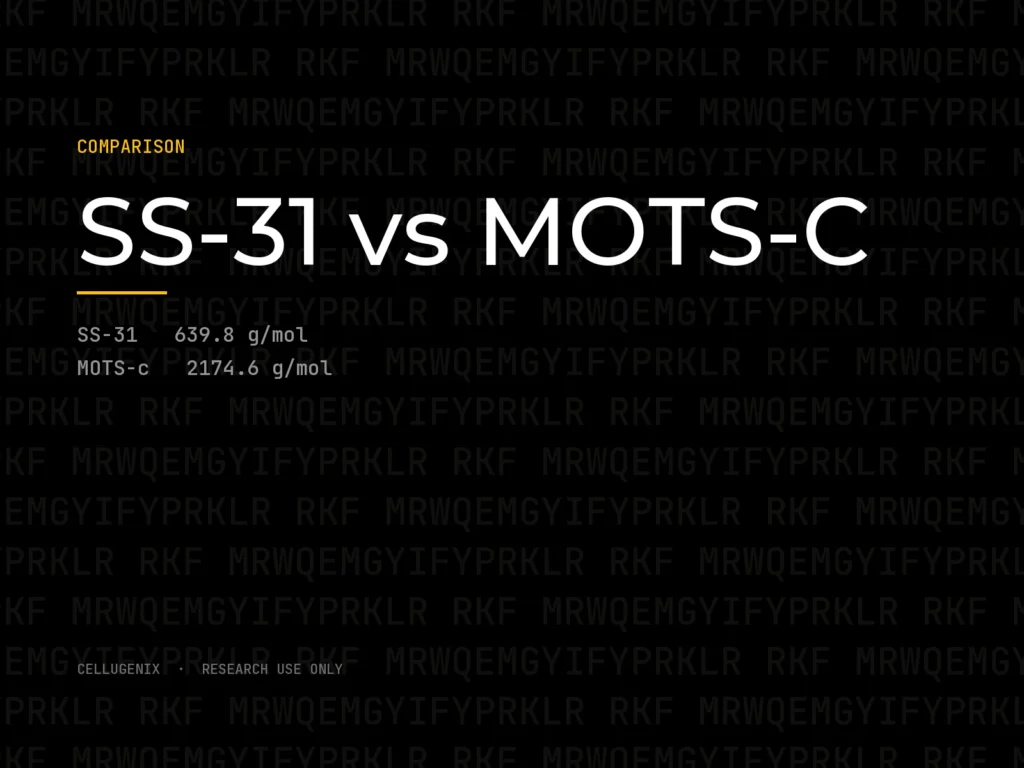
KPV is the tripeptide Lys-Pro-Val, copied from the last three positions (11 to 13) of alpha-melanocyte-stimulating hormone (α-MSH). It leaves out the His-Phe-Arg-Trp core that the full hormone uses at melanocortin receptors.
Cell-line work on KPV looks at melanocortin-related signalling and the NF-κB pathway. Dalmasso and colleagues (2008) measured KPV uptake through the PepT1 transporter and NF-κB activity in epithelial cell lines. Land (2012) ran NF-κB reporter work in human bronchial epithelial cells. The KPV 10 mg single vial matches the blend’s KPV amount.
The KLOW Ratio: 5:1:1:1 by Mass, and What That Means in Moles
The 5:1:1:1 ratio describes weight. GHK-Cu makes up 50 of the 80 mg, and BPC-157, TB-500, and KPV each make up 10 mg. Molecules don’t care about milligrams, though. Divide each mass by its molecular weight, and the picture changes completely.
| Component | Mass share |
| GHK-Cu | 62.5% |
| BPC-157 | 12.5% |
| TB-500 | 12.5% |
| KPV | 12.5% |
Now the molar view, calculated from the PubChem molecular weights above (calculated values; a COA reports measured ones):
| Component | mg | MW | µmol per vial (approx.) | Molar share |
| GHK-Cu | 50 | 402.9 | 124 | ~72% |
| KPV | 10 | 342.4 | 29 | ~17% |
| TB-500 (fragment) | 10 | 889.0 | 11 | ~7% |
| BPC-157 | 10 | 1419.5 | 7 | ~4% |
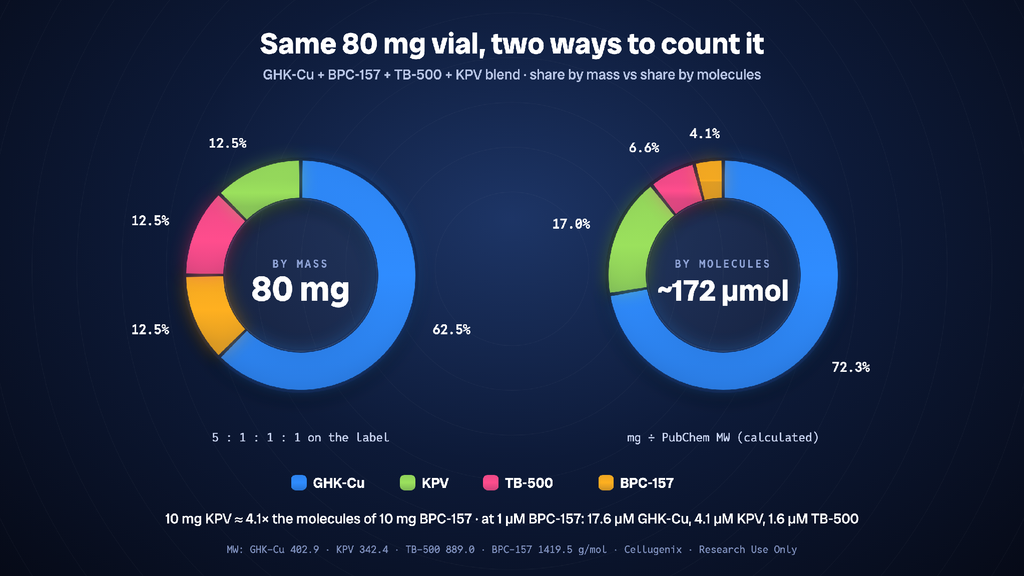
Mass share vs molar share in the 80 mg GHK-Cu + BPC-157 + TB-500 + KPV blend
Equal milligrams, very unequal molecule counts. KPV is about a quarter of BPC-157’s size, so 10 mg of it holds roughly 4.1 times as many molecules.
That difference shows up the moment an assay is planned in micromolar terms. Set a medium so BPC-157 reaches 1 µM, and the same well holds about 17.6 µM GHK-Cu, 4.1 µM KPV and 1.6 µM TB-500. A fixed-ratio blend can’t move one of those numbers without moving the others.
The ratio also varies between products. Besides the 80 mg layout at 5:1:1:1, some listings use an equal 10 mg each, 40 mg total. Same nickname, very different molar picture, so read the label and the COA before any calculation.
Why a Blend Has No Single Molecular Weight
A molecular weight belongs to one molecule. A blend is four molecules in one container, so it has four molecular weights, four formulas, and four CAS numbers, and each one stays exactly as listed in the table above.
Freeze-drying doesn’t change that. A lyophilized powder is the dried form of whatever went into the vial, so each peptide stays in the cake as its own compound.
If a product listing shows a single “blend MW” or one CAS number for the whole vial, treat it as a red flag. It usually means the identity data were copied from a single-compound page, or averaged into a figure no instrument would ever report. A proper blend COA lists each component separately, with its own expected mass.
KLOW vs GLOW: How the Compositions Differ
The two blends share their first three ingredients at identical amounts. The 80 mg four-peptide blend is the 70 mg three-peptide blend plus 10 mg of KPV. Nothing else changes.
| GLOW (70 mg) | KLOW (80 mg) | |
| Components | GHK-Cu 50 + BPC-157 10 + TB-500 10 | Same + KPV 10 |
| Ratio by mass | 5:1:1 | 5:1:1:1 |
| Total | 70 mg | 80 mg |
| Extra identity check on the COA | 3 peaks | 4 peaks |
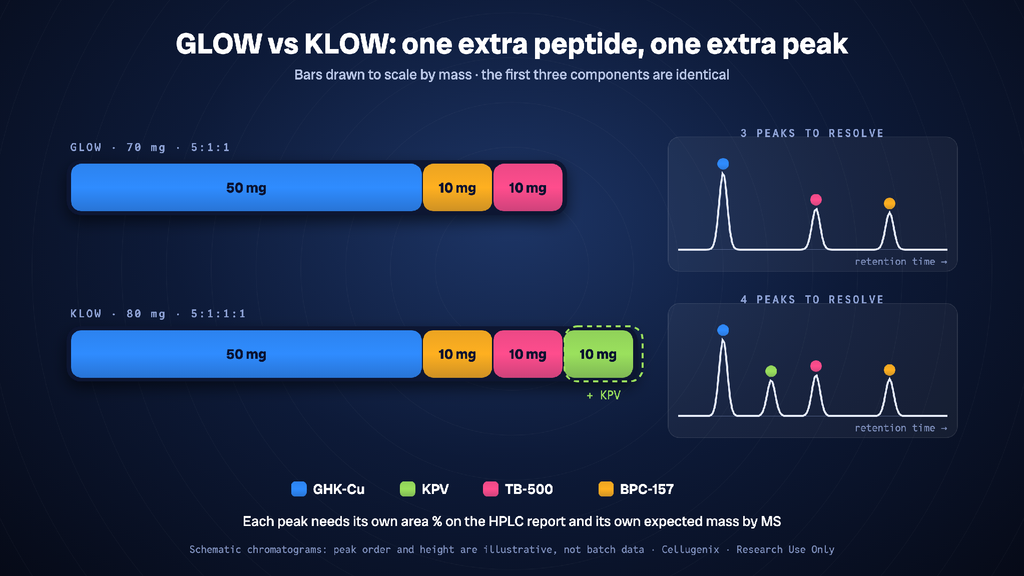
GLOW 70 mg vs KLOW 80 mg composition and expected HPLC peaks
Both trace back to a simpler two-peptide pairing, the BPC-157 + TB-500 Blend 5/5 mg, sold under the nickname “Wolverine.” Add 50 mg of GHK-Cu, and you have the GHK-Cu + BPC-157 + TB-500 Blend 70 mg. Add KPV to that, and you reach the 80 mg blend. For how the two shared peptides compare on structure alone, see BPC-157 vs TB-500.
So which one fits a study? Composition decides it. If an assay plan includes the KPV tripeptide, the four-component vial carries it; if it doesn’t, the three-component vial leaves it out. On the COA, KPV adds one more peak to resolve and one more mass to confirm.
Pre-Mixed Blend vs Single Vials
A pre-mixed vial gives the same 5:1:1:1 ratio every time it’s opened. Four single vials give a lab control over each component’s amount. Which one suits a project depends on whether the ratio is the variable under study or a constant.
| Pre-mixed blend | Four single vials | |
| Fixed ratio | Yes, set at manufacture | Set by the lab |
| Number of COAs | 1 (covers all four) | 4 |
| Identity checks per report | 4 on one chromatogram | 1 per report |
| Flexibility | Ratio can’t change | Each concentration can vary on its own |
Single vials suit work that needs to vary one peptide while holding the others steady, or run each one alone as a control. The four single compounds are GHK-Cu 50 mg, BPC-157 10 mg, TB-500 5 mg, and KPV 10 mg. The blend suits work that repeats one fixed composition across many runs, with one lot number to record.
Why Is the KLOW Powder Blue?
The blue comes from copper. GHK-Cu holds a Cu(II) ion, and Cu(II) has a partly filled set of d-orbitals. When visible light hits the complex, electrons jump between those d-orbitals (a d-d transition) and absorb light from the orange-red end of the spectrum. What reaches the eye is the leftover blue.
Blue is normal for any copper-peptide blend. The other three components dry to a white powder, so their only effect is to lighten the color. A pure-white “KLOW” cake should raise a question: is the GHK-Cu there at all, or was copper-free GHK used? The COA’s GHK-Cu peak and mass will answer it.
How a KLOW Blend Is Tested: Reading a Blend COA
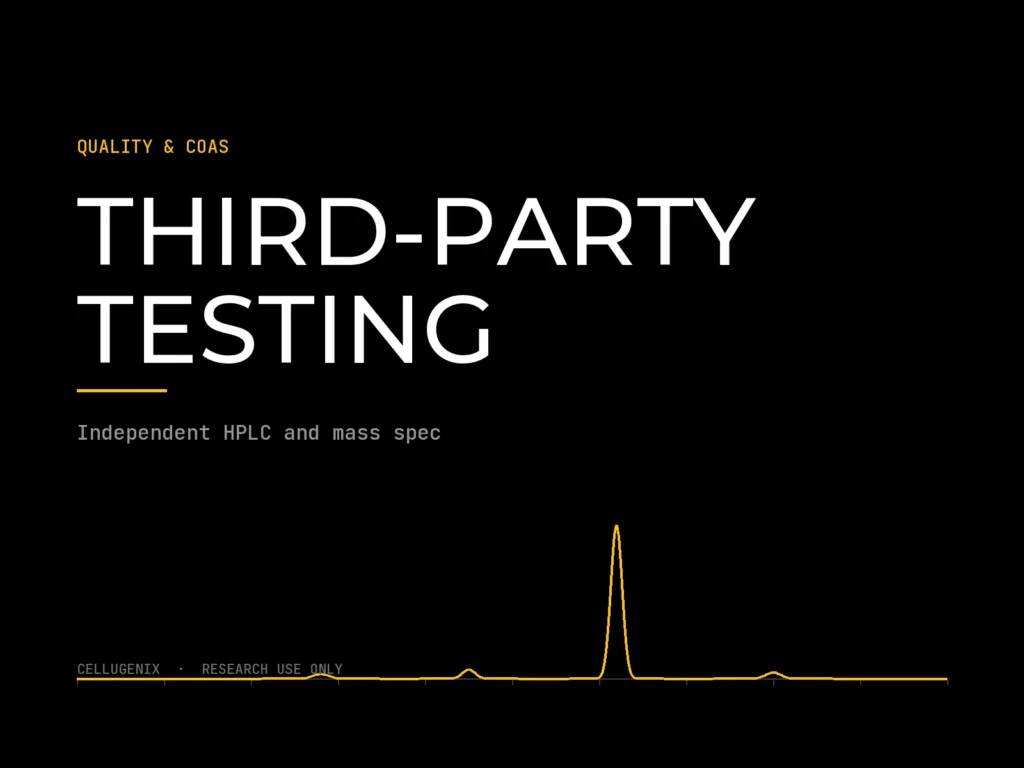
A blend COA needs to prove two things for each of the four peptides: that it’s present at the right identity, and that it’s clean. High-performance liquid chromatography (HPLC) handles separation and purity. Mass spectrometry (MS) handles identity.
HPLC. The column pulls the four peptides apart by how strongly each one sticks, so each appears as its own peak at its own retention time. Every peak should carry its own area %. A single “total purity” figure for the whole vial says little, because a strong 50 mg GHK-Cu peak can mask a weak 10 mg peak beside it.
Mass spectrometry. MS weighs the molecules. Each component should show its expected mass, roughly 403, 1,419.5, 889, and 342 for GHK-Cu, BPC-157, TB-500, and KPV. Mass is what confirms which TB-500 molecule is in the vial.
Identity checks carry extra weight for this group of peptides. At the July 2026 compounding committee meeting, FDA reviewers described BPC-157 as “not well-characterized from the physical and chemical characterization perspective,” according to a Bass, Berry & Sims summary of the meeting.
Five things to check on a blend COA:
1. The lot number matches the number on the vial.
2. All four components are named and identified.
3. Each component has its own amount or assay result.
4. The test date and the testing lab are shown.
5. The report has an ID you can verify.
For the 80 mg blend sold here: purity by HPLC, see the batch result. For a full walk-through, read how to read a COA, compare HPLC vs mass spectrometry, or browse the COA library.
Storage and Handling of Lyophilized KLOW Vials
Keep the sealed vial cold, dry, and out of light, at the conditions printed on the label. A freeze-dried cake holds up well because there’s almost no water left for reactions to run in, but heat, moisture, and light still wear it down over time.
Light deserves extra care here. GHK-Cu is light-sensitive, so keep the vial in its box or another opaque container between uses.
Temperature swings are the other thing to avoid. Each trip from cold storage to the bench and back can pull a little condensation onto the glass, so plan to take the vial out as few times as possible. Our storage and handling guide covers labels, logs, and cold-chain records.
Regulatory Status of KLOW in the US (2026)
No form of this blend is an FDA-approved drug, and the same goes for each of its four peptides on its own. Sellers supply it as a research reagent labelled Research Use Only.
Here is where things stand as of 23 October 2026:
| Date | What happened | Source |
| 22 Apr 2026 | BPC-157 came off Category 2 of FDA’s 503A bulks list once the nominations for it were withdrawn | FDA, 503A bulks list update |
| 23 to 24 Jul 2026 | FDA’s Pharmacy Compounding Advisory Committee reviewed BPC-157, TB-500 and KPV as 503A bulk nominations | FDA meeting agenda |
| 23 to 24 Jul 2026 | The committee voted 8 to 6 to recommend each one; the vote is advisory and adds nothing to the list | Bass, Berry & Sims, 31 Jul 2026 |
| 24 Aug 2026 | FDA sent warning letters to five online peptide sellers, finding their products intended for human use “despite statements on your product labeling,” based on dosing guidance, reconstitution calculators and disease claims | Arent Fox Schiff, 18 Sep 2026 |
Two points keep that table in proportion. Leaving Category 2 doesn’t place a substance in Category 1. And an advisory vote isn’t an approval: adding a substance to the 503A list takes notice-and-comment rulemaking, and none had been published as of this update.
In sport, the WADA 2026 Prohibited List names BPC-157 under S0 (non-approved substances) and “Thymosin-β4 and its derivatives e.g. TB-500” under S2. WADA published its 2027 List in September 2026, and it takes effect on 1 January 2027.
For the wider picture, read Are research peptides legal in the US?
FAQ
What is the KLOW peptide blend?
The KLOW peptide blend is a freeze-dried research reagent containing four synthetic peptides in one vial: GHK-Cu 50 mg, BPC-157 10 mg, TB-500 10 mg, and KPV 10 mg. That’s 80 mg in a 5:1:1:1 ratio by mass. “KLOW” is a seller’s nickname with no chemical meaning.
What are the KLOW peptide ingredients?
The four KLOW peptide ingredients are GHK-Cu (a copper tripeptide complex, 402.9 g/mol), BPC-157 (a 15-residue synthetic peptide, 1419.5 g/mol), TB-500 (the acetylated LKKTETQ fragment of thymosin β4, 889.0 g/mol), and KPV (Lys-Pro-Val from α-MSH, 342.4 g/mol). Amounts vary by product, so check the label.
What’s the difference between KLOW and GLOW?
KLOW is GLOW plus 10 mg of KPV. GLOW holds GHK-Cu 50 mg, BPC-157 10 mg, and TB-500 10 mg (70 mg, 5:1:1). KLOW adds KPV for 80 mg at 5:1:1:1. On a COA, that means four HPLC peaks and four masses to confirm, one more of each than GLOW.
Why is KLOW blue?
KLOW is blue because of the copper(II) ion in GHK-Cu. Cu(II) absorbs orange-red light through d-d electron transitions, so the powder looks blue. The other three peptides are white. A white cake labelled as this blend suggests the copper complex may be missing, which the COA can confirm.
Does KLOW have one molecular weight?
It has four. KLOW is a mixture of four separate molecules, each with its own molecular weight: about 402.9, 1419.5, 889.0, and 342.4 g/mol. A single “blend MW” on a listing doesn’t describe any real molecule. A proper COA reports each component’s expected and measured mass.
Is KLOW FDA-approved?
No. As of 23 October 2026, neither the blend nor any of its four peptides is an FDA-approved drug. FDA’s compounding committee voted 8 to 6 in July 2026 to recommend BPC-157, TB-500, and KPV for the 503A list, but that vote is advisory, and no rule has followed.
How do I check a KLOW COA?
Match the lot number to the vial, then confirm all four components appear with their own HPLC peak, area %, and expected mass. Look for a per-component amount, the test date, the lab’s name, and a report ID you can verify. One “total purity” figure isn’t enough for a four-part blend.
Next Step
Specifications, storage notes, and batch details are on the product page. View the GHK-Cu + BPC-157 + TB-500 + KPV Blend 80 mg and its batch documentation, or browse the COA library to see how our reports are laid out.
For laboratory research use only. Not for human or animal use.
References
- PubChem: GHK-Cu (CID 71587328), BPC-157 (CID 9941957), TB-500 (CID 62707662), KPV (CID 125672), thymosin β4 (CID 16132341). Accessed 23 October 2026. Database.
- Pickart L, Thaler MM. Nature New Biology, 1973. PMID 4349963. In vitro; isolation of GHK from human plasma (origin fact only).
- Hsieh MJ, et al. J Mol Med, 2017. PMID 27847966. In vitro (HUVEC) section cited; the paper also includes animal work.
- Chang CH, et al. J Appl Physiol, 2011. PMID 21030672. In vitro (cultured rat fibroblasts) section cited.
- Rossenu S, et al. J Biol Chem, 2003. PMID 12606551. In vitro (phage display, actin binding).
- Dalmasso G, et al. Gastroenterology, 2008. PMID 18061177. In vitro (epithelial cell lines) section cited; the paper also includes animal work.
- Land SC. Int J Physiol Pathophysiol Pharmacol, 2012. PMID 22837805. In vitro (human bronchial epithelial cells) section cited.
- FDA. Bulk drug substances nominated for use in compounding under section 503A, updated 22 April 2026. Regulatory.
- FDA. Pharmacy Compounding Advisory Committee meeting agenda, 23 to 24 July 2026. Regulatory.
- Bass, Berry & Sims. FDA advisory committee recommends six peptides for compounding, 31 July 2026. Legal analysis.
- Arent Fox Schiff. Alert on the August 2026 FDA warning letters to peptide vendors. Legal analysis.
- World Anti-Doping Agency. 2026 Prohibited List (in force 1 January 2026). Sport regulation.
For laboratory research use only. Not for human or animal use.