GLOW Peptide Blend: What’s in the 70 mg Vial, the 5:1:1 Ratio and How It’s Tested
For laboratory research use only. Not for human or animal use. Legal notice
A 70 mg GLOW vial contains three peptides, yet one of them supplies close to nine of every ten molecules inside. The label’s tidy 5:1:1 describes weight, and weight hides how lopsided the mixture really is once you count molecules. That difference between grams and molecules is where most confusion about the glow peptide starts.
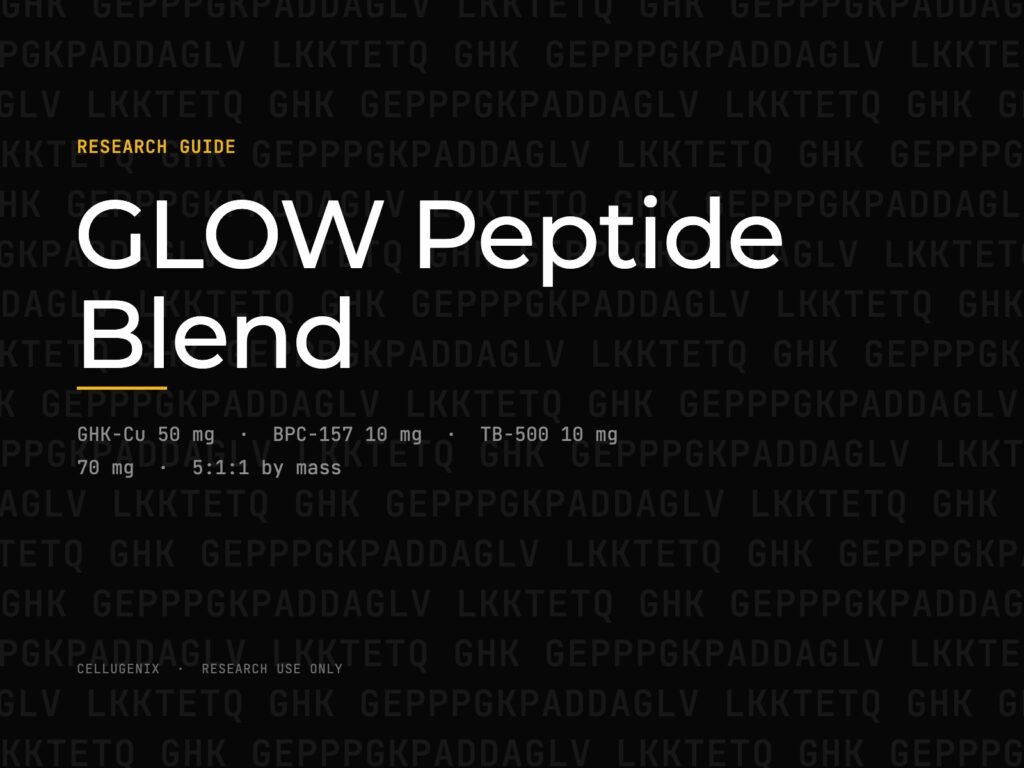
Quick answer: what is the GLOW peptide blend? GLOW is the market name for a three-peptide research blend: GHK-Cu 50 mg, BPC-157 10 mg and TB-500 10 mg in one 70 mg lyophilized vial, a 5:1:1 ratio by mass. No FDA drug approval covers it; it’s a lab reagent, and a separate thing from the cosmetic “glow” serums sold for topical use.
✔ 3 components, physically mixed and unbonded
✔ 70 mg total, 5:1:1 by mass
✔ Lyophilized solid with a batch COA
Contents
- What is the GLOW peptide blend?
- GLOW peptide ingredients: the three components
- The GLOW ratio: 5:1:1 by mass, and what it means in molecules
- Why a blend has no single molecular weight
- GLOW vs KLOW vs Wolverine: how the blends compare
- Why is the GLOW powder blue?
- GLOW research blend vs “glow” skincare peptides
- Pre-mixed blend vs single vials
- How a GLOW blend is tested: reading a three-component COA
- What are the limits of the research data?
- Storage of lyophilized GLOW vials
- Regulatory status of GLOW in the US (2026)
- Frequently asked questions
What Is the GLOW Peptide Blend?
The GLOW peptide blend is a pre-mixed, freeze-dried powder containing three separate synthetic research peptides in one sealed vial: GHK-Cu, BPC-157, and TB-500. They’re mixed side by side as a physical blend. Nothing links them chemically, and each keeps its own formula and mass.
“GLOW” is a seller nickname. It isn’t a chemical name, an International Nonproprietary Name or a PubChem entry, which is why this guide uses the composition from here on: the GHK-Cu + BPC-157 + TB-500 blend.
Three things follow from that:
- One vial, three molecules. The blend is never a single compound.
- No drug status. None of the three is an approved drug, alone or combined.
- No standard recipe. The nickname guarantees nothing; the label and the batch COA set the milligrams.
At Cellugenix, the product is listed by its composition: GHK-Cu + BPC-157 + TB-500 Blend 70 mg.
GLOW Peptide Ingredients: The Three Components
The GLOW peptide ingredients are GHK-Cu (50 mg), a copper(II) complex of a tripeptide; BPC-157 (10 mg), a synthetic 15-residue peptide; and TB-500 (10 mg), an acetylated seven-residue fragment of thymosin beta-4. Identity data below come from PubChem, checked October 25, 2026, and the notes cover structure, origin, and in-vitro assay use only.
| Component | Amount | Type | Sequence | Formula | MW (g/mol) | CAS |
| GHK-Cu | 50 mg | Cu(II) tripeptide complex | Gly-His-Lys · Cu | C14H23CuN6O4+ | 402.9 | 89030-95-5 |
| BPC-157 | 10 mg | Synthetic pentadecapeptide | GEPPPGKPADDAGLV | C62H98N16O22 | 1419.5 | 137525-51-0 |
| TB-500 | 10 mg | Synthetic thymosin β4 fragment | Ac-LKKTETQ | C38H68N10O14 | 889.0 | 885340-08-9 (see note) |
GHK-Cu (50 mg)
Chemically, GHK-Cu pairs one copper(II) ion with the tripeptide glycyl-L-histidyl-L-lysine. The tripeptide itself was first isolated from human serum by Pickart and Thaler in 1973 (Nature New Biology, PMID 4349963), and the copper complex is listed on PubChem as CID 71587328.
In the lab, GHK-Cu serves as a small model of copper coordination: the histidine imidazole, the glycine amine and the backbone nitrogens together grip a single Cu²⁺ ion. Cell-culture studies use it in gene-expression profiling and cell-behaviour assays, with each finding tied to the cell line used.
By weight it dominates the vial, 50 of every 70 mg, and it’s also the only coloured component. More on that below. Our GHK-Cu copper peptide guide goes deeper, and the single compound is available as GHK-Cu 50 mg.
BPC-157 (10 mg)
The 10 mg BPC-157 portion is a synthetic chain of 15 residues, GEPPPGKPADDAGLV, drawn from a larger parent protein’s sequence (PubChem CID 9941957). Like the other two components, it’s produced by solid-phase synthesis.
Published cell-level work uses it in signalling and migration assays. Endothelial-cell work by Hsieh et al. (2017, PMID 27847966) followed VEGFR2 levels and signalling through Akt and eNOS, while fibroblast work by Chang et al. (2011, PMID 21030672), in primary rat cultures, followed transwell migration plus FAK and paxillin phosphorylation. Only the in-vitro parts of both papers are cited here.
See the BPC-157 research overview and BPC-157 10 mg.
TB-500 (10 mg)
TB-500 copies the stretch of thymosin beta-4 (Tβ4) that contacts actin. PubChem lists it as the acetylated heptapeptide Ac-LKKTETQ, Tβ4 residues 17-23 (CID 62707662, 889.0 g/mol), far lighter than the full 43-residue protein at about 4,963 g/mol.
The motif has been dissected residue by residue. Using a phage-display binding assay, Rossenu et al. (2003, PMID 12606551) mutated the LKKTET hexapeptide and found the second and fourth positions most important for actin binding, a cell-free result about the motif itself. Labs use TB-500 in G-actin binding and scratch-migration assays.
One identity note: catalogues attach different CAS numbers to “TB-500”, and PubChem’s entry for the acetylated fragment lists 885340-08-9. An LC-MS mass on the certificate settles which molecule a given lot holds. See the TB-500 research overview and TB-500 5 mg.
The GLOW Ratio: 5:1:1 by Mass, and What It Means in Molecules
GLOW’s 5:1:1 ratio is by mass: GHK-Cu makes up 71.4% of the 70 mg, and BPC-157 and TB-500 14.3% each. Counted in molecules, the picture changes sharply, because GHK-Cu is so light. It accounts for roughly 87% of all molecules in the vial.
| Component | mg | MW (g/mol) | µmol | Molar share |
| GHK-Cu | 50 | 402.9 | 124 | ~87% |
| TB-500 (fragment) | 10 | 889.0 | 11 | ~8% |
| BPC-157 | 10 | 1419.5 | 7 | ~5% |
Values are calculated from the PubChem molecular weights. Put as ratios, the vial holds about 17.6 GHK-Cu molecules and 1.6 TB-500 molecules for every molecule of BPC-157.
Identity changes the arithmetic. If a product’s “TB-500” turns out to be full-length thymosin beta-4, 10 mg holds only about 2 µmol, a fifth of what the fragment would supply. That’s one more reason the nickname fixes nothing: the label and the COA decide what is actually in the vial.
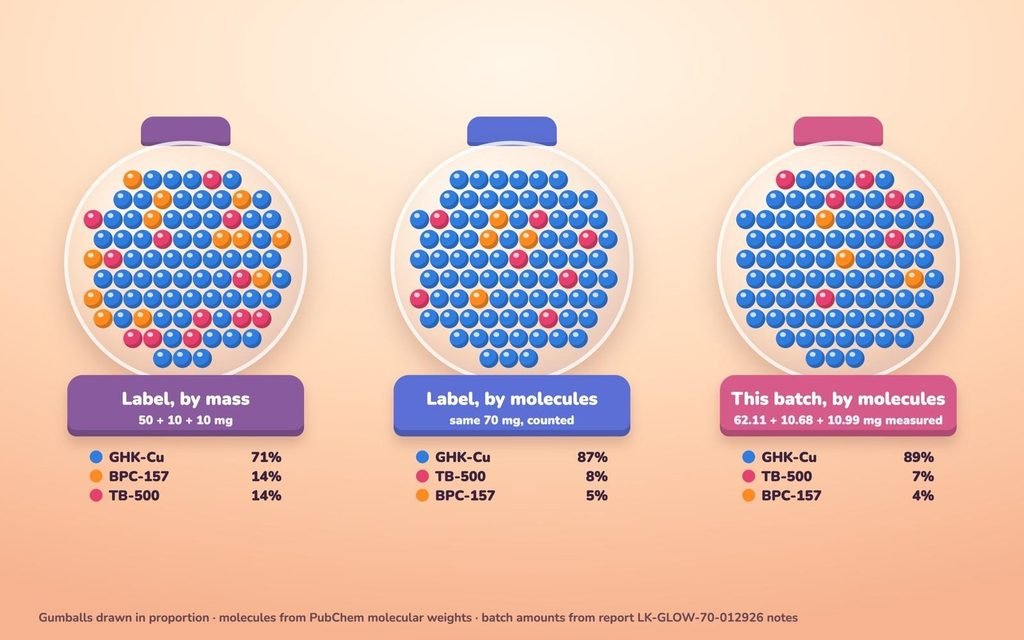
Mass share vs molar share in the 70 mg GHK-Cu, BPC-157 and TB-500 blend, at label amounts and for the current batch
Why a Blend Has No Single Molecular Weight
A blend contains three molecules, so it has three formulas, three molecular weights and three CAS numbers. Freeze-drying removes water from the mixture; it doesn’t join the peptides into a new compound.
That makes a single “blend molecular weight” on a product listing a red flag. A proper certificate lists each component on its own, by name, amount and, ideally, mass. Our guide to lyophilized peptides explains what the freeze-drying step does and doesn’t change.
GLOW vs KLOW vs Wolverine: How the Blends Compare
GLOW, KLOW and the BPC-157 + TB-500 pairing often called “Wolverine” form one family of blends built outward from the same two-peptide base. GLOW adds 50 mg of GHK-Cu to BPC-157 and TB-500; KLOW adds 10 mg of KPV on top of GLOW. Composition is the only meaningful difference.
| Blend | Composition | Ratio | Total | COA peaks |
| BPC-157 + TB-500 (“Wolverine”) | BPC-157 + TB-500 | 1:1 | 10 or 20 mg | 2 |
| GLOW | GHK-Cu 50 + BPC-157 10 + TB-500 10 | 5:1:1 | 70 mg | 3 |
| KLOW | GLOW + KPV 10 | 5:1:1:1 | 80 mg | 4 |
Each step up the family adds a peak to the chromatogram and a line to the certificate. No blend is “better” than another. They are simply different fixed compositions, and the choice depends on which components a study design needs. For the two-peptide base, see our BPC-157 vs TB-500 comparison.
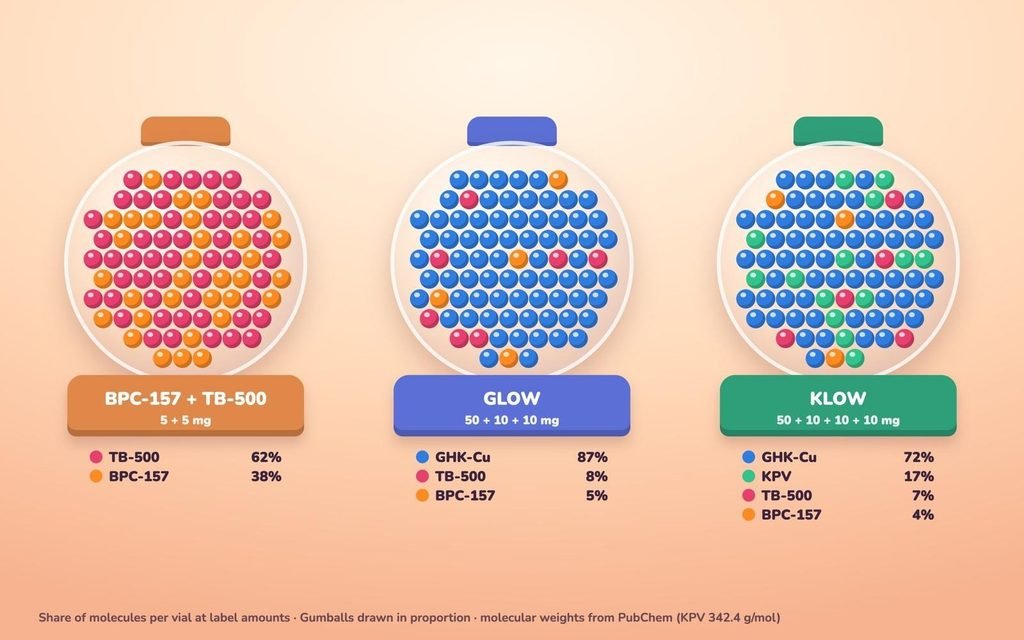
Share of molecules per vial in the BPC-157 + TB-500, GLOW and KLOW blends
Why Is the GLOW Powder Blue?
Copper(II) complexes such as GHK-Cu absorb part of the orange-red end of visible light through d-d electronic transitions, so they look blue. BPC-157 and TB-500 are white powders. In a GLOW blend, any blue tint comes from the GHK-Cu alone.
Colour is a hint, never proof. How strongly the cake shows it depends on the copper content, the cake’s density, and the lighting. What settles the question is the certificate: a batch report that names GHK-Cu and gives its measured amount shows the copper peptide is there in the quantity stated.
GLOW Research Blend vs “Glow” Skincare Peptides
Searches for “glow peptide” also return serums and creams. Those belong to a different product category: topical cosmetics with their own ingredient lists, sold and regulated as cosmetics. The GLOW research blend is a lyophilized laboratory reagent.
| GLOW research blend | Cosmetic “glow” products | |
| Form | Lyophilized powder, sealed vial | Serum, cream |
| Contents | GHK-Cu + BPC-157 + TB-500 at stated mg | Varies (ingredient list) |
| Sold for | Laboratory research only | Cosmetic use |
| Documentation | Batch COA per lot | INCI ingredient label |
The overlap is in the name and, sometimes, in one ingredient, since copper peptides appear in both worlds. The products themselves, their purpose and their paperwork are entirely separate. Our GHK-Cu guide covers the copper peptide on its own.
Pre-Mixed Blend vs Single Vials
A pre-mixed blend fixes the 5:1:1 ratio in one lot with one COA. Single vials let a lab set each amount itself, run every component alone as a control, and document each with its own certificate.
| Pre-mixed blend | Single vials | |
| Ratio | Fixed at 5:1:1 | Set by the lab |
| COAs | One per lot | One per compound |
| Identity checks | Three components in one report | Each compound on its own report |
| Flexibility | One composition | Any ratio; each component can run alone as a control |
What is the GLOW blend used for in research? A blend makes sense when a study needs to repeat one fixed three-peptide composition exactly, batch after batch. Work on any single component, such as the assays described in the ingredients section, is usually cleaner with the single vials: GHK-Cu 50 mg, BPC-157 10 mg, and TB-500 5 mg.
How a GLOW Blend Is Tested: Reading a Three-Component COA
A three-component COA should show three resolved HPLC peaks, each with its own area, plus mass spectrometry confirming each identity near 403, 1,419.5, and 889 g/mol. A single “total purity” figure can hide a weak 10 mg component behind the dominant GHK-Cu peak.
Mass spectrometry adds what HPLC can’t: it confirms which TB-500 is present, the heptapeptide or the full protein. A five-point check covers most of what a lab needs:
- Lot match. The vial’s batch code is printed on the report.
- All three identified. Each component is named, ideally with a mass.
- Per-component amount. Each peptide’s measured milligrams appear beside its label amount.
- Date and lab. The report shows a test date and an independent lab.
- Verifiable ID. Entering the report number on the lab’s site brings up the same record.
The Testides archive lists the current Cellugenix batch report, LK-GLOW-70-012926, as a valid record issued February 6, 2026. It’s HPLC-UV only: purity by HPLC, see the batch result, is reported for the vial as a whole, while the notes break out each peptide’s measured milligrams.
Field-by-field help is in our guides to reading a COA and HPLC vs mass spectrometry, and the COA library holds the full PDF.
What Are the Limits of the Research Data?
No published study has tested this three-peptide combination. The literature covers each peptide separately, mostly in cell culture, cell-free systems, and animal models, and those findings don’t transfer automatically to a mixture.
That shapes how any GLOW-related claim should be read:
- Label the study type. Every finding cited in this guide names its model: cultured endothelial cells, primary fibroblasts, a phage-display binding assay.
- Keep molecules apart. Results for full-length thymosin beta-4 don’t automatically apply to the TB-500 fragment, and none of the three peptides’ results describe the blend.
- Check the batch. Identity, ratio, and contamination can only be confirmed on a batch COA.
Storage of Lyophilized GLOW Vials
Keep sealed GLOW vials cold, dry, and dark, at the temperature on the label. GHK-Cu is sensitive to light, so the vial is best kept boxed, and trips between cold storage and the bench should be kept to a minimum, since each one invites condensation.
Record the report number alongside each experiment that uses the vial. Our storage and handling guide sets out conditions by product family.
Regulatory Status of GLOW in the US (2026)
No form of the GLOW blend, and none of its three peptides, is an FDA-approved drug. Research-grade material is supplied under Research Use Only labelling for laboratory study. The 2026 FDA activity on these peptides concerns pharmacy compounding.
| Date | Event | Source |
| April 2026 | FDA removed 12 peptides, including BPC-157 and TB-500, from Category 2 after their nominators withdrew them | Federal Register 2026-07361; FDA page |
| July 23, 2026 | The FDA advisory committee voted 8 to 6, with one abstention, to recommend BPC-157 and TB-500 for the 503A Bulks List; the vote is advisory | FDA Law Blog |
| August 24, 2026 | FDA warning letters to online peptide sellers | FDA warning letter |
| October 25, 2026 | No Federal Register rule adding any peptide to the 503A Bulks List | Federal Register |
GHK-Cu’s own status reads differently: FDA’s compounding page lists “GHK-Cu (for injectable routes)” among withdrawn nominations, and it wasn’t among the seven peptides the advisory committee reviewed in July. On the sport side, WADA’s 2026 Prohibited List names BPC-157 under S0 (non-approved substances) and thymosin-β4 derivatives such as TB-500 under S2.3. Our guide are peptides legal in the US? covers the wider rules.
Frequently Asked Questions
What is the GLOW peptide blend?
GLOW is the market name for a three-peptide research blend: GHK-Cu 50 mg, BPC-157 10 mg, and TB-500 10 mg in one 70 mg lyophilized vial, a 5:1:1 ratio by mass. It’s a lab reagent without FDA approval and a different product from cosmetic glow serums.
What are the GLOW peptide ingredients?
Three peptides: GHK-Cu, a copper(II) tripeptide complex at 402.9 g/mol; BPC-157, a 15-residue synthetic peptide at 1,419.5 g/mol; and TB-500, the acetylated thymosin beta-4 fragment Ac-LKKTETQ at 889.0 g/mol. Amounts can vary by product, so check the label and COA.
What’s the difference between GLOW and KLOW?
KLOW is GLOW plus 10 mg of KPV, a three-residue fragment of alpha-MSH. That brings the vial to 80 mg, changes the ratio to 5:1:1:1, and adds a fourth component, so its COA should show four peaks.
What is the GLOW blend used for in research?
A blend suits studies that need to repeat one fixed three-peptide composition exactly. The published assay work covers each component on its own: copper coordination and gene-expression assays for GHK-Cu, signalling assays for BPC-157 and actin assays for TB-500.
Why is the GLOW blend blue?
GHK-Cu contains copper(II), which absorbs part of the orange-red end of visible light through d-d transitions, so it looks blue. BPC-157 and TB-500 are white. The certificate’s measured GHK-Cu amount, more than the colour, confirms the copper peptide is present.
Is GLOW the same as glow skincare peptides?
No. The GLOW research blend is a lyophilized laboratory reagent sold for research with a batch COA. “Glow” skincare products are topical cosmetics with their own ingredient lists, sold and regulated as cosmetics. They share a name and, at most, one ingredient.
Is the GLOW peptide FDA-approved?
No. Neither the blend nor any of its three peptides is an FDA-approved drug. FDA’s compounding page (dated April 22, 2026) lists BPC-157, TB-500, and GHK-Cu among withdrawn nominations, and the July 2026 committee votes were advisory.
Where to find it. The full product page, with price and the current batch report, is the GHK-Cu + BPC-157 + TB-500 Blend 70 mg. Every report for the blend and its single components is in the COA library.
For laboratory research use only. Not for human or animal use. Our Terms
References
- PubChem: GHK-Cu, CID 71587328; BPC-157, CID 9941957; TB-500, CID 62707662; thymosin beta-4, CID 45382195, checked October 25, 2026
- Pickart L, Thaler MM. Nature New Biology, 1973 (isolation from human serum). PMID 4349963
- Hsieh MJ, et al. J Mol Med, 2017 (in vitro section: cultured human endothelial cells). PMID 27847966
- Chang CH, et al. J Appl Physiol, 2011 (in vitro section: primary rat fibroblast cultures). PMID 21030672
- Rossenu S, et al. J Biol Chem, 2003 (in vitro: phage-display actin-binding assay). PMID 12606551
- FDA, bulk drug substances page, content current as of April 22, 2026
- Federal Register, notice 2026-07361, April 16, 2026
- FDA Law Blog, PCAC day 1, July 24, 2026
- FDA, warning letter dated August 24, 2026
- WADA, 2026 Prohibited List, S0 and S2.3
- Testides, report LK-GLOW-70-012926, verified October 25, 2026
For laboratory research use only. Not for human or animal use.