BPC-157 vs. TB-500: Comparing Two Research Peptides
Quick Answer
BPC-157 and TB-500 are two unrelated research peptides that are often ordered together. BPC-157 is a synthetic 15-amino-acid peptide whose sequence comes from a protein isolated from human gastric juice. TB-500 is a synthetic peptide based on the actin-binding region of thymosin β-4. In the laboratory they appear in different kinds of assays: BPC-157 in cell-culture signaling work on the VEGFR2 and nitric oxide (NO) pathways, TB-500 in actin-binding and cell-migration assays. Both are sold for in-vitro research only, and batch COAs are published in the COA library.
Key Takeaways
- BPC-157: 15 residues, sequence GEPPPGKPADDAGLV, about 1419 Da, derived from a gastric juice protein.
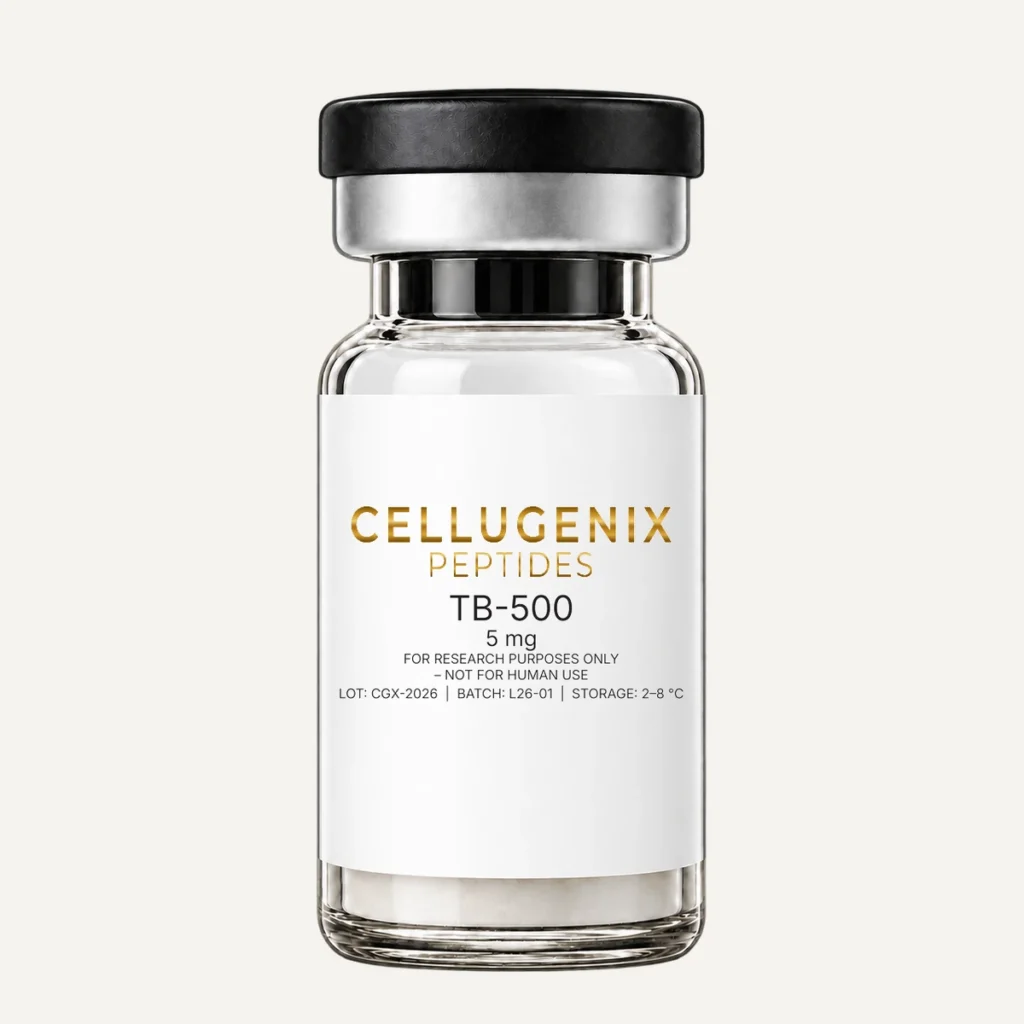
- TB-500: a synthetic peptide built around the actin-binding motif of thymosin β-4, a 43-residue actin-sequestering protein.
- BPC-157 is studied at downstream signaling pathways (VEGFR2, eNOS/NO, FAK/paxillin). TB-500 is studied as a G-actin binding peptide.
- Neither has an established dedicated cell-surface receptor, so both are characterized by the pathways and binding partners they are studied at.
- Purity by HPLC, see the batch COA.
BPC-157 vs TB-500 at a Glance
The table lines up the identity and assay facts a buyer compares before ordering. Knowing how to read the research-grade markers on a COA is how you confirm that the vial in hand matches these entries.
| BPC-157 | TB-500 | |
| Origin of sequence | Partial sequence of a protein isolated from human gastric juice (the “body protection compound”) | Actin-binding region of thymosin β-4 |
| Length | 15 amino acids (pentadecapeptide) | Short synthetic fragment; parent protein is 43 residues |
| Sequence | GEPPPGKPADDAGLV | Built around the LKKTET actin-binding motif; exact lot sequence on the COA |
| Molecular weight | About 1419 Da | See the batch COA |
| Studied at | VEGFR2, eNOS/NO and FAK/paxillin signaling | G-actin binding and actin polymerization |
| Typical assays | Endothelial and fibroblast cell-culture signaling assays | Actin-binding, polymerization and cell-migration assays |
| Verification | HPLC purity, MS identity, batch COA | HPLC purity, MS identity, batch COA |
What Is BPC-157?
BPC-157 is a synthetic linear peptide of 15 amino acids, GEPPPGKPADDAGLV, with a molecular weight of about 1419 Da. Its name, “body protection compound”, refers to the gastric juice protein its sequence was taken from. It is not found as a free peptide in that form; the research material is made by solid-phase synthesis.
The published record on BPC-157 is broad. A 2025 literature-and-patent review in Pharmaceuticals catalogues that work. For a lab buyer, the useful point is narrower: at the cell level, BPC-157 is studied at signaling pathways rather than at a single identified receptor.
What Is TB-500?
TB-500 is a synthetic peptide based on thymosin β-4, a 43-residue protein that cells carry in large amounts and that binds monomeric actin (G-actin). The part of thymosin β-4 that contacts actin centres on the short motif LKKTET, and TB-500 is built around that region.
Because the name TB-500 is used loosely across the market, the batch COA is the document that tells you exactly which sequence and mass a given lot contains. Check it before designing an assay around a specific fragment.
BPC-157 vs TB-500: Pathways Compared
The two peptides are studied at different layers of the cell. BPC-157 appears in endothelial cell-culture work on receptor tyrosine kinase signaling: VEGFR2 expression and phosphorylation, the downstream Akt and eNOS steps, and nitric oxide production. In fibroblast cultures it is studied at FAK and paxillin phosphorylation, the focal adhesion signaling that governs cell spreading.
BPC-157 vs TB-500
TB-500 sits one layer deeper, at the cytoskeleton. Its actin-binding region sequesters G-actin, which is measured in actin-binding and polymerization assays. A paper in The Journal of Biological Chemistry mapped the actin-binding site of thymosin β-4, which is the region TB-500 is based on. In cell culture, TB-500 is most often used in migration assays such as scratch and transwell formats.
Put simply, BPC-157 is chosen when an assay asks about growth factor receptor and NO signaling; TB-500 is chosen when it asks about actin dynamics and cell motility.
Assay Contexts for Each
BPC-157 research at the cell level centres on endothelial cells and fibroblasts. Typical readouts are western blots for phosphorylated VEGFR2, Akt, eNOS, FAK and paxillin, qPCR for VEGFR2 expression, and NO measurement in culture supernatant.
TB-500 research centres on the actin cytoskeleton. Typical readouts are G-actin binding, actin polymerization kinetics and cell migration in scratch or transwell assays. These are all in-vitro formats, and they are the context in which we supply both compounds.
Are They Studied Together?
They are often ordered together because they cover different questions: BPC-157 for receptor and NO signaling, TB-500 for actin dynamics. We offer the pair as a combined Wolverine Blend (BPC-157 + TB-500, 5 mg / 5 mg) alongside the single vials. Each component in the kit has its own identity and purity data on the batch COA.
BPC-157, TB-500, or the combined kit: choose by the pathway your assay measures.
When both are run in the same lab, keep their vials, labels and lot numbers separate and record each lot against its COA. Confusing two lyophilized white powders is an easy error, and the paperwork is what prevents it.
BPC-157 vs TB-500 vs GHK-Cu
A third compound often appears next to these two. GHK-Cu is the tripeptide glycyl-L-histidyl-L-lysine complexed with copper(II), studied mainly as a copper-binding peptide. It is structurally unrelated to BPC-157 and TB-500.
The three are combined in the GLOW blend, and GHK-Cu is also available on its own as GHK-Cu 50mg. A four-component blend, KLOW, adds the tripeptide KPV (Lys-Pro-Val). For any blend, the COA lists each component so the lot can be verified as a whole.
Regulatory Status
Neither peptide is an approved drug, and both are sold strictly for in-vitro laboratory research. If you are new to how the research-use category works, our overview of what research peptides are covers the labeling. None of this is legal advice.
Storage of the Sealed Vial
Both peptides ship lyophilized, meaning freeze-dried to a dry powder, which is the stable form for transit and storage. Store the sealed lyophilized vial as stated on the label, protected from light and moisture. Our guide to storage and documentation practices covers lot tracking in more detail.
Analytical Verification and Documentation
Research-grade sourcing rests on documentation you can check before buying: a per-batch COA, purity by HPLC, identity by mass spectrometry, and clear research-use labeling. A seller who cannot show the COA has answered the question for you. Our guide to evaluating a peptide vendor lays out the full checklist.
Cellugenix publishes third-party batch COAs in the COA library. Purity by HPLC, see the batch COA. For BPC-157, the mass spectrum should show a mass consistent with about 1419 Da; for TB-500, compare the observed mass with the sequence stated on the COA. Our HPLC vs mass spectrometry guide explains what each test proves.
Frequently Asked Questions
Which is better, BPC-157 or TB-500?
Neither is better in general; they are different molecules for different assay questions. BPC-157 fits work on VEGFR2, eNOS/NO and FAK/paxillin signaling. TB-500 fits work on G-actin binding, actin polymerization and cell migration.
Can BPC-157 and TB-500 be used in the same study?
Yes, in-vitro designs can include both, since they are studied at separate pathways. Track each lot separately and verify each against its own COA.
What is in the combined kit?
The Wolverine Blend is a single-vial research blend of BPC-157 (5 mg) and TB-500 (5 mg), with its own batch documentation.
How do I verify a batch?
Find the lot number on the vial, open the matching COA in the COA library, and check the HPLC purity and the mass spectrometry identity result against the expected sequence and mass.
The Bottom Line
BPC-157 and TB-500 differ in origin, sequence and the pathways they are studied at. BPC-157 is a 15-residue gastric-protein-derived peptide used in receptor tyrosine kinase and NO signaling assays; TB-500 is a thymosin β-4 based peptide used in actin and cell-migration assays. Choose by the question your assay asks, and confirm every lot with its batch COA before it goes on the bench.
For Research Use Only. Not for use in diagnostic or therapeutic procedures.