Wolverine Peptide: The BPC-157 + TB-500 Blend, Its Composition, Ratio and Testing
Two products can both print “TB-500, 5 mg” on the label and contain molecules that differ in weight more than fivefold. Pair either one with 5 mg of BPC-157 and you get a vial sold as the Wolverine peptide. In the first vial, TB-500 molecules outnumber BPC-157 by about 1.6 to 1. In the second, BPC-157 outnumbers TB-500 by about 3.5 to 1.
Same name, same label weights, opposite molecular picture. That’s the most useful thing to know about this blend, and it starts with a simple definition.
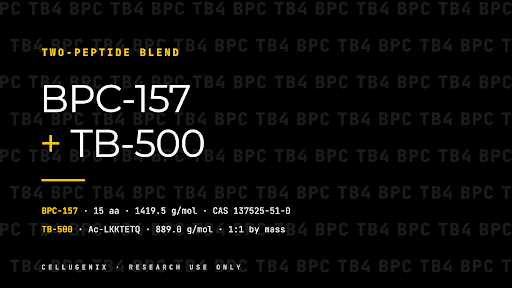
Quick answer: “Wolverine” is a market nickname for a two-peptide research blend: BPC-157 and TB-500 in one lyophilized vial, usually in a 1:1 ratio by mass (5 mg + 5 mg or 10 mg + 10 mg). BPC-157 is a 15-residue synthetic peptide; TB-500 is a synthetic fragment of thymosin β4. It’s sold as a research reagent and has no FDA drug approval.
Key facts: 2 components · 1:1 by mass · 5/5 mg (10 mg) or 10/10 mg (20 mg) · lyophilized solid · batch COA
What Is the Wolverine Peptide?
The Wolverine peptide is a pre-mixed blend: BPC-157 and TB-500, freeze-dried together in one sealed vial and supplied as peptides for laboratory research. Each peptide keeps its own sequence. They aren’t linked, so the vial holds two separate compounds at fixed amounts.
Marketing coined the name, and that’s all it is. You won’t find “Wolverine” in PubChem, on an INN register, or in any FDA document. From here on, this guide uses the composition instead: the BPC-157 + TB-500 blend.
A nickname also leaves room for drift. Here’s what the label “Wolverine” can’t promise:
- One molecule. The vial holds two peptides, each with its own formula and mass. Nothing new is formed when they’re blended.
- One recipe. Some sellers use the name for two separate vials sold as a set. Others add GHK-Cu, or a CJC-1295 and ipamorelin pair, under the same banner.
- One TB-500. As the opening showed, “TB-500” itself can mean different molecules from one listing to the next.
That puts the weight on two things you can check: the printed label and the lot number. The BPC-157 + TB-500 Blend 5/5 mg we supply is the single-vial version, with 5 mg of each peptide under one lot and one certificate.
What’s in the Wolverine Blend: BPC-157 and TB-500
Below, each peptide gets the same treatment: what it’s made of, where its sequence comes from, and which cell-based assays use it. Formulas and weights were pulled from PubChem on 23 October 2026.
| BPC-157 | TB-500 | |
| Type | Synthetic pentadecapeptide | Synthetic thymosin β4 fragment |
| Sequence | GEPPPGKPADDAGLV (15 residues) | Ac-LKKTETQ (actin-binding region of Tβ4) |
| Formula | C62H98N16O22 | C38H68N10O14 (PubChem, acetylated heptapeptide); confirm on the batch COA |
| MW (g/mol) | 1419.5 | ~889 for the fragment (full Tβ4 ~4,963; see COA) |
| CAS | 137525-51-0 | 885340-08-9 in PubChem; some listings give full Tβ4’s 77591-33-4 |
| Origin | Partial sequence of a gastric-juice protein (“body protection compound”) | Derived from thymosin β4, a 43-residue actin-binding protein found in most cell types |
BPC-157
BPC-157 is a chain of 15 amino acids, GEPPPGKPADDAGLV, made by solid-phase synthesis. Its sequence copies part of a larger protein that researchers first isolated from gastric juice and called “body protection compound,” which is where the initials come from.
At the bench, BPC-157 shows up mostly in cell-migration and signaling assays. Two in vitro studies give a sense of the work:
- Hsieh and colleagues, 2017 (cultured endothelial cells): measured VEGFR2 activation and the signals that follow it in human umbilical vein endothelial cells.
- Chang and colleagues, 2011 (cultured rat fibroblasts): followed phosphorylation of FAK and paxillin, two proteins that link the cell’s adhesion points to its internal scaffold.
Both papers also contain animal work; only their cell-culture sections are cited here. The peptide comes as the single-compound BPC-157 10 mg and BPC-157 5 mg as well.
TB-500
TB-500 is built on LKKTETQ, the seven-residue stretch at positions 17 to 23 of thymosin β4. That stretch is the protein’s main contact point with actin. PubChem records TB-500 as the N-acetylated heptapeptide, Ac-LKKTETQ, at about 889 g/mol.
The parent protein has a long history in actin research. In 1991, Safer and colleagues showed that thymosin β4 is the same molecule as “Fx,” a peptide that binds G-actin (single actin units) and keeps them from joining filaments. Rossenu and colleagues (2003) later used phage display to measure how each actin-binding motif in thymosin β4 contributes to affinity. Both are in vitro studies. TB-500 itself turns up in G-actin binding assays and in scratch assays, where cells move into a cleared strip of a culture dish.
The catch, however: “TB-500” isn’t one standard molecule on the market. Some sellers supply the seven-residue fragment. Others supply full-length thymosin β4 under the same name. Only mass spectrometry on the COA tells the two apart. The single TB-500 5 mg vial carries the same compound found in our blend.
This guide covers the blend. For how the two peptides compare individually, see our side-by-side guide.
The 1:1 Ratio: 5/5 mg vs 10/10 mg, and What It Means in Moles
“1:1” on a blend label means equal milligrams. You’ll see three versions sold under the nickname:
- 5 mg + 5 mg in one vial, 10 mg total
- 10 mg + 10 mg in one vial, 20 mg total, the figure that comes up most often in search results
- Two separate vials sold together as a set
Milligrams and molecule counts part ways as soon as the two peptides differ in size. Here’s the 5/5 mg vial converted to micromoles, using PubChem molecular weights (a calculation; the COA reports what was measured):
| Component | mg | MW | µmol (approx.) |
| BPC-157 | 5 | 1419.5 | 3.5 |
| TB-500 (7-residue fragment) | 5 | ~889 | 5.6 |
| TB-500 if full Tβ4 | 5 | ~4,963 | 1.0 |
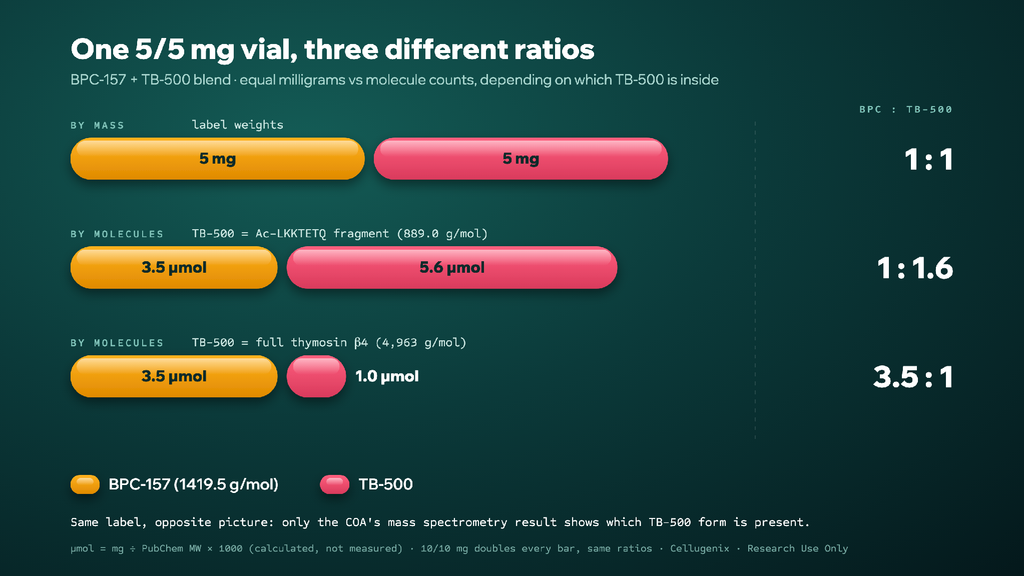
Mass vs molar ratio of a 5/5 mg BPC-157 + TB-500 blend with each TB-500 form
Three things come out of that table:
1. With the fragment, 1:1 by mass is about 1:1.6 by moles. TB-500 is the smaller molecule, so each milligram holds more of it.
2. With full thymosin β4, the ratio flips to about 3.5:1. Now BPC-157 is the smaller molecule and the more numerous one.
3. Only the COA’s mass data tells you which case you’re in. The label weight is identical either way.
The difference carries straight into assay design. If a well is set to 1 µM BPC-157, the same well holds about 1.6 µM TB-500 with the fragment, or about 0.29 µM with full thymosin β4. A 10/10 mg vial doubles every amount but keeps the same ratios.
Wolverine, GLOW and KLOW: How the Blends Build on Each Other
The two-peptide blend is the base layer for two larger blends. Each step keeps the earlier components at the same amounts and adds one more.
| Blend | Components | Typical total |
| BPC-157 + TB-500 (“Wolverine”) | BPC-157 + TB-500 | 10 or 20 mg |
| GHK-Cu + BPC-157 + TB-500 (“GLOW”) | + GHK-Cu 50 mg | 70 mg |
| GHK-Cu + BPC-157 + TB-500 + KPV (“KLOW”) | + KPV 10 mg | 80 mg |
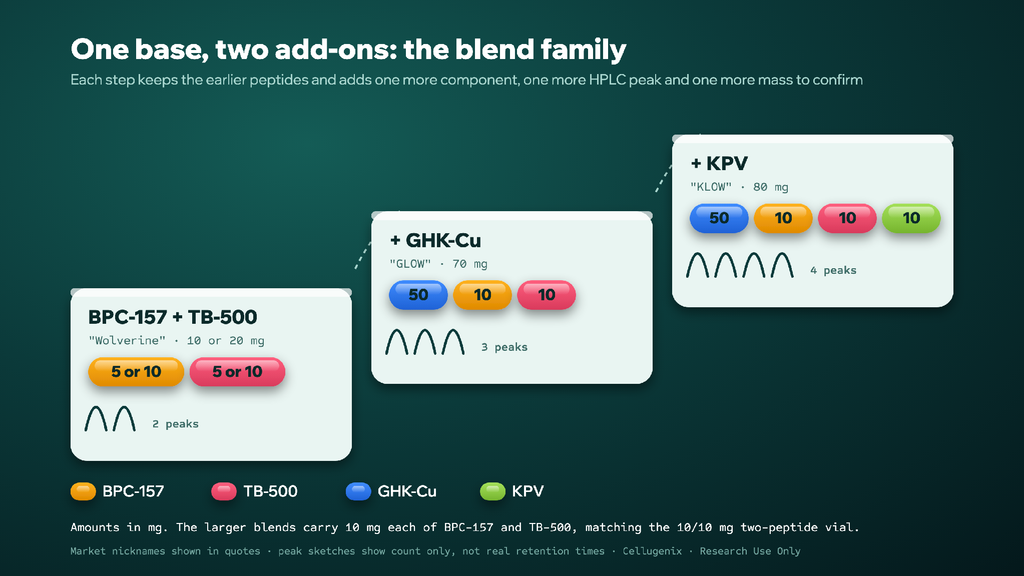
BPC-157 + TB-500 blend family: two, three and four components
Searches for a “Wolverine stack with GHK-Cu” land on that middle row. It’s the GHK-Cu + BPC-157 + TB-500 Blend 70 mg, where GHK-Cu, a copper-bound tripeptide, joins at 50 mg and the two base peptides come in at 10 mg apiece.
The last row brings in KPV, a three-residue fragment of alpha-MSH, at 10 mg. That composition is the GHK-Cu + BPC-157 + TB-500 + KPV Blend 80 mg, and our KLOW peptide blend guide covers its four peaks and molar shares.
Note the step in amounts. The larger blends carry 10 mg each of BPC-157 and TB-500, matching a 10/10 mg two-peptide vial; the 5/5 mg vial carries half that. Each added component also adds one more peak and one more mass for the COA to confirm. Choosing between them comes down to which compounds a study plan includes.
Pre-Mixed Blend vs Separate Vials
A pre-mixed vial locks the ratio at manufacture, so every run starts from the same composition. Separate vials let the lab set each peptide’s concentration on its own.
| Pre-mixed blend | Separate vials | |
| Ratio control | Fixed at 1:1 by mass | Set by the lab for each run |
| Number of COAs | 1 for the blend | 2, one per compound |
| Identity checks | Both peptides on one report | Each peptide on its own report, so the TB-500 form can be checked alone |
| Flexibility | One composition | Change one peptide, keep the other constant |
Separate vials suit concentration-response work, where one peptide changes and the other stays put, or runs with a single-peptide control. Those come as BPC-157 10 mg and TB-500 5 mg. For three separately labelled compounds, there’s the BPC-157, TB-500 and GHK-Cu research set.
The blend suits repeat work on one fixed composition, with one lot number to log.
How a BPC-157 + TB-500 Blend Is Tested
Testing a two-peptide blend means answering three questions: is each peptide clean, is each one the right molecule, and is each present in the right amount? Each question needs its own method.
HPLC (high-performance liquid chromatography). The column separates the two peptides, so a good chromatogram shows two distinct peaks, each reported with an area %. A single “blend purity” figure is less helpful. It can look excellent while one peptide is short, because it describes the mix as a whole.
Mass spectrometry (MS). MS confirms identity by weight. BPC-157 should come in near 1419.5. For TB-500, the result shows which form is present: about 889 for the acetylated fragment, or about 4,963 for full thymosin β4.
Quantitation. A content result for each component shows whether a “5/5 mg” vial really holds 5 mg of each. A total-content figure for the whole vial can’t tell you how the two are shared.
Five checks for any blend COA:
1. The report’s lot number is the one printed on your vial.
2. MS confirms each peptide, with the TB-500 mass stated.
3. BPC-157 and TB-500 each have a content result in mg.
4. You can see when the sample was tested and which lab ran it.
5. A report number lets you look the result up on the lab’s own site.
Our 5/5 mg blend lists purity by HPLC; see the batch result for the figure. To go deeper, we have guides on how to read a COA and HPLC vs mass spectrometry, and every published report is kept in the COA library.
Forms Supplied for Research: Lyophilized Vials vs Capsules
Research-grade BPC-157 + TB-500 blends are supplied as lyophilized solids: a dry, freeze-dried cake sealed in a glass vial. Freeze-drying strips out nearly all the water, which keeps both peptides stable in storage.
Capsule products carrying the BPC-157 name, alone or with TB-500, also appear on the market. The same COA questions apply to them: which compounds, how much of each, and which lot.
Storage of Lyophilized BPC-157 + TB-500 Vials
Keep the sealed vial cold, dry and shielded from light, following the conditions on its label. A dry cake is far more stable than a solution, but warmth, humidity and light still slowly degrade peptides.
Repeated temperature cycling is the habit to avoid. Each move from cold storage to room temperature can pull moisture onto the vial, so take it out only when needed and return it promptly. Log the lot number with your records. Our storage and handling page covers cold-chain and record-keeping in more detail.
What Safety Data Exists?
The published research on both peptides is preclinical: cell-culture (in vitro) studies and animal studies. Every BPC-157 and thymosin β4 study cited in this guide is in vitro. Animal studies of each peptide alone also exist.
For the two peptides together, the record is thinner still. A ClinicalTrials.gov search on 23 October 2026 returned no registered trial of BPC-157 and TB-500 combined. Trials registered for each peptide on its own had posted no results.
That leaves the batch COA as the one document a lab can check. Identity, ratio and contamination can only be read from a lab report tied to the lot in hand, so gray-market material without one is an unknown.
Regulatory and Sport Status in the US (2026)
The BPC-157 + TB-500 blend isn’t an FDA-approved drug, and neither peptide is approved on its own. Research-grade material is sold as a laboratory reagent labelled Research Use Only.
Here’s the timeline as of 23 October 2026:
| Date | Event | Source |
| April 2026 | BPC-157 was dropped from Category 2 of FDA’s 503A bulks list when its nominators withdrew | FDA, 503A bulks list (updated 22 Apr 2026) |
| 23 to 24 Jul 2026 | BPC-157 and TB-500, each in free base and acetate form, went before FDA’s Pharmacy Compounding Advisory Committee | FDA meeting agenda |
| Jul 2026 | Each peptide drew an 8 to 6 vote to recommend listing; committee votes are advice to FDA only | Bass, Berry & Sims, 31 Jul 2026 |
| 24 Aug 2026 | Five online peptide vendors received FDA warning letters; FDA found the products were drugs for human use whatever their labels said | Arent Fox Schiff, 18 Sep 2026 |
Two limits apply. A substance removed from Category 2 isn’t moved to Category 1 by that step, and nothing joins the 503A list without notice-and-comment rulemaking, which hadn’t started for either peptide by this update.
Sport bodies list both peptides by name:
- WADA: BPC-157 appears by name in class S0 (non-approved substances) of the 2026 Prohibited List, and class S2 covers “Thymosin-β4 and its derivatives e.g. TB-500”. The 2027 List applies from 1 January 2027.
- NCAA: the 2026-27 banned substances list names BPC-157 and TB-500 among its peptide-hormone examples.
Our guide Are research peptides legal in the US? covers the wider rules for research reagents.
FAQ
What is the Wolverine peptide?
The Wolverine peptide is a nickname for a research blend of two synthetic peptides, BPC-157 and TB-500, freeze-dried together in one vial. The usual ratio is 1:1 by mass, as 5/5 mg or 10/10 mg. It’s a laboratory reagent with no FDA approval, and the name has no chemical meaning.
What’s in the Wolverine blend?
The blend holds BPC-157, a 15-residue synthetic peptide (GEPPPGKPADDAGLV, 1419.5 g/mol), and TB-500, a synthetic peptide based on thymosin β4’s actin-binding motif LKKTETQ. PubChem lists TB-500 as the acetylated fragment at about 889 g/mol, but some products use full thymosin β4.
Is Wolverine 5/5 mg or 10/10 mg?
Both exist. A 5/5 mg vial holds 10 mg in total; a 10/10 mg vial holds 20 mg. Some sellers also use the name for two separate vials sold together. The ratio stays 1:1 by mass in each case, so check the label and the batch COA for the actual amounts.
What’s the difference between Wolverine and GLOW?
GLOW adds 50 mg of GHK-Cu to BPC-157 and TB-500 at 10 mg each, for 70 mg in a 5:1:1 mass ratio. Wolverine is BPC-157 and TB-500 alone. The search phrase “Wolverine stack with GHK-Cu” describes the GLOW layout, and its COA needs a third peak.
Is TB-500 the same as thymosin beta-4?
They’re related but different. Thymosin β4 is a 43-residue protein of about 4,963 g/mol. PubChem defines TB-500 as Ac-LKKTETQ, a seven-residue fragment from positions 17 to 23, at about 889 g/mol. Some sellers label full thymosin β4 as TB-500, so mass spectrometry on the COA decides which one is present.
Is the Wolverine peptide FDA-approved?
It isn’t. Neither peptide, alone or blended, held FDA drug approval on 23 October 2026. An FDA advisory committee recommended both for the 503A compounding list by 8 to 6 votes in July 2026, but the committee only advises, and FDA had proposed no rule by that date.
Is the Wolverine peptide on the WADA list?
Yes, both components are. BPC-157 is named in WADA’s S0 class of the 2026 Prohibited List, and TB-500 falls under S2 as a derivative of thymosin β4. In US college sport, the NCAA’s 2026-27 banned list names both peptides among its peptide-hormone examples.
Next Step
Specifications, storage conditions and lot documentation for the blend are on its product page. View the BPC-157 + TB-500 Blend 5/5 mg and its batch COA, or browse the COA library to see reports lot by lot.
For laboratory research use only. Not for human or animal use.
References
- PubChem: BPC-157 (CID 9941957), TB-500 (CID 62707662), thymosin β4 (CID 16132341). Accessed 23 October 2026. Database.
- Safer D, Elzinga M, Nachmias VT. J Biol Chem, 1991. PMID 1999398. In vitro (biochemistry, G-actin binding).
- Rossenu S, et al. J Biol Chem, 2003. PMID 12606551. In vitro (phage display, actin binding).
- Hsieh MJ, et al. J Mol Med, 2017. PMID 27847966. In vitro (HUVEC) section cited; the paper also includes animal work.
- Chang CH, et al. J Appl Physiol, 2011. PMID 21030672. In vitro (cultured rat fibroblasts) section cited; the paper also includes animal work.
- ClinicalTrials.gov searches for “BPC-157” and “TB-500”, 23 October 2026. Trial registry.
- FDA. Bulk drug substances nominated for use in compounding under section 503A, updated 22 April 2026. Regulatory.
- FDA. Pharmacy Compounding Advisory Committee meeting agenda, 23 to 24 July 2026. Regulatory.
- Bass, Berry & Sims. FDA advisory committee recommends six peptides for compounding, 31 July 2026. Legal analysis.
- Arent Fox Schiff. Alert on the August 2026 FDA warning letters to peptide vendors, 18 September 2026. Legal analysis.
- World Anti-Doping Agency. 2026 Prohibited List, in force 1 January 2026. Sport regulation.
- NCAA. 2026-27 Banned Substances list. Sport regulation.
For laboratory research use only. Not for human or animal use.